Compliance Risks In Human Resources Jennifer Swayze SPHR-CA, - - PowerPoint PPT Presentation

compliance risks in human resources
SMART_READER_LITE
LIVE PREVIEW

Compliance Risks In Human Resources Jennifer Swayze SPHR-CA, - - PowerPoint PPT Presentation

Compliance Risks In Human Resources Jennifer Swayze SPHR-CA, GPHR, SHRM SCP, CEBS Employment Law Compliance Analyst The information in these materials, and that provided by the presenter, should not be considered legal, accounting, or

slide-1
SLIDE 1

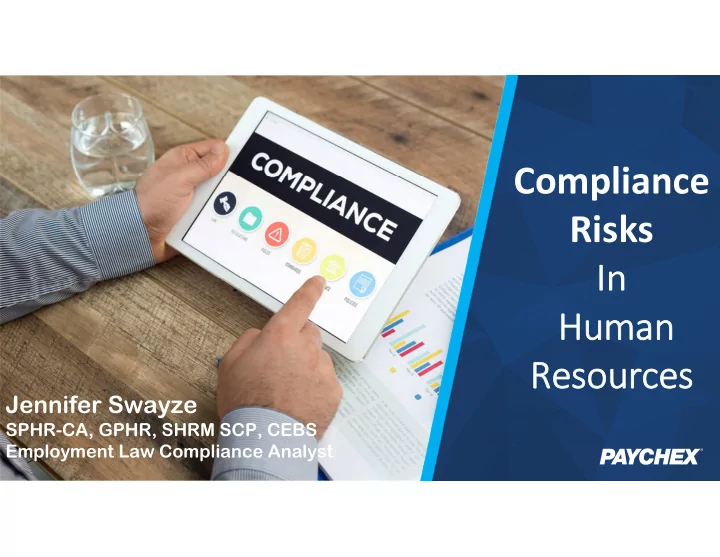
Compliance Risks In Human Resources

Jennifer Swayze

SPHR-CA, GPHR, SHRM SCP, CEBS Employment Law Compliance Analyst

slide-2
SLIDE 2
  • The information in these materials, and that provided by the

presenter, should not be considered legal, accounting, or investment advice, and it should not substitute for legal, accounting, and other professional advice where the facts and circumstances warrant. It is provided for informational purposes only.

  • If you require legal or accounting advice, or need other professional

assistance, you should always consult your attorney, accountant, or

  • ther professional advisor to discuss your particular facts,

circumstances, and business needs.

slide-3
SLIDE 3

Agenda

  • Hiring
  • Immigration
  • Postings
  • Policies and

Practices

  • Performance/
  • Employee

Management

  • Wage and Hour

Discuss HR Compliance Risk Discuss significant enforcement and compliance risks

  • Benefits
  • Compensation
  • Reporting
  • Leave and Disability

Management

  • OSHA and Workplace Safety
  • Recordkeeping
  • Discipline
  • Termination
slide-4
SLIDE 4
slide-5
SLIDE 5

Human Resource Risks

Strategic Risk Operational Risk Financial Risk Compliance Risk

slide-6
SLIDE 6

HR Compliance Ris isks

  • The employer-employee relationship is highly regulated.
  • Risk of violating the laws and regulations may be substantial
  • Costs of failing to comply with employment laws is significant
slide-7
SLIDE 7

Hiring

slide-8
SLIDE 8

Hir iring: Job Descriptions

  • Although ADA doesn't require

written job descriptions, having a written job description before advertising or interviewing applicants is strong evidence of whether a particular job function is considered an essential function. Risks:

  • No job descriptions
  • Outdated don’t match actual

requirements of the position

slide-9
SLIDE 9

Hir iring: Job Postings

Advertising the job opening Risks:

  • Not using variety of job boards
  • Language - discrimination
slide-10
SLIDE 10

Hir iring: Applications

Risks

  • Discriminatory Questions
  • Ban the Box
  • Salary History
slide-11
SLIDE 11

Hir iring – In Interviews

Risks:

  • Inconsistent questions/off track

discussions

  • Discriminatory Questions
  • Reasonable accommodations
slide-12
SLIDE 12

Hir iring – Background Checks

  • Background checks are generally considered

"consumer reports" under the federal Fair Credit Reporting Act (FCRA).

  • There are both civil and statutory penalties for

failing to comply with the FCRA's procedural requirements.

  • Increase in the state and local regulations

related to background checks/credit checks.

slide-13
SLIDE 13

Hir iring – Social Media

  • Many employers are using social

media in their hiring process. Risks

  • Discrimination
  • Requiring passwords
slide-14
SLIDE 14

Hir iring – Pre-Employment Tests

  • Intelligence tests
  • Personality tests
  • Emotional tests

Although not prohibited, employer must ensure that these tests are valid and are not designed to filter out applicants based on any protected status.

slide-15
SLIDE 15

Hir iring: Recruitment & Applicant Tracking

  • System that allows for time savings

and organized way to handle the hiring process. Risks:

  • Global challenges
  • Security – breach
  • Parse/filters should not have

adverse impact on protected class.

slide-16
SLIDE 16

Hir iring: Offer Letters

  • Many employers provide offer

letters. Risks:

  • EAW
  • Expiration
  • Contingencies
  • Pay
  • Exempt/non-exempt
slide-17
SLIDE 17

Hir iring – Onboarding

Risks

  • New Hire Requirements
  • Timeliness
  • Payment
  • Signature
slide-18
SLIDE 18

Immigration

slide-19
SLIDE 19

Im Immigration – Form I- I-9

Employers must:

  • Verify the identity and employment authorization
  • f each person hired after Nov. 6, 1986.
  • Complete and retain Form I-9, Employment

Eligibility Verification, for each employee who is required to complete the form. IRCA Paperwork Violation

  • Min. 220. Max. 2,191.

Unlawful employment of aliens, first order (per unauthorized alien)

  • Min. 548. Max. 4,384

Enforcement increased

slide-20
SLIDE 20

Im Immigration – E-Verify

  • In certain cases of suspected

misuse, abuse, and/or fraud, E- Verify participants may be referred to agencies that investigate illegal employer activities. Federal contractors could face debarment.

  • States that require E-Verify may

also penalize employers. Penalties include, but are not limited to, loss

  • f business license, loss of

government contracts, loss of tax credits and permanent debarment from doing business in the state.

slide-21
SLIDE 21

Im Immigration – Vis isas

  • Some employment visa’s impose

significant employer responsibilities and substantial risks if requirements not followed.

  • For Example H-1B
  • Job location changes – new LCA

needed

  • Fee charges generally do not comply

with LCA

  • Temporary Layoff and H-1B
  • Employers promoting an H‐1B worker

– new LCA needed

  • Termination – must notify USCIS
slide-22
SLIDE 22

Workplace Postings

slide-23
SLIDE 23

Workplace Postings

  • Some statutes and regulations

require that notices be provided to employees and/or posted in the workplace.

  • Some posters are also required to

be placed where they can be seen by applicants

  • Not all employers are required to

post specific notice(s).

slide-24
SLIDE 24

Policies and Practices

slide-25
SLIDE 25

Policies: Handbooks

It is a best practice to have employee handbooks for any size business. It reviews expectations and communicates policies to employees. Risks

  • Discriminatory language
  • Vague policies
  • Outdated policies
  • Missing policies
  • EAW
slide-26
SLIDE 26

Education and Training

Education and training programs should be implemented Documentation of materials covered and attendance should be maintained

slide-27
SLIDE 27

Performance Management

slide-28
SLIDE 28

Performance Management: Goal Setting

Best practice to set reasonable performance goals for employees. Risk:

  • Unethical behavior
  • Over focus on tasks
  • Neglecting other tasks
slide-29
SLIDE 29

Performance Management: Reviews

Risks

  • Intentional and unintentional

Discrimination

  • Varying or inconsistent

performance standards or ratings

  • Negative evaluations without

data/documentation to back up

slide-30
SLIDE 30

Employee Management

slide-31
SLIDE 31

Employee Management: Retention

Some employers are using AI to monitor employee engagement and determine who is likely to leave. Risks:

  • Using past data to predict future

performance.

  • Discriminatory design
slide-32
SLIDE 32

Wage and Hour

slide-33
SLIDE 33

Wage and Hour: Mis isclassification Exempt/Non-exempt

  • Employees who are not subject to all provisions of the FLSA are referred to

as “exempt employees.” White-collar employees (executive, administrative, professional, outside sales, and certain skilled computer employees) are exempt from both minimum wage and overtime provisions. White collar exempt employees:

  • generally must receive a minimum weekly salary as outlined in the federal

regulations,

  • must meet the job duties test for one of the “white-collar” exemptions,

and

  • generally must be paid on a salary or fee basis.
  • Because exemptions are narrowly defined, employers are encouraged to

review exact terms and conditions on the DOL website or by contacting the local U.S. DOL.

slide-34
SLIDE 34

Wage and Hour: Mis isclassification In Independent Contractor

  • Worker classification may be defined

differently under different laws and enforced differently by different government agencies.

  • Classification potentially affects payroll,

wages, taxes, eligibility for workers’ compensation and unemployment insurance benefits, eligibility for company benefits, and protection under federal, state, and local laws.

  • Agency guidance has recently changed.
slide-35
SLIDE 35

Wage and Hour: Wage Payment

Risks:

  • Failure to pay correct wages and

OT

  • Improper wage deductions
  • Improper determination of

hours worked

  • Off-the-clock work
  • Meals and rest breaks
slide-36
SLIDE 36

Wage and Hour: Type & Timing of Payment

Risks

  • Inappropriate Pay periods
  • Failure to pay timely
  • Final Pay
  • Direct Deposit authorization
  • Payroll Card authorization
slide-37
SLIDE 37

Benefits

slide-38
SLIDE 38

Benefits: Health In Insurance

Many employers offer health insurance to attract and retain talent. Risks:

  • If covered by ERISA, must meet

those requirements

  • Different jurisdictional laws
  • Possible ACA/ESR penalties

(large employers)

slide-39
SLIDE 39

Benefits: Section 125 Pla lans

Section 125 Plan allows employees to pay for benefits (health insurance premiums, FSA, other covered plans)on a pretax basis. Risks:

  • Pre-tax deductions may be

disallowed back to the beginning

  • IRS assessment of unpaid back

taxes plus interest and penalties

  • Possible daily Department of Labor

fines.

slide-40
SLIDE 40

Benefits: Retirement Savings

Many employers offer retirement plans to attract and retain talent. Risks:

  • late payment of employee

deferrals

  • Incorrect calculations due to

misunderstanding of what is compensation

  • Not following rules – who is

eligible, break in service, etc

slide-41
SLIDE 41

Compensation

slide-42
SLIDE 42

Compensation

  • Equal Pay
  • There are tools to help

employers determine if they are at risk for equal pay violation Risks:

  • Equal pay violation
  • Discrimination
slide-43
SLIDE 43

Reporting

slide-44
SLIDE 44

Reporting: EEO-1

The Employer Information Report EEO-1, otherwise known as the EEO-1 Report, is required to be filed with the U.S. Equal Employment Opportunity Commission's EEO-1 Joint Reporting Committee. Risks:

  • Lawsuit
  • Imprisonment
  • Debarment from contracts
slide-45
SLIDE 45

Reporting: OSHA Accid ident and Il Illness

  • Many employers are required to keep a record of serious work-

related injuries and illnesses. Risks:

  • Substantial OSHA penalties
slide-46
SLIDE 46

Leave & Disability Management

slide-47
SLIDE 47

Leave & Dis isability Management: FMLA

  • A federal law designed to help

employees balance their work and family responsibilities by allowing them to take reasonable job- protected, unpaid leave for certain family and medical reasons.

  • Employees who feel their rights

under the FMLA have been violated have the right to file a complaint with the Secretary of Labor or file a private lawsuit.

slide-48
SLIDE 48

Leave & Dis isability Management: Paid Family Leave

  • Certain jurisdictions have

implemented paid family leave. The requirements vary by law/regulation. Risks:

  • Reinstatement
  • Lost wages
  • Attorney’s fees
  • Civil penalties
slide-49
SLIDE 49

Leave & Disability Management: Paid id Sic ick Leave

  • Many states and local

jurisdictions require paid sick leave.

  • There are no federal laws that

require employers to provide paid sick leave for their employees. Risks:

  • Monetary penalties
  • Civil action
slide-50
SLIDE 50

Leave & Dis isability Management: Mil ilitary Leave

  • Most states and the federal

government require military leave Risks

  • Back wages
  • Benefits
  • Interest
  • Liquidated damages
slide-51
SLIDE 51

Leave & Dis isability Management: Voting Leave

  • Many jurisdictions require

employers to allow time off to

  • vote. Some jurisdictions require

this time be paid. Risks:

  • Exempt employee deductions
  • Monetary penalties
slide-52
SLIDE 52

Leave & Dis isability Management: Jury Duty Leave

  • Most states and some localities

prohibit employers from taking adverse action against an employee for serving on a jury. Risks:

  • imprisonment
  • Monetary fines
slide-53
SLIDE 53

Recordkeeping

slide-54
SLIDE 54

Recordkeeping and Retention

  • Over 2 dozen laws that impact

recordkeeping and retention of employment records. Risks

  • Records not kept
  • Inappropriate access
  • Location of storage
  • Kept too long
slide-55
SLIDE 55

Discipline

slide-56
SLIDE 56

Dis iscipline

  • Design disciplinary program for

employee misconduct or poor performance.

  • Implement program consistently

Risks

  • Discrimination
  • EAW
slide-57
SLIDE 57

Termination

slide-58
SLIDE 58

Termination

Employers and employees end the employment relationship for a variety of reasons. Risks:

  • Discrimination
  • Wrongful Termination
  • Lawsuits
slide-59
SLIDE 59

Conducting HR Audits

slide-60
SLIDE 60

Agenda

  • Discuss types of and components of HR

Audits

  • Discuss HR Audit Best Practices
  • Determine

areas/products/practices/procedures in need of modification

  • Review use of HR Audit findings
slide-61
SLIDE 61

HR Self Audit Best Practice

  • Determine Scope of Audit
  • Develop Audit Plan
  • Gather data/ interview

appropriate employees

  • Analyze data
  • Produce Report
  • Create action plan based on

findings

  • Evaluate effectiveness of

implemented actions

slide-62
SLIDE 62

Using Outside Legal Counsel for Audits

  • Can provide legal advice on all

legal questions

  • Can act as a “Subject Matter

Experts” in various areas.

  • Can offer information on

external enforcement and liability environment

  • Can lead or assist with necessary

investigations

  • Can assist and or complete risk

assessments, gaps analyses, possibly under attorney –client privilege

slide-63
SLIDE 63

Hir iring

  • Do you have completed job

descriptions prior to posting

  • penings?
  • Are your job postings compliant

with nondiscrimination, equal employment opportunity, and disability regulations?

  • Do your job descriptions help you

comply with the Americans with Disabilities Act (ADA) by setting forth essential job functions and duties?

  • Do you use a structured interview

checklist with legally permissible interview questions?

  • Do you have candidates complete

an employment application?

  • Do you conduct background checks
  • r drug testing?
  • Are the tests and assessments you

conduct job-related and validated based on actual job performance?

slide-64
SLIDE 64

Im Immigration

  • Determine if an electronic Form

I-9 system is appropriate

  • Develop a transparent process

for audit

  • Review enforcement agency

guidance on conducting internal Form I-9 audits.

  • Review all Form I-9’s
  • Determine if they were

completed timely. If certain hiring managers are making errors, retrain them.

  • Correct forms that can be

corrected

  • Purge documents that do not

have to be retained.

slide-65
SLIDE 65

Workplace Postings

  • Do you know what required

notices you need to provide to your employees and in what languages?

  • Ensure correct and current

versions of posters are up

  • Are postings where both

applicants and employees can view?

slide-66
SLIDE 66

Policies and Procedures

  • Have statements made on job

application forms, offer letters, and

  • ther personnel action forms been

reviewed to determine if they are consistent with statements made in the employee handbook?

  • Is English the second language of

some employees or font size large enough to read?

  • Is the handbook legally reviewed?

How often?

  • Is handbook compliant with federal

and state rules for the areas where your company operates?

  • Are all employees required to sign

a receipt of employee handbook acknowledgement form and are these forms kept in employees’ personnel files?

  • Required policies and best practice

policies included?

slide-67
SLIDE 67

Performance Management

  • Do you have a standard process

for measuring and reviewing performance with employees?

  • Has design of the process been

reviewed by legal counsel?

  • Does process include goal

setting, performance reviews and performance improvement plans?

  • Are employee goals SMART?
  • Is feedback continuous?
  • Is process documented?
  • Is process implemented

consistently?

slide-68
SLIDE 68

Wage & Hour

  • Review compensation

information, job duties, actual work performed, interviews with the manager or supervisor, and

  • ther information to determine

jobs classified as exempt correctly

  • Review ICs to determine they are

not employees

  • Are paying employees in

compliance with federal, state and local wage and hour laws?

  • Are you aware of all the laws

and regulations that apply in the jurisdictions in which you

  • perate?
  • Do you accurately track time

worked, including meal and rest periods?

slide-69
SLIDE 69

Benefits

  • Do you have Summary Plan Descriptions for the required plans and have

they been distributed?

  • Plan being operating according to plan document provisions?
  • Are your benefit plans clearly communicated to eligible employees?
  • Do your plans that are subject to IRS Section 125 (Cafeteria Plans) or

Employee Retirement Income Security Act (ERISA) meet the design, notification, nondiscrimination, and recordkeeping requirements of those plans?

  • Is your process for participants eligible for health care continuation

through the Consolidated Omnibus Budget Reconciliation Act (COBRA) defined and followed timely?

slide-70
SLIDE 70

Compensation

  • Do you have a method to

determine compensation and benefits?

  • Do you write position descriptions,

seek employee input and develop consensus for position descriptions?

  • Do you have a consistent job

evaluation system?

  • Are positions where women and

minorities work evaluated according to the same standards as jobs where men or non- minorities work?

  • Do you look at workers with

substantially similar levels of experience and education who hold jobs calling for substantially similar degrees of skill, effort, responsibility and working conditions, even though job titles may be different?

slide-71
SLIDE 71

Reporting

  • What reports are required?
  • Do they have to be submitted or
  • nly retained?
  • Are they completed/submitted

timely?

  • Is needed data tracked?
  • Are reports accurate?
  • Are reports submitted correctly?
  • Do you maintain your annual

OSHA log to record all employee work-related illnesses and injuries?

  • Do you maintain and limit access

to self identification documents for EEO-1 and VETS 4212 filing?

slide-72
SLIDE 72

Leave and Dis isability Management

  • Do you have a policy about

managing various leaves of absence, pregnancy disability, military leaves or other types of special time off needs?

  • Is process to request time

consistent?

  • Are managers trained on leaves

and protections?

  • Do you track each leave to ensure

all benefits available to employee are utilized?

  • Are employees notified of balances

available?

  • Are all required documents

provided to employees timely?

  • Does time and attendance system

track appropriate data and is that data shared with leave management staff?

  • Are return to work forms

completed when necessary? Are they always required?

slide-73
SLIDE 73

OSHA and Workplace Safety

  • Do you have a designated safety
  • fficer?
  • Do you have a safety training

program?

  • Have you complied with all

OSHA and notification requirements related to your industry?

  • Are managers trained on how to

handle an OSHA audit?

  • Do you have an emergency

response and communications plan?

  • Do you have your process and

communications in place for employees and managers to immediately report all

  • ccupational injuries?
  • Do you document compliance

with requirements?

slide-74
SLIDE 74

Recordkeeping

  • Do you know what types of

personnel records to maintain in your files?

  • Do you know how long to

maintain your personnel records?

  • Are your personnel files (cloud
  • r paper) secure, with limited

access to those who have a legitimate business need to have access?

slide-75
SLIDE 75

Dis iscipline

  • Do you have an established

process and managers trained to ensure that company standards are being followed prior to disciplining an employee?

  • Do you include a second level of

review prior to taking disciplinary action?

  • Do you document all disciplinary

action?

  • Is disciplinary action applied

consistently?

  • Are PIP written to protect EAW?
  • Are best practices followed for

disciplinary meetings?

slide-76
SLIDE 76

Termination

  • Do you have an established

process and managers trained to ensure that company standards are being followed prior to terminating a

  • Do you have a process in place
  • Required paperwork/notifications
  • Return of company property
  • Exit interviews
  • Access removed physical/virtual
  • Are best practices followed for

termination meeting?

slide-77
SLIDE 77

After the Audit

  • Implement plan to address gaps
  • Determine date to revisit to

determine if deficiencies have been corrected and risks mitigated

  • Train staff as needed to

implement new procedures/processes

  • Outsource certain functions if

necessary/cost effective

  • Determine if insurance would be

helpful or appropriate

  • Determine if more in depth

audits of certain areas are needed and determine schedule for those audits

slide-78
SLIDE 78

Questions

slide-79
SLIDE 79

Thank you!

The information in these materials, and that provided by the presenter, should not be considered legal, accounting, investment, or fiduciary advice, and it should not substitute for legal, accounting, investment, and other professional advice where the facts and circumstances warrant. It is provided for informational purposes only. If you require legal, accounting, or investment advice, or need other professional assistance, you should always consult your attorney, accountant, or other professional advisor to discuss your particular facts, circumstances, business, personal finance, and investment needs.