
SLIDE 1
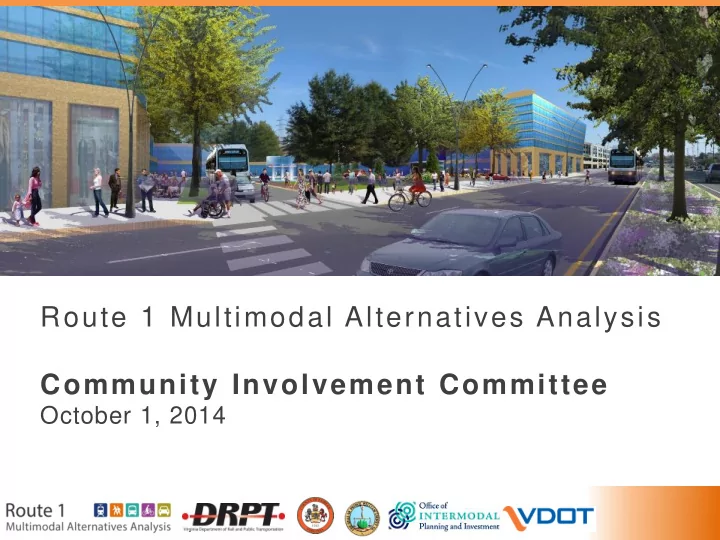
Community Involvement Committee October 1, 2014 Agenda 1. Purpose - - PowerPoint PPT Presentation
Route 1 Multimodal Alternatives Analysis Community Involvement Committee October 1, 2014 Agenda 1. Purpose of the study What weve learned from you 2. 3. Review of study process and status 4. Evaluation of Alternatives 5. Key
1. Purpose of the study 2. What we’ve learned from you 3. Review of study process and status 4. Evaluation of Alternatives 5. Key considerations for implementation
Population and employment growth Traffic capacity Phasing and funding of multimodal improvements
6. Next Steps
2
3
4
5
Needs:
bicycle access
accommodation
land development Purpose: Provide improved performance for transit, bicycle and pedestrian, and vehicular conditions and facilities along the Route 1 corridor that support long-term growth and economic development.
6
7
8
9
10
Purpose and Need Weighting of evaluation measures Recommendations and action plan
11
12
13
14
We are here
15
Screen 1: Initial Alternatives Screen 2: Refined Alternatives Screen 3: Detailed Evaluation Recommendations
Public Meeting #1 (Fall 2013) Public Meeting #2 (Spring 2014) Public Meeting #3 (Fall 2014)
16
17
18
BRT operates in dedicated curb lanes to Pohick Road North BRT operates in mixed traffic from Pohick Road North to Woodbridge
Huntington Penn Daw Beacon Hill Lockheed Blvd Hybla Valley Woodbridge VRE
BRT in Dedicated Lanes BRT in Mixed Traffic Proposed P&R
BRT operates in median in dedicated lanes in Fairfax County; transitions to mixed traffic through Prince William County
19
Huntington
Penn Daw Beacon Hill Lockheed Blvd Hybla Valley Woodbridge VRE
BRT in Dedicated Lanes BRT in Mixed Traffic Proposed Park & Ride
Light Rail operates in median in dedicated lanes for entire corridor
20
Huntington
Penn Daw Beacon Hill Lockheed Blvd Hybla Valley Woodbridge VRE
LRT in Dedicated Lanes
Proposed Park & Ride
21
supporting BRT in the long-term
Huntington Beacon Hill Hybla Valley Woodbridge VRE
BRT in Dedicated Lanes BRT in Mixed Traffic Metrorail (Underground) Proposed Park & Ride
Median Running BRT in the near-term
22
Based on Scenario 1 Land Use (COG 2035 Forecast) Alt 1: BRT- Curb Alt 2: BRT- Median Alt 3: LRT Alt 4: Metro/BRT Hybrid Average Weekday Ridership (2035)
15,200 16,600 18,400 26,500
(BRT 10,600; Metro 22,900)
Conceptual Capital Cost
$832 M $1.01 B $1.56 B $2.46 B*
(Metro $1.46B; BRT $1 B)
Annual O&M Cost
(Each Alternative includes $5 M annual cost for Ft. Belvoir shuttle service)
$18 M
(BRT $13M; Ft Belvoir Shuttle $5M)
$17 M
(BRT $12M; Ft Belvoir Shuttle $5M)
$24 M
(LRT $19M; Ft Belvoir Shuttle $5M)
$31 M**
(Metro $17M; BRT $8M; Ft Belvoir Shuttle $5M)
Cost Effectiveness
(Annualized capital + operating cost per rider)
$19 $20 $27
$28**
(Metrorail: $28; BRT: $29)
* This figure represents full BRT construction between Huntington and
Woodbridge, then Metrorail extension from Huntington to Hybla Valley ** These figures assume operation of Metrorail between Huntington and Hybla Valley, and BRT between Hybla Valley and Woodbridge
23
Goal Example Measures Goal 1: Local and Regional Mobility
Goal 2: Safety and Accessibility
Goal 3A: Economic Development
Goal 3B: Cost Effectiveness
Goal 4: Community Health and Resources
24
–
–
Check out Board 4 for full evaluation results!
25
Evaluation results suggest:
near-term would provide a cost effective transportation solution to support economic development plans.
term has potential to provide a higher level of local and regional mobility and support long- term corridor development, contingent upon increased future land use density.
26
27
28
Population and employment growth Traffic capacity Phasing and funding of multimodal improvements
Land use planning Transportation investment Support high quality community development Demand for new residential units and commercial space Employment growth Population growth
29
30
31
32
Artist’s Rendering
33 P-6 (70+) P-4 (14-34) P-3 (7-14) P-5 (34-70)
(Population + Employment per Acre) Ballston-Rosslyn Norfolk LRT
(End of line station) (End of line station)
34
P-6 (70+) P-4 (14-34) P-3 (7-14) P-5 (34-70)
35
P-6 (70+) P-4 (14-34) P-5 (34-70)
36
P-6 (70+) P-5 (34-70)
37
P-6 (70+) P-5 (34-70)
38
P-6 (70+) P-5 (34-70)
39
40
41
42
43
– Assess potential “worst case” traffic impacts and define need for roadway and intersection capacity
– Intersection Level of Service (LOS) – Theoretical additional roadway capacity needed – Theoretical local street capacity + increased transit share + walk and bike trips
44
Addition of median transit lanes:
performance
12.1 14.6 16.8 13.6 4 8 12 16
1 2
Segment Travel Time (min) 2035 No Build 2035 Build
Transit travel time Auto travel time
(Janna Lee Ave. to Huntington)
45
+15-25% over Scenario 1
Time Time
70 AD (+160%) 50 AD (+80%)
Population and employment growth up to 160% over Scenario 1
For highest density proposed station areas: Beacon Hill and Hybla Valley
Scenario 2 Share of trips: transit, walk, bike, internal, and peak spreading
20% 25% Widen Route 1
From 6 lanes to 8 lanes From 6 lanes To 8 lanes
OR Add parallel local streets
One new 2-lane street One new 2-lane street Scenario 3 Share of trips: transit, walk, bike, internal, and peak spreading
25% 40% to 50% Widen Route 1
From 6 lanes to 12 lanes From 6 lanes to 10 lanes
OR Add parallel local streets
Six new 2-lane streets Three new 2-lane streets
Street Infrastructure Required to Accommodate Growth
+15-25%
46
Route 1 corridor in all scenarios, including COG 2035 forecast
recommended Route 1 transportation investment must be complemented by
public safety, parks):
– Network of local streets – Mixed use development – Walkable, pedestrian friendly environment
require significantly more infrastructure investment than BRT levels
47
48
Huntington Hybla Valley Fort Belvoir Woodbridge
($306 M)
3.1 mi
49
($224 M)
Huntington Hybla Valley Fort Belvoir Woodbridge
7.3 mi
50
($472 M)
Huntington Hybla Valley Fort Belvoir Woodbridge
4.6 mi
51
($1.46 B)
Huntington Hybla Valley Fort Belvoir Woodbridge
3.1 mi
*Contingent upon future land use
52
7.3 mi
Phase I+II : Huntington to Fort Belvoir
New Starts/Small Starts funding
Phase III: Fort Belvoir to Woodbridge
widening
10% 33% 20% 22% 15%
Federal Formula State Regional Local Unidentified
50% 33% 8% 9% Federal State Regional Local
53
7.3 mi
Phase IV: Huntington to Hybla Valley
New Starts funding in 2040
50% 33% 8% 9% Federal State Regional Local
54
Comprehensive Plan Planning Scoping/ NEPA PE Final Design Right of Way Utilities Relocation Construction Operation
Approach: BRT and Long-Term Metrorail Implementation (2040)
Legend: General Project Development Sequence
15 16 17 18 19 20 21 22 23 24 25 26 27 28 29 30 31 32 33 34 35 36 37 38 39 40 Roadway Widening, Bike/Ped, BRT Phase I Comprehensive Plan Revisions
Phase II: Hybla Valley to Fort Belvoir
Bike/Ped, BRT Phase II Comprehensive Plan Revisions Roadway Widening, Bike/Ped, BRT Phase III Comprehensive Plan Revisions
Phase IV: Huntington to Hybla Valley Metrorail Extension
Metrorail Phase IV Comprehensive Plan Revisions Years (2015-2040)
Phase I: Huntington to Hybla Valley + Roadway Widening Phase III: Fort Belvoir to Woodbridge Improvements
Note: Timelines assume a funding stream to support projects implementation. *Contingent upon increased future land use density. *
55
Comprehensive Plan Planning Scoping/ NEPA PE Final Design Right of Way Utilities Relocation Construction Operation
Legend: General Project Development Sequence
15 16 17 18 19 20 21 22 23 24 25 26 27 28 29 30 31 32 33 34 35 36 37 38 39 40 Roadway Widening, Bike/Ped, BRT Phase I Comprehensive Plan Revisions
Phase II: Hybla Valley to Fort Belvoir
Bike/Ped, BRT Phase II Comprehensive Plan Revisions Roadway Widening, Bike/Ped, BRT Phase III Comprehensive Plan Revisions
Phase IV: Huntington to Hybla Valley Metrorail Extension
Metrorail Phase IV Comprehensive Plan Revisions Years (2015-2040)
Phase I: Huntington to Hybla Valley + Roadway Widening Phase III: Fort Belvoir to Woodbridge Improvements
Note: Timelines assume a funding stream to support projects implementation. *Contingent upon increased future land use density. *
FTA NEW STARTS PROJECT DEVELOPMENT PROCESS FTA SMALL STARTS PROJECT DEVELOPMENT PROCESS
Typical New Starts Funding Steps/Sequence:
56
57
58
Conduct Market Studies, Identify Comprehensive Plan Updates
Coordination with public stakeholders and state and federal agencies
59