
SLIDE 1
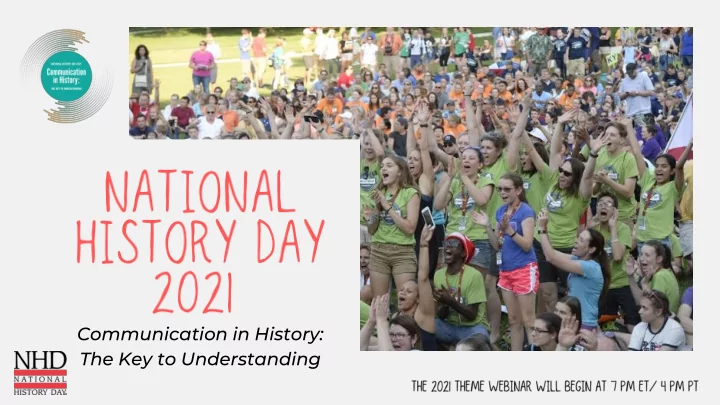
Communication in History: The Key to Understanding
Communication in History: The Key to Understanding Get your digital - - PowerPoint PPT Presentation
Communication in History: The Key to Understanding Get your digital copy today at nhd.org/rulebook or a hard copy at nhd.org/buyrulebook Get your digital copy today at nhd.org/themebook or purchase a hard copy at nhd.org/buythemebook NARA
Communication in History: The Key to Understanding
Get your digital copy today at nhd.org/rulebook or a hard copy at nhd.org/buyrulebook
Get your digital copy today at nhd.org/themebook or purchase a hard copy at nhd.org/buythemebook
NARA holds approximately 10 billion pages of textual records; 12 million maps, charts, and architectural and engineering drawings; 25 million still photographs and millons of other materials. Start your research at nara.gov.
REVOLUTIONIZE YOUR CLASSROOM WITH NATIONAL HISTORY DAY! To learn more and register, visit NHD.org/onlineeducation
To learn more visit, nhd.org/nhdwebcentral.
“The White House Historical Association is a private, nonprofit organization founded in 1961 by First Lady Jacqueline Kennedy with a mission to protect, preserve, and provide public access to the rich history of America’s Executive Mansion.” Start your research at whha.org
N H D . O R G / V I R T U A L 2 0 2 0 S T U D E N T S
N H D . O R G / V I R T U A L 2 0 2 0 S T U D E N T S
NHD began as a one-day competition at Case Western University in 1974, at which just over one hundred students competed.
Presidential Libraries and Museums promote understanding of the presidency and the American
include materials from President Hoover to President Obama.
To find a presidental library's website and archives, visit archives.gov/presidential- libraries.
Lynne O’Hara, Director of Programs, National History Day Ken O’Regan, Education Specialist, White House Historical Association Jeffrey Urbin, Director of Education at the Franklin Delano Roosevelt Presidential Library and Museum
Communication is spoken. Communication is heard and received.
Communication is written.
White House Historical Association Ronald Reagan Presidential Library and Museum Tudor Place Foundation Inc.
Communication happens in gatherings.
Communication is a key part of civics and government. Communication is part of the political process.
Library of Congress National Archives and Records Administration National Archives and Records Administration
Language is key to communication.
Miscommunications are part of the story.
Two-sided communication is imperative.
National Archives and Records Administration Library of Congress National Archives and Records Administration
Chinatown Garment Workers, New York, New York (New York University) Whittier, California (Whittier Public Library) Columbia, South Carolina (Historic Columbia) The Mansfield Crisis, Mansfield, Texas (Teaching Tolerance)
The Roosevelt Presidential Library and Museum
National Archives and Records Administration
TOC
Overview Understanding the problems Project objective Target audience Market trends Cycle diagram Introducing: Lorem ipsum
Spotlight on desktop Spotlight on mobile Spotlight on landscape view on mobile Spotlight on wearables Spotlight on tablet Spotlight on landscape view on tablet Spotlight on wearables
Project timeline
Roosevelt Presidential Library and Museum
Email: education@whha.org Twitter: @WhiteHouseHstry www.whitehousehistory .org
Ken O’Regan, Education Specialist
PR PRES ESIDENTS IDENTS AN AND THE D THE PR PRESS ESS
In the 19th century, newspapers were the main vehicle for information.
Andrew Jackson tried to garner favorable coverage by offering federal government jobs
Reporters didn’t routinely cover the White House until Grover Cleveland’s second administration
PR PRES ESIDENTS IDENTS AN AND THE D THE PR PRESS ESS
Press conferences emerge in the 20th century and make the president accountable in real-time
The press has had dedicated working space in the White House since the 1902 renovation
Televised press conferences emerge during the Eisenhower administration
TE TECH CHNOLO NOLOGY Y & & COM OMMU MUNICA NICATION TION AT AT TH THE WH WHITE TE HO HOUSE SE
The mid-19th century sees the telegraph emerge as a revolutionary tool
Andrew Johnson installs first WH telegraph in 1866
President Hayes installs the first telephone in 1879 – his number? “1”
Typewriters introduced in 1880
TE TECH CHNOLO NOLOGY Y & & COM OMMU MUNICA NICATION TION AT AT TH THE WH WHITE TE HO HOUSE SE
Franklin D. Roosevelt embraces radio as a tool to communicate with the nation
FDR installs a theater to watch newsreels in WWII
Truman embraces television, Eisenhower and Kennedy follow
Email debuts 1992, a website in 1994
PR PROT OTEST EST AT AT TH THE E WH WHIT ITE E HO HOUS USE
Protests in Lafayette Park have
What better way to be heard than to bring your cause to the president’s front door?
Suffragists first bring protests to the White House in 1917, paving the way for the 19th Amendment
PR PROT OTEST EST AT AT TH THE E WH WHIT ITE E HO HOUS USE
After World War II, civil rights became a focal point of demonstrations – there was even a sit-in inside the White House
Anti-war demonstrations have been a fixture since the Vietnam War
The first documented LGBTQ+ protest happens in 1965
Lafayette Square remains a very visible site of protest to this day
www.whitehousehistory.org
Free to Use
Digital Library (thousands of images) Classroom Resource Packets (30 subjects) Historian Articles (wide variety of topics) Short Videos (quick content delivery)
Find us on Facebook or Twitter (@WhiteHouseHstry) for daily stories of White House history Contact Us: education@whha.org
More Resources for White House History
Library of Congress – loc.gov
National Archives – archives.gov - includes 14 presidential libraries
Sharing White House History – explore this index of other presidential sites: whitehousehistory.org/sharing-white- house-history