Common Infections of the Skin Toby Maurer, MD University of - - PDF document

common infections of the skin
SMART_READER_LITE
LIVE PREVIEW

Common Infections of the Skin Toby Maurer, MD University of - - PDF document

Common Infections of the Skin Toby Maurer, MD University of California, San Francisco Candida of Nails Look for paronychia (erythema and swelling around nailbed) and green nails Occurs in persons who have hands in water Green nails


slide-1
SLIDE 1

1

Common Infections of the Skin

Toby Maurer, MD University of California, San Francisco

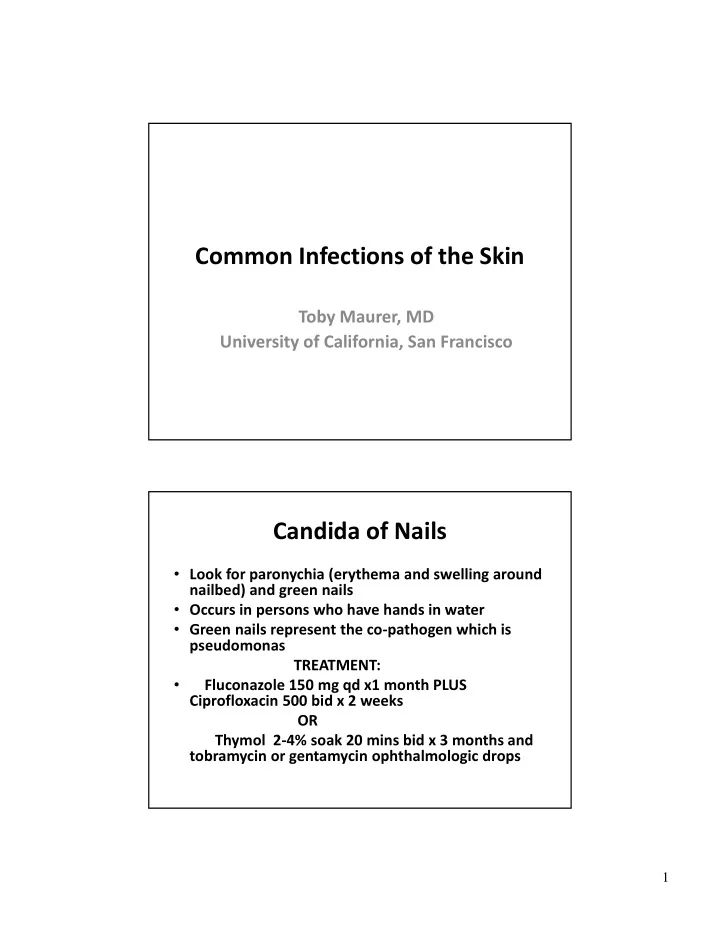
Candida of Nails

  • Look for paronychia (erythema and swelling around

nailbed) and green nails

  • Occurs in persons who have hands in water
  • Green nails represent the co‐pathogen which is

pseudomonas TREATMENT:

  • Fluconazole 150 mg qd x1 month PLUS

Ciprofloxacin 500 bid x 2 weeks OR Thymol 2‐4% soak 20 mins bid x 3 months and tobramycin or gentamycin ophthalmologic drops

slide-2
SLIDE 2

2

How to diagnose

  • Not all dystrophic nails= onychomycosis
  • KOH‐difficult to do and operator dependent
  • CULTURE is gold standard but takes 3 weeks to grow
  • ut.
  • Now PCR‐used in Scotland with high sensitivity and

specificity

  • Cost effective and results in 72 hours

Alexander et al Br. J Derm 2011 May

Onychomycosis

  • Topical treatment –use for the right type of

lesions

  • Naftin gel for small superficial lesions
  • Penlac (Ciclopirox 8%) reported to work 35‐

52% of the time

– cost: expensive

slide-3
SLIDE 3

3

Right type of lesions for topicals

  • Lunula not affected
  • Less than 5 nails affected
  • No thickening of nails
  • No separation of nail plate on sides
  • Griseofulvin‐least hepatotoxic but lower

efficacy‐ 250 mg bid x 12‐18 months

  • Fluconazole‐ 150 mg qweek for more than 6

months –July 2012 Dermat Tx Gupta AK et al

  • Itraconazole‐ can pulse it‐ 400 mg qd x 7 days

q month x 4 months

slide-4
SLIDE 4

4

Terbinafine (Lamisil)

  • Still the leader of the pack‐most effective in

terms of INITIAL and LONG‐TERM cure rate.

  • DOSE: 250 mg qd Continuously x 3 months

for fingernails and x4 months for toenails (July 2012) i.e. no pulsing BASELINE 1 YR 5 YR Terbinafine 77% 75% 50% Itraconazole 70% 50% 13% Grispeg 41% Fluconazole ? ? ?

slide-5
SLIDE 5

5

Onychomycosis A New Approach

  • Toenails take 12‐18 months to grow
  • Pulse terbinafine 250 mg per day for 1 week

every 2‐3 months for one year

  • Booster dose at 9 months (250 mg qd x 1

month)

Liver toxicity

  • Transaminase elevation 0.4% to 1% with

terbinafine and intraconazole

  • Transaminase elevation does not predict liver

failure

  • Liver failure 1/100,000
  • Terbinafine has gone generic
slide-6
SLIDE 6

6

What about laser?

  • Photo‐ inactivation laser and destructive

laser

  • Destructive laser‐reduced fungal elements

by 75‐85% but long term??

  • Photoinactivation‐mycologic cure at 9

months=38% (1 study)

  • No randomized controlled studies at this

point

Dissecting Cellulitis of Scalp

  • Occurs in persons of color
  • Culture for tinea but ususally bacterial
  • Culture and ask lab to provide identification
  • f organism regardless of colony count
  • Can take 1‐2 years to treat with long‐term

antibiotics

slide-7
SLIDE 7

7

Tinea Capitis

  • Scaling and alopecia
  • Examine all children in the family
  • “Brush” culture and begin empiric therapy
  • Treatment

– Gris‐PEG: 15‐25mg/day x 6 weeks – Reculture

New thoughts on Tinea Capitis

  • Terbinafine for children
  • Much shorter course 2‐4 weeks

62.5mg/kg(10‐20kg) 125 mg/day(20‐40 kg) 250 mg/day(>40 kg)

  • J of European Academy of Derm and Venerology,Nov 2003
slide-8
SLIDE 8

8

Cutaneous Tinea

  • KOH is helpful in distinguishing tinea

from eczema

  • Topical antifungals x 4‐6 weeks
  • Just say NO to Lotrisone PLEASE!

Pitted Keratolysis

  • May be confused with tinea on foot
  • See pits
  • Bad odor
  • From bacteria (corynibacteria)‐topical

erythromycin bid

slide-9
SLIDE 9

9

Intertrigo

  • Under pannus and breasts
  • Always a component of candida
  • Blow dry area
  • Topical antifungals
  • Tucks pads (wet to dry dressing)
slide-10
SLIDE 10

10

Erosio interdigitalis blastomycetica

  • Candida and bacteria between toes or fingers
  • Spreads to DORUM of foot and has

impetiginous look

  • Treatment:

Drying agents: Burow’s soaks (aluminum acetate)20 mins bid Antibiotics for staph aureus Topical or po antifungals Mild topical steroid for itch

Tinea Versicolor

Treatment: ‐ for localized areas, topical antifungal otherwise:

– Ketoconazole (Nizoral)200 mg po daily x 4 days – Sweat x1 hour after taking med – Leave sweat on body for 8‐12 hours – Selenium sulfate shampoo 15 mins q week for prevention

slide-11
SLIDE 11

11

Recurrent Staph Infection

  • Tx for methcillin resistant staph (MRSA) right
  • ff the bat‐Doxycycline, septra, clinda and

cipro

  • Eradicate staph for 3 months by adding

rifampin 600 qd x 5 days (watch drug‐drug interactions) or

  • Mupiricin intranasally qd for first 5 days of

every month

Recurrent skin infection

  • UNDERLYING disease that could be portal of

entry

  • Dry skin‐lubricate with grease
  • Eczema/Contact Dermtitis‐TAC and

lubrication

  • Psoriasis‐staph exacerbates psoriasis and

psoriasis portal of entry

  • Tinea‐ portal of entry‐tx with antifungals
slide-12
SLIDE 12

12

If not improving

  • Was patient treated long enough?

Once hair structures are involved or deep tissues, treatment time may be longer

Don’t forget strep

  • Strep: Doxycycline and septra may not cover

strep

  • Cipro/levo do not cover strep
  • Add antibiotic that covers strep‐

Cephalosporins or Dicloxicillin Jacobs et al Diagn Microb Inf Dis 2007, March

slide-13
SLIDE 13

13

Skin Surgeries in Diabetics

  • More infection? Worse healing?
  • Pts with DM had 66% higher risk for infection

especially on legs, ears or with flaps and grafts.

  • May be prudent to prophylax these pts

undergoing these procedures with antibiotics before surgery

  • HEALING NOT WORSE

Dixon et al Dermatol Surg 2009 July

Cellulitis

  • Goal in study was to have dermatologists

diagnose cellulitis vs other diseases

  • 635 pts seen‐67% had cellulitis N=425
  • 33% had other‐eczema, lymphedema,

lipodermatosclerosis Levell et al Br J of Dermatol (BJD) 2011 Feb

slide-14
SLIDE 14

14

  • Of the 425 with cellulitis, 30% had

predisposing dermatologic disease like tinea, eczema, psoriasis (treat underlying derm disease!!!)

  • Hospitalization was averted for 96% of those

with cellulitis (p.o. antibiotics with close follow‐up)

Take Home Points:

  • Does the patient really have cellulitis?
  • Is there an underlying dermatologic cause

that contributes to condition‐if treated could prevent repeated episodes?

  • Does this patient require hospitalization?
slide-15
SLIDE 15

15

Venous Insufficiency Ulcer

  • Control Edema

– Elevation of leg above heart 2 hours twice daily – Walk, don’t sit – Compression

  • Diuretics overused and not of benefit unless

fluid retention due to central problem is present (CHF, CRF)

  • Create healing wound environment

Venous Insufficiency Ulcer

  • Metrogel on ulcer‐decreases anaerobes
  • Semipermeable dressing (Hydrosorb, Duoderm,

etc)

  • Compression ‐

Unna boot covered by Coban – This both provides graded compression AND creates the correct wound environment

  • Change dressing weekly
  • Refer to dermatology if not healing
slide-16
SLIDE 16

16

When is a Leg Ulcer Infected?

  • All leg ulcers are colonized with bacteria.

Surface culture of little value

  • Suspect infection if:

– Increasing pain – Surrounding erythema, cellulitis – Focal area not healing and undermining present

  • Treat superficial contaminant with

vinegar/Burow’s soaks

Was it an inflammatory condition and not an infection?

  • Erythema nodosum
  • Pyoderma gangrenosum
  • Hidradenitis suppurativa
slide-17
SLIDE 17

17

Erythema Nodosum

  • Not an infection
  • Reaction pattern to strep , cocci, oral

contraceptives, estrogen replacement, inflammatory bowel disease

  • Painful, red nodules lower legs
  • Pt’s feel bad
  • Biopsy diagnosis‐inflammation of fat
  • Treatment with bedrest, NSAIDS, prednisone

Pyoderma Gangrenosum

  • Not an infectious disease
  • A “reactive” inflammatory disease
  • Biopsy diagnosis
  • Surgical I&D/excision make it worse
slide-18
SLIDE 18

18

Treatment

  • Do Not I&D
  • Prednisone/cyclosporine
  • Thalidomide
  • Tacrolimus (protopic)
  • Tx underlying disease

Hidradenitis Supparativa

  • Not an infectious disease
  • Disease of apocrine glands
  • Treatment

– IL Kenalog – Minocycline

NEW: clindamycin and rifampin for 12 weeks or acitretin

– Surgery – NOT Antibiotics for bacteria i.e. 10 day course – Biologics : infliximab (remicade)

slide-19
SLIDE 19

19

  • Remember HSV‐culture
  • Skin biopsy for histology and tissue culture
  • Diseases that Masquerade as Infectious

Diseases Ann Int Med 2005 Jan 4; 142:47‐55

Orolabial Herpes Simplex

  • No prophylaxis
  • Treat when symptomatic
  • Sun exposure can activate HSV‐ACV 800 mg 1

hour before sun exposure

slide-20
SLIDE 20

20

  • HSV can give an erythema multiforme

reaction

  • Usually painful targetoid lesions on elbows

and knees When bullous erythema multiforme, also consider mycolplasma

Warts

60 different wart types We have been exposed by the age of 2 to cutaneous warts 60 ways to treat‐only 50% efficacy Tx every 3 wks LN2 most common Sal acid effective but use nightly for 3 months at least

slide-21
SLIDE 21

21

Molluscum

  • In normal host‐self‐limited
  • LN2 works
  • Picking center works
  • Retinoids /imiquimod do not work