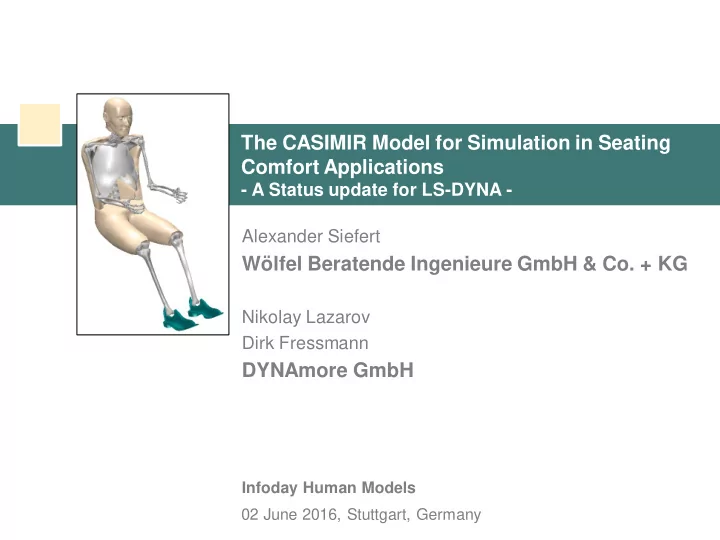
SLIDE 1 Alexander Siefert
Wölfel Beratende Ingenieure GmbH & Co. + KG
Nikolay Lazarov Dirk Fressmann
DYNAmore GmbH The CASIMIR Model for Simulation in Seating Comfort Applications
- A Status update for LS-DYNA -
02 June 2016, Stuttgart, Germany Infoday Human Models
SLIDE 2
■ Introduction to the CASIMIR model and seat development with
CASIMIR/Automotive
■ LS-DYNA integration and validation process ■ Summary ■ Outlook
Contents
SLIDE 3
- Human Body Model - History
■ Initially the CASIMIR model was developed in the 1990ies at the TU Darmstadt ■ First applications were investigations with respect to the risk of occupational
diseases due to whole human body exposures
■ Accordingly the model included a detailed model of the lumbar spine ■ Step by step the range of application is enhanced with focus on applications in
the automotive, commercial vehicle and aerospace industry 1998 2015
SLIDE 4 Detail model of lumbar spine and abdomen Volumetric model of several types of tissue Detailed muscle approach for stabilized posture
SLIDE 5 ■ The properties of the different model parts are validated in comparison
to real subject or tissue test
Validation of dynamic behaviour via data of test with real persons Validation of lumbar spine segments via data of cadaver tests
Force [N] Displacement [mm] Preload in Z and loading in X Frequency [Hz] Dynamic Behaviour – Vertical Excitation Apparent Mass [kg]
- Human Body Model - Validation
SLIDE 6 ■ Today model is the main part of a software package CASIMIR/Automotive to
evaluate the seating comfort
■ There are different occupant models available ■ The software is currently used by Daimler, Fiat, GM, JCI and NHK
CASIMIR/Automotive - Overview
Individual Percentiles North America Average Percentiles Asia Average Percentiles Europe
SLIDE 7 ■ Using the human body model in combination with detailed seat models taking
into account nonlinear and frequency dependent quantities enables a virtual seat development with increased efficiency and quality
CASIMIR/Automotive - Objective
Seat pressure distribution Seated posture Input packaging Seat Transmissibility Meat-to-Metal Statics Dynamics
SLIDE 8
LS-DYNA integration and validation process
SLIDE 9 ■ CASIMIR/Automotive currently only available for ABAQUS ■ First steps of the translation to LS-DYNA ■ Model setup
■ Rigid body chain with joints ■ Special stiffness definition of the lumbar spine ■ Deformable tissue ■ Springs and dampers representing the muscles
■ Converted human body model validated on a simplified seat
■ Implicit solution schemes
■ Static non-linear seating procedure ■ Subsequent eigenvalue analysis
The CASIMIR model in LS-DYNA
SLIDE 10
■ Seating simulation performed under gravity loading ■ Segment-based mortar contact with friction between CASIMIR and seat ■ For validation purposes, three different cases have been investigated:
■ Case 1 - elastic materials of both human body tissue and seat foam ■ Case 2 - non-linear material behavior of the tissue but linear material for the foam ■ Case 3 - non-linear materials of both human body tissue and seat foam
The CASIMIR model in LS-DYNA
SLIDE 11
■ Von Mises stress distribution on the seat in MPa ■ Seat contact pressure distribution in N/mm2
Case 1 – All linear materials
LS-DYNA LS-DYNA ABAQUS ABAQUS
SLIDE 12
■ Seat contact nodal normal force in N ■ Difference at the peaks of the contact normal pressure ■ Almost identical results for the contact nodal normal force
both solvers provide the same output difference in the contact normal pressure due to not equal projection approaches of the contact definitions and due to different post-processing
Case 1 – All elastic materials
LS-DYNA ABAQUS
SLIDE 13
■ Von Mises stress distribution on the seat in MPa ■ Seat contact pressure distribution in N/mm2
Case 2 – Nonlinear pelvis tissue, linear seat foam material
LS-DYNA LS-DYNA ABAQUS ABAQUS
SLIDE 14
■ Von Mises stress distribution on the seat in MPa ■ Seat contact pressure distribution in N/mm2
Case 3 – All non-linear materials
LS-DYNA LS-DYNA ABAQUS ABAQUS
SLIDE 15
■ Eigenvalues of the already seated model extracted and evaluated as further
validation criteria
■ Eigenmode comparison also considered as model quality check ■ The first 15 eigenvalues taken into account in the range of 0 ~ 6.5 Hz ■ Results of case 2 omitted due to similarity to Case 1
Eigenvalue and eigenmode evaluation
Case 1 Case 3
SLIDE 16
■ Samples of the eigenvectors for the eigenvalue 8# near 4 Hz ■ Pre-stresses and deformations considered by both solvers
Eigenvalue and eigenmode evaluation
LS-DYNA ABAQUS
SLIDE 17
CASIMIR/Automotive for LS-DYNA
■ The pre-processing is currently implemented in HyperMesh using a plugin menu ■ The adaption of the posture can
be carried out by the Posture Manager
SLIDE 18
■ The combination with an existing seat model is supported by the project
manager in combination with a graphical user interface for positioning
CASIMIR/Automotive for LS-DYNA
SLIDE 19
■ The CASIMIR model for seating comfort simulations presented ■ Human body model currently converted to LS-DYNA ■ Translation and validation still in progress ■ First LS-DYNA simulations with simple seat model showed good correlation to
the ABAQUS results regarding:
■ Seat stress distribution ■ Seat contact pressure distribution ■ Eigenvalues respectively eigenmodes in seated position
■ Both linear elastic and non-linear elastic behaviors of the seat foam respectively
human body tissue considered
Summary
SLIDE 20 ■ Further developments in the model conversion
■ Consideration of more complex seat models ■ Frequency dependent materials ■ Extension to pre- and post-processing tools for LS-DYNA ■ Steady state dynamic analysis
Outlook
Frequency
SLIDE 21
Thank you for your attention!
Your LS-DYNA distributor and more