
SLIDE 1
Microbial Source Tracking at Arroyo Burro Beach
Jared Ervin Holden Lab, UCSB
- Sept. 20th, 2012
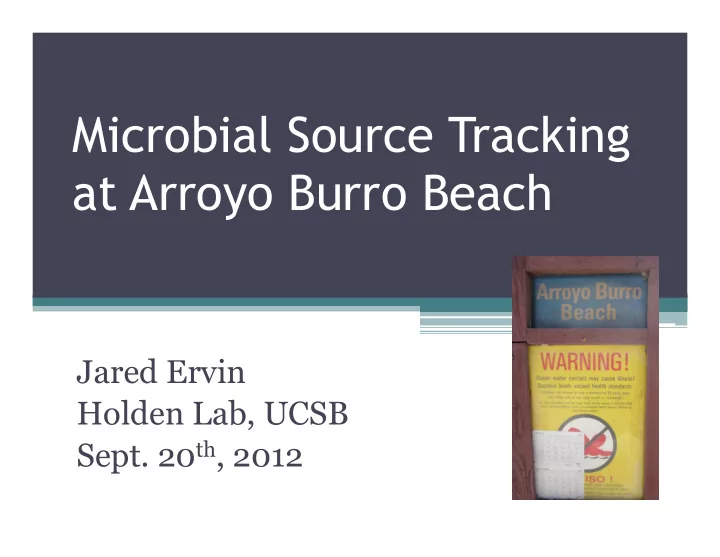
Microbial Source Tracking at Arroyo Burro Beach Jared Ervin Holden - - PowerPoint PPT Presentation
Microbial Source Tracking at Arroyo Burro Beach Jared Ervin Holden Lab, UCSB Sept. 20 th , 2012 Arroyo Burro Microbial Source Tracking Part of a larger multi-lab project called the Source Identification Protocol Project (SIPP) Funded
#7 on Heal the Bay’s top ten beach bummer list in 2011, #9 in 2007 F grade on 4 of the last 6 annual report cards Grades are based on County of Santa Barbara weekly surf zone water quality monitoring
*From Heal the Bay’s 2011 Annual Beach Report Card
▫ May 1st thru October 31st ▫ Sample taken each week at each beach ▫ 16 beaches monitored in Santa Barbara County
▫ Total Coliforms: 10,000 “cells” per 100mL ▫ Fecal Coliforms/E. coli: 400 “cells” per 100mL ▫ Enterococcus: 104 “cells” per 100mL ▫ TC>1,000 & FC:TC ratio greater than 0.1
*From: County of Santa Barbara weekly surf zone sampling
10-24-11 10-26-11 Limit Total Coliforms 882 122 10,000 Fecal Coliforms 697 31 400 Enterococcus 487 <10 104 FC/TC Ratio N/A N/A TC>1,000 0.1 Beach Status Warning Open
*From: County of Santa Barbara weekly surf zone sampling
*From: Cao et. al. 2011, Microbial Source Tracking
*From: Cao et. al. 2011, Microbial Source Tracking
FIB Culturing
FIB
▫ Source Identification ▫ Characterizing the origin of the bacteria (e.g., humans, birds, or livestock)
▫ Source Tracking ▫ Following bacterial signal back to its source (e.g., a specific storm drain, campground, or leaking sewage pipe)
▫ qPCR targeting specific fecal sources ▫ Whole bacterial community analysis
▫ Dye studies and televising of sewers ▫ Detection of caffeine and cotinine
Bird Specific Bacterial DNA Cow Specific Bacterial DNA Human Specific Bacterial DNA
DNA (qPCR)
Bacteroides in water sample
1 copy 2 copies 4 copies 8 copies 20x = 1 million copies
▫ 18 methods tested at UCSB
▫ Human, septage, sewage, chicken, cow, deer, dog, goose, gull, horse, pig & pigeon
▫ Doheny State Beach, Dana Point, CA
▫ Cowell Beach, Santa Cruz, CA
▫ Topanga State Beach, Malibu, CA
▫ Arroyo Burro Beach, Santa Barbara, CA
▫ Sampling results from City & County ▫ Previous work done at Holden Lab & City
▫ Investigation of all potential sources
▫ 10 weeks of sampling during summer 2012 ▫ Samples collected at upstream locations, in the lagoon and across the beach ▫ Sand and wrack samples also collected
▫ Birds & Dogs ▫ Sand & Wrack (i.e. kelp)
▫ Birds ▫ Humans
▫ Humans ▫ Horses
*Human sources may include homeless, leaking sanitary sewers and failing septic systems.
▫ 5 locations across the surf zone ▫ Sand and Wrack samples
▫ 3 locations in the lagoon ▫ Creeks and lagoon outlet
▫ 5 locations along Arroyo Burro and Las Positas Creeks
▫ 178 water samples collected ▫ 30 sand and 30 wrack samples ▫ All samples filtered and frozen for DNA analyses
▫ Total Coliforms, E. coli, Enterococcus
▫ 2 human, bird, dog, horse
▫ Chemical analysis for caffeine & cotinine ▫ Community analysis (TRFLP) ▫ Viral analysis
lagoon may impact surf zone water quality
sampling locations along this creek
UCSB Holden Lab
▫ Dr. Trish Holden ▫ Laurie Van De Werfhorst ▫ Ning Jiang ▫ Ngoc Hoang ▫ Corinne Dorais
City Creeks Division
▫ Dr. Jill Murray ▫ James Rumbley
County Environmental Health
▫ Willie Brummett
Questions/Comments? Contact: lagoon_study@bren.ucsb.edu Funding for the SIPP project comes from California Proposition 84 through the Clean Beaches Initiative (CBI)