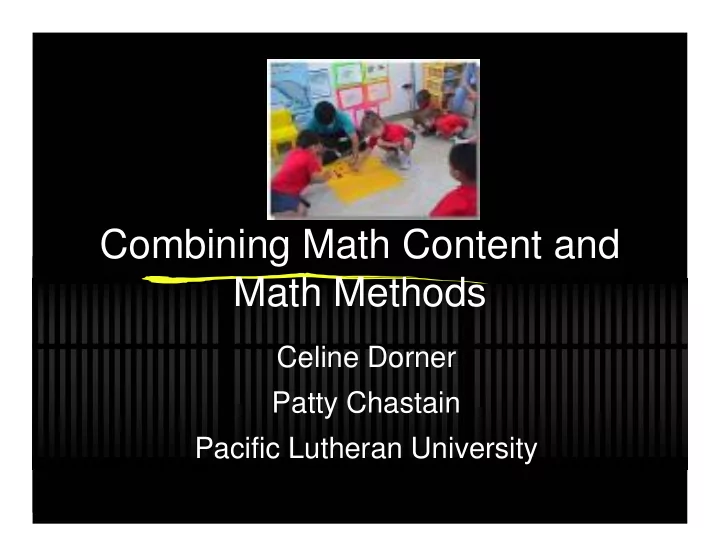
Combining Math Content and Math Methods Celine Dorner Patty - - PowerPoint PPT Presentation

combining math content and math methods
SMART_READER_LITE
LIVE PREVIEW

Combining Math Content and Math Methods Celine Dorner Patty - - PowerPoint PPT Presentation

Combining Math Content and Math Methods Celine Dorner Patty Chastain Pacific Lutheran University Background Pacific Lutheran University Separate courses Lack of mathematical background in teacher candidates Realization that


slide-1
SLIDE 1

Combining Math Content and Math Methods

Celine Dorner Patty Chastain Pacific Lutheran University

slide-2
SLIDE 2

Background

Pacific Lutheran University Separate courses Lack of mathematical background in teacher candidates Realization that content and methods overlap, yet left gaps Our recent experiences with DMI

slide-3
SLIDE 3

Vision and Goals

Recommendations from CBMS

  • Vol. 11: The Mathematical Education
  • f Teachers and Washington State

novice teacher competencies Focus on students’ thinking and understanding of Mathematics through the use of DMI cases Teacher candidates experience the mathematics as learners, and communicate their understanding to classmates See how students learn similar mathematics, and how they can facilitate student learning in the classroom through familiarity with research-based instructional strategies based on NCTM recommendations

slide-4
SLIDE 4

Grant requests

Planning time for development of essentially new courses Document cameras Stipends for former teacher candidates who would serve as advisors during planning stages

Breea Mearig Jeff Tompkins

slide-5
SLIDE 5

Planning: First Steps

Summarize recommendations of PMET and State competencies in mathematics for elementary teachers

  • Celine’s chart of Standards, topics, big math ideas,

children’s thinking -> readings/resources

Comparison of “old” syllabi to find gaps and overlaps between standards and what we had been doing Consultation with former teacher candidates about both of our classes - what they liked and wished for

slide-6
SLIDE 6

Planning: Content decisions Divide math content

Math 123 includes: Number sense and

  • perations, including Cognitively Guided

Instruction; algebraic thinking and problem- solving; proof Educ 406 includes: Review of CGI; geometry; measurement; data and statistics; probability

slide-7
SLIDE 7

Planning: Divide pedagogy instruction

MATH 123:

MATH > pedagogy No practicum Includes non-education majors Group presentation project based on “big” problems from Fostering Algebraic Thinking Toolkit (2001, Driscoll) DMI focus on considering student work and planning further instructional tasks (based on CGI)

EDUC 406

Math < PEDAGOGY Required to include focus on assessment, lesson planning, equity pedagogy, etc. 60 hr. practicum (with literacy methods)

Structured observation (communication patterns) Assessment of learners’ problem-solving skills Develop 2-week unit plan suitable for practicum class and teach a minimum of 2 math lessons

slide-8
SLIDE 8

Planning: Book selection

Hoped for 1 book that included both mathematics and methods, plus DMI casebooks Chose 2 texts from MAA list of recommended texts

(http://www.maa.org/pmet/resources/textbooks.html) Van de Walle (2005) Elementary and Middle School Mathematics: Teaching Developmentally, Pearson Allyn & Bacon Bassarear (2005) Mathematics for Elementary School Teachers, Houghton-Mifflin,

DMI: Making Meaning for Operations and Measurement in 1, 2, and 3 Dimensions

slide-9
SLIDE 9

Planning: Agreed on “usual” instructional sequence

Math content Focus on student learning Discussion and reading about instructional strategies

Math Content Student Understanding Instructional Planning

slide-10
SLIDE 10

A Closer Look: Planning math content

Math content

Math problems to solve; sharing using document camera Group investigations/guided inquiry based on “big ideas” Occasional direct instruction in various math topics Connections between numerical, geometrical, graphical, and algebraic representations

Multiplication transparency Video

Math Content Student Understanding Instructional Planning

slide-11
SLIDE 11

QuickTime™ and a QuickDraw decompressor are needed to see this picture.

slide-12
SLIDE 12

A Closer Look: Planning student learning focus

Development of student understanding Cases and videos of children doing mathematics, developing their own strategies, and sharing their work

Example

Ramon and Tanya are making diagrams to explain 1/3 + 1/3. Explain the reasoning of Ramon and Tanya

Math Content Student Understanding Instructional Planning

slide-13
SLIDE 13

A Closer Look: Planning instructional strategies DMI questions: What does child understand? Go next? Questions for child? Cognitively Guided Instruction

(http://www.coehs.uwosh.edu/Anishinabe/Curriculum/legend18.h

tm

Van de Walle, Elementary and Middle School Mathematics: Teaching Developmentally (2004)

Math Content Student Understanding Instructional Planning

slide-14
SLIDE 14

Reflections: Orchids

Teacher candidates

Communication - verbal and written, esp. document camera Deeper understanding underlying the math that they know and will be teaching Better understanding of how children develop understanding and sometimes struggle with math concepts they thought were simple

slide-15
SLIDE 15

More Orchids

Teacher candidates

have enhanced vision

  • f how math can be done and taught

more highly value children’s development of ideas and strategies

Increased partnerships between math dept. and education (“guest teaching”, teaming; inservice teacher education) Increased incorporation of technology

slide-16
SLIDE 16

Reflections: Concerns (Onions)

“Chunks” of mathematics content have been deleted

Set theory, Logic **different bases were scheduled for deletion, but consultation with former students convinced us to keep it

Bumpy coordination of math and pedagogy There is still a need for more math (especially probability) and more pedagogy - we need another semester! Students and instructors felt the workload was heavy for the credit Need for more multicultural perspective, inclusion of families

slide-17
SLIDE 17

Revisions planned for 2006-7

Different books (4 books too expensive!)

Recommendations? Review revised novice teacher competencies

Increased use of technology - recommendations? MATH 123

Increased math content: set theory, counting strategies? Increased history of math? Increased use of K-8 curriculum Include some preliminary lesson planning

EDUC 406

Reconsideration of assignments More time and instruction on some math topics (probability, geometry) Balance of “doing” versus “discussing” specific math activities (e.g. M&M Statistics, AIMS Mini-Metric Olympics; Plains Indian Star Quilts) More focus on multicultural perspective and including families in learning (beyond newsletters)

slide-18
SLIDE 18

Personal Reflections

Celine: Value of partnership, learning more about pedagogy, CGI, deeper understanding of the math Patty: Value of partnership, connections with teachers and math department, teacher candidates more confident

slide-19
SLIDE 19

Selected references

  • Developing Mathematical Ideas Casebooks: Making Meaning for Operations and

Measurement in 1,2, and 3 Dimensions (Schifter, Bastable, & Russell, 1999) available from Dale Seymour/Pearson Learning. Videos are available, too, separately or packaged with the facilitator’s guides and casebooks.

  • Children’s Mathematics: Cognitively Guided Instruction (with two multimedia

CDs), Thomas P. Carpenter, Elizabeth Fennema, Megan Loef Franke, Linda Levi and Susan B. Empson. Published through Heinemann. To find this book, go to Heinemann site and search for Children’s Mathematics.

  • CGI videotapes and summative log book complement the above publication. To
  • rder, contact Cheryle Wampole at the Wisconsin Center for Education

Research, 1025 W. Johnson Street, Room 242, Madison, WI 53706, TEL: (608) 265-9698 FAX: (608)263-6448. CGI Logs & Videotapes — Elizabeth Fennema, Thomas Carpenter, Linda Levi, Megan Loef Franke, Susan Empson. $100.00 single set.

  • Thinking Mathematically : Integrating Arithmetic & Algebra in Elementary School

by Thomas P. Carpenter, et al (2003)