Coarsening of three-dimensional structured and unstructured grids - - PowerPoint PPT Presentation

coarsening of three dimensional structured and
SMART_READER_LITE
LIVE PREVIEW

Coarsening of three-dimensional structured and unstructured grids - - PowerPoint PPT Presentation

Coarsening of three-dimensional structured and unstructured grids for subsurface flow Jrg Espen Aarnes and Vera Louise Hauge SINTEF ICT, Norway Yalchin Efendiev Texas A&M University, Texas, USA Task: Given ability to model velocity on


slide-1
SLIDE 1

Coarsening of three-dimensional structured and unstructured grids for subsurface flow

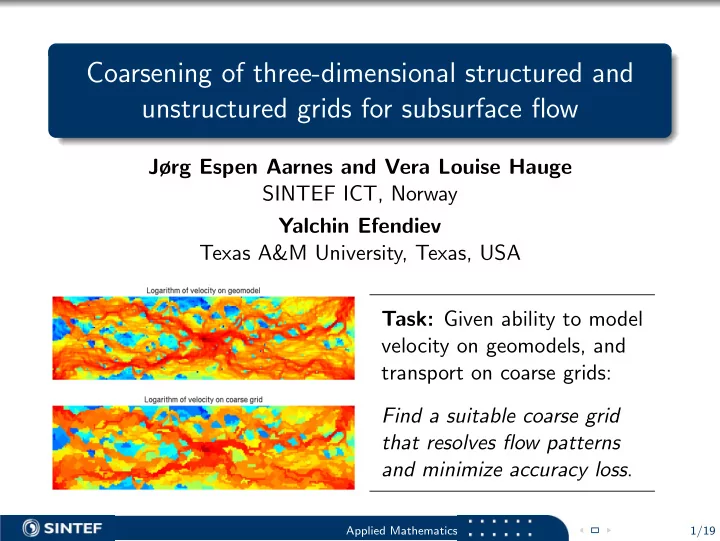
Jørg Espen Aarnes and Vera Louise Hauge SINTEF ICT, Norway Yalchin Efendiev Texas A&M University, Texas, USA Task: Given ability to model velocity on geomodels, and transport on coarse grids: Find a suitable coarse grid that resolves flow patterns and minimize accuracy loss.

Applied Mathematics 1/19

slide-2
SLIDE 2

Motivation

Today: Geomodels too large and complex for flow simulation: Upscaling performed to obtain Simulation grid(s). Effective parameters and pseudofunctions. Reservoir simulation workflow

Geomodel

− →

Upscaling

− →

Flow simulation

− →

Management

Tomorrow: Earth Model shared between geologists and reservoir engineers — Simulators take Earth Model as input, users specify grid-resolution to fit available computer resources and project requirements.

Applied Mathematics 2/19

slide-3
SLIDE 3

Objectives

Main objective: Develop a generic grid coarsening algorithm for reservoir simulation that resolves dominating flow patterns. – generic: one implementation applicable to all types of grids. – resolve flow patterns: separate high flow and low flow regions. Secondary objective: Reduce the need for pseudofunctions.

Applied Mathematics 3/19

slide-4
SLIDE 4

Simulation model and solution strategy

Simulation model Pressure equation and component mass-balance equations Primary variables: Darcy velocity v, Liquid pressure po, Saturations sj, j=aqueous, liquid, vapor. Iterative sequential solution strategy: vν+1 = v(sj,ν), po,ν+1 = po(sj,ν), sj,ν+1 = sj(po,ν+1, vν+1). (Fully implicit with fixed point rather than Newton iteration).

Applied Mathematics 4/19

slide-5
SLIDE 5

Simulation model and solution strategy

Simulation model Pressure equation and component mass-balance equations Primary variables: Darcy velocity v, Liquid pressure po, Saturations sj, j=aqueous, liquid, vapor. Iterative sequential solution strategy: vν+1 = v(sj,ν), po,ν+1 = po(sj,ν), sj,ν+1 = sj(po,ν+1, vν+1). (Fully implicit with fixed point rather than Newton iteration). Advantages with sequential solution strategy: Grid for pressure and mass balance equations may be different. Multiscale methods may be used to solve pressure equation. Pressure eq. allows larger time-steps than mass balance eqs.

Applied Mathematics 4/19

slide-6
SLIDE 6

Discretization

Pressure equation: Solution grid: Geomodel — no effective parameters. Discretization: Multiscale mixed / mimetic method Coarse grid:

  • btained by

up-gridding in index space Mass balance equations: Solution grid: Non-uniform coarse grid. Discretization: Two-scale upstream weighted FV method — integrals evaluated on geomodel. Pseudofunctions: No.

Applied Mathematics 5/19

slide-7
SLIDE 7

Generation of coarse grid for mass balance equations

Coarsening algorithm

1 Separate regions with different magnitude of flow. 2 Combine small blocks with a neighboring block. 3 Refine blocks with too much flow. 4 Repeat step 2.

Example: Layer 1 SPE10 (Christie and Blunt), 5 spot well pattern.

Applied Mathematics 6/19

slide-8
SLIDE 8

Grid generation procedure

Example: Layer 1 SPE10 (Christie and Blunt), 5 spot well pattern

Separate: Define g = ln |v| and D = (max(g) − min(g))/10. Region i = {c : min(g) + (i − 1)D < g(c) < min(g) + iD}. Initial grid: connected subregions — 733 blocks

Applied Mathematics 7/19

slide-9
SLIDE 9

Grid generation procedure

Example: Layer 1 SPE10 (Christie and Blunt), 5 spot well pattern

Separate: Define g = ln |v| and D = (max(g) − min(g))/10. Region i = {c : min(g) + (i − 1)D < g(c) < min(g) + iD}. Initial grid: connected subregions — 733 blocks Merge: If |B| < c, merge B with a neighboring block B′ with 1 |B|

  • B

ln |v|dx ≈ 1 |B′|

  • B′ ln |v| dx

Step 2: 203 blocks

Applied Mathematics 7/19

slide-10
SLIDE 10

Grid generation procedure

Example: Layer 1 SPE10 (Christie and Blunt), 5 spot well pattern

Refine: If criteria —

  • B ln |v|dx < C — is violated, do

Start at ∂B and build new blocks B′ that meet criteria. Define B = B\B′ and progress inwards until B meets criteria. Step3: 914 blocks

Applied Mathematics 8/19

slide-11
SLIDE 11

Grid generation procedure

Example: Layer 1 SPE10 (Christie and Blunt), 5 spot well pattern

Refine: If criteria —

  • B ln |v|dx < C — is violated, do

Start at ∂B and build new blocks B′ that meet criteria. Define B = B\B′ and progress inwards until B meets criteria. Step3: 914 blocks Cleanup: Merge small blocks with adjacent block. Final grid: 690 blocks

Applied Mathematics 8/19

slide-12
SLIDE 12

Example: Log of velocity magnitude on different grids

Applied Mathematics 9/19

slide-13
SLIDE 13

Layer 68 SPE10, 5 spot well pattern

Geomodel: 13200 cells Coarse grid: 660 cells Coarse grid: 649 cells Coarse grid: 264 cells Coarse grid: 257 cells

Applied Mathematics 10/19

slide-14
SLIDE 14

Numerical examples

Performance studies

Experimental setup: Model: Incompressible two-phase flow (oil and water). Initial state: Completely oil-saturated. Relative permeability: krj = s2

j,

0 ≤ sj ≤ 1. Viscosity ratio: µo/µw = 10. Error measures: (Time measured in PVI) Saturation error: e(S) = 1

S(·,t)−Sref(·,t)L1(Ω) Sref(·,t)L1(Ω)

dt. Water-cut error: e(w) = w − wrefL2([0,1])/wrefL2([0,1]).

Applied Mathematics 11/19

slide-15
SLIDE 15

Example 1: Geomodel = individual layers from SPE10

5-spot well pattern, upscaling factor ∼ 20

10 20 30 40 50 60 70 80 0.05 0.1 0.15 0.2

e(w) Layer Water−cut error for each of the 85 layers in the SPE10 model

10 20 30 40 50 60 70 80 0.1 0.2 0.3 0.4 0.5

e(S) Layer Saturation error for each of the 85 layers in the SPE10 model Non−uniform coarsening Uniform coarsening Non−uniform coarsening Uniform coarsening

Geomodel: 60 × 220 × 1 Uniform grid: 15 × 44 × 1 Non-uni. grid: 619–734 blocks Observations: First 35 layers smooth ⇒ Uniform grid adequate. Last 50 layers fluvial ⇒ Uniform grid inadequate. Non-uniform grid gives consistent results for all layers.

Applied Mathematics 12/19

slide-16
SLIDE 16

Example 2: Geomodel = stack of five layers from SPE10

5-spot well pattern, upscaling factor ∼ 100

2 4 6 8 10 12 14 16 18 0.05 0.1 0.15 0.2 0.25

e(w) Stack Water−cut error for each of the 17 stacks of five consecutive layers in the SPE10 model

2 4 6 8 10 12 14 16 18 0.1 0.2 0.3 0.4 0.5 0.6 0.7 0.8

e(S) Stack Saturation error for each of the 17 stacks of five consecutive layers in the SPE10 model Non−uniform coarsening Uniform coarsening Non−uniform coarsening Uniform coarsening

Geomodel: 60 × 220 × 5 Uniform grid: 15 × 44 × 1 Non-uniform grid: 655–714 blocks Observations: Uniform grid inadequate, also for stacks from layers 1–35 — lognormal mean of permeability in layers varies significantly. Non-uniform grid gives consistent results for all stacks.

Applied Mathematics 13/19

slide-17
SLIDE 17

Example 3: Geomodel = unstructured corner-point grid

20 realizations from lognormal distribution, Q-of-5-spot well pattern, upsc. factor ∼ 25

2 4 6 8 10 12 14 16 18 20 0.05 0.1 0.15 0.2 0.25 0.3 Water−cut error for µo=10µw Water−cut error for 20 stochastic permeability realizations 2 4 6 8 10 12 14 16 18 20 0.1 0.2 0.3 0.4 0.5 0.6 0.7 Average saturation error for µo=10µw Saturation error for 20 stochastic permeability realizations Non−uniform coarsening Uniform coarsening Non−uniform coarsening Uniform coarsening

⇐ 2 realizations. Geomodel: 15206 cells Uniform grid: 838 blocks Non-uni. grid: 647–704 blocks Observations: Coarsening algorithm applicable to unstructured grids — accuracy consistent with observations for SPE10 models. Results obtained with uniform grid (in index space) inaccurate.

Applied Mathematics 14/19

slide-18
SLIDE 18

Example 4: Geomodel = four bottom layers from SPE10

Robustness with respect to degree of coarsening, 5-spot well pattern

Number of cells in grid (upscaling factor 4–400) Uniform grid 30x110x4 20x55x4 15x44x2 10x22x2 6x22x1 13200 4400 1320 440 132 Non-U. grid 7516 3251 1333 419 150

30x110x4 20x55x4 15x44x2 10x22x2 6x22x1 0.05 0.1 0.15 0.2 0.25 0.3 0.35 0.4 0.45 0.5 Average saturation error 30x110x4 20x55x4 15x44x2 10x22x2 6x22x1 0.05 0.1 0.15 0.2 0.25 Water−cut error Non−uniform coarsening Uniform coarsening Non−uniform coarsening Uniform coarsening

Observations: Non-uniform grid gives better accuracy than uniform grid. Water-cut error almost grid-independent for non-uniform grid.

Applied Mathematics 15/19

slide-19
SLIDE 19

Example 5: Geomodel = four bottom layers from SPE10

Robustness with respect to well configuration, upscaling factor ∼ 40

A B C E D

= Producer = Injector

Wellpatterns

A (1333) B (1355) C (1348) D (1347) E (1337) 0.05 0.1 0.15 0.2 0.25 0.3 0.35 0.4 0.45 0.5 Average saturation error Non−uniform coarsening Uniform coarsening A (1333) B (1355) C (1348) D (1347) E (1337) 0.05 0.1 0.15 Water−cut error Non−uniform coarsening Uniform coarsening

Uniform grid: 15 × 44 × 2 Non-uniform grid ∼ 1320 blocks Non-uniform grid gives better accuracy than uniform grid — substantial difference in water-cut error for all cases.

Applied Mathematics 16/19

slide-20
SLIDE 20

Example 6: Geomodel = four bottom layers from SPE10

Dependency on initial flow conditions, upscaling factor ∼ 40

Grid generated with respective well patterns. Grid generated with pattern C.

A (1333) B (1355) C (1348) D (1347) E (1337) 0.05 0.1 0.15 0.2 0.25 0.3 0.35 0.4 0.45 0.5 Average saturation error Non−uniform coarsening Uniform coarsening A (1333) B (1355) C (1348) D (1347) E (1337) 0.05 0.1 0.15 Water−cut error Non−uniform coarsening Uniform coarsening

Observation: Grid resolves high-permeable regions with good connectivity — Grid need not be regenerated if well pattern changes.

Applied Mathematics 17/19

slide-21
SLIDE 21

Example 7: Geomodel = four bottom layers from SPE10

Robustness with respect changing well positions and well rates, upscaling factor ∼ 40

0.1 0.2 0.3 0.4 0.5 0.6 0.7 0.8 0.9 1 0.1 0.2 0.3 0.4 0.5 0.6 0.7 0.8 0.9

Water−cuts for case with changing well−rates PVI Reference solution Non−uniform coarsening: e(w)=0.0123 Uniform coarsening: e(w)=0.0993

0.1 0.2 0.3 0.4 0.5 0.6 0.7 0.8 0.9 1 0.1 0.2 0.3 0.4 0.5 0.6 0.7 0.8 0.9 1

Water−cuts for case with changing well−configurations PVI Reference solution Non−uniform coarsening: e(w)=0.0273 Uniform coarsening: e(w)=0.0902

5-spot, random prod. rates well patterns: 4 cycles A–E grid generated with equal rates grid generated with pattern C Observations: NU water-cut tracks reference curve closely: 1%–3% error. Uniform grid gives ∼ 10% water-cut error.

Applied Mathematics 18/19
slide-22
SLIDE 22

Conclusions

Flashback: A generic semi-automated algorithm for generating coarse grids that resolve flow patterns has been presented. Solutions are significantly more accurate than solutions

  • btained on uniform coarse grids with similar number of cells.

Water-cut error: 1%–3% — pseudofunctions superfluous. Grid need not be regenerated when flow conditions change! Potential application: User-specified grid-resolution to fit available computer resources. Relation to other methods: Belongs to family of flow-based gridsa: designed for flow scenarios where heterogeneity, rather than gravity, dominates flow patterns.

aGarcia, Journel, Aziz (1990,1992), Durlofsky, Jones, Milliken (1994,1997) Applied Mathematics 19/19