SLIDE 1 Variational Inference for Structured NLP Models
ACL, August 4, 2013 David Burkett and Dan Klein
Tutorial Outline
- 1. Structured Models and Factor Graphs
- 2. Mean Field
- 3. Structured Mean Field
- 4. Belief Propagation
- 5. Structured Belief Propagation
- 6. Wrap-Up
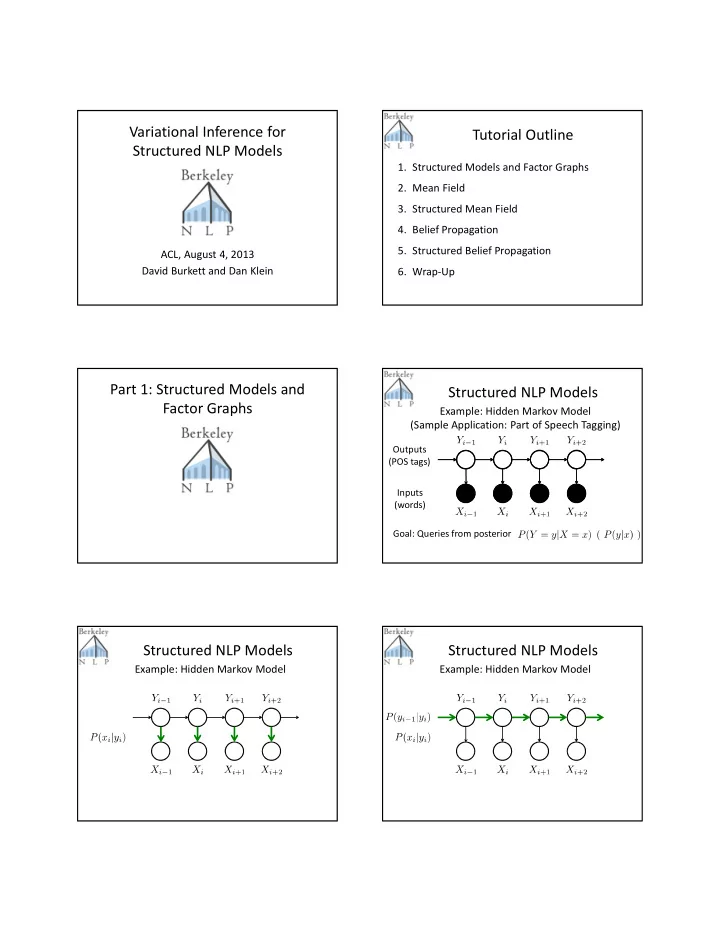
Part 1: Structured Models and Factor Graphs Structured NLP Models
Inputs (words) Outputs (POS tags)
Example: Hidden Markov Model (Sample Application: Part of Speech Tagging)
Goal: Queries from posterior
Structured NLP Models
Example: Hidden Markov Model
Structured NLP Models
Example: Hidden Markov Model
SLIDE 2
Structured NLP Models
Example: Hidden Markov Model
Structured NLP Models
Example: Hidden Markov Model
Structured NLP Models
Example: Hidden Markov Model
Structured NLP Models
Example: Hidden Markov Model
Factor Graph Notation
Factors Cliques Unary Factor Binary Factor Variables Yi
Factor Graph Notation
Factors Cliques Variables Yi
SLIDE 3
Factor Graph Notation
Factors Cliques Variables have factor (clique) neighbors: Variables Yi Factors have variable neighbors:
Structured NLP Models
Example: Conditional Random Field (Sample Application: Named Entity Recognition)
(Lafferty et al., 2001)
Structured NLP Models
Example: Conditional Random Field
Structured NLP Models
Example: Conditional Random Field
Structured NLP Models
Example: Edge-Factored Dependency Parsing
the cat ate the rat L L L L O O O O O O
(McDonald et al., 2005)
Structured NLP Models
the cat ate the rat L L L L O O O O O O
Example: Edge-Factored Dependency Parsing
SLIDE 4
Structured NLP Models
the cat ate the rat L L R R O O O O O O
Example: Edge-Factored Dependency Parsing
Structured NLP Models
the cat ate the rat L R L L O O O O O O
Example: Edge-Factored Dependency Parsing
Structured NLP Models
Example: Edge-Factored Dependency Parsing
L L L L L L L L L L
Inference
Input: Factor Graph Output: Marginals
Inference
Typical NLP Approach: Dynamic Programs! Examples:
Sequence Models (Forward/Backward) Phrase Structure Parsing (CKY, Inside/Outside) Dependency Parsing (Eisner algorithm) ITG Parsing (Bitext Inside/Outside)
Complex Structured Models
POS Tagging Named Entity Recognition Joint (Sutton et al., 2004)
SLIDE 5
Complex Structured Models
Dependency Parsing with Second Order Features (Carreras, 2007) (McDonald & Pereira, 2006)
Complex Structured Models
Word Alignment
I saw the cold cat vi el gato frío
(Taskar et al., 2005)
Complex Structured Models
Word Alignment
I saw the cold cat vi el gato frío
Variational Inference
Approximate inference techniques that can be applied to any graphical model This tutorial:
Mean Field: Approximate the joint distribution with a product of marginals Belief Propagation: Apply tree inference algorithms even if your graph isn’t a tree Structure: What changes when your factor graph has tractable substructures
Part 2: Mean Field Mean Field Warmup
Wanted: Iterated Conditional Modes (Besag, 1986) Idea: coordinate ascent Key object: assignments
SLIDE 6
Mean Field Warmup
Wanted:
Mean Field Warmup
Wanted:
Mean Field Warmup
Wanted:
Mean Field Warmup
Wanted:
Mean Field Warmup
Wanted: Approximate Result:
Iterated Conditional Modes Example
SLIDE 7
Iterated Conditional Modes Example Iterated Conditional Modes Example Iterated Conditional Modes Example Iterated Conditional Modes Example Iterated Conditional Modes Example Iterated Conditional Modes Example
SLIDE 8
Iterated Conditional Modes Example
Mean Field Intro
Mean Field is coordinate ascent, just like Iterated Conditional Modes, but with soft assignments to each variable!
Mean Field Intro
Wanted: Idea: coordinate ascent Key object: (approx) marginals
Mean Field Intro Mean Field Intro Mean Field Intro
Wanted:
SLIDE 9
Mean Field Intro
Wanted:
Mean Field Intro
Wanted:
Mean Field Procedure
Wanted:
Mean Field Procedure
Wanted:
Mean Field Procedure
Wanted:
Mean Field Procedure
Wanted:
SLIDE 10
Example Results Mean Field Derivation
Goal: Approximation: Constraint: Objective: Procedure: Coordinate ascent on each What’s the update?
Mean Field Update
1) 2) 3-9) Lots of algebra 10) f
Approximate Expectations
Yi
General:
General Update *
Exponential Family: Generic:
Mean Field Inference Example
1 1 1 1 2 5 2 1 .7 .3 .4 .6 .2 .5 .2 .1 .5 .5 .5 .5
SLIDE 11
Mean Field Inference Example
1 1 1 1 2 5 2 1 .7 .3 .4 .6 .2 .5 .2 .1 .69 .31 .5 .5
Mean Field Inference Example
1 1 1 1 2 5 2 1 .7 .3 .4 .6 .2 .5 .2 .1 .69 .31 .5 .5
Mean Field Inference Example
1 1 1 1 2 5 2 1 .7 .3 .4 .6 .2 .5 .2 .1 .69 .31 .40 .60
Mean Field Inference Example
1 1 1 1 2 5 2 1 .7 .3 .4 .6 .2 .5 .2 .1 .73 .27 .40 .60
Mean Field Inference Example
1 1 1 1 2 5 2 1 .7 .3 .4 .6 .2 .5 .2 .1 .73 .27 .38 .62
Mean Field Inference Example
1 1 1 1 2 5 2 1 .7 .3 .4 .6 .2 .5 .2 .1 .73 .27 .38 .62 .28 .45 .10 .17
SLIDE 12 Mean Field Inference Example
2 1 2 1 1 1 1 1 .67 .33 .67 .33 .44 .22 .22 .11 .67 .33 .67 .33 .44 .22 .22 .11
Mean Field Inference Example
1 1 1 1 9 1 1 5 .62 .38 .62 .38 .56 .06 .06 .31 .82 .18 .82 .18 .67 .15 .15 .03
Mean Field Q&A
Are the marginals guaranteed to converge to the right thing, like in sampling? Is the algorithm at least guaranteed to converge to something? So it’s just like EM? No Yes Yes
Why Only Local Optima?!
Variables: Discrete distributions: e.g. P(0,1,0,…0) = 1 All distributions (all convex combos) Mean field approximable (can represent all discrete ones, but not all)
Part 3: Structured Mean Field Mean Field Approximation
Model: Approximate Graph:
… … … … … … … …
SLIDE 13 Structured Mean Field Approximation
Model: Approximate Graph:
… … … … … … … …
(Xing et al, 2003)
Structured Mean Field Approximation Structured Mean Field Approximation Structured Mean Field Approximation
Computing Structured Updates
??
Computing Structured Updates
Marginal probability of under . Computed with forward-backward Updating . consists of computing all marginals .
SLIDE 14
Structured Mean Field Notation Structured Mean Field Notation Structured Mean Field Notation Structured Mean Field Notation Structured Mean Field Notation
Connected Components
Structured Mean Field Notation
Neighbors:
SLIDE 15 Structured Mean Field Updates
Naïve Mean Field: Structured Mean Field:
Expected Feature Counts Component Factorizability *
Example Feature
(pointwise product)
Generic Condition Condition
Component Factorizability *
(Abridged)
Use conjunctive indicator features Joint Parsing and Alignment
High levels
product and project 产品 、 项目 水平 高
(Burkett et al, 2010)
Joint Parsing and Alignment
High levels
product and project 产品 、 项目 水平 高 Sentences
Input:
SLIDE 16 Joint Parsing and Alignment
High levels
product and project 产品 、 项目 水平 高
Output: Trees contain
Nodes
Joint Parsing and Alignment
High levels
product and project 产品 、 项目 水平 高
Output:
Alignments
Joint Parsing and Alignment
High levels
product and project 产品 、 项目 水平 高
Output:
Alignments contain Bispans
Joint Parsing and Alignment
High levels
product and project 产品 、 项目 水平 高
Output:
Joint Parsing and Alignment
High levels
product and project 产品 、 项目 水平 高 Variables
Joint Parsing and Alignment
High levels
product and project 产品 、 项目 水平 高 Variables
SLIDE 17 Joint Parsing and Alignment
High levels
product and project 产品 、 项目 水平 高 Variables
Joint Parsing and Alignment
High levels
product and project 产品 、 项目 水平 高 Factors
Joint Parsing and Alignment
High levels
product and project 产品 、 项目 水平 高 Factors
Joint Parsing and Alignment
High levels
product and project 产品 、 项目 水平 高 Factors
Joint Parsing and Alignment
High levels
product and project 产品 、 项目 水平 高 Factors
Notational Abuse
Structural factors are implicit Subscript Omission: Skip Nonexistent Substructures: Shorthand:
SLIDE 18
Model Form
Expected Feature Counts Marginals
Training
Structured Mean Field Approximation Approximate Component Scores
Monolingual parser: Score for To compute : Score for If we knew : Score for
Expected Feature Counts
Marginals computed with bitext inside-outside Marginals computed with inside-outside For fixed :
Initialize:
Inference Procedure
SLIDE 19
Iterate marginal updates:
Inference Procedure
…until convergence!
Approximate Marginals Decoding
(Minimum Risk)
Structured Mean Field Summary
Split the model into pieces you have dynamic programs for Substitute expected feature counts for actual counts in cross-component factors Iterate computing marginals until convergence
Structured Mean Field Tips
Try to make sure cross-component features are products of indicators You don’t have to run all the way to convergence; marginals are usually pretty good after just a few rounds Recompute marginals for fast components more frequently than for slow ones
e.g. For joint parsing and alignment, the two monolingual tree marginals ( ) were updated until convergence between each update of the ITG marginals ( )
Break Time!
SLIDE 20 Part 4: Belief Propagation Belief Propagation
Wanted: Idea: pretend graph is a tree Key objects: Beliefs (marginals) Messages
/
Belief Propagation Intro
Assume we have a tree
Belief Propagation Intro Messages
Variable to Factor
/
Factor to Variable Both take form of “distribution” over
Messages General Form
Messages from variables to factors:
SLIDE 21
Messages General Form
Messages from factors to variables:
Marginal Beliefs
Belief Propagation on Tree- Structured Graphs
If the factor graph has no cycles, BP is exact
Can always order message computations
After one pass, marginal beliefs are correct
“Loopy” Belief Propagation
Problem: we no longer have a tree Solution: ignore problem
“Loopy” Belief Propagation
Just start passing messages anyway!
Belief Propagation Q&A
Are the marginals guaranteed to converge to the right thing, like in sampling? Well, is the algorithm at least guaranteed to converge to something, like mean field? Will everything often work out more or less OK in practice? No No Maybe
SLIDE 22 Belief Propagation Example
7 1 1 3 1 1 1 8 6 1 2 3 1 9 8 1
.59 .41 .16 .84 .34 .66 .81 .19
7 1 1 3
.5 .5 .5 .5 .5 .5 .5 .5 .67 .33 .67 .33
Exact BP
Belief Propagation Example
.59 .41 .16 .84 .34 .66 .81 .19
1 1 1 8
.67 .33 .5 .5 .67 .33 .5 .5 .31 .69 .23 .77
Exact BP
.67 .33 .74 .26
Belief Propagation Example
.59 .41 .16 .84 .34 .66 .81 .19 .5 .5 .31 .69 .23 .77
6 1 2 3
.74 .26
Exact BP
.74 .26
Belief Propagation Example
.59 .41 .16 .84 .34 .66 .81 .19 .31 .69 .23 .77 .74 .26
1 9 8 1
.86 .14 .13 .87
Exact BP
.53 .47
Belief Propagation Example
.59 .41 .16 .84 .34 .66 .81 .19 .35 .65 .86 .14 .13 .87
Exact BP
7 1 1 3
.53 .47
Belief Propagation Example
.59 .41 .16 .84 .34 .66 .81 .19 .30 .70 .86 .14 .14 .86
Exact BP
1 1 1 8
SLIDE 23 .61 .39
Belief Propagation Example
.59 .41 .16 .84 .34 .66 .81 .19 .30 .70 .80 .20 .14 .86
Exact BP
6 1 2 3
.61 .39
Belief Propagation Example
.59 .41 .16 .84 .34 .66 .81 .19 .30 .70 .79 .21 .19 .81
Exact BP
1 9 8 1
.57 .43
Belief Propagation Example
.59 .41 .16 .84 .34 .66 .81 .19 .37 .63 .77 .23 .21 .79
Exact BP
.57 .43
Belief Propagation Example
.59 .41 .16 .84 .34 .66 .81 .19 .37 .63 .77 .23 .21 .79
Exact BP
.85 .15 .03 .97 .38 .62 .97 .03
Mean Field
.36 .64
Belief Propagation Example
.29 .71 .19 .81 .24 .76 .77 .23 .28 .72 .69 .31 .27 .73
Exact BP
Playing Telephone
SLIDE 24
Part 5: Belief Propagation with Structured Factors Structured Factors
Problem:
Computing factor messages is exponential in arity Many models we care about have high-arity factors
Solution:
Take advantage of NLP tricks for efficient sums
Examples:
Word Alignment (at-most-one constraints) Dependency Parsing (tree constraint)
Warm-up Exercise Warm-up Exercise Warm-up Exercise Warm-up Exercise
SLIDE 25
Warm-up Exercise Warm-up Exercise Warm-up Exercise Warm-up Exercise
Benefits:
Cleans up notation Saves time multiplying Enables efficient summing
The Shape of Structured BP
Isolate the combinatorial factors Figure out how to compute efficient sums
Directly exploiting sparsity Dynamic programming
Work out the bookkeeping
Or, use a reference!
Word Alignment with BP
(Cromières & Kurohashi, 2009) (Burkett & Klein, 2012)
SLIDE 26
Computing Messages from Factors
Exponential in arity of factor (have to sum over all assignments) Arity 1 Arity Arity
Computing Constraint Factor Messages
Input: Goal:
Computing Constraint Factor Messages
: Assignment to variables where
Computing Constraint Factor Messages
: Assignment to variables where : Special case for all off
Computing Constraint Factor Messages
Input: Goal:
Only need to consider for
Computing Constraint Factor Messages
SLIDE 27
Computing Constraint Factor Messages Computing Constraint Factor Messages Computing Constraint Factor Messages Computing Constraint Factor Messages Computing Constraint Factor Messages Computing Constraint Factor Messages
SLIDE 28 Computing Constraint Factor Messages
2.
- 3. Partition:
- 4. Messages:
Using BP Marginals
Expected Feature Counts: Marginal Decoding:
Dependency Parsing with BP
(Smith & Eisner, 2008) (Martins et al., 2010)
Dependency Parsing with BP
Arity 1 Arity 2 Arity Exponential in arity of factor
Messages from the Tree Factor
Input: for all variables Goal: for all variables
What Do Parsers Do?
Initial state:
Value of an edge ( has parent ): Value of a tree:
Run inside-outside to compute:
Total score for all trees: Total score for an edge:
SLIDE 29 Initializing the Parser
Product over edges in :
Product over ALL edges, including
Problem: Solution:
Use odds ratios (Klein & Manning, 2002)
Running the Parser
Sums we want:
Computing Tree Factor Messages
- 1. Precompute:
- 2. Initialize:
- 3. Run inside-outside
- 4. Messages:
Using BP Marginals
Expected Feature Counts: Minimum Risk Decoding:
- 1. Initialize:
- 2. Run parser:
Structured BP Summary
Tricky part is factors whose arity grows with input size Simplify the problem by focusing on sums of total scores Exploit problem-specific structure to compute sums efficiently Use odds ratios to eliminate “default” values that don’t appear in dynamic program sums
Belief Propagation Tips
Don’t compute unary messages multiple times Store variable beliefs to save time computing variable to factor messages (divide one out) Update the slowest messages less frequently You don’t usually need to run to convergence; measure the speed/performance tradeoff
SLIDE 30
Part 6: Wrap-Up
Mean Field vs Belief Propagation
When to use Mean Field:
Models made up of weakly interacting structures that are individually tractable Joint models often have this flavor
When to use Belief Propagation:
Models with intersecting factors that are tractable in isolation but interact badly You often get models like this when adding non- local features to an existing tractable model
Mean Field vs Belief Propagation
Mean Field Advantages
For models where it applies, the coordinate ascent procedure converges quite quickly
Belief Propagation Advantages
More broadly applicable More freedom to focus on factor graph design when modeling
Advantages of Both
Work pretty well when the real posterior is peaked (like in NLP models!)
Other Variational Techniques
Variational Bayes
Mean Field for models with parametric forms (e.g. Liang et al., 2007; Cohen et al., 2010)
Expectation Propagation
Theoretical generalization of BP Works kind of like Mean Field in practice; good for product models (e.g. Hall and Klein, 2012)
Convex Relaxation
Optimize a convex approximate objective
Related Techniques
Dual Decomposition
Not probabilistic, but good for finding maxes in similar models (e.g. Koo et al., 2010; DeNero & Machery, 2011)
Search approximations
E.g. pruning, beam search, reranking Orthogonal to approximate inference techniques (and often stackable!)
Thank You
SLIDE 31 Appendix A: Bibliography References
Conditional Random Fields
John D. Lafferty, Andrew McCallum, and Fernando C.
- N. Pereira (2001). Conditional Random Fields:
Probabilistic Models for Segmenting and Labeling Sequence Data. In ICML.
Edge-Factored Dependency Parsing
Ryan McDonald, Koby Crammer, and Fernando Pereira (2005). Online Large-Margin Training of Dependency Parsers. In ACL. Ryan McDonald, Fernando Pereira, Kiril Ribarov, and Jan Hajič (2005). Non-projective Dependency Parsing using Spanning Tree Algorithms. In HLT/EMNLP.
References
Factorial Chain CRF
Charles Sutton, Khashayar Rohanimanesh, and Andrew McCallum (2004). Dynamic Conditional Random Fields: Factorized Probabilistic Models for Labeling and Segmenting Sequence Data. In ICML.
Second-Order Dependency Parsing
Ryan McDonald and Fernando Pereira (2006). Online Learning of Approximate Dependency Parsing
Xavier Carreras (2007). Experiments with a Higher- Order Projective Dependency Parser. In CoNLL Shared Task Session.
References
Max Matching Word Alignment
Ben Taskar, Simon, Lacoste-Julien, and Dan Klein (2005). A discriminative matching approach to word
Iterated Conditional Modes
Julian Besag (1986). On the Statistical Analysis of Dirty
- Pictures. Journal of the Royal Statistical Society, Series
- B. Vol. 48, No. 3, pp. 259-302.
Structured Mean Field
Eric P. Xing, Michael I. Jordan, and Stuart Russell (2003). A Generalized Mean Field Algorithm for Variational Inference in Exponential Families. In UAI.
References
Joint Parsing and Alignment
David Burkett, John Blitzer, and Dan Klein (2010). Joint Parsing and Alignment with Weakly Synchronized
Word Alignment with Belief Propagation
Jan Niehues and Stephan Vogel (2008). Discriminative Word Alignment via Alignment Matrix Modelling. In ACL:HLT. Fabien Cromières and Sadao Kurohashi (2009). An Alignment Algorithm using Belief Propagation and a Structure-Based Distortion Model. In EACL. David Burkett and Dan Klein (2012). Fast Inference in Phrase Extraction Models with Belief Propagation. In NAACL.
References
Dependency Parsing with Belief Propagation
David A. Smith and Jason Eisner (2008). Dependency Parsing by Belief Propagation. In EMNLP. André F. T. Martins, Noah A. Smith, Eric P. Xing, Pedro M. Q. Aguiar, and Mário A. T. Figueiredo (2010). Turbo Parsers: Dependency Parsing by Approximate Variational Inference. In EMNLP.
Odds Ratios
Dan Klein and Chris Manning (2002). A Generative Constituent- Context Model for Improved Grammar Induction. In ACL.
Variational Bayes
Percy Liang, Slav Petrov, Michael I. Jordan, and Dan Klein (2007). The Infinite PCFG using Hierarchical Dirichlet Processes. In EMNLP/CoNLL. Shay B. Cohen, David M. Blei, and Noah A. Smith (2010). Variational Inference for Adaptor Grammars. In NAACL.
SLIDE 32 References
Expectation Propagation
David Hall and Dan Klein (2012). Training Factored PCFGs with Expectation Propagation. In EMNLP-CoNLL.
Dual Decomposition
Terry Koo, Alexander M. Rush, Michael Collins, Tommi Jaakkola, and David Sontag (2010). Dual Decomposition for Parsing with Non-Projective Head Automata. In EMNLP. Alexander M. Rush, David Sontag, Michael Collins, and Tommi Jaakkola (2010). On Dual Decomposition and Linear Programming Relaxations for Natural Language Processing. In EMNLP. John DeNero and Klaus Macherey (2011). Model-Based Aligner Combination Using Dual Decomposition. In ACL.
Further Reading
Theoretical Background
Martin J. Wainwright and Michael I. Jordan (2008). Graphical Models, Exponential Families, and Variational Inference. Foundations and Trends in Machine Learning, Vol. 1, No. 1-2, pp. 1-305.
Gentle Introductions
Christopher M. Bishop (2006). Pattern Recognition and Machine Learning. Springer. David J.C. MacKay (2003). Information Theory, Inference, and Learning Algorithms. Cambridge University Press.
Further Reading
More Variational Inference for Structured NLP
Zhifei Li, Jason Eisner, and Sanjeev Khudanpur (2009). Variational Decoding for Statistical Machine Translation. In ACL. Michael Auli and Adam Lopez (2011). A Comparison of Loopy Belief Propagation and Dual Decomposition for Integrated CCG Supertagging and Parsing. In ACL. Veselin Stoyanov and Jason Eisner (2012). Minimum-Risk Training of Approximate CRF-Based NLP Systems. In NAACL. Jason Naradowsky, Sebastian Riedel, and David A. Smith (2012). Improving NLP through Marginalization of Hidden Syntactic
- Structure. In EMNLP-CoNLL.
Greg Durrett, David Hall, and Dan Klein (2013). Decentralized Entity-Level Modeling for Coreference Resolution. In ACL.
Appendix B: Mean Field Update Derivation Mean Field Update Derivation
Model: Approximate Graph: Goal:
Mean Field Update Derivation
SLIDE 33
Mean Field Update Derivation Mean Field Update Derivation Mean Field Update Derivation Mean Field Update Derivation Mean Field Update Derivation Mean Field Update Derivation
SLIDE 34
Mean Field Update Derivation Mean Field Update Derivation Mean Field Update Derivation Mean Field Update Derivation Mean Field Update Derivation Mean Field Update Derivation
SLIDE 35
Mean Field Update Derivation Mean Field Update Derivation
Appendix C: Joint Parsing and Alignment Component Distributions Joint Parsing and Alignment Component Distributions Joint Parsing and Alignment Component Distributions Joint Parsing and Alignment Component Distributions
SLIDE 36
Appendix D: Forward-Backward as Belief Propagation
Forward-Backward as Belief Propagation Forward-Backward as Belief Propagation Forward-Backward as Belief Propagation Forward-Backward Marginal Beliefs