Coaching Definitions A process that enables learning and - - PowerPoint PPT Presentation

coaching definitions
SMART_READER_LITE
LIVE PREVIEW

Coaching Definitions A process that enables learning and - - PowerPoint PPT Presentation

A P A C M o n t h l y T a l k / s p e a k e r = J e r r y c o n n o r / 2 0 1 1 J u l y 2 0 t h WE D 8 p m- 9 p m 1 Coaching Definitions A process that enables learning and development


slide-1
SLIDE 1

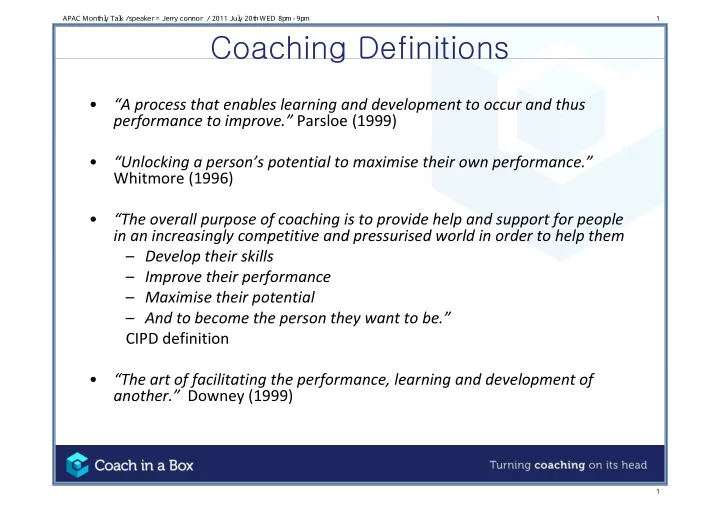
Coaching Definitions

  • “A process that enables learning and development to occur and thus

performance to improve.” Parsloe (1999)

  • “Unlocking a person’s potential to maximise their own performance.”

Whitmore (1996)

  • “The overall purpose of coaching is to provide help and support for people

in an increasingly competitive and pressurised world in order to help them Develop their skills – Develop their skills – Improve their performance – Maximise their potential d b h h b ” – And to become the person they want to be.” CIPD definition

  • “The art of facilitating the performance, learning and development of

another.” Downey (1999)

A P A C M

  • n

t h l y T a l k / s p e a k e r = J e r r y c

  • n

n

  • r

/ 2 1 1 J u l y 2 t h WE D 8 p m- 9 p m 1 1

slide-2
SLIDE 2

Telling

“When I was a little boy, my parents told me what to do, and scolded me if I didn’t. When I went to school, my teachers told me what to do and caned me if I didn’t When I joined the army the sergeant told me what to do me if I didn t. When I joined the army, the sergeant told me what to do, and God help me if I didn’t, so I did!! When I got my first job, my boss told me what to do too. So when I reached a position of some authority, what did I do? I told people what to do because that is what all my role models did I do? I told people what to do, because that is what all my role models had done. That is true for the majority of us. We have been brought up on telling – and we are very good at it .” Sir John Whitmore

A P A C M

  • n

t h l y T a l k / s p e a k e r = J e r r y c

  • n

n

  • r

/ 2 1 1 J u l y 2 t h WE D 8 p m- 9 p m 2 2

slide-3
SLIDE 3

Having a Big Impact

In our lives we often have the opportunity to have an impact on those around us. We get to have a small impact many times but, for most of us, we only have a really big impact on a few people. On these occasions we can really shape the way an individual sees their career, h b d h l h b d l their job and themselves. The impact is big and it is lasting. In order to have this kind of impact it is likely that we are operating at our very best. For some reason we have been able to touch someone and make a difference to their lives. If we can recapture this and apply a little of it to more situations we have the potential to radically improve our coaching. hi k f h h d bi i

  • Think of someone you have had a big impact on.
  • Think of a specific conversation, or situation, where your impact was particularly strong.
  • What was going on? What happened? What exactly did you do?
  • Which of the faces of coaching were you showing most strongly at this time?

Wh li i bl d d hi ? (T h l i h hi l k h bl b l )

‘Face’ Supporter Challenger Expert Counsellor

  • What quality in you enabled you to do this? (To help with this look at the table below.)

Typical Quality Caring/love Seeing the best in the other

  • person. Inspiring them to

take the step. Courage Seeing what can be different. Having confidence in what they see. Wisdom Having confidence in what they know and really wanting to share it. Respect Believing the other person’s capacity to learn from and solve their own problems.

A P A C M

  • n

t h l y T a l k / s p e a k e r = J e r r y c

  • n

n

  • r

/ 2 1 1 J u l y 2 t h WE D 8 p m- 9 p m 3 3

slide-4
SLIDE 4

4 Faces of Coaching

Supporter Challenger Expert Counsellor C C

Counsellor Challenger Helps the coachee to:

  • Look at the problem in a new light
  • Share feeling and concerns which block

progress Helps the coachee to:

  • See blind spots in their thinking and plans
  • Break the mould and look for new ways of doing

things progress

  • Change the attitudes or beliefs that hold them

back Quality R t things

  • Recognise how they might be the limiting factor

Quality

  • Courage
  • Respect

Expert Helps the coachee to: Supporter Helps the coachee to:

  • Receive clear guidance and instructions
  • Deepen their knowledge and understanding
  • Break a complex challenge down into

manageable chunks

  • Believe in themselves and what they are doing
  • Try something new and stretch their limits
  • Find ways to achieve their goals

Quality Quality

  • Wisdom

Quality

  • Care

A P A C M

  • n

t h l y T a l k / s p e a k e r = J e r r y c

  • n

n

  • r

/ 2 1 1 J u l y 2 t h WE D 8 p m- 9 p m 4 4

slide-5
SLIDE 5

Situational Coaching

Expert Supporter

Skill – skills and knowledge

Requires …..

Will willingness and confidence Will – willingness and confidence

Challenger Counsellor

Requires …..

A P A C M

  • n

t h l y T a l k / s p e a k e r = J e r r y c

  • n

n

  • r

/ 2 1 1 J u l y 2 t h WE D 8 p m- 9 p m 5 5

slide-6
SLIDE 6

The Four Faces

WILL

COUNSELLOR CHALLENGER

W SKILL

EXPERT SUPPORTER

PUSH PULL

Low

A P A C M

  • n

t h l y T a l k / s p e a k e r = J e r r y c

  • n

n

  • r

/ 2 1 1 J u l y 2 t h WE D 8 p m- 9 p m 6 6

slide-7
SLIDE 7

Expert Expert

A P A C M

  • n

t h l y T a l k / s p e a k e r = J e r r y c

  • n

n

  • r

/ 2 1 1 J u l y 2 t h WE D 8 p m- 9 p m 7 7

slide-8
SLIDE 8

Teaching (Expert)

Describing what you want vs. describing what you don’t want U d i ti l (t ll t i ) Use descriptive language (tell stories) Memorable & Simple e o ab e S p e

A P A C M

  • n

t h l y T a l k / s p e a k e r = J e r r y c

  • n

n

  • r

/ 2 1 1 J u l y 2 t h WE D 8 p m- 9 p m 8 8

slide-9
SLIDE 9

Supporter Supporter

A P A C M

  • n

t h l y T a l k / s p e a k e r = J e r r y c

  • n

n

  • r

/ 2 1 1 J u l y 2 t h WE D 8 p m- 9 p m 9 9

slide-10
SLIDE 10

Come to the Edge

“Come to the edge. We might fall. g f Come to the edge. It's too high! COME TO THE EDGE! COME TO THE EDGE! And they came, and he pushed, and they flew ” and they flew. Christopher Logue p g

A P A C M

  • n

t h l y T a l k / s p e a k e r = J e r r y c

  • n

n

  • r

/ 2 1 1 J u l y 2 t h WE D 8 p m- 9 p m 1 1

slide-11
SLIDE 11

Review

Plan Plan D D Dr aw Dr aw Conc lusions Conc lusions Do Do Re fle c t Re fle c t

A P A C M

  • n

t h l y T a l k / s p e a k e r = J e r r y c

  • n

n

  • r

/ 2 1 1 J u l y 2 t h WE D 8 p m- 9 p m 1 1 1 1

slide-12
SLIDE 12

GROW Model

1. Establish the Goal: Define and agree the goal or outcome to be achieved. 2. Examine the current Reality: Ask the coachee to describe the current situation Ask the coachee to describe the current situation. As the coachee tells you about his or her current reality, the solution may start to emerge. “Describe what is happening now” “What, who, when, how?” 3. Explore the Options: Help the coachee to generate as many good options as possible, and discuss these. “What else could you do?” “What if this or that constraint were What else could you do? What if this or that constraint were removed?” “What are the benefits and downsides of each option?” “What factors will you use to weigh up the

  • ptions?”

p Only offer your own suggestions once you have heard from the coachee. 4. Establish the Will: l h h f bl h h h ll d Help the coachee to commit to specific actions, establishing his or her will and motivation. “So what will you do now…and when?” “What could stop you moving forward?” “And how will you

  • vercome it?”

“How likely is this option to succeed?” “What else will you do?”

A P A C M

  • n

t h l y T a l k / s p e a k e r = J e r r y c

  • n

n

  • r

/ 2 1 1 J u l y 2 t h WE D 8 p m- 9 p m 1 2 1 2

slide-13
SLIDE 13

Challenger Challenger

A P A C M

  • n

t h l y T a l k / s p e a k e r = J e r r y c

  • n

n

  • r

/ 2 1 1 J u l y 2 t h WE D 8 p m- 9 p m 1 3 1 3

slide-14
SLIDE 14

Challenger

Key Questions What hidden potential do you see in the individual? What do you see in them that holds them back? h d h d h h h h l ? What do they do that prevents them achieving their goals?

A P A C M

  • n

t h l y T a l k / s p e a k e r = J e r r y c

  • n

n

  • r

/ 2 1 1 J u l y 2 t h WE D 8 p m- 9 p m 1 4 1 4

slide-15
SLIDE 15

Iceberg Model

Social Business Business Trust

A P A C M

  • n

t h l y T a l k / s p e a k e r = J e r r y c

  • n

n

  • r

/ 2 1 1 J u l y 2 t h WE D 8 p m- 9 p m 1 5 1 5

slide-16
SLIDE 16

Recreating Safety

S Shared Purpose – rebuild a sense of shared purpose A Apologise for ‘your part’ in losing safety A Apologise for your part in losing safety F

  • Feelings. Listen for feelings.

E

  • Explain. Reframe what you are trying to say

“I’m imagining you might be thinking g g y g g that..... What I am really trying to say is simply ” simply..

A P A C M

  • n

t h l y T a l k / s p e a k e r = J e r r y c

  • n

n

  • r

/ 2 1 1 J u l y 2 t h WE D 8 p m- 9 p m 1 6 1 6

slide-17
SLIDE 17

Counsellor Counsellor

A P A C M

  • n

t h l y T a l k / s p e a k e r = J e r r y c

  • n

n

  • r

/ 2 1 1 J u l y 2 t h WE D 8 p m- 9 p m 1 7 1 7

slide-18
SLIDE 18

Three Level Listening

Level Zero CLOSED MIND L l O OPEN MIND Level One OPEN MIND Level Two OPEN HEART Level Three OPEN WILL

18

A P A C M

  • n

t h l y T a l k / s p e a k e r = J e r r y c

  • n

n

  • r

/ 2 1 1 J u l y 2 t h WE D 8 p m- 9 p m 1 8 1 8

slide-19
SLIDE 19

Going in the Box

Behaviour Attitude F li Feelings Thoughts Experiences Education Beliefs Nature

A P A C M

  • n

t h l y T a l k / s p e a k e r = J e r r y c

  • n

n

  • r

/ 2 1 1 J u l y 2 t h WE D 8 p m- 9 p m 1 9 1 9