Click to edit Master title style Click to edit Master text styles - - PowerPoint PPT Presentation

click to edit master title style
SMART_READER_LITE
LIVE PREVIEW

Click to edit Master title style Click to edit Master text styles - - PowerPoint PPT Presentation

Click to edit Master title style Click to edit Master text styles Second level Third level Fourth level Replacing Blood and Performing Surgery Replacing Blood and Performing Surgery Fifth level with the NASG in Place with the NASG


slide-1
SLIDE 1

Click to edit Master title style

  • Click to edit Master text styles

– Second level

  • Third level

– Fourth level » Fifth level

1/24/2011 1
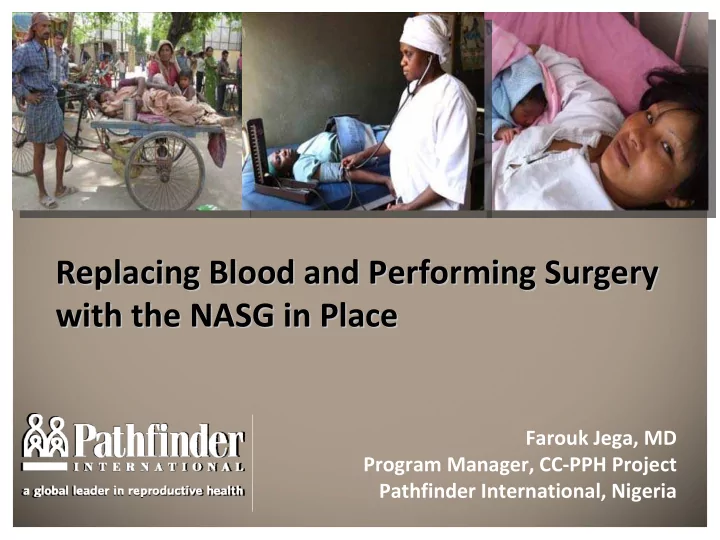
Replacing Blood and Performing Surgery Replacing Blood and Performing Surgery with the NASG in Place with the NASG in Place

Farouk Jega, MD Program Manager, CC‐PPH Project Pathfinder International, Nigeria

slide-2
SLIDE 2

Click to edit Master title style

  • Click to edit Master text styles

– Second level

  • Third level

– Fourth level » Fifth level

1/24/2011 2

Introduction Introduction

  • The Non‐Pneumatic Anti‐Shock Garment (NASG) is NOT

definitive treatment for PPH.

  • The NASG helps the clinician to stabilize the patient in shock,

while awaiting definitive treatment or transfer.

  • In most instances, further treatment (intravenous fluid

infusions, blood transfusion, uterotonics, surgery) is required.

slide-3
SLIDE 3

Click to edit Master title style

  • Click to edit Master text styles

– Second level

  • Third level

– Fourth level » Fifth level

1/24/2011 3

Blood Transfusion with the NASG Blood Transfusion with the NASG

  • Immediate priority is to expand blood

volume with crystalloids.

  • Appropriate IV infusions are also not

always available at public health facilities.

  • Blood transfusion a must in severe PPH; most women die

from delay/not receiving blood transfusion at all following PPH.

  • Unfortunately, availability of safe blood for transfusion still an

issue in most intervention health facilities.

slide-4
SLIDE 4

Click to edit Master title style

  • Click to edit Master text styles

– Second level

  • Third level

– Fourth level » Fifth level

1/24/2011 4

Uterotonics for Treatment of Atonic PPH Uterotonics for Treatment of Atonic PPH

  • Oxytocin, ergometrine, misoprostol
  • All relatively cheap
  • Not always available
  • Issues with storage (temperature, light), resulting in instability
  • Some resistance with use of misoprostol as an abortifacient

drug

  • Procurement logistics also an issue
slide-5
SLIDE 5

Click to edit Master title style

  • Click to edit Master text styles

– Second level

  • Third level

– Fourth level » Fifth level

1/24/2011 5

Blood and Blood Products in PPH Blood and Blood Products in PPH

  • Essential for the management of PPH.
  • Unfortunately not always available even in

so‐called Comprehensive Essential Obstetric Care (CEOC) facilities.

  • The National Blood Transfusion Service takes the lead in securing

safe blood in public health facilities in the country; grossly under‐ funded.

  • Problems with power supply for storage, apathy of potential blood

donors, and screening.

  • Most blood banks operate a replacement policy; source usually

paid donors and patients’ relatives.

slide-6
SLIDE 6

Click to edit Master title style

  • Click to edit Master text styles

– Second level

  • Third level

– Fourth level » Fifth level

1/24/2011 6

Our Solution: Our Solution: Solar Blood Banks and Solar Blood Banks and ‘ ‘Emergency Blood Emergency Blood’ ’

  • 5‐10 pints of blood secured and saved for obstetric

emergencies (collaboration between maternity unit and blood bank)

  • Challenges still with replenishing used up blood
  • Solar blood bank set up with Cloverleaf funding
  • Community being mobilized to donate blood voluntarily as

part of community component of the project

slide-7
SLIDE 7

Click to edit Master title style

  • Click to edit Master text styles

– Second level

  • Third level

– Fourth level » Fifth level

1/24/2011 7

Surgery with the NASG Surgery with the NASG

  • Different types of surgery possible with the NASG:

– Vaginal route

  • Manual removal of placenta
  • Evacuation of retained products of conception
  • Repair of lacerations

– Abdominal

  • Caesarean section
  • Laparotomy
  • Uterine devascularization procedures
  • Hysterectomy
slide-8
SLIDE 8

Click to edit Master title style

  • Click to edit Master text styles

– Second level

  • Third level

– Fourth level » Fifth level

1/24/2011 8

Uterine Compression Sutures Uterine Compression Sutures

  • Conservative surgical intervention for atonic PPH
  • Easier than emergency hysterectomy and devascularization

procedures

  • Different types described: Hayman; Cho multiple square

sutures; B‐Lynch sutures

  • Same principle: the suture aims to exert continuous vertical

compression on the uterine vascular system

slide-9
SLIDE 9

Click to edit Master title style

  • Click to edit Master text styles

– Second level

  • Third level

– Fourth level » Fifth level

1/24/2011 9

B B‐ ‐Lynch Sutures Lynch Sutures

  • Also called brace sutures
  • First applied for a patient with massive hemorrhage who

refused consent for hysterectomy (November 1989)

  • Slight modification of the other compression sutures with

many advantages

slide-10
SLIDE 10

Click to edit Master title style

  • Click to edit Master text styles

– Second level

  • Third level

– Fourth level » Fifth level

1/24/2011 10

Anterior and Posterior Suture Placement Anterior and Posterior Suture Placement

slide-11
SLIDE 11

Click to edit Master title style

  • Click to edit Master text styles

– Second level

  • Third level

– Fourth level » Fifth level

1/24/2011 11

Anterior and Posterior Suture Placement Anterior and Posterior Suture Placement

Repeat the same procedure posteriorly as before with assistant maintaining compression

More details including video available at www.glowm.com

slide-12
SLIDE 12

Click to edit Master title style

  • Click to edit Master text styles

– Second level

  • Third level

– Fourth level » Fifth level

1/24/2011 12

Postoperative Follow Postoperative Follow‐ ‐up up

  • No major complications nor mortality reported
  • MRI showed no intraperitoneal
  • r intrauterine sequelae
  • Most have had successful future pregnancies and deliveries
slide-13
SLIDE 13

Click to edit Master title style

  • Click to edit Master text styles

– Second level

  • Third level

– Fourth level » Fifth level

1/24/2011 13

B B‐ ‐Lynch Suture: Clinical Points Lynch Suture: Clinical Points

  • Basic surgical competence required
  • Bimanual compression first to test potential efficacy
  • Simple and cost‐effective
  • Future fertility preserved
  • Potential for prophylactic application at Caesarean section
  • Relatively new procedure so not all providers comfortable

with technique

  • Hard to get the opportunity to train surgeons
slide-14
SLIDE 14

Click to edit Master title style

  • Click to edit Master text styles

– Second level

  • Third level

– Fourth level » Fifth level

1/24/2011 14

Conclusion Conclusion

  • The B‐Lynch procedure has been recommended by the 2000‐

2002 Triennial Confidential Enquiry into Maternal Deaths and the RCOG in the UK and the Cochrane Database of Systematic Reviews.

  • To date, no serious complications have been reported.
  • Procedure is simple, safe and effective in arresting

hemorrhage due to uterine atony.

  • Particularly useful in our setting where women want to keep

their uteri to maintain fertility and menstruation for religious and cultural reasons.

slide-15
SLIDE 15

Click to edit Master title style

  • Click to edit Master text styles

– Second level

  • Third level

– Fourth level » Fifth level

1/24/2011 15

Conclusion, cont Conclusion, cont’ ’d d

  • The NASG is not the definitive treatment for the NASG. We

have found that blood replacement and performing surgery are the most difficult elements of the Clinical and Community Action Model to put in place.