Objectives Attitudes and Perceptions of Family Planning Among - - PDF document

objectives
SMART_READER_LITE
LIVE PREVIEW

Objectives Attitudes and Perceptions of Family Planning Among - - PDF document

Objectives Attitudes and Perceptions of Family Planning Among Patients and Skilled To determine the most common barriers for termination of pregnancy (TOP) Medical Providers at Axim To examine the attitudes and perceptions of health care


slide-1
SLIDE 1

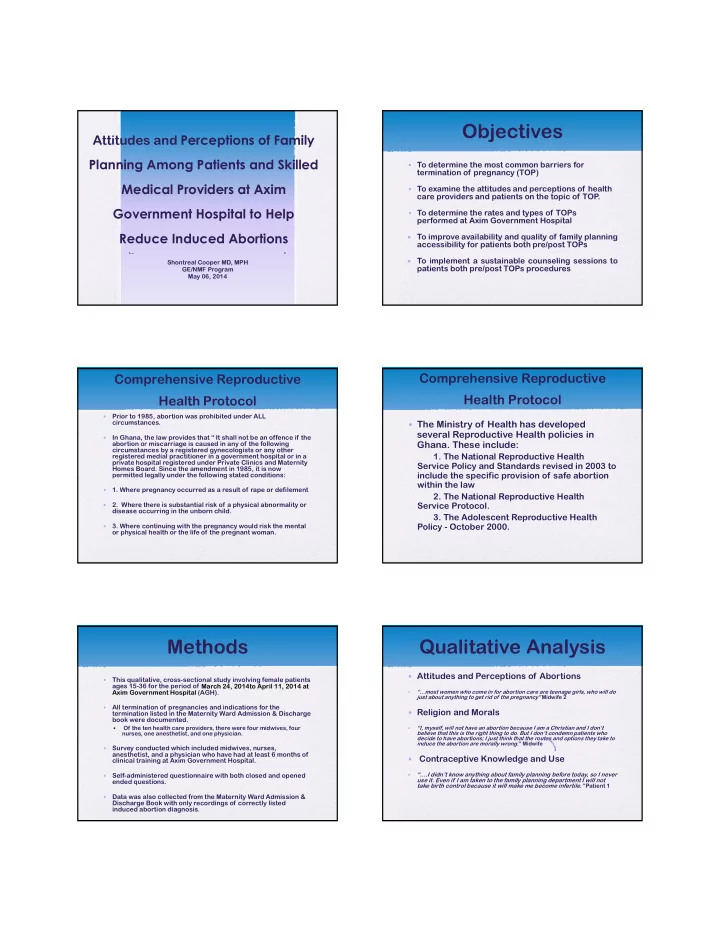
Attitudes and Perceptions of Family Planning Among Patients and Skilled Medical Providers at Axim Government Hospital to Help Reduce Induced Abortions

Shontreal Cooper MD, MPH GE/NMF Program May 06, 2014

Objectives

  • To determine the most common barriers for

termination of pregnancy (TOP)

  • To examine the attitudes and perceptions of health

care providers and patients on the topic of TOP .

  • To determine the rates and types of TOPs

performed at Axim Government Hospital  To improve availability and quality of family planning accessibility for patients both pre/post TOPs  To implement a sustainable counseling sessions to patients both pre/post TOPs procedures

Comprehensive Reproductive Health Protocol

  • Prior to 1985, abortion was prohibited under ALL

circumstances.

  • In Ghana, the law provides that “ It shall not be an offence if the

abortion or miscarriage is caused in any of the following circumstances by a registered gynecologists or any other registered medial practitioner in a government hospital or in a private hospital registered under Private Clinics and Maternity Homes Board. Since the amendment in 1985, it is now permitted legally under the following stated conditions:

  • 1. Where pregnancy occurred as a result of rape or defilement
  • 2. Where there is substantial risk of a physical abnormality or

disease occurring in the unborn child.

  • 3. Where continuing with the pregnancy would risk the mental
  • r physical health or the life of the pregnant woman.

Comprehensive Reproductive Health Protocol

  • The Ministry of Health has developed

several Reproductive Health policies in

  • Ghana. These include:
  • 1. The National Reproductive Health

Service Policy and Standards revised in 2003 to include the specific provision of safe abortion within the law

  • 2. The National Reproductive Health

Service Protocol.

  • 3. The Adolescent Reproductive Health

Policy - October 2000.

Methods

  • This qualitative, cross-sectional study involving female patients

ages 15-36 for the period of March 24, 2014to April 11, 2014 at Axim Government Hospital (AGH).

  • All termination of pregnancies and indications for the

termination listed in the Maternity Ward Admission & Discharge book were documented.

  • Of the ten health care providers, there were four midwives, four

nurses, one anesthetist, and one physician.

  • Survey conducted which included midwives, nurses,

anesthetist, and a physician who have had at least 6 months of clinical training at Axim Government Hospital.

  • Self-administered questionnaire with both closed and opened

ended questions.

  • Data was also collected from the Maternity Ward Admission &

Discharge Book with only recordings of correctly listed induced abortion diagnosis.

Qualitative Analysis

  • Attitudes and Perceptions of Abortions
  • “…most women who come in for abortion care are teenage girls, who will do

just about anything to get rid of the pregnancy” Midwife 2

  • Religion and Morals
  • “I, myself, will not have an abortion because I am a Christian and I don’t

believe that this is the right thing to do. But I don’t condemn patients who decide to have abortions; I just think that the routes and options they take to induce the abortion are morally wrong.” Midwife

  • Contraceptive Knowledge and Use
  • “….I didn’t know anything about family planning before today, so I never

use it. Even if I am taken to the family planning department I will not take birth control because it will make me become infertile.” Patient 1

slide-2
SLIDE 2

Qualitative Analysis

Variable # % Estimated age (years) ≤20 4 40 21-25 2 20 26-30 1 10 31-35 1 10 ≥35 2 20 Marital Status Single 6 60 Married 4 40 Widowed Education No Education Primary School 2 20 Junior Secondary School 4 40 Senior Secondary School 4 40 Work Unemployed 2 20 Trading 7 70 Teacher 1 10 Nursing

Table 1: Demographics of patients that were interviewed and surveyed

Qualitative Analysis

Attitudes of Health Care Providers on TOP at Axim Government Hospital Responses Opinion Ye s No Do you understand the definition of TOP? 6 4 Do you pre-counsel patients before TOP? 5 5 Do you post-counsel patients after TOP? 3 7 Are you comfortable with elective TOP? 2 8

Table 2: Displays the attitudes of health care providers that were interviewed and surveyed

Results

6 6 1 6 11 1 3 12 1 6 14 1 8 4 5 12 1 5 6

T hre a te n I nc o mple te Misse d T hre a te n I nc o mple te Misse d T hre a te n I nc o mple te Misse d T hre a te n I nc o mple te T hre a te n I nc o mple te Misse d T hre a te n I nc o mple te Misse d T hre a te n I nc o mple te Misse d Se pte mb e r Oc to b e r No ve mb e rDe c e mb e r Ja nua ry F e b rua ry Ma rc h

Total # of Termination Diagnosed/Month

T

  • ta l

Results

5 10 15 20 25 Se lf-I nduc e d Cyto te c E ne ma Ma la ria Unkno wn

Causes of Incomplete Termination Stratified By Age

>30 26-30 21-25 15-20

Results

5 10 15 20 25 30 35 40 15-20 21-25 26-30 >30

Types of Terminations Stratified by Age

I nc o mple te Misse d T hre a te n

Results

26% 32% 23% 19%

Risk Factors for Abortions: Patients' Response

L a c k o f K no wle dg e No Fa mily Pla nning Ava ila b le No Co unse ling Unwa nte d Pre g na nc y 0.5 1 1.5 2 2.5 3 3.5 4

Risk Factors for Abortions: Providers Response

Mid wife Re spo nse Re pro duc tive He a lth

slide-3
SLIDE 3

Findings

  • There is a festival that occurs in September which

correlates with low rates of abortions for this month.

  • Most health care providers believe that emergency TOPs

were needed however, many of them personally did not feel comfortable doing elective TOPs if they were

  • ffered.
  • Nurses were also observed spending little time

counseling patients prior to any TOP procedure, which have been a result of shortage of skilled staff and the multitasking of most midwives.

  • Majority of the health care providers also indicated

commitment and readiness to provide counseling services for women both pre/post TOPs.

Recommendations

  • Provide condoms and education material

during the festival in September as prevention of unwanted pregnancy.

  • Offer contraceptive options to all patients

admitted for TOPs regardless of age.

  • Provide counseling to all patients by both

midwives and a reproductive health care provider both pre/post abortion.

  • Provide family planning sessions to all

women coming to Antenatal Clinic.

Acknowledgements

  • I would first like to thank Dr. George Hagan for allowing me to

conduct research at Axim Government Hospital. I want to thank all the nurses, midwives, and reproductive health care team for allowing me to interview them, implement interventions to improve their services, aiding me in collecting data, and translating questions to the patients. I want to also thank Dr. Ebenezer Amekah for providing the clinical guidance and supervision at St. Luke’s Hospital. I am forever grateful. I would also like to thank GE/NMF for allowing me the opportunity to engage and learn about a different culture, while also learning different techniques and research analysis about patients at Axim Government Hospital. I am eternally grateful. Also, I’d like to thank Dr. Oduroboatey for his mentorship Lastly I’d like to thank Dr. Buckle, Kenneth, and the rest of the staff at Integrated Health Solutions for helping to make this such a memorable experience.

Questions?