Click to edit Master title style Felix G. Castrodad nMotion Transit - - PowerPoint PPT Presentation

click to edit master title style
SMART_READER_LITE
LIVE PREVIEW

Click to edit Master title style Felix G. Castrodad nMotion Transit - - PowerPoint PPT Presentation

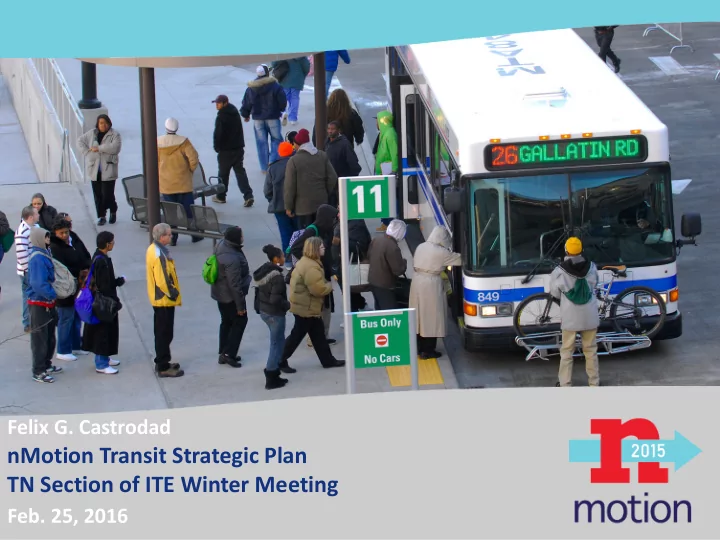
Click to edit Master title style Felix G. Castrodad nMotion Transit Strategic Plan TN Section of ITE Winter Meeting Feb. 25, 2016 1 Click to edit Master title style Nashville MTA MTA operates 46 bus routes and AccessRide paratransit


slide-1
SLIDE 1

Click to edit Master title style

1

Felix G. Castrodad

nMotion Transit Strategic Plan TN Section of ITE Winter Meeting

  • Feb. 25, 2016
slide-2
SLIDE 2

Click to edit Master title style

2

Nashville MTA

2

  • MTA operates 46 bus

routes and AccessRide paratransit service

– More than 7.7 million miles driven annually – Approximately 10 million annual trips – Average weekday ridership = 33,000

  • 166 fixed route buses and

100 Access Ride buses.

slide-3
SLIDE 3

Click to edit Master title style

3

RTA of Middle Tennessee

3

  • Responsible for inter-county services
  • Funded through member city

and county dues, state and federal funds

– Includes 9 counties in Middle Tennessee

  • Provides 10 regional

commuter express routes, Music City Star Commuter Rail, Vanpool and Rideshare services

  • Approx. 600,000 annual trips
slide-4
SLIDE 4

Click to edit Master title style

4

Projected Regional Growth

4

slide-5
SLIDE 5

Click to edit Master title style

5

Traffic Congestion, Energy Costs, & Environmental Concerns

Why Mass Transit?

slide-6
SLIDE 6

Click to edit Master title style

6

Current and Projected Congestion

6

Source: Nashville Area MPO 2040 RTP

slide-7
SLIDE 7

Click to edit Master title style

7

Why Mass Transit?

7

Evolving Markets & Changing Demographics

slide-8
SLIDE 8

Click to edit Master title style

8

Economic Competitiveness & Continued Prosperity Why Mass Transit?

8

slide-9
SLIDE 9

Click to edit Master title style

9

nMotion

9

  • Goal: To develop a great regional

transit system

  • Develop a system to meet the region’s

growing needs for transit

  • More directly respond to increasing

demand

  • All options considered
  • Short, medium and long-term options
  • Goal: 10,000 interactions
  • Extensive civic engagement
  • Over 9,000 comments received

#nMotion2016 nMotion2016.org

slide-10
SLIDE 10

Click to edit Master title style

10

Building on Prior Work: MPO Regional Vision

10

slide-11
SLIDE 11

Click to edit Master title style

11

Building on Previous Work: NashvilleNext

11

slide-12
SLIDE 12

Click to edit Master title style

12

Market-Based Approach

12

slide-13
SLIDE 13

Click to edit Master title style

13

nMotion

13

Jan – Jun Jul – Nov Nov – Jan Jan – May Mid-2016

slide-14
SLIDE 14

Click to edit Master title style

14

What the Public is saying…

14

slide-15
SLIDE 15

Click to edit Master title style

15

What the Public is saying…

15

  • Convenience

– Simplicity – Span – Frequency – Speed – Directness (“Straight Lines”)

  • Dependability

– On-Time Performance – Predictability

  • Safety

– Access to/from Transit – Perception of Personal Security at Stop

slide-16
SLIDE 16

Click to edit Master title style

16

The Mobility Backdrop: Safety and Access

16

slide-17
SLIDE 17

Click to edit Master title style

17

Potential Improvements…

17

slide-18
SLIDE 18

Click to edit Master title style

18

“Building Block” Approach

Start with improvements that can be implemented quickly, then add more difficult/longer-term improvements over time:

  • 1. Make Service Easier to Use
  • 2. Improve Existing Services
  • 3. Improve Access to Transit
  • 4. Provide More Comfortable Service
  • 5. Develop a Frequent Transit Network
  • 6. Expand Service to New Areas
  • 7. Develop High Capacity Transit Services

18

slide-19
SLIDE 19

Click to edit Master title style

19

nMotion Scenarios

19

  • 1. Comprehensive Regional System
  • 2. Bus-Focused Expansion
  • 3. Modest Improvements
slide-20
SLIDE 20

Click to edit Master title style

20

nMotion Scenarios

  • 1. Comprehensive Regional System
  • 2. Bus-Focused Expansion
  • 3. Modest Improvements

20

slide-21
SLIDE 21

Click to edit Master title style

21

Underlying Issues: Short Term Enhancements

21

  • Simplified fare structure/payment and

enhanced use of technology

  • Unified branding for the region
  • Longer hours on key routes
  • More frequent service on key routes
  • Integrated travel options between transit and

alternative services

  • More and better bus shelters/park & ride lots
slide-22
SLIDE 22

Click to edit Master title style

22

Key to all Scenarios: Downtown Priority Circulation

22

slide-23
SLIDE 23

Click to edit Master title style

23

Assumptions

  • All scenarios based on:

– NashvilleNext’s preferred future – MPO regional growth projections

  • Downtown Nashville remains

region’s major focal point

  • Denser and more mixed use

development along major corridors in Davidson County

  • Much better pedestrian

conditions along major

corridors in Davidson County

23

slide-24
SLIDE 24

Click to edit Master title style

24

Assumptions

  • Largest growth in outer

counties

  • Traffic congestion will worsen

significantly

  • Downtown parking costs will

continue to increase

  • Major transit lines would

receive priority over other traffic

  • Workforce housing

development will be aligned with transit investments

24

slide-25
SLIDE 25

Click to edit Master title style

25

Similarities Among All Scenarios

  • Simpler, faster, more hours and more frequent
  • Unified branding
  • Streamlined service downtown
  • Network of local services to complement high level services
  • A smarter system through technology
  • Better facilities and amenities
  • New fare payment options
  • Improvements to pedestrian connections
  • Better “first mile/last mile” connections
  • Expand utilization of public/private partnerships
  • Continue to expand and enhance AccessRide service

25

slide-26
SLIDE 26

Click to edit Master title style

26

Scenario 1: Comprehensive Regional System

  • 1. Comprehensive Regional System

– Includes Light Rail, Commuter Rail, Bus Rapid Transit (BRT), Rapid Bus, Streetcar, Freeway BRT, Express Bus on Shoulder, and local bus – Major improvements in service spans and frequencies (including weekend service) – Major increases in ridership – Greater transit mode share – Transit becomes the best choice for many trips – “Car-free” lifestyle possible in some locations

26

slide-27
SLIDE 27

Click to edit Master title style

27

Scenario 1: Comprehensive Regional System

  • 1. Comprehensive Regional System

(Continued)

– Attract transit oriented development – Transit as an integral element of Middle Tennessee’s transportation system – Long build out – Requires new dedicated funding sources

27

slide-28
SLIDE 28

Click to edit Master title style

28

Scenario 2: Bus-Focused Expansion

  • 2. Bus-Focused Expansion

– Major focus on bus improvements – Includes Bus Rapid Transit (BRT), Rapid Bus, Freeway BRT, Express Bus on Shoulder, and local bus – Rail investment limited to Music City Star – Major improvements in service spans and frequencies, but less than in Scenario 1

28

slide-29
SLIDE 29

Click to edit Master title style

29

Scenario 2: Bus-Focused Expansion

  • 2. Bus-Focused Expansion (Continued)

– Meaningful transit mode shift, but less than Scenario 1 – Limited transit oriented development

  • pportunities

– Requires new funding sources, but at lower levels than Scenario 1 – Shorter build-out time than Scenario 1

29

slide-30
SLIDE 30

Click to edit Master title style

30

Scenario 3: Modest Improvements

  • 3. Modest Improvements

– Focus on most affordable building blocks – Includes Rapid Bus, Express Bus on Shoulder, and local bus – Rail investment limited to Music City Star – Incremental improvements in service and ridership in proportion to population growth – Longer hours and more frequent service, but less than in Scenarios 1 and 2 – Improve experience for existing customers

– Transit remains a niche mode

30

slide-31
SLIDE 31

Click to edit Master title style

31

Scenario 3: Modest Improvements

  • 3. Modest Improvements (Continued)

– Invest in areas where service currently exists – Does not address current concerns related to congestion and inadequate transportation infrastructure – (…same improvements would be made as initial steps of Scenarios 1 and 2)

31

slide-32
SLIDE 32

Click to edit Master title style

32

Potential Improvements: Better Bus

32

Raleigh, NC Minneapolis, MN Signal Priority Freeway Bus Rapid Transit Queue Jumps

slide-33
SLIDE 33

Click to edit Master title style

33

Potential Improvements: Better Bus

33

Minneapolis, MN Denver, CO San Francisco, CA Kansas City, MO Minneapolis, MN Transit Priority Corridor

slide-34
SLIDE 34

Click to edit Master title style

34

Music City Star Austin, TX Tucson, AZ Portland, OR CSX Network

Potential Improvements: Rail

slide-35
SLIDE 35

Click to edit Master title style

35

Scenario 4?

35

slide-36
SLIDE 36

Click to edit Master title style

36

Key and Controversial Issues Moving Forward

36

  • Allocation of Scarce Real Estate

– Transit Priority and Dedicated Right of Way – Downtown Nashville Circulation/Transit Priority – Interstate and State Right of Way Corridors

  • Nashville and Regional Projects
  • Equity Considerations
  • Complementary Public Policy

– Land Use and Development (Density, Mixed Use) – Pedestrian Access – Workforce Housing and Public Facilities

  • Money: How Much, Who Pays and How?
  • Sequencing of Improvements
slide-37
SLIDE 37

Click to edit Master title style

37

Community Input Plan

37

nMotion2016.org / #nMotion2016

  • Web-based Survey Tool & complementary

Printed Survey Tool

  • 8 Public Meetings in Davidson County
  • 9 Public Regional Meetings
  • Transit Talks
  • Rider Outreach
  • Community Partners
  • Community Events
  • Elected Official Briefings
  • Davidson County & Regional Delegation
  • Metro Council
  • One-on-one Meetings
  • Focus Groups
  • nMotion2016.org Discussion Forum
  • Email campaign, Facebook, Twitter,

Nextdoor

slide-38
SLIDE 38

Click to edit Master title style

38 38

nMotion2016.org / #nMotion2016

MetroQuest

slide-39
SLIDE 39

Click to edit Master title style

39

Key Considerations

39

Mass Transit is not “the solution,” but it is an important tool and any rapidly growing city that ignores it will severely limit the mobility choices of its residents.

nMotion2016.org

slide-40
SLIDE 40

Click to edit Master title style

40 40

slide-41
SLIDE 41

Click to edit Master title style

41

Family of Services Across Scenarios

41

Scenario 1 Scenario 2 Scenario 3 Light Rail √ Streetcar √ Commuter Rail Star + NW Star Star Bus Rapid Transit (BRT) √ √ Freeway BRT √ √ Rapid Bus (akin to BRT-Lite) √ √ √ Freeway “Bus on Shoulder” √ √ √ Regional Rapid Bus √ √ √ Commuter/Express √ √ √ Frequent All Day or Peak √ √ √ Local 30 Peak or All Day √ √ √ Circulator √ √ √ Lifeline & Access-Ride Improvements √ √ √

slide-42
SLIDE 42

Click to edit Master title style

42

Order of Magnitude Costs ($2015)

42

  • All scenarios would require significantly higher

expenditures

  • Scenario 3 expenditures would increase in line with

population increases

  • Scenarios 1 and 2 would represent a greater

emphasis on transit

Costs in millions Scenario 1 Comprehensive Regional System Scenario 2 Major Imps in Key Corridors Scenario 3 Improve Existing System Existing System (FY 2016) Total Regional System (MTA & RTA) Annual Operating Costs $311.5 $206.5 $129.4 $83.2 Total Capital Costs through 2040 $5,400 $2,400 $800 NA Per Capita Costs; Total System (MTA & RTA, Operating and Annualized Capital Costs) MTA & RTA $227 $109 $68 $67