Class Voice: Review of Chapter 10 Voice Quality and Resonance Tenor - - PowerPoint PPT Presentation

class voice review of chapter 10
SMART_READER_LITE
LIVE PREVIEW

Class Voice: Review of Chapter 10 Voice Quality and Resonance Tenor - - PowerPoint PPT Presentation

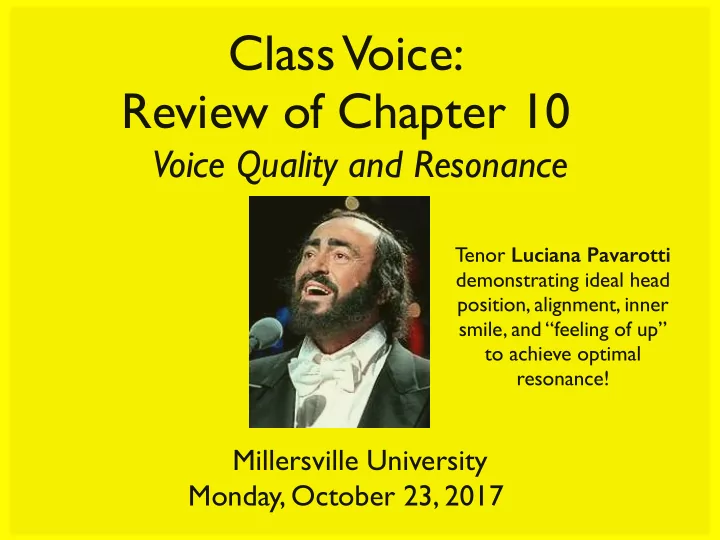
Class Voice: Review of Chapter 10 Voice Quality and Resonance Tenor Luciana Pavarotti demonstrating ideal head position, alignment, inner smile, and feeling of up to achieve optimal resonance! Millersville University Monday, October


slide-1
SLIDE 1

Class Voice: Review of Chapter 10

Monday, October 23, 2017

Voice Quality and Resonance

Millersville University

Tenor Luciana Pavarotti demonstrating ideal head position, alignment, inner smile, and “feeling of up” to achieve optimal resonance!

slide-2
SLIDE 2
  • Sound is initiated in the larynx; quality

depends upon the shape of the pharynx, which is highly flexible and capable of forming many different shapes.

  • Each variation will cause your voice to

produce a different voice quality (or tone color (timbre)).

#1 : The Pharynx

slide-3
SLIDE 3

#2 Pharynx Purpose

  • Pharynx serves a dual purpose: as an

air and food passageway. For breathing, it is relaxed and spacious; for swallowing it closes around the food and squeezes it down into the esophagus.

slide-4
SLIDE 4

#3 Swallowing

  • When you swallow, the whole pharynx is

pulled up and narrowed to squeeze food down, which brings the larynx up with it.

  • Whole throat is short and narrow – not a

good space for singing. When pharynx muscles relax, the space is wide and long –

  • ptimum for the most resonant and freely

produced sound. In reality, people sing in many gradations between the open and closed throat.

slide-5
SLIDE 5

#4 Pharynx map

  • The pharynx is a muscular sleeve-like

structure that hangs from the base of the skull and attaches itself to various bone and cartilages along the way. It

  • pens into the nose, the mouth, and

the larynx, and then becomes completely circular and continues as the esophagus.

slide-6
SLIDE 6

#5 Pharynx (3 parts)

  • Anatomists and acousticians usually divide

the pharynx into three main sections: the nasal pharynx, the oral pharynx, and the laryngeal pharynx (see Fig. 10.1). Know the location of these areas and be able to identify them on a diagram. These three areas are continuous but are usually described separately to help explain the structures better.

slide-7
SLIDE 7

Divisions of the Pharynx (from our textbook)

slide-8
SLIDE 8

Nasal Pharynx Oral Pharynx Laryngeal Pharynx

[from the side]

slide-9
SLIDE 9

#6 Nasal Pharynx

  • Nasal pharynx is located between the base
  • f the skull and soft palate. The soft palate

(the soft part located at the end of your hard palate) can move up and close off the nose as in making non-nasal sounds or swallowing, and it can be lowered for nasal sounds or breathing.

slide-10
SLIDE 10

#7 Oral Pharynx

  • The oral pharynx begins at the level of the

soft palate and continues to the level of the middle of the epiglottis near the back of the tongue. This area is most flexible and subject to many different shapes. Because the soft palate can move up and down and your tongue and larynx can move as well, the oral pharynx can get taller, wider, narrower, short, etc. This is the place where most of your resonance occurs.

slide-11
SLIDE 11

#8 Laryngeal Pharynx

  • The laryngeal pharynx is the area

from the middle of the epiglottis to the lower border of the cricoid

  • cartilage. It is the area credited with

contributing to the acoustic part of the voice responsible for its carrying power, often referred to as the “ring”

  • f the voice.
slide-12
SLIDE 12

#9 Bones and Cartilages

  • Bones and Cartilages to Which the Muscles of

the Pharynx Attach. In Fig. 10.2, you should know and be able to identify the following:

  • a. Outline of hard palate
  • b. Styloid process
  • c. Styloid-hyoid ligament
  • d. Hyoid bone
  • e. Thyroid cartilage
  • f. Cricoid cartilage
slide-13
SLIDE 13
slide-14
SLIDE 14

#10 Constrictors!

  • Important muscles that form the pharynx. To

swallow something the muscles need to contract and narrow the back of the throat in order to squeeze the food down. The larynx comes up under the tongue as part of the same action. What muscles are contracting to cause these actions to happen? Constrictors! When they contract, they exert a pull on the least stable area – in this case, the back of the throat – and cause a narrowing of the throat. Release or relax these muscles to have a wide, long pharynx.

slide-15
SLIDE 15

Swallowing Muscles (Constrictors)

slide-16
SLIDE 16

#11 Soft Palate

  • Not considered part of the pharynx, but through

shared muscles the two are linked intricately. Soft palate is very flexible and capable of moving up and

  • down. Closes off the back of the nose to prevent food

from entering the nasal passages. In efficient vocal production, the palate does the same thing to prevent air from going into the nose and causing an unwanted nasal resonance. Raising of the soft palate also creates more resonance space in the throat. Palate will be lowered during intentional use of nasal consonants or

  • sounds. [Note the tip offered in the book for

determining nasality in sound.]

slide-17
SLIDE 17

#12 Muscles of the Soft Palate

  • Muscles of the soft palate. Four main muscles

form the soft palate: two that are above it and two below it. There is a pair of muscles that lifts the palate (levator palate) and a pair that widens it (tensor palate). See Fig. 10.4. On each side of your tongue is a fold that forms an arch with the uvula hanging down in the

  • middle. That fold is the palatoglossus muscle.
slide-18
SLIDE 18

#13 Tongue and Palate

  • The tongue and the palatal relationship is a

particularly important one. When a singer has the habit of tensing the tongue or pulling it town in the back to make sound, the soft palate can be prevented from going up because the palatoglossus is acting as an antagonist to the levator palate. The sound that results is a bit garbled and not too pleasant.

slide-19
SLIDE 19

#14 Pharynx and Larynx

  • Relationship between Pharynx and Larynx.

Notice illustration that shows relationship between skull, jaw, hyoid bone, and larynx. When these structures are in alignment, the muscles of the pharynx and the position of the larynx is freely suspended in the neck. They are in position to respond easily to what is asked of them. When the head or jaw pushes forward, this alignment is distorted and the pharynx and larynx are put at a disadvantage.

slide-20
SLIDE 20

#15 Acoustic Deception

  • How you think you sound and how you

actually sound can be very different. Reason: you have so much feedback inside of your head. Your bones act as conductors of

  • vibrations. Larynx buzzes, and sound bouncing

around your throat can be noisy and deceptive. Your audience does not hear all of this! This is why “outside feedback” (voice teacher, friends, video, etc.) is so important.

slide-21
SLIDE 21

#16 Even Tone [Consistent Sound]

  • Many singers, especially classical ones (bel

canto), aspire to create beautiful, even sounds throughout their ranges: creating a consistent sound from top to bottom!! Trying to do this by exerting excessive control over everything in the throat and mouth results in an even sound inside the head and an uneven or tight

  • ne to the listener. With freedom and pure

vowels your voice will be consistent throughout.

slide-22
SLIDE 22

#17 Expression and Timbre

  • Your expression and vocal color (timbre)

will respond to your understanding of the text and to your imagination and energy. Focusing on and deeply understanding your message will go a long way toward crating the vocal effects you want—whether they are dark, bright, light, or heavy. You can sing any song in a variety of characters—old, young, kind, queen, witch, or any other you desire.

slide-23
SLIDE 23

#18 Primary Resonator

  • A resonator needs to be hollow and

have an opening for the sound to

  • escape. In singing, your throat acts as

the primary resonator with help from the nose (nasal sounds) and mouth.

slide-24
SLIDE 24

#19 Primary Pharynx Problem: Tension

  • Tension is the main problem associated

with the pharynx. Tension will narrow the space of the throat and cause the larynx to rise under the tongue. Misalignment of the head and shoulders is another major contributor to poor tone quality and to potential vocal damage.

slide-25
SLIDE 25

#20 Take Care of Your Speaking Voice!!

  • You speaking voice needs the same

careful attention that you give to your

  • singing. Using good speaking habits

may feel artificial to you at first, but keep working at it!

slide-26
SLIDE 26

#1 Major muscle of Inspiration (Inhalation)

slide-27
SLIDE 27

#4 #2 #3 #3 Major muscles of Expiration (Exhalation)

slide-28
SLIDE 28

#20 #22 #23 #25 #21 #24

These cartilages are inside the Larynx

slide-29
SLIDE 29

Anatomy of the Larynx