City of Burlington Official Plan Review: Indian Point Character Area - - PowerPoint PPT Presentation

city of burlington
SMART_READER_LITE
LIVE PREVIEW

City of Burlington Official Plan Review: Indian Point Character Area - - PowerPoint PPT Presentation

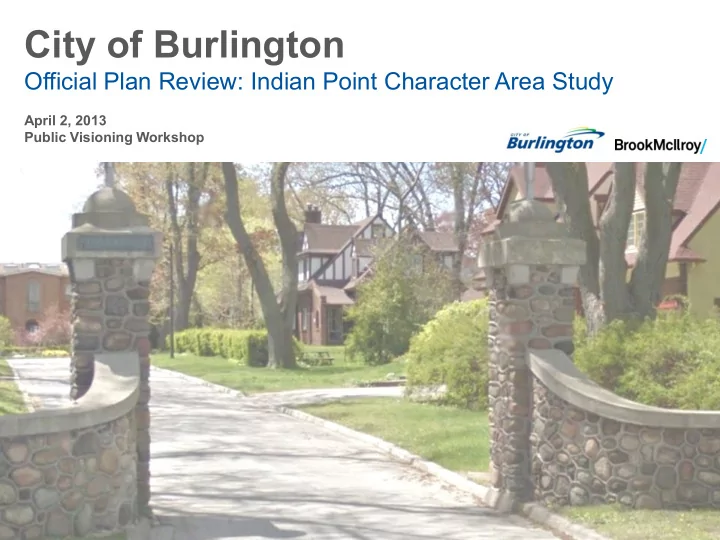
City of Burlington Official Plan Review: Indian Point Character Area Study April 2, 2013 Public Visioning Workshop Tonights Schedule 6:30 6:35 Citys Introduction 6:35 7:05 Consultant Presentation 7:05 8:15 Workshop Exercise

slide-1
SLIDE 1

City of Burlington

Official Plan Review: Indian Point Character Area Study

April 2, 2013 Public Visioning Workshop

slide-2
SLIDE 2

Tonight’s Schedule

6:30 – 6:35 City’s Introduction 6:35 – 7:05 Consultant Presentation 7:05 – 8:15 Workshop Exercise and Reporting Back 8:15 – 8:30 Wrap-up and Next Steps

slide-3
SLIDE 3

1. The Project Team and Stakeholders 2. Character Area Study 3. The Study Area 4. Precedent Review 5. Character Area Components 6. Workshop Exercises 7. Next Steps

Presentation Outline

slide-4
SLIDE 4

The Project Team and Stakeholders

City of Burlington

  • Andrea Smith, Acting

Manager of Policy and Research

  • Rosa Bustamante,

Project Manager

Key Stakeholders:

  • Indian Point residents and

landowners, residents of Burlington, development community, etc.

Brook McIlroy

  • Anne McIlroy, Principal-in-Charge
  • Matt Reid, Project Manager
  • Maryann Alisch, Planner
slide-5
SLIDE 5

What is Neighbourhood Character?

Neighbourhood character refers to the 'look and feel of an area'. Character Areas are areas of the community that have achieved a distinct, recognizable, character that is different from neighbouring areas. These differences may be the result of topography, age and style of housing, built environment, land use patterns, landscaping, street patterns, open space, and streetscapes.

  • The Big Move (2008)

Character Area Study

slide-6
SLIDE 6

What is a Character Area Study? The Indian Point Character Area Study is a process that will:

  • Identify and define the private and

public realm character components

  • f the neighbourhood that

distinguish it from other areas of Burlington

  • Develop tools to improve the

management of neighbourhood character issues related to development applications

  • Protect and support the character of

the Indian Point neighbourhood

Character Area Study

slide-7
SLIDE 7

Fifteen (15) acres in size Located south west of the QEW along the northern edge of Lake Ontario One of the oldest neighbourhoods in the city Area has cultural heritage significance Residential Area in Burlington Official Plan Zoned as Low Density Residential in Burlington Zoning By-Law 2020

Indian Point Neighbourhood

slide-8
SLIDE 8

Our Process Detailed site visits Background and policy review Precedent review Detailed qualitative and quantitative review of neighbourhood mapping Extensive consultation with community members

Character Area Study

slide-9
SLIDE 9

9

Old Port Credit Village, Mississauga Heritage Conservation Plan

  • Buildings of historic interest include

those dating from the nineteenth and early twentieth centuries

  • Lessons Learned
  • The goal of the plan is to conserve and

enhance the historical character of old Port Credit village and to maintain the district’s predominately low-density residential character

Precedent Review

slide-10
SLIDE 10

10

Trafalgar Road, Oakville Heritage Conservation District Plan

  • Predominantly late nineteenth and early to

mid twentieth century houses Lessons Learned

  • The Plan provides the basis for protection of

the district's heritage features and nineteenth and twentieth century houses,

  • pen space, streets and street trees
  • Provides guidance on planning and

development matters that may affect the future of this area

Precedent Review

slide-11
SLIDE 11

11

Wychwood Park Heritage Conservation District Plan

  • Neighbourhood of sixty homes in Toronto
  • Houses built between 1906 – 1917
  • Considerable architectural significance
  • Distinct tree canopy and topography

Lessons Learned

  • Change in the character of individual buildings
  • r of the overall setting are neither necessary or

desirable in this neighbourhood

  • New houses should be designed in character

with neighbouring houses which may be perceived as being part of a related group in the park

Precedent Review

slide-12
SLIDE 12

12

Interactive Voting!

  • Each person should have their own clicker.
  • If you make a mistake or change your mind, simply press enter

your answer again. The clicker will only use your most recent answer.

  • After the poll is closed, you can no longer vote on that question.
slide-13
SLIDE 13

13

Are you someone who….

(Pick as many answers as apply)

  • 1. 1. Lives in Indian Point
  • 2. 2. Lived in Indian Point, but no

longer lives there

  • 3. 3. Visits Indian Point
  • 4. 4. Has never been to Indian

Point

  • 5. 5. Owns property in Indian

Point

  • 6. 6. Rents property in Indian

Point

  • 7. 7. Has development interests

in Indian Point

slide-14
SLIDE 14

14

How long have you lived in Indian Point?

  • 1. Less than 5 years
  • 1. 2. Between 5-10 years
  • 2. 3. Between 10-20 years
  • 3. 4. More than 20 years
  • 4. 5. You do not live in Indian Point
slide-15
SLIDE 15

15

Large Mature Trees

  • Large tree canopy creates shaded

streetscapes

  • Tree-lined streets create sense of

enclosure and arrival into the neighbourhood

Character Area Components

slide-16
SLIDE 16

16

Large Mature Trees

  • 1. 1. Not Important
  • 2. 2. Slightly Important
  • 3. 3. Neutral
  • 4. 4. Quite Important
  • 5. 5. Very Important
slide-17
SLIDE 17

17

Lakeside Context

  • Location on a peninsula creates a

sense of a neighbourhood enclave

  • Houses, landscape, open space

and views to and from the Lake

Character Area Components

slide-18
SLIDE 18

18

Lakeside Context

  • 1. 1. Not Important
  • 2. 2. Slightly Important
  • 3. 3. Neutral
  • 4. 4. Quite Important
  • 5. 5. Very Important
slide-19
SLIDE 19

19

Landmarks

  • Historic gateway signifies arrival

into the neighbourhood

  • Represents Indian Point’s early

history and unique location in the City

Character Area Components

slide-20
SLIDE 20

20

Landmarks

  • 1. 1. Not Important
  • 2. 2. Slightly Important
  • 3. 3. Neutral
  • 4. 4. Quite Important
  • 5. 5. Very Important
slide-21
SLIDE 21

21

Views

  • Indian Road stretches along the

waterfront, offering exceptional views of Lake Ontario

Character Area Components

slide-22
SLIDE 22

22

Views

  • 1. 1. Not Important
  • 2. 2. Slightly Important
  • 3. 3. Neutral
  • 4. 4. Quite Important
  • 5. 5. Very Important
slide-23
SLIDE 23

23

Private Enclave

  • Indian Road is the connecting

street, running along the Lake, Mohawk Rd, Algonquin Rd and Iroquois Rd extending west

  • Lack of sidewalks and through

traffic

Character Area Components

slide-24
SLIDE 24

24

Private Enclave

  • 1. 1. Not Important
  • 2. 2. Slightly Important
  • 3. 3. Neutral
  • 4. 4. Quite Important
  • 5. 5. Very Important
slide-25
SLIDE 25

25

Topography

  • Land gently slopes downward

toward the Lake, allowing for heightened views from the roads extending east of Indian Road

Character Area Components

slide-26
SLIDE 26

26

Topography

  • 1. 1. Not Important
  • 2. 2. Slightly Important
  • 3. 3. Neutral
  • 4. 4. Quite Important
  • 5. 5. Very Important
slide-27
SLIDE 27

27

Spacious Properties

  • Large lot frontages ranging

from 24 - 60 metres reinforce the prominence of the homes

  • Minimal lot coverage with

significant private amenity space

Character Area Components

slide-28
SLIDE 28

28

Spacious Properties

  • 1. 1. Not Important
  • 2. 2. Slightly Important
  • 3. 3. Neutral
  • 4. 4. Quite Important
  • 5. 5. Very Important
slide-29
SLIDE 29

29

Height and Scale of Houses

  • Scale and massing that is

appropriate to the lot size

  • Predominantly 1 ½ to 2 ½ storey

houses with pitched roofs and varied architectural period detailing

  • One storey cottage-like houses on

Indian Road along the Lake

  • Allows for clear views of the water

from the street

Character Area Components

slide-30
SLIDE 30

30

Height and Scale of Houses

  • 1. 1. Not Important
  • 2. 2. Slightly Important
  • 3. 3. Neutral
  • 4. 4. Quite Important
  • 5. 5. Very Important
slide-31
SLIDE 31

31

Style of Architecture

  • Mix of historic architectural styles:

Neo-Tudor and Arts & Crafts styles predominate

  • Housing variety strengthens

character and provides choice

Character Area Components

slide-32
SLIDE 32

32

Style of Architecture

  • 1. 1. Not Important
  • 2. 2. Slightly Important
  • 3. 3. Neutral
  • 4. 4. Quite Important
  • 5. 5. Very Important
slide-33
SLIDE 33

33

Private Landscaping

  • Gives each property a distinct,

clearly defined character

  • Promotes privacy and defined

property edges

Character Area Components

slide-34
SLIDE 34

34

Private Landscaping

  • 1. 1. Not Important
  • 2. 2. Slightly Important
  • 3. 3. Neutral
  • 4. 4. Quite Important
  • 5. 5. Very Important
slide-35
SLIDE 35

1. 1. Retent ention ion of Trees s 2. 2. View of the Lake e 3. 3. Housing sing design

Workshop Exercises

Team Introductions

  • Introduce yourself to your table
  • Assign a note taker, and someone to

report back

Post-It Note Exercise

  • What character elements are important to

you for the future of Indian Point?

Group Discussions

  • Complete the worksheet at your table
slide-36
SLIDE 36

Next Steps

Prepare Summary of Workshop

  • April, 2013

Steering Committee Meeting

  • April, 2013

Prepare Interim Report of Findings

  • May, 2013

Second Public Workshop

  • Early summer, 2013