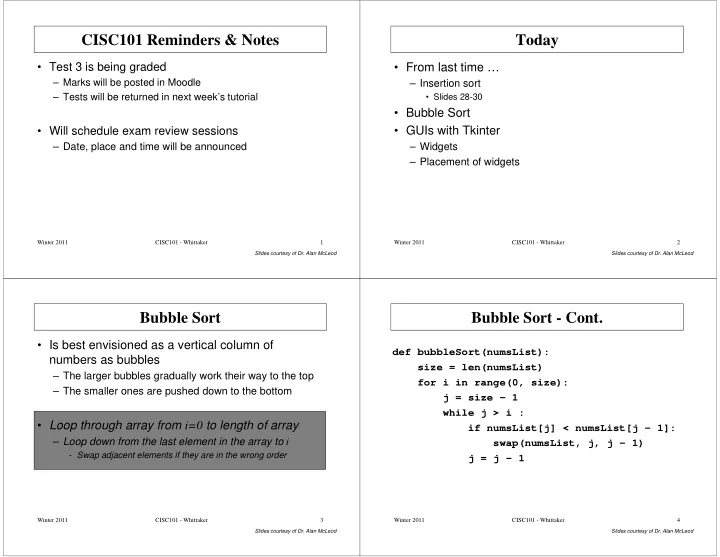
CISC101 Reminders & Notes Today Test 3 is being graded From - - PowerPoint PPT Presentation

cisc101 reminders notes today
SMART_READER_LITE
LIVE PREVIEW

CISC101 Reminders & Notes Today Test 3 is being graded From - - PowerPoint PPT Presentation

CISC101 Reminders & Notes Today Test 3 is being graded From last time Marks will be posted in Moodle Insertion sort Tests will be returned in next weeks tutorial Slides 28-30 Bubble Sort GUIs with


slide-1
SLIDE 1

CISC101 Reminders & Notes

  • Test 3 is being graded

– Marks will be posted in Moodle – Tests will be returned in next week’s tutorial

  • Will schedule exam review sessions

Slides courtesy of Dr. Alan McLeod

– Date, place and time will be announced

Winter 2011 CISC101 - Whittaker 1

Today

  • From last time …

– Insertion sort

  • Slides 28-30
  • Bubble Sort
  • GUIs with Tkinter

Slides courtesy of Dr. Alan McLeod

– Widgets – Placement of widgets

Winter 2011 CISC101 - Whittaker 2

Bubble Sort

  • Is best envisioned as a vertical column of

numbers as bubbles

– The larger bubbles gradually work their way to the top – The smaller ones are pushed down to the bottom

Slides courtesy of Dr. Alan McLeod

  • Loop through array from i=0 to length of array

– Loop down from the last element in the array to i

  • Swap adjacent elements if they are in the wrong order

Winter 2011 CISC101 - Whittaker 3

def bubbleSort(numsList): size = len(numsList) for i in range(0, size): j = size - 1 while j > i :

Bubble Sort - Cont.

Slides courtesy of Dr. Alan McLeod

while j > i : if numsList[j] < numsList[j - 1]: swap(numsList, j, j - 1) j = j - 1

Winter 2011 CISC101 - Whittaker 4

slide-2
SLIDE 2

def bitBetterBubbleSort(numsList): size = len(numsList) i = 0 isSorted = False while i < size and not isSorted: j = size - 1 isSorted = True

Bubble Sort – A Slight Improvement

Slides courtesy of Dr. Alan McLeod

isSorted = True while j > i : if numsList[j] < numsList[j - 1]: swap(numsList, j, j - 1) isSorted = False j = j - 1 i = i + 1

Winter 2011 CISC101 - Whittaker 5

  • The improvement will (potentially) reduce the

number of iterations

  • Possibly the simplest sorting algorithm to code
  • Also the slowest sorting algorithm!

Bubble Sort - Cont.

Slides courtesy of Dr. Alan McLeod

  • Also the slowest sorting algorithm!

– Assume that there are n elements – On average, bubble sort makes n times more moves than selection or insertion sort

Winter 2011 CISC101 - Whittaker 6

Timing Summary

  • 1000 data points

– Between 1 and 1000

Sort Millisec

Python sort() 0.62 Insertion 159

Slides courtesy of Dr. Alan McLeod

Selection 182 Bubble 450 Better?Bubble 448

Winter 2011 CISC101 - Whittaker 7

Next Slide – Quicksort

  • You are not responsible for knowing this algorithm

– It is included here strictly for interest

Slides courtesy of Dr. Alan McLeod

Winter 2011 CISC101 - Whittaker 8

slide-3
SLIDE 3

def quickSort(numsList, start, finish) : lower = start + 1 upper = finish swap(numsList, start, (start + finish) / 2) pivot = numsList[start] while lower <= upper : while numsList[lower] < pivot : lower = lower + 1 while numsList[upper] > pivot : upper = upper - 1 if lower < upper:

Slides courtesy of Dr. Alan McLeod

swap(numsList, lower, upper) upper = upper - 1 lower = lower + 1 swap(numsList, upper, start) if upper - start > 1 : quickSort(numsList, start, upper - 1) if finish - upper > 1 : quickSort(numsList, upper + 1, finish)

Winter 2011 CISC101 - Whittaker 9

GUI with Tkinter

  • Stands for “Tk Interface”
  • A Python interface to the Tk GUI toolkit

– Maintained by ActiveState

  • www.activestate.com
  • They also distribute a free Python development tool called

ActivePython, which is an alternative to IDLE

Slides courtesy of Dr. Alan McLeod

ActivePython, which is an alternative to IDLE

  • Tk consists of a bunch of components or widgets

– Tk can be used with other languages like Perl or Ruby

  • See Section 24.1 in the Python Library Reference

Winter 2011 CISC101 - Whittaker 10

Some Tkinter Widgets

  • Button

– Something to click on

  • Canvas

– To draw on or display graphics

  • Checkbutton

Slides courtesy of Dr. Alan McLeod

  • Checkbutton

– A checkbox (on or off)

  • Entry

– Single line text entry

Winter 2011 CISC101 - Whittaker 11

Some Tkinter Widgets - Cont.

  • Frame

– Container for other widgets

  • Label

– Displays one line of text that the user cannot change

  • Listbox

Slides courtesy of Dr. Alan McLeod

  • Listbox

– Drop down list for user selection

  • Menu

– A list of choices displayed by a Menubutton

Winter 2011 CISC101 - Whittaker 12

slide-4
SLIDE 4

Some Tkinter Widgets - Cont.

  • Message

– Shows multiple lines of text

  • Radiobutton

– Appear in groups where the user can only select one

  • Scale

Slides courtesy of Dr. Alan McLeod

  • Scale

– A slider

  • Scrollbar

– Allows scrolling for other widgets

  • Text

– User can enter multiple lines of text

Winter 2011 CISC101 - Whittaker 13

Using the Tkinter Module

  • It is important to note that IDLE is programmed

itself using Tkinter

– This might cause some strange results – Does not seem to be a problem with Python 3.1 …

  • You must import the Tkinter module with one of

Slides courtesy of Dr. Alan McLeod

  • You must import the Tkinter module with one of

import tkinter from tkinter import *

  • You may have to install the module for this to work

– For Windows Python installs it should already be there

Winter 2011 CISC101 - Whittaker 14

Using Tkinter - Cont.

  • Create your main or root window using

top_window = tkinter.Tk()

  • Then start the main loop using

tkinter.mainloop()

Slides courtesy of Dr. Alan McLeod

tkinter.mainloop()

– This assumes you used the first import statement

Winter 2011 CISC101 - Whittaker 15

Using Tkinter - Cont.

  • The first line top_window = tkinter.Tk()

creates a Tk object

– Calls a constructor to create the object – Assigns the object to variable top_window

  • The main loop is the “listener” loop for the window

Slides courtesy of Dr. Alan McLeod

  • The main loop is the “listener” loop for the window

– It will wait very patiently for the user to do something

  • Demo: WindowBasic.py

– Note the functionality built into even this simple window!

Winter 2011 CISC101 - Whittaker 16

slide-5
SLIDE 5

Adding a Label

  • Demo: WindowLabel.py

helloWorldLabel = tkinter.Label(top, text="HelloWorld!") helloWorldLabel.pack()

  • The pack() method is invoked to place the label

into the first available position in the window

Slides courtesy of Dr. Alan McLeod

into the first available position in the window

  • Pretty small font …

– Demo: WindowLabelFont.py

  • How can we get away from this top-down stacking of

widgets in the window?

Winter 2011 CISC101 - Whittaker 17

The “Packer”

pack(side="top/right/bottom/left", expand=0/1, anchor="n/nw/w...", fill="x/y/both") – All of these arguments are optional

  • The “packer” is very simple but just jams stuff in

Slides courtesy of Dr. Alan McLeod

– Displays each widget in its own row or column – Must use frames to get more than one widget in a single row or column

  • We won’t be covering frames

Winter 2011 CISC101 - Whittaker 18

The Grid Manager

  • The Grid Manager is an alternative to the packer

– Just a bit harder to use

  • Specify a row and column position for widgets

instead

  • Do not mix the packer and grid together

Slides courtesy of Dr. Alan McLeod

– Use one or the other!

Winter 2011 CISC101 - Whittaker 19

The Grid Manager - Cont.

grid(row=?, column=?, rowspan=?, columnspan=?, sticky="news", ipadx=?, ipady=?, padx=?, pady=?)

  • "news" is North, East, West, and/or South

– Dictates which side the widget “sticks” to in its portion

  • f the grid

Slides courtesy of Dr. Alan McLeod

  • f the grid

– Can set sticky to a subset of "news"

  • e.g., "n“, “e“, “ws"
  • Other dimensions are in pixels

– What is a pixel, anyways?

Winter 2011 CISC101 - Whittaker 20

slide-6
SLIDE 6

The Grid Manager - Cont.

  • Demo: WindowGrid.py
  • Note how the columns and rows are sized to the

width and height of the largest widget in that row

  • r column
  • Widgets are centre-aligned by default

Slides courtesy of Dr. Alan McLeod

  • Widgets are centre-aligned by default

– Change this using the sticky option

  • They can span multiple rows and columns

– Use rowspan or columnspan (or both!)

  • Add extra “padding” using padx and pady

Winter 2011 CISC101 - Whittaker 21

Widget Options

  • widget_name.keys()

– Gives you a list of dictionary keys – Each is an option that can be changed for that widget

  • Any set of these keys can be set when you create

the widget

Slides courtesy of Dr. Alan McLeod

  • widget_name.configure()

– Gives you the dictionary with keys and values

Winter 2011 CISC101 - Whittaker 22

Widget Options - Cont.

  • widget_name.cget(option)

– Returns the value of the specified option as a string

  • widget_name.configure(option=?,
  • ption=?, …)

Slides courtesy of Dr. Alan McLeod

– Changes as many options as you want all at once

  • Demo: WindowWidgetOptions.py

Winter 2011 CISC101 - Whittaker 23

Button Widget

  • A button allows the user to initiate an event

– Most often to invoke some function in your program

button = Tkinter.Button(master, text=?, command=?)

  • master is the window’s name

Slides courtesy of Dr. Alan McLeod

  • master is the window’s name

– Must be present when you create any widget

Winter 2011 CISC101 - Whittaker 24

slide-7
SLIDE 7

Button Widget - Cont.

  • Demo: WindowButton.py
  • The command option is given the name of a

function

– It is not a string

Slides courtesy of Dr. Alan McLeod

– It cannot have brackets or parameters

  • That window re-sizing thing is really annoying!

– How do we fix it?

Winter 2011 CISC101 - Whittaker 25

Grid Manager Methods

  • Use the columnconfigure(…) or

rowconfigure(…) methods on the master

columnconfigure(column, option=value, ...)

  • Options

– minsize

Slides courtesy of Dr. Alan McLeod

– minsize – pad – weight

  • Let’s add some padding too

– Demo: WindowGridConfigure.py

Winter 2011 CISC101 - Whittaker 26

GUI Design

  • A great deal of the time spent building a GUI

program goes into design

  • Two primary considerations

– The appearance and functionality of the components

Slides courtesy of Dr. Alan McLeod

– The window’s layout, i.e., where the components will sit in the window

Winter 2011 CISC101 - Whittaker 27

Colours!

  • Demo: WindowColours.py
  • Colours are specified using the RGB system

– Red, green and blue

  • The intensity of each colour lies between 0x00

and 0xFF in hex

Slides courtesy of Dr. Alan McLeod

and 0xFF in hex

– 0 and 255 in decimal – Possible range of 256*256*256 = 16,777,216 colours!

  • Windows uses 32 bit colour

– The extra byte is used to specify transparency

Winter 2011 CISC101 - Whittaker 28

slide-8
SLIDE 8

Colours - Cont.

  • You can also specify colours as a parameter

– "black", "red", "green", "blue", "cyan", "yellow", and "magenta“ – There may be others such as “lightblue”, etc.

  • The demo program is also using a colour chooser

Slides courtesy of Dr. Alan McLeod

  • The demo program is also using a colour chooser

dialog box called tkinter.colorchooser

– This is a GUI window that has already been constructed for us

Winter 2011 CISC101 - Whittaker 29

Other Dialog Boxes

  • tkinter.commondialog

– Base class for the dialogs defined in the other modules listed here

  • tkinter.filedialog

– Common dialog for opening or saving a file

  • tkinter.messagebox

Slides courtesy of Dr. Alan McLeod

  • tkinter.messagebox

– Access to standard Tk dialog boxes

  • tkinter.simpledialog

– Basic dialogs and convenience functions

  • Demo: WindowDialogs.py

Winter 2011 CISC101 - Whittaker 30

Entry Widget

  • Allows the user to provide information to your

program by typing it into the text box

  • Specify a width (width=?) in addition to the

master and the font, as a minimum when you create one

Slides courtesy of Dr. Alan McLeod

create one

  • Use the get() method on the Entry widget to get

the contents

– Returned as a string only

  • Demo: WindowEntry.py

Winter 2011 CISC101 - Whittaker 31

Radiobutton Widget

  • Allow the user to make a single choice from a list
  • f options

– Like the station buttons on old car radios …

  • Demo: WindowRadiobutton.py

Slides courtesy of Dr. Alan McLeod

  • Note …

– the use of IntVar() to create a “container” radioChoices that stores the buttons’ value – the use of a callback function with command=… – how the colour of choiceLabel is set to red

Winter 2011 CISC101 - Whittaker 32

slide-9
SLIDE 9

Common Widgets Not Covered Here

  • Canvas
  • Checkbutton
  • Listbox
  • Menu and Menubutton
  • Message

Slides courtesy of Dr. Alan McLeod

  • Message
  • Scale
  • Scrollbar
  • Text

Winter 2011 CISC101 - Whittaker 33

More Info on Tkinter

  • There are lots of web resources
  • A good starting place are the links collected at

http://wiki.python.org/moin/TkInter

Slides courtesy of Dr. Alan McLeod

Winter 2011 CISC101 - Whittaker 34