CISC101 Reminders & Notes Today Finish up chained if statements - - PowerPoint PPT Presentation

cisc101 reminders notes today
SMART_READER_LITE
LIVE PREVIEW

CISC101 Reminders & Notes Today Finish up chained if statements - - PowerPoint PPT Presentation

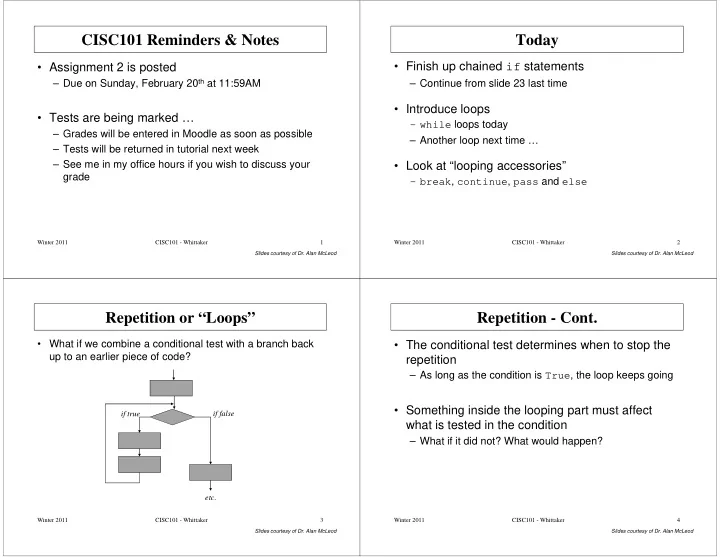
CISC101 Reminders & Notes Today Finish up chained if statements Assignment 2 is posted Due on Sunday, February 20 th at 11:59AM Continue from slide 23 last time Introduce loops Tests are being marked while


slide-1
SLIDE 1

CISC101 Reminders & Notes

  • Assignment 2 is posted

– Due on Sunday, February 20th at 11:59AM

  • Tests are being marked …

– Grades will be entered in Moodle as soon as possible

Slides courtesy of Dr. Alan McLeod

– Grades will be entered in Moodle as soon as possible – Tests will be returned in tutorial next week – See me in my office hours if you wish to discuss your grade

Winter 2011 CISC101 - Whittaker 1

Today

  • Finish up chained if statements

– Continue from slide 23 last time

  • Introduce loops

– while loops today – Another loop next time …

Slides courtesy of Dr. Alan McLeod

– Another loop next time …

  • Look at “looping accessories”

– break, continue, pass and else

Winter 2011 CISC101 - Whittaker 2

Repetition or “Loops”

  • What if we combine a conditional test with a branch back

up to an earlier piece of code?

if true if false

Slides courtesy of Dr. Alan McLeod

etc. if true if false

Winter 2011 CISC101 - Whittaker 3

Repetition - Cont.

  • The conditional test determines when to stop the

repetition

– As long as the condition is True, the loop keeps going

  • Something inside the looping part must affect

Slides courtesy of Dr. Alan McLeod

what is tested in the condition

– What if it did not? What would happen?

Winter 2011 CISC101 - Whittaker 4

slide-2
SLIDE 2

Repetition - Cont.

  • Suppose we wanted this loop to execute only 20

times …

i = 1

if true if false

Slides courtesy of Dr. Alan McLeod

i < 21 i = i+1

Winter 2011 CISC101 - Whittaker 5

etc. if true if false

Repetition - Cont.

  • Suppose we wanted this loop to execute only 20

times …

i = 1

if true if false

i <= 20 would

Slides courtesy of Dr. Alan McLeod

i < 21 i = i+1

Winter 2011 CISC101 - Whittaker 6

etc. if true if false

i <= 20 would also work This ensures that i >= 21 eventually

Repetition - Cont.

  • The number of repetitions is controlled by

changing the limit value for the loop counter

– i in the example on the previous slide

  • That example had i increasing by one each time

– The loop counter was being incremented by one

  • It could be incremented by any other value

Slides courtesy of Dr. Alan McLeod

  • It could be incremented by any other value

– “i = i + 2” would increment the loop counter by 2 – This is the case for any value

  • If the counter is decreased in value each time, it is

being decremented

Winter 2011 CISC101 - Whittaker 7

Repetition - Cont.

  • Another way for the loop to execute 20 times …

i = 20

if true if false

i > -1 would

Slides courtesy of Dr. Alan McLeod

i >= 0 i = i-1

Winter 2011 CISC101 - Whittaker 8

etc. if true if false

i > -1 would also work

slide-3
SLIDE 3

Repetition - Cont.

  • There are lots of other ways of stopping a loop

– Sometimes you don’t need to count iterations at all – Condition might be based on …

  • user input (e.g., looking for a specific values)
  • value returned from a function
  • etc.

Slides courtesy of Dr. Alan McLeod

  • etc.
  • But you still need a conditional expression that is

affected by something inside the loop

– Asking for user input – Invoking a function – etc.

Winter 2011 CISC101 - Whittaker 9

Repetition - Cont.

  • Consider this example where i is decremented by
  • ne but the condition is i < 21 – what will happen?

i = 1

if true if false

Slides courtesy of Dr. Alan McLeod

Winter 2011 CISC101 - Whittaker 10

i < 21 i = i-1

etc. if true if false

Repetition - Cont.

  • The dreaded “infinite loop”!

– Caused by a logic error, not a syntax error

  • The interpreter will not prevent you from coding a

loop like the one shown - it will run!

Slides courtesy of Dr. Alan McLeod

  • And run, and run, and run, and run, and run, and run, and run, and run, and run, and run…
  • As a programmer, you must be “on guard” for such

logic errors in your code

Winter 2011 CISC101 - Whittaker 11

Python Loops

  • Python has two kinds of looping syntax

– while loops – for loops

  • The loops are somewhat interchangeable

– We’ll use just the while loop for a while …

Slides courtesy of Dr. Alan McLeod

  • The while loop is easier to use at first

– … but the for loop is more powerful and versatile

  • A while loop tests a condition

– ... but the for loop iterates through elements

Winter 2011 CISC101 - Whittaker 12

slide-4
SLIDE 4

while loop

  • A while loop can be used to code the structure

shown in the flowchart shown previously

– The “increment” one on slide 6 i = 1 while i < 21 :

Slides courtesy of Dr. Alan McLeod

print(i) i = i + 1

  • Let’s try this out

– Also try versions on slides 7, 9, and 11

  • How do you stop an infinite loop in IDLE?

Winter 2011 CISC101 - Whittaker 13

  • while loop syntax:

while boolean_expression : line1 line2 …

while loop - Cont.

Slides courtesy of Dr. Alan McLeod

  • As long as boolean_expression is True, the

statements in the loop continue to execute

Winter 2011 CISC101 - Whittaker 14

Demo - CalculateAverage.py

  • Obtain any number of numbers from the user,

sum them up and then display the average of the numbers

– Ignore the possibility of non-numeric input

Slides courtesy of Dr. Alan McLeod

  • How do we stop such a process?
  • What about “special cases”, like when no

numbers are supplied?

Demo – Factorial.py

  • Write a program that displays all the values of n!

(or “n factorial”) for 2! up to the user supplied value of n

=

n

i n!

Slides courtesy of Dr. Alan McLeod

  • For example, 5! = 5 * 4 * 3 * 2, which is 120

=

=

i

i n

1

!

slide-5
SLIDE 5

Large Demo - DragonSlayer.py

  • Game where a knight fights dragons

– Knight has several properties

  • Current and maximum hit points
  • Maximum and minimum attack damage

– Each dragon has the same

  • Values are generated randomly for each fight

Slides courtesy of Dr. Alan McLeod

  • Values are generated randomly for each fight
  • Knight can choose to fight a dragon or rest

– Resting recovers hit points

  • During a fight hits are exchanged

– Knight can choose to fight or run away

Demo If Time - BoxDrawing.py

  • Write a program that prints a square box outline of

stars to the screen of a size provided by the user

– The size must be at least 3, but no more than 80

  • Note use of loop to ensure that a legal number is
  • btained

Slides courtesy of Dr. Alan McLeod

  • btained

– It still crashes with text input …

  • Consider other ways to use a loop to simplify the

middle part of the box

  • You’ll see this in the next lab

Winter 2011 CISC101 - Whittaker 18

Use of break and continue With Loops

  • Don’t use these keywords unless you feel it

makes your code easier to read and debug!

  • break exits a loop immediately

Slides courtesy of Dr. Alan McLeod

  • continue jumps to the next iteration immediately
  • Demo: BreakContinue.py

Use of else and pass With Loops

  • else with a loop gives you a chance to see how

the loop exited

– If it was a “normal” exit, the else is executed

  • Using break does not qualify as normal
  • Demo: LoopElse.py

Slides courtesy of Dr. Alan McLeod

  • pass is used when a statement is required, but

you don’t have anything you want to do!

– Or you have not yet written the code

  • Demo: LoopPass.py