SIMD Is a Message Digest Gatan Leurent, Pierre-Alain Fouque, Charles - - PowerPoint PPT Presentation

simd is a message digest
SMART_READER_LITE
LIVE PREVIEW

SIMD Is a Message Digest Gatan Leurent, Pierre-Alain Fouque, Charles - - PowerPoint PPT Presentation

Introduction Description Security Implementation SIMD Is a Message Digest Gatan Leurent, Pierre-Alain Fouque, Charles Bouillaguet cole Normale Suprieure Paris, France http://www.di.ens.fr/~leurent/simd.html First SHA-3 Conference A 0 B


slide-1
SLIDE 1

Introduction Description Security Implementation

SIMD Is a Message Digest

Gaëtan Leurent, Pierre-Alain Fouque, Charles Bouillaguet

École Normale Supérieure Paris, France http://www.di.ens.fr/~leurent/simd.html

First SHA-3 Conference

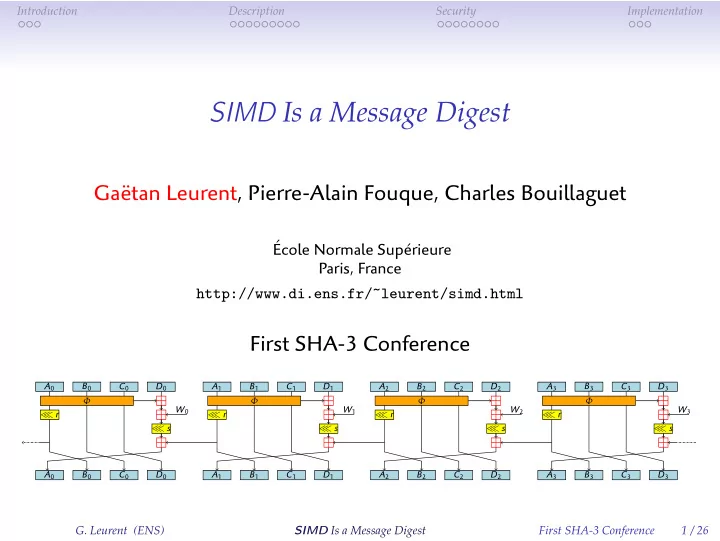
A0 B0 W0 C0 D0 D0 A0 B0 C0 ≪ r Φ ≪ s A1 B1 W1 C1 D1 D1 A1 B1 C1 ≪ r Φ ≪ s A2 B2 W2 C2 D2 D2 A2 B2 C2 ≪ r Φ ≪ s A3 B3 W3 C3 D3 D3 A3 B3 C3 ≪ r Φ ≪ s

  • G. Leurent (ENS)

SIMD Is a Message Digest First SHA-3 Conference 1 / 26

slide-2
SLIDE 2

Introduction Description Security Implementation

Main Features of SIMD

◮ Security

◮ Strong message expansion ◮ Proof of security against differential cryptanalysis

◮ Parallelism

◮ Small scale parallelism (inside the compression function):

good for hardware / software with SIMD instructions

◮ Can use two cores: message expansion / compression

◮ Performance

◮ Very good on high-end desktops: 11 cycles/byte on Core2 ◮ Good if SIMD instructions are available:

SSE on x86, AltiVec on PowerPC, IwMMXt on ARM,VIS on SPARC...

◮ Drawback: no portable efficient implementation.

  • G. Leurent (ENS)

SIMD Is a Message Digest First SHA-3 Conference 2 / 26

slide-3
SLIDE 3

Introduction Description Security Implementation

General Design

◮ Merkle-Damgård-like iteration ◮ Davies-Meyer-like compression function ◮ Feistel-based block cipher ◮ Two versions:

Message block size m Internal state size p SIMD-256 512 512 SIMD-512 1024 1024 can be truncated (e.g. SIMD-224, SIMD-384)

  • G. Leurent (ENS)

SIMD Is a Message Digest First SHA-3 Conference 3 / 26

slide-4
SLIDE 4

Introduction Description Security Implementation

Outline

Introduction Description Mode of operation Compression Function Message Expansion Security Resistance to Differential Cryptanalysis Implementation Performance

  • G. Leurent (ENS)

SIMD Is a Message Digest First SHA-3 Conference 4 / 26

slide-5
SLIDE 5

Introduction Description Security Implementation

Iteration mode

The iteration mode is based on ChopMD (a.k.a. wide pipe). M M0 M1 M2 IV H0 H1 H2 C C C C H3 T h(M) M3 C′ |M| H4

◮ Pad with zeros ◮ Use the message length as input of the last block:

quite constrained, kind of blank round

◮ Tweaked final compression function (i.e. prefix-free encoding) ◮ Security proof: indifferentiable up to 2n

  • G. Leurent (ENS)

SIMD Is a Message Digest First SHA-3 Conference 5 / 26

slide-6
SLIDE 6

Introduction Description Security Implementation

How to build a compression function?

Two inputs: Hi−1 hard to control / M easy to control Davies-Meyer: E Hi M Hi−1 Hi = EM(Hi−1) ⊕ Hi−1

◮ differential attack on C

related key attack on E

◮ Message expansion

can reduce control over M Matyas-Meyer-Oseas: E Hi M Hi−1 Hi = EHi−1(M) ⊕ M

◮ differential attack on C

differential attacks E

  • G. Leurent (ENS)

SIMD Is a Message Digest First SHA-3 Conference 6 / 26

slide-7
SLIDE 7

Introduction Description Security Implementation

How to build a compression function?

Two inputs: Hi−1 hard to control / M easy to control Davies-Meyer: E Hi M Hi−1 Hi = EM(Hi−1) ⊕ Hi−1

◮ differential attack on C

related key attack on E

◮ Message expansion

can reduce control over M Matyas-Meyer-Oseas: E Hi M Hi−1 Hi = EHi−1(M) ⊕ M

◮ differential attack on C

differential attacks E

  • G. Leurent (ENS)

SIMD Is a Message Digest First SHA-3 Conference 6 / 26

slide-8
SLIDE 8

Introduction Description Security Implementation

The Compression Function

E P Hi M M Hi−1

◮ Modified Davies-Meyer mode.

◮ XOR M in the beginning:

no message modifications

◮ Use some more Feistel

rounds as the feed-forward: avoids some fixed points and multiblock attacks

◮ Same security proofs as DM:

good if E if good

◮ Feistel-based cipher ◮ Strong message expansion

  • G. Leurent (ENS)

SIMD Is a Message Digest First SHA-3 Conference 7 / 26

slide-9
SLIDE 9

Introduction Description Security Implementation

The Feistel Round

A0 B0 W0 C0 D0 D0 A0 B0 C0 ≪ r Φ ≪ s A1 B1 W1 C1 D1 D1 A1 B1 C1 ≪ r Φ ≪ s A2 B2 W2 C2 D2 D2 A2 B2 C2 ≪ r Φ ≪ s A3 B3 W3 C3 D3 D3 A3 B3 C3 ≪ r Φ ≪ s

◮ 4 parallel Feistel ladders (8 for SIMD-512) with 32 bit words ◮ 4 (expanded) message words enter each round ◮ Interaction between the Feistel ladders via the permutations p(i) ◮ Constants hidden in the message expansion

A(i)

j

=

  • D(i−1)

j

⊞ W(i)

j

⊞ φ(i)(A(i−1)

j

, B(i−1)

j

, C(i−1)

j

) ≪s(i) ⊞

  • A(i−1)

p(i)(j)

≪r(i) B(i)

j

= A(i−1)

j ≪r(i)

C(i)

j

= B(i−1)

j

D(i)

j

= C(i−1)

j

  • G. Leurent (ENS)

SIMD Is a Message Digest First SHA-3 Conference 8 / 26

slide-10
SLIDE 10

Introduction Description Security Implementation

Round Parameters

◮ Rotations and

Boolean functions: φ(i) r(i) s(i) IF π0 π1 IF π1 π2 IF π2 π3 IF π3 π0 MAJ π0 π1 MAJ π1 π2 MAJ π2 π3 MAJ π3 π0

◮ Permutations:

chosen for maximal diffusion p(j) = j + 1 p(j) = j + 2

  • G. Leurent (ENS)

SIMD Is a Message Digest First SHA-3 Conference 9 / 26

slide-11
SLIDE 11

Introduction Description Security Implementation

Round Parameters

◮ Rotations and

Boolean functions: φ(i) r(i) s(i) IF π0 π1 IF π1 π2 IF π2 π3 IF π3 π0 MAJ π0 π1 MAJ π1 π2 MAJ π2 π3 MAJ π3 π0

◮ Permutations:

chosen for maximal diffusion p(j) = j + 1 p(j) = j + 2

  • G. Leurent (ENS)

SIMD Is a Message Digest First SHA-3 Conference 9 / 26

slide-12
SLIDE 12

Introduction Description Security Implementation

The Message Expansion

Message block Expanded message Minimal distance SIMD-256 512 bits 4096 bits 520 bits SIMD-512 1024 bits 8192 bits 1032 bits

◮ Provides resistance to differential attack ◮ Based on (error correcting) codes with a good minimal distance ◮ Concatenated code:

◮ outer code gives a high word distance ◮ inner code gives a high bit distance

  • G. Leurent (ENS)

SIMD Is a Message Digest First SHA-3 Conference 10 / 26

slide-13
SLIDE 13

Introduction Description Security Implementation 16 steps 4 steps 16 steps 4 steps Hi−1 Hi P1 ⊠185 P2 ⊠233 W W M M NTT

  • G. Leurent (ENS)

SIMD Is a Message Digest First SHA-3 Conference 11 / 26

slide-14
SLIDE 14

Introduction Description Security Implementation

Outer Code

Reed-Solomon code

◮ Interpret the input (k words) as a polynomial

  • f degree k − 1 over some finite field

◮ Evaluate on n points (n > k) ◮ MDS code: minimal distance n − k + 1

k n d SIMD-256 64 128 65 SIMD-512 128 256 129

◮ Efficiency:

◮ Compute with an FFT algorithm ◮ Use the field F257

◮ Add a constant part: affine code

  • G. Leurent (ENS)

SIMD Is a Message Digest First SHA-3 Conference 12 / 26

slide-15
SLIDE 15

Introduction Description Security Implementation

Inner code

We encode the output words of the NTT twice, through two different inner codes. Very efficient codes, with a single 16-bit multiplication. I185 : F257 → Z216 x → 185 ⊠ x where − 128 ≤ x ≤ 128 and x = x (mod 257) I233 : F257 → Z216 x → 233 ⊠ x where − 128 ≤ x ≤ 128 and x = x (mod 257) The magic constants 185 and 233 give a minimal distance of 4 bits. (also for signed difference)

  • G. Leurent (ENS)

SIMD Is a Message Digest First SHA-3 Conference 13 / 26

slide-16
SLIDE 16

Introduction Description Security Implementation

Security of SIMD

◮ The mode of operation is indifferentiable. ◮ No generic multicollision attack, second-preimage on long

messages,

  • r herding attack

◮ Any attack has to use some property of the block cipher. ◮ The most obvious property is to find differential trails.

  • G. Leurent (ENS)

SIMD Is a Message Digest First SHA-3 Conference 14 / 26

slide-17
SLIDE 17

Introduction Description Security Implementation

Security Proof: Attacker goal

We model a differential attacker: Attacker game

◮ Choose a message difference ∆ ◮ Build a differential path u v ◮ Find a message M s.t. (M, M + ∆) follows the path

At each step there is a probability p that the path is followed i.e. there are c conditions, c = − log2(p). We want to show that c ≥ 128.

  • G. Leurent (ENS)

SIMD Is a Message Digest First SHA-3 Conference 15 / 26

slide-18
SLIDE 18

Introduction Description Security Implementation

Differential attacks

Two possible differentials:

◮ XOR difference: specifies which bits are modified

◮ Easy to use ◮ No condition for carry on bit 31

(limited number due to the inner code)

◮ Signed difference: specifies which bits go up or down

◮ More powerful:

Used by Wang et al. to break MD4, MD5, SHA-1, HAVAL, ...

◮ No condition when differences cancel out in ⊞ ◮ Less conditions on the Boolean functions ◮ Need a condition for the sign of bit 31

  • G. Leurent (ENS)

SIMD Is a Message Digest First SHA-3 Conference 16 / 26

slide-19
SLIDE 19

Introduction Description Security Implementation

State Differences

W1 W1 W1 W1 W1 A1 B1 C1 D1 D1 A1 B1 C1 ≪ r φ ≪ s D1 A1 B1 C1 ≪ r φ ≪ s D1 A1 B1 C1 ≪ r φ ≪ s D1 A1 B1 C1 ≪ r φ ≪ s D1 A1 B1 C1 ≪ r φ ≪ s

◮ We consider a single isolated

difference bit in the state.

◮ One condition to control the carry

when the difference is introduced

◮ Three conditions for the

Boolean functions

  • G. Leurent (ENS)

SIMD Is a Message Digest First SHA-3 Conference 17 / 26

slide-20
SLIDE 20

Introduction Description Security Implementation

Security Proof: Attacker game

We will ask the adversary to play an easier game: Simplified adversary

◮ You have 520 differences in the expanded message (δW) ◮ You want to get rid of them by placing differences in the state (δA):

◮ Each δA can consume some δW ◮ But it costs you some conditions

The adversary is looking for a set of δA’s with a good exchange rate. He wins if the rate is less that 1/4.

  • G. Leurent (ENS)

SIMD Is a Message Digest First SHA-3 Conference 18 / 26

slide-21
SLIDE 21

Introduction Description Security Implementation

Adversary I: No control over the message differences

Adversary I

1 Choose a message difference of minimal weight 2 Find a path connecting the δW’s

If the message difference has no other property, Most of the δW will introduce a δA, i.e. 4 conditions. Realistic if optimal message pairs (minimal weight difference) are hard to find. Exchange rate: 4/1. FAIL. (p ≈ 2−2048) Lesson: the adversary need some control over the extended message.

  • G. Leurent (ENS)

SIMD Is a Message Digest First SHA-3 Conference 19 / 26

slide-22
SLIDE 22

Introduction Description Security Implementation

Adversary II: Local Collisions

A1 B1 C1 D1 D1 A1 B1 C1 ≪ r φ ≪ s D1 A1 B1 C1 ≪ r φ ≪ s D1 A1 B1 C1 ≪ r φ ≪ s D1 A1 B1 C1 ≪ r φ ≪ s D1 A1 B1 C1 ≪ r φ ≪ s D0 ≪ s A0 W1 W1 W1 W1 W1 W0

Adversary II

1 Choose a set δA 2 Use the neighbours of this δA as δW

If the state difference are isolated, c ≈ 4δA. Realistic if optimal message pairs are not so easy to find. δW ≤ 6δA Exchange rate: 4/6. FAIL. (p ≈ 2−340) Lesson: the adversary needs to combine local collisions.

  • G. Leurent (ENS)

SIMD Is a Message Digest First SHA-3 Conference 20 / 26

slide-23
SLIDE 23

Introduction Description Security Implementation

Adversary III: Combining Local Collisions

With a signed difference, many conditions can be avoided when two differences enters the same φ. Exchange rate as low as 1/4.5. WIN? (p ≈ 2−113) We expect that it is impossible to choose a possible δW and a matching δA that achieve this exchange rate. Can we prove it? We modelled this game as a linear integer program. The solver proved that there is no solution with less than 130 conditions (and counting).

  • G. Leurent (ENS)

SIMD Is a Message Digest First SHA-3 Conference 21 / 26

slide-24
SLIDE 24

Introduction Description Security Implementation

Adversary III: Combining Local Collisions

With a signed difference, many conditions can be avoided when two differences enters the same φ. Exchange rate as low as 1/4.5. WIN? (p ≈ 2−113) We expect that it is impossible to choose a possible δW and a matching δA that achieve this exchange rate. Can we prove it? We modelled this game as a linear integer program. The solver proved that there is no solution with less than 130 conditions (and counting).

  • G. Leurent (ENS)

SIMD Is a Message Digest First SHA-3 Conference 21 / 26

slide-25
SLIDE 25

Introduction Description Security Implementation

Adversary III: Combining Local Collisions

With a signed difference, many conditions can be avoided when two differences enters the same φ. Exchange rate as low as 1/4.5. WIN? (p ≈ 2−113) We expect that it is impossible to choose a possible δW and a matching δA that achieve this exchange rate. Can we prove it? We modelled this game as a linear integer program. The solver proved that there is no solution with less than 130 conditions (and counting).

  • G. Leurent (ENS)

SIMD Is a Message Digest First SHA-3 Conference 21 / 26

slide-26
SLIDE 26

Introduction Description Security Implementation

Proof summary

The adversary:

◮ Chooses the message difference and

the expanded message difference independently

◮ Can place the differences arbitrarily in the inner code ◮ Uses a signed diference

His optimal strategy:

◮ Use only local collisions (no error propagation) ◮ Locate the state differences next to each other

to avoid most conditions. Then, any differential path has at least 130 conditions. (that includes pseudo-near-collision paths)

  • G. Leurent (ENS)

SIMD Is a Message Digest First SHA-3 Conference 22 / 26

slide-27
SLIDE 27

Introduction Description Security Implementation

SIMD instructions

The NTT and the Feistel ladder can be parallelized using SIMD instructions.

◮ Single Instruction, Multiple Data

1 2 3 4 5 5 5 5 6 7 8 9 A B A + B

◮ Available on most architectures:

x86 MMX (64-bit registers), SSE (128-bit registers) PPC Altivec (128-bit registers) ARM IwMMXt (64-bit registers) Sparc VIS (64-bit registers)

  • G. Leurent (ENS)

SIMD Is a Message Digest First SHA-3 Conference 23 / 26

slide-28
SLIDE 28

Introduction Description Security Implementation

Performance Overview

◮ Message expansion vs. Feistel: 50/50 ◮ No need for 64-bit arithmetic ◮ Efficient on some embedded architectures: ARM Xscale, x86 Atom ◮ About 80% of the throughput of SHA-1 with a good SIMD unit

(Core2, Atom, G4)

◮ SIMD units are improved in each generation of processors

  • G. Leurent (ENS)

SIMD Is a Message Digest First SHA-3 Conference 24 / 26

slide-29
SLIDE 29

Introduction Description Security Implementation

Performance in cycle/byte

Scalar Vector Architecture SHA-1/256/512 SIMD-256/512 SIMD-256/512 Core2 32 bits 11 21 63 90 118 12 13 64 bits 9 16 13 63 85 11 12 K10 32 bits 12 18 64 80 125 17 64 bits 9 17 13 65 85 16 P4 32 bits 19 89 147 170 210 32 43 K8 32 bits 12 19 65 90 135 25 64 bits 9 18 14 66 88 26 Atom 32 bits 24 46 133 220 280 25 G4 32 bits 12 23 78 125 166 16 23 ARM 22 38 138 200 260 46 See eBASH for more accurate figures...

  • G. Leurent (ENS)

SIMD Is a Message Digest First SHA-3 Conference 25 / 26

slide-30
SLIDE 30

Conclusion

SIMD is

◮ Built on the MD/SHA legacy ◮ Secure (mode of operation and compression function) ◮ Fast on the reference platform: 11-13 cycles/byte

  • G. Leurent (ENS)

SIMD Is a Message Digest First SHA-3 Conference 26 / 26