Circular q-shift - Hypercube Using E-cube routing q-shift in a - - PowerPoint PPT Presentation

circular q shift hypercube
SMART_READER_LITE
LIVE PREVIEW

Circular q-shift - Hypercube Using E-cube routing q-shift in a - - PowerPoint PPT Presentation

Circular q-shift - Hypercube Using E-cube routing q-shift in a hypercube with p nodes: longest path has log p - (q) links, where (q) is the highest integer j, such that q is divisable by 2 j Pairwise communication using E- cube


slide-1
SLIDE 1

1

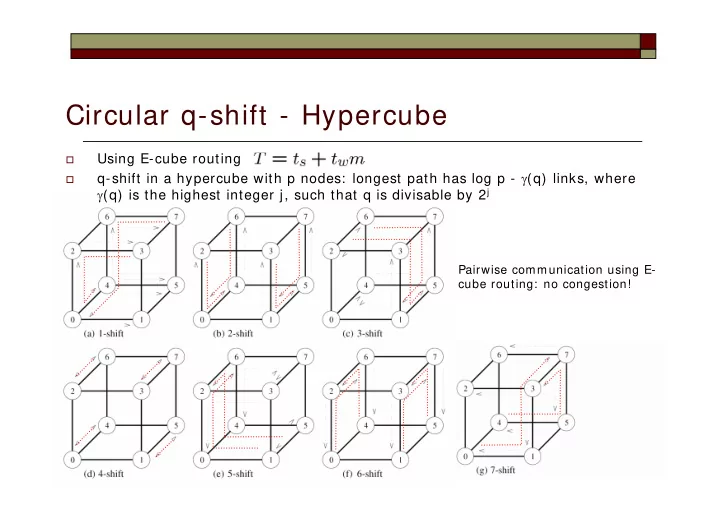
Circular q-shift - Hypercube

  • Using E-cube routing
  • q-shift in a hypercube with p nodes: longest path has log p - γ(q) links, where

γ(q) is the highest integer j, such that q is divisable by 2j

Pairwise communication using E- cube routing: no congestion!

slide-2
SLIDE 2

2

Minimal cost-optimal execution time

  • Isoefficiency function ∈ Θ(f(p)):
  • A problem of size W is solved cost-optimally ⇔ W ∈ Ω(f(p))

p W grows at least like f(p)

  • r: Cost-opimality for a problem of size W ⇔ p ∈ O(f-1(W))

p grows maximally like f-1(W) W

  • Parallel execution time of a cost-optimal parallel system is Θ(W/ p).

Furthermore it holds 1/ p ∈ Ω (1/ f-1(W)).

  • Lower bound for parallel runtime for solving a problem of size W cost-
  • ptimally
slide-3
SLIDE 3

3

Scaled speedup

What is the speedup S(n,p) behavior for

growing values for p? How to choose n?

  • Memory-constrained scaled speedup:

Memory grows propotionally with p ⇒ determine n Memory requirement: m = fm(n) Memory per node: m 0 fm(n) = p m 0 ⇒ n = fm

  • 1 (p m 0)
  • Time-constrained speedup:
slide-4
SLIDE 4

4

Scaled speedup

  • Example 1: Matrix-vector product:

TS= t c n2, TP ∈ Θ(n2/ p), t c : execution time for a mult-add-operation memory requirement: m= fm(n)∈Θ(n2) Memory-constrained scaled speedup: available memory: m = m 0p∈Θ(p), i.e. n2 = c × p Time-constrained scaled speedup: TP ∈ Θ(n2/ p), TP constant, i.e. n2 = c × p, scaled speedup see above

slide-5
SLIDE 5

5

  • Example 2: Matrix-Matrix multiplication

Memory requirement: Θ(n2) Memory-constrained scaled speedup: m∈Θ(p), m∈Θ(n2), i.e. n2= c × p Time-constrained scaled speedup: TP∈Θ(n3/ p) const., i.e. n3= c × p