Chemistry 121(01) Winter 2009 Introduction to Organic Chemistry and - - PDF document

chemistry 121 01 winter 2009
SMART_READER_LITE
LIVE PREVIEW

Chemistry 121(01) Winter 2009 Introduction to Organic Chemistry and - - PDF document

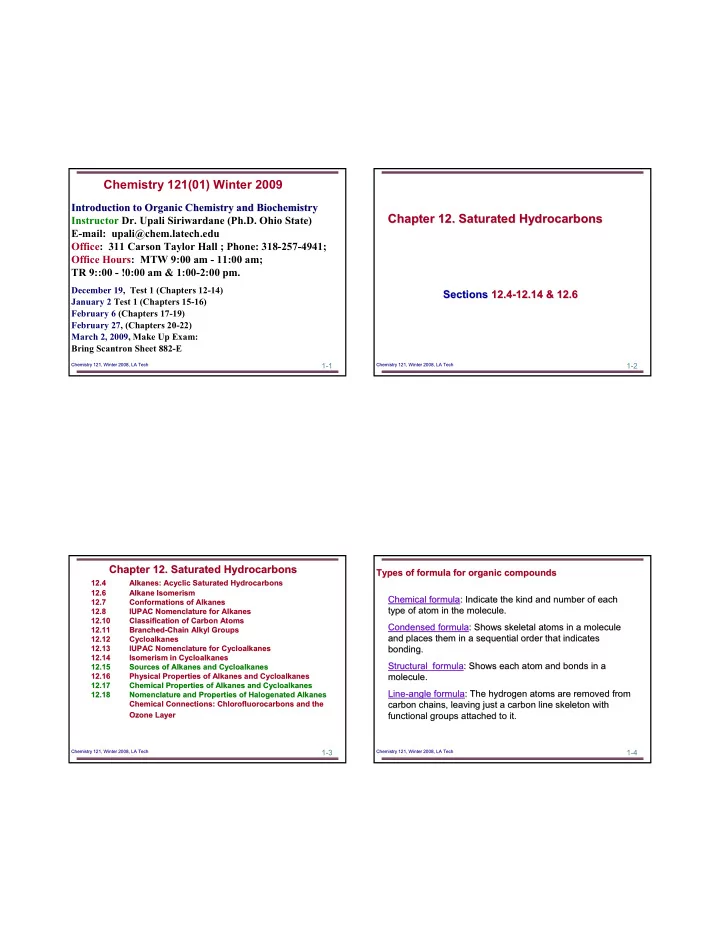
Chemistry 121(01) Winter 2009 Introduction to Organic Chemistry and Biochemistry Introduction to Organic Chemistry and Biochemistry Chapter 12. Saturated Hydrocarbons Chapter 12. Saturated Hydrocarbons Instructor Dr. Upali Siriwardane (Ph.D.


slide-1
SLIDE 1

1-1

Chemistry 121, Winter 2008, LA Tech Chemistry 121, Winter 2008, LA Tech

Introduction to Organic Chemistry and Biochemistry Introduction to Organic Chemistry and Biochemistry Instructor Dr. Upali Siriwardane (Ph.D. Ohio State) E-mail: upali@chem.latech.edu Office: 311 Carson Taylor Hall ; Phone: 318-257-4941; Office Hours: MTW 9:00 am - 11:00 am; TR 9::00 - !0:00 am & 1:00-2:00 pm.

December 19, Test 1 (Chapters 12-14) January 2 Test 1 (Chapters 15-16) February 6 (Chapters 17-19) February 27, (Chapters 20-22) March 2, 2009, Make Up Exam: Bring Scantron Sheet 882-E

Chemistry 121(01) Winter 2009

1-2

Chemistry 121, Winter 2008, LA Tech Chemistry 121, Winter 2008, LA Tech

Chapter 12. Saturated Hydrocarbons Chapter 12. Saturated Hydrocarbons

Sections Sections 12.4 12.4-

  • 12.14 & 12.6

12.14 & 12.6

1-3

Chemistry 121, Winter 2008, LA Tech Chemistry 121, Winter 2008, LA Tech

Chapter 12. Saturated Hydrocarbons Chapter 12. Saturated Hydrocarbons

12.4 12.4 Alkanes Alkanes: Acyclic Saturated Hydrocarbons : Acyclic Saturated Hydrocarbons 12.6 12.6 Alkane Alkane Isomerism Isomerism 12.7 12.7 Conformations of Conformations of Alkanes Alkanes 12.8 12.8 IUPAC Nomenclature for IUPAC Nomenclature for Alkanes Alkanes 12.10 12.10 Classification of Carbon Atoms Classification of Carbon Atoms 12.11 12.11 Branched Branched-

  • Chain Alkyl Groups

Chain Alkyl Groups 12.12 12.12 Cycloalkanes Cycloalkanes 12.13 12.13 IUPAC Nomenclature for IUPAC Nomenclature for Cycloalkanes Cycloalkanes 12.14 12.14 Isomerism in Isomerism in Cycloalkanes Cycloalkanes 12.15 12.15 Sources of Sources of Alkanes Alkanes and and Cycloalkanes Cycloalkanes 12.16 12.16 Physical Properties of Physical Properties of Alkanes Alkanes and and Cycloalkanes Cycloalkanes 12.17 12.17 Chemical Properties of Chemical Properties of Alkanes Alkanes and and Cycloalkanes Cycloalkanes 12.18 12.18 Nomenclature and Properties of Halogenated Nomenclature and Properties of Halogenated Alkanes Alkanes Chemical Connections: Chlorofluorocarbons and the Chemical Connections: Chlorofluorocarbons and the Ozone Layer Ozone Layer 1-4

Chemistry 121, Winter 2008, LA Tech Chemistry 121, Winter 2008, LA Tech

Types of formula for organic compounds Types of formula for organic compounds Chemical formula Chemical formula: Indicate the kind and number of each : Indicate the kind and number of each type of atom in the molecule. type of atom in the molecule. Condensed formula Condensed formula: Shows skeletal atoms in a molecule : Shows skeletal atoms in a molecule and places them in a sequential order that indicates and places them in a sequential order that indicates bonding. bonding. Structural formula Structural formula: Shows each atom and bonds in a : Shows each atom and bonds in a molecule. molecule. Line Line-

  • angle formula

angle formula: T : The hydrogen atoms are removed from he hydrogen atoms are removed from carbon chains, leaving just a carbon line skeleton with carbon chains, leaving just a carbon line skeleton with functional groups attached to it. functional groups attached to it.

slide-2
SLIDE 2

1-5

Chemistry 121, Winter 2008, LA Tech Chemistry 121, Winter 2008, LA Tech

Alicyclic Alicyclic Alkanes Alkanes

Are saturated hydrocarbons:

  • Noncyclic

Noncyclic alkanes alkanes: : General molecular formula, CnH2n+2 Structural formula: Structural formula:

1-6

Chemistry 121, Winter 2008, LA Tech Chemistry 121, Winter 2008, LA Tech

Organic Nomenclature Organic Nomenclature

Organic molecules can be very complex. Organic molecules can be very complex. Naming system must be able to tell Naming system must be able to tell

  • Number of carbons in the longest chain

Number of carbons in the longest chain

  • The location of any branches

The location of any branches

  • Which functional groups are present and where

Which functional groups are present and where they are located. they are located.

The The IUPAC IUPAC Nomenclature System provides a Nomenclature System provides a uniform set of rules that we can follow. uniform set of rules that we can follow.

1-7

Chemistry 121, Winter 2008, LA Tech Chemistry 121, Winter 2008, LA Tech

Naming Naming alkanes alkanes

1 1 Find the longest carbon chain. Find the longest carbon chain. Use as base name with an Use as base name with an ane ane ending. ending. 2 2 Locate any branches on chain. Locate any branches on chain. Use base names with a Use base names with a yl yl ending. ending. 3 3 For multiple branch of the same type, For multiple branch of the same type, modify name with modify name with di di, tri, ... , tri, ... 4 4 Show the location of each branch with Show the location of each branch with numbers. numbers. 5 5 List multiple branches alphabetically List multiple branches alphabetically

  • the

the di di, tri, ... don , tri, ... don’ ’t count.. t count..

1-8

Chemistry 121, Winter 2008, LA Tech Chemistry 121, Winter 2008, LA Tech

Alkanes Alkanes

First four members of the First four members of the alkanes alkanes Name Name # of C # of C Condensed formula Condensed formula Methane Methane 1 1 CH CH4

4

Ethane Ethane 2 2 CH CH3

3CH

CH3

3

Propane Propane 3 3 CH CH3

3CH

CH2

2CH

CH3

3

Butane Butane 4 4 CH CH3

3CH

CH2

2CH

CH2

2CH

CH3

3

Called a Called a homologous series homologous series

  • “Members differ by number of CH2 groups”
slide-3
SLIDE 3

1-9

Chemistry 121, Winter 2008, LA Tech Chemistry 121, Winter 2008, LA Tech

Nomenclature: Nomenclature: Unbranched Unbranched or straight chain

  • r straight chain alk

alkanes anes

General molecular formula: CnH2n+2 All bond angles about tetrahedral carbon are approximately 109.5° Molecular Formula Name heptane hexane pentane butane propane ethane methane CH4 C2H6 C3H8 C4H10 C5H12 C6H14 C7H16 tetradecane hexadecane

  • ctadecane

eicosane decane nonane

  • ctane

C8H1 8 C9H2 0 C10H2 2 C14H3 0 C16H3 4 C18H3 8 C20H4 2 dodecane C12H2 6 Molecular Formula Name 1-10

Chemistry 121, Winter 2008, LA Tech Chemistry 121, Winter 2008, LA Tech

Isomerism Isomerism

Isomers Isomers -

  • different compounds having the same molecular

different compounds having the same molecular formula but different structural formulas formula but different structural formulas There are two type of Isomers: There are two type of Isomers: Constitutional isomerism Constitutional isomerism: : Different connections Different connections among among atoms in the atoms in the

  • Skeleton
  • Position
  • Functional group

Stereoisomerism Stereoisomerism: : Same connectivity Same connectivity among atoms, but among atoms, but these atoms differ in spatial orientation these atoms differ in spatial orientation

  • geometric
  • conformational
  • ptical

1-11

Chemistry 121, Winter 2008, LA Tech Chemistry 121, Winter 2008, LA Tech

CH 3CH 2CH 2CH 3 CH 3CHCH 3 CH3

CH 3CH 2CH 2 CH 3CH CH 3 Br Br CH 3CH 2OH CH 3O CH 3

CH3 H H H CH3 H

C C H Br H Br C C H Br Br H

CH3 H H CH3 H H

CO2H CH3 H OH C CO2H CH3 HO H C

Constitutional Isomers

Positional (Chp. 12)

Skeletal (Chp. 12)

Enantiomers (Optical) (Chp. 16)

Functional (Chp. 14) Stereoisomers Stereoisomers Conformational (Chp.12) Geometric (Chp. 13)

1-12

Chemistry 121, Winter 2008, LA Tech Chemistry 121, Winter 2008, LA Tech

Constitutional isomers in butane Constitutional isomers in butane

Constitutional isomers Constitutional isomers: : compounds with the same compounds with the same molecular formula but a different connectivity of their molecular formula but a different connectivity of their atoms in the skeleton. atoms in the skeleton. There are two constitutional isomers with molecular There are two constitutional isomers with molecular formula C formula C4

4H

H10

10

CH3CH2CH2CH3 CH3CHCH3 CH3 Butane (bp -0.5°C) 2-Methylpropane (bp -11.6°C)

slide-4
SLIDE 4

1-13

Chemistry 121, Winter 2008, LA Tech Chemistry 121, Winter 2008, LA Tech

Constitutional isomers Constitutional isomers

Compounds with the same number and type of atoms but with different arrangements. Molecular Formula Molecular Formula C C5

5H

H12

12

Condensed structural formulas. Condensed structural formulas.

CH3CH2CH2CH2CH3 pentane CH3CH(CH3)CH2CH3 2-methylbutane (CH3)4C 2,2-dimethylpropane

All are constitutional isomers of C5H12.

1-14

Chemistry 121, Winter 2008, LA Tech Chemistry 121, Winter 2008, LA Tech

Rules of IUPAC Nomenclature of Branched Rules of IUPAC Nomenclature of Branched Alkanes Alkanes Parent name Parent name: the longest carbon chain : the longest carbon chain Substituent Substituent: a group bonded to the parent chain : a group bonded to the parent chain Alkyl group Alkyl group: a substituent derived by removal of a : a substituent derived by removal of a hydrogen from an hydrogen from an alkane alkane; given the symbol R ; given the symbol R-

  • written in

written in alphabetical order

alphabetical order CH CH4

4 becomes CH

becomes CH3

3-

  • (methyl)

(methyl) CH CH3

3CH

CH3

3 becomes CH

becomes CH3

3CH

CH2

2-

  • (ethyl)

(ethyl)

Prefixes: Prefixes: di di-

  • , tri

, tri-

  • , tetra

, tetra-

  • , etc. are not included

, etc. are not included in alphabetization in alphabetization

1-15

Chemistry 121, Winter 2008, LA Tech Chemistry 121, Winter 2008, LA Tech

Common alkyl groups Common alkyl groups

  • CH2CH3
  • CH3
  • CH2CH2CH3
  • CHCH3

CH3

  • CH2CH2CH2CH3
  • CH2CHCH3

CH3

  • CHCH2CH3

CH3

  • CCH3

CH3 CH3 tert-butyl sec-butyl isobutyl butyl isopropyl propyl ethyl methyl Name Condensed Structural Formula Condensed Structural Formula Name

1-16

Chemistry 121, Winter 2008, LA Tech Chemistry 121, Winter 2008, LA Tech

Names of Alkyl Groups Names of Alkyl Groups

methyl methyl H H4

4 methane: CH

methane: CH3

3-

  • methyl

methyl ethyl ethyl CH CH3

3CH

CH3

3 ethane: CH

ethane: CH3

3CH

CH2

2-

  • ethyl

ethyl propyl propyl CH CH3

3CH

CH2

2CH

CH2

2-

  • isopropyl

isopropyl (CH (CH3

3)

)2

2CH

CH-

  • butyl

butyl CH CH3

3CH

CH2

2CH

CH2

2CH

CH2

2-

  • sec

sec-

  • butyl

butyl CH CH3

3CH

CH2

2 (CH

(CH3

3)

) CH CH-

  • isobutyl

isobutyl (CH (CH3

3)

)2

2CHCH

CHCH2

2-

  • tert

tert-

  • butyl

butyl (CH (CH3

3)

)3

3C

C-

slide-5
SLIDE 5

1-17

Chemistry 121, Winter 2008, LA Tech Chemistry 121, Winter 2008, LA Tech

IUPAC Nomenclature of branched IUPAC Nomenclature of branched alkanes alkanes

  • suffix -ane

ane specifies an alkane

  • prefix tells the number of carbon atoms

undec- dodec- tetradec- pentadec- hexadec- heptadec- nonadec- eicos- tridec- 11 12 13 14 15 16 17

  • ctadec-

18 19 20 Prefix meth- eth- prop- but- pent- hex-

  • ct-

non- dec- 1 2 3 4 5 6 7 hept- 8 9 10 Carbons Carbons Prefix

1-18

Chemistry 121, Winter 2008, LA Tech Chemistry 121, Winter 2008, LA Tech

Example Example

Name the following Name the following.

(C (CH3)2CHC CHCH2CH CH2CH( CH(CH3)2

This This is is a condens a condensed d structural f ructural formula. rmula. Firs First conv t convert it to ert it to a a carbon s carbon skele eleton, le ton, leav avin ing

  • ut the hy
  • ut the hydroge

drogen. 1-19

Chemistry 121, Winter 2008, LA Tech Chemistry 121, Winter 2008, LA Tech

(C (CH3)2CHCH2CH2C H3)2CHCH2CH2CH(CH3) (CH3)2 C C C | | | C - C

  • C -
  • C - C
  • C - C
  • C - C
  • C

Now name it! Now name it! 1-20

Chemistry 121, Winter 2008, LA Tech Chemistry 121, Winter 2008, LA Tech

C C C | | | | C C C C -

  • C

C C C -

  • C

C C C -

  • C

C C C -

  • C

C C C -

  • C

C

  • 1. Longes
  • 1. Longest

t chain is chain is 6 - 6 - hexa exane

  • 2. Two methy
  • 2. Two methyl grou

l groups ps -

  • dimethy

imethyl

  • 3. Us
  • 3. Use 2,

e 2,5-dimethy 5-dimethylhexane exane

slide-6
SLIDE 6

1-21

Chemistry 121, Winter 2008, LA Tech Chemistry 121, Winter 2008, LA Tech

Giving IUPAC names Giving IUPAC names

CH3CCH2CHCH2CH3 CH3 CH2CH3 CH3 4-Ethyl-2,2-dimethylhexane 1 2 3 4 5 6

substituent 4-Methyloctane parent chain

1 2 3 4 5 6 7 8

  • CH

CH3

3CH

CH2

2CH

CH2

2CH(CH

CH(CH3

3)CH

)CH2

2CH

CH2

2CH

CH2

2CH

CH3

3

Parent name: octane Substituent Substituent: Methyl at 4

4-mehtyl

Name: 4-Methyloctane CH CH3

3C(CH

C(CH3

3)

)2

2CH

CH2

2CH(CH

CH(CH2

2CH

CH3

3)CH

)CH2

2CH

CH3

3

1-22

Chemistry 121, Winter 2008, LA Tech Chemistry 121, Winter 2008, LA Tech

Primary (1 Primary (1° °) carbon: ) carbon: a C bonded to one other carbon Secondary (2 Secondary (2° °) carbon : ) carbon : a C bonded to two other carbons Tertiary (3 Tertiary (3° °) carbon : ) carbon : a C bonded to three other carbons Quaternary (4 Quaternary (4° °) carbon ) carbon : a C bonded to four other carbons Primary (1 Primary (1° °) hydrogen: ) hydrogen: a H bonded to primary (1°) carbon Secondary (2 Secondary (2° °) hydrogen : ) hydrogen : a H bonded to secondary (2°) carbon Tertiary (3 Tertiary (3° °) hydrogen : ) hydrogen : a H bonded to tertiary (3 tertiary (3° °) carbon ) carbon

a 4° carbon a 3° carbon a 2° carbon CH3 -C-CH2-CH-CH3 2,2,4-Trimethylpentane CH3 CH3 CH3 a 1° carbon a 1° carbon

Types of carbon and hydrogen atoms Types of carbon and hydrogen atoms

1-23

Chemistry 121, Winter 2008, LA Tech Chemistry 121, Winter 2008, LA Tech

A type of stereoisomerism in which the isomers (known as conformers) differ by the degree of rotation around a carbon-carbon single bond Newman projections Newman projections: A way used to represent conformers using a projection that looks down a carbon-carbon bond front carbon back carbon Conformational Isomerism Conformational Isomerism

Newman Projection 1-24

Chemistry 121, Winter 2008, LA Tech Chemistry 121, Winter 2008, LA Tech

Staggered and Eclipsed Staggered and Eclipsed conformations of conformations of alkanes alkanes and and cycloalkanes cycloalkanes

Conformation Stereoisomerism Conformation Stereoisomerism: Any three : Any three-

  • dimensional

dimensional arrangement of atoms in a molecule that results from arrangement of atoms in a molecule that results from rotation about a single bond rotation about a single bond Staggered conformation Staggered conformation: : A conformation about a carbon A conformation about a carbon-

  • carbon single bond where the atoms on one carbon are as

carbon single bond where the atoms on one carbon are as far apart as possible from the atoms on an adjacent far apart as possible from the atoms on an adjacent carbon carbon

H H H H H H Newman Projection

slide-7
SLIDE 7

1-25

Chemistry 121, Winter 2008, LA Tech Chemistry 121, Winter 2008, LA Tech

Conformations of Conformations of Alkanes Alkanes

Conformers shown by Newman Projections Conformers shown by Newman Projections Ethane :staggered, Ethane :staggered, ecliped ecliped Butane: two staggered and two Butane: two staggered and two ecliped ecliped conformations conformations

H H H

H

H H 1-26

Chemistry 121, Winter 2008, LA Tech Chemistry 121, Winter 2008, LA Tech

H H H

H

H H

Eclipsed conformation Eclipsed conformation: : a conformation about a carbon-carbon single bond in which the atoms on

  • ne carbon are as close as possible to the atoms on

an adjacent carbon Lowest energy conformation of an alkane is a fully staggered conformation. The torsional strain between staggered and eclipsed ethane is approximately 3.0 kcal (12.6 kJ)/ mol

Newman Projection 1-27

Chemistry 121, Winter 2008, LA Tech Chemistry 121, Winter 2008, LA Tech

Sources of Sources of Alkanes Alkanes

Natural gas Natural gas

90-95% methane, 5-10% ethane

Petroleum Petroleum

  • gases (bp below 20°C)
  • naphthas, including gasoline (bp 20 - 200°C)
  • kerosene (bp 175 - 275°C)
  • fuel oil (bp 250 - 400°C)
  • lubricating oils (bp above 350°C)
  • asphalt (residue after distillation)

Coal Coal

1-28

Chemistry 121, Winter 2008, LA Tech Chemistry 121, Winter 2008, LA Tech

Molecular Structure and Physical Properties Molecular Structure and Physical Properties

  • Bp

Bp decreases with hydrocarbon chain branching due to decreases with hydrocarbon chain branching due to decrease in surface area which results in fewer decrease in surface area which results in fewer intermolecular attractions. intermolecular attractions.

  • Mp

Mp increases with hydrocarbon chain branching increases with hydrocarbon chain branching because the more compact molecules have a better fit in because the more compact molecules have a better fit in the crystal lattice making it more stable the crystal lattice making it more stable.

.

  • Solubility

Solubility -

  • the quantity of solute that will dissolve in a

the quantity of solute that will dissolve in a solvent depends on polarity of solute and solvent. solvent depends on polarity of solute and solvent. “ “Like dissolves like Like dissolves like” ” refers to polar liquids tending to refers to polar liquids tending to dissolve polar solutes and dissolve polar solutes and nonpolar nonpolar liquids tend to liquids tend to dissolve dissolve nonpolar nonpolar solutes.

  • solutes. Alkanes

Alkanes are are nonpolar nonpolar. .

slide-8
SLIDE 8

1-29

Chemistry 121, Winter 2008, LA Tech Chemistry 121, Winter 2008, LA Tech

Alkanes Alkanes

Physical Properties Physical Properties

  • Nonpolar molecules
  • Not soluble in water
  • Low density

Low density

  • Low melting point

Low melting point

  • Low boiling point

Low boiling point

These go up These go up as as the number the number

  • f carbons
  • f carbons

in increa ease ses. s. These go up These go up as as the number the number

  • f carbons
  • f carbons

in increa ease ses. s. 1-30

Chemistry 121, Winter 2008, LA Tech Chemistry 121, Winter 2008, LA Tech

Physical Properties of Physical Properties of Alkanes Alkanes

Name Name bp bp, , o

  • C

C mp, mp, o

  • C

C Density at 20 Density at 20 o

  • C

C Methane Methane -

  • 161.7

161.7 -

  • 182.6

182.6 0.000667 0.000667 Ethane Ethane -

  • 88.6

88.6 -

  • 182.8

182.8 0.00125 0.00125 Propane Propane

  • 42.2

42.2 -

  • 187.1

187.1 0.00183 0.00183 Butane Butane -

  • 0.5

0.5 -

  • 135.0

135.0 0.00242 0.00242 Pentane 36.1 Pentane 36.1 -

  • 129.7

129.7 0.626 0.626 Hexane Hexane 68.7 68.7 -

  • 94.0

94.0 0.659 0.659 Heptane Heptane 98.4 98.4 -

  • 90.5

90.5 0.684 0.684 Octane Octane 125.6 125.6 -

  • 56.8

56.8 0.703 0.703 Nonane Nonane 150.7 150.7 -

  • 53.7

53.7 0.718 0.718 Decane Decane 174.0 174.0

  • 29.7

29.7 0.730 0.730

1-31

Chemistry 121, Winter 2008, LA Tech Chemistry 121, Winter 2008, LA Tech

Physical Properties of The Saturated Hydrocarbons Physical Properties of The Saturated Hydrocarbons

Name Name Molecular Molecular Formula Formula Melting Melting Point ( Point (oC

  • C)

) Boiling Boiling Point ( Point (oC

  • C)

) State State at 25oC at 25oC methane methane CH CH4

4

  • 182.5

182.5

  • 164

164 gas gas ethane ethane C C2

2H

H6

6

  • 183.3

183.3

  • 88.6

88.6 gas gas propane propane C C3

3H

H8

8

  • 189.7

189.7

  • 42.1

42.1 gas gas butane butane C C4

4H

H10

10

  • 138.4

138.4

  • 0.5

0.5 gas gas pentane pentane C C5

5H

H12

12

  • 129.7

129.7 36.1 36.1 liquid liquid hexane hexane C C6

6H

H14

14

  • 95

95 68.9 68.9 liquid liquid heptane heptane C C7

7H

H16

16

  • 90.6

90.6 98.4 98.4 liquid liquid

  • ctane
  • ctane

C C8

8H

H18

18

  • 56.8

56.8 124.7 124.7 liquid liquid nonane nonane C C9

9H

H20

20

  • 51

51 150.8 150.8 liquid liquid decane decane C C10

10H

H22

22

  • 29.7

29.7 174.1 174.1 liquid liquid eicosane eicosane C C20

20H

H42

42

36.8 36.8 343 343 solid solid

1-32

Chemistry 121, Winter 2008, LA Tech Chemistry 121, Winter 2008, LA Tech

Constitutional isomerism in Constitutional isomerism in alkane alkane

The number of constitutional isomerism increases with the carbon number in the alkane 4,111,846,763 4,347 75 3 1 Constitutional Isomers Molecular Formula CH4 C5 H1 2 C1 0 H2 2 C1 5 H3 2 C3 0 H6 2 36,797,588 C2 5 H5 2

slide-9
SLIDE 9

1-33

Chemistry 121, Winter 2008, LA Tech Chemistry 121, Winter 2008, LA Tech

Physical Properties Constitutional isomers Physical Properties Constitutional isomers

Constitutional isomers are different compounds and Constitutional isomers are different compounds and have different physical properties have different physical properties

Melting Point (°C) Boiling Point (°C) Name hexane 2-methylpentane 3-methylpentane 2,3-dimethylbutane 2,2-dimethylbutane 69 62 64 58 50 Density (g/mL)

  • 95
  • 23
  • 6
  • 129
  • 100

0.659 0.653 0.664 0.662 0.649

Hexane 2,2-Dimethylbutane 1-34

Chemistry 121, Winter 2008, LA Tech Chemistry 121, Winter 2008, LA Tech

Reactions of Reactions of alkanes alkanes

Halogenation Halogenation

  • A reaction where a halogen replaces one or more

hydrogens.

CH CH4

4(g)

(g) + Cl

+ Cl2

2(g)

(g)

CH CH3

3Cl

Cl(g)

(g) +

+ HCl HCl(g

(g) )

Used to prepare many solvents Used to prepare many solvents

  • dichloromethane - paint stripper
  • chloroform
  • once used as anesthesia
  • 1,2-dichloroethane - dry cleaning fluid

heat o eat or lig light

1-35

Chemistry 121, Winter 2008, LA Tech Chemistry 121, Winter 2008, LA Tech

Reactions of Reactions of alkanes alkanes

Combustion Combustion

  • CH

CH4

4(g)

(g) + 2O

+ 2O2

2(g)

(g)

CO CO2

2(g)

(g) + 2H

+ 2H2

2O

O(g)

(g)

Many Many alkanes alkanes are used this way are used this way -

  • as fuels

as fuels

  • Methane

Methane

  • natural gas
  • Propane

Propane

  • used in gas grills
  • Butane

Butane

  • lighters
  • Gasoline

Gasoline

  • mixture of many hydrocarbons,

1-36

Chemistry 121, Winter 2008, LA Tech Chemistry 121, Winter 2008, LA Tech

Reactions of Reactions of Alkanes Alkanes

Oxidation is the basis for the use of Oxidation is the basis for the use of alkanes alkanes as as energy sources for heat and power energy sources for heat and power

heat of combustion heat of combustion: : heat released when one mole

  • f a substance is oxidized to carbon dioxide and

water in a combustion reaction.

CH4 2O2 CH3CH2CH3 5O2 CO2 3CO2 2H2O 4H2O Methane + + + + Propane ∆H° = -212 kcal/mol ∆H° = -530 kcal/mol

slide-10
SLIDE 10

1-37

Chemistry 121, Winter 2008, LA Tech Chemistry 121, Winter 2008, LA Tech

Synthesis Gas Synthesis Gas

A mixture of carbon monoxide and hydrogen in varying proportions, depending on how it is produced Methanol and acetic acid are produced from synthesis gas

C H2O CH4 O2 CO CO H2 2H2 + heat + Coal

1

+ catalyst +

2

Methane CO CH3OH + CO 2H2 CH3OH CH3COH O catalyst Methanol Acetic acid + catalyst Methanol 1-38

Chemistry 121, Winter 2008, LA Tech Chemistry 121, Winter 2008, LA Tech

Cycloalknes Cycloalknes

Cyclic Cyclic alkanes alkanes: : General molecular formula, General molecular formula, C Cn

nH

H2n

2n

Structure and nomenclature Structure and nomenclature

  • named similar to noncyclic alkanes
  • to name, prefix the name of the corresponding open-chain alkane

with cyclo cyclo-

  • ,

, and name each substituent on the ring

  • if only one substituent, no need to give it a number
  • if two substituents, number from the substituent of lower

alphabetical order

  • if three or more substituents, number to give them the lowest set
  • f numbers, and then list substituents in alphabetical order
  • in planar cyclopentane, all C-C-C bond angles are 108°, which

differ only slightly from the tetrahedral angle of 109.5°consequently there is little angle strain 1-39

Chemistry 121, Winter 2008, LA Tech Chemistry 121, Winter 2008, LA Tech

Naming simple Naming simple of

  • f cycloalkanes

cycloalkanes: :

cyclopropane cyclopropane cyclobutane cyclobutane cyclopentane cyclopentane cyclohexane cyclohexane cycloheptane cycloheptane cyclooctane cyclooctane

1-40

Chemistry 121, Winter 2008, LA Tech Chemistry 121, Winter 2008, LA Tech

Ring strain in Ring strain in cycloalkane cycloalkane

The stability of cycloalkanes depends on their ability to relieve ring strain when the bond angles are less than 109.5˚.

60º 108º 90º 109.5º

Most stable Least stable

slide-11
SLIDE 11

1-41

Chemistry 121, Winter 2008, LA Tech Chemistry 121, Winter 2008, LA Tech

Commonly written as line Commonly written as line-

  • angle formulas

angle formulas

examples: Isopropylcyclopentane 1-tert-Butyl-4-methyl- cyclohexane 1-Isobutyl-2-methyl- cyclohexane 1-Ethyl-1-methyl- cyclopropane

Naming Naming branched

branched cycloalkanes

cycloalkanes

1-42

Chemistry 121, Winter 2008, LA Tech Chemistry 121, Winter 2008, LA Tech

Cycloalkanes Cycloalkanes :saturated hydrocarbons with a carbon ring :saturated hydrocarbons with a carbon ring

Have C Have C-

  • C single bonds in a ring structure.

C single bonds in a ring structure. General formula General formula C

Cn

nH

H2n

2n

cyclopropane cyclobutane

1-43

Chemistry 121, Winter 2008, LA Tech Chemistry 121, Winter 2008, LA Tech

Naming Naming Cycloalkanes Cycloalkanes

Have the carbons connected in a ring. These Have the carbons connected in a ring. These compounds are known collectively as compounds are known collectively as To name a To name a cycloalkane cycloalkane, use the prefix , use the prefix cyclo cyclo-

  • with

with the parent. If there is only one substituent, a the parent. If there is only one substituent, a number is not needed. number is not needed.

1-44

Chemistry 121, Winter 2008, LA Tech Chemistry 121, Winter 2008, LA Tech

Conformations of Conformations of Cycloalkanes Cycloalkanes

Cyclohexane Cyclohexane Chair conformation Chair conformation-

  • low energy

low energy Boat conformation Boat conformation-

  • higher energy

higher energy

slide-12
SLIDE 12

1-45

Chemistry 121, Winter 2008, LA Tech Chemistry 121, Winter 2008, LA Tech

Geometrical ( Geometrical (cis cis & trans) Isomers of & trans) Isomers of Cycloalkanes Cycloalkanes

Carbon ring create a rigid structure Carbon ring create a rigid structure trans and trans and cis cis is used to describe the is used to describe the arrangements of alkyl groups with respect arrangements of alkyl groups with respect to the plane of the ring to the plane of the ring cis cis: on the same side : on the same side trans: on the opposite sides trans: on the opposite sides

1-46

Chemistry 121, Winter 2008, LA Tech Chemistry 121, Winter 2008, LA Tech

Cis Cis and trans Geometrical isomers of and trans Geometrical isomers of Cycloalkanes Cycloalkanes

two groups are said to be located two groups are said to be located cis cis to each other if to each other if they lie on the same side of a plane. they lie on the same side of a plane. If they are on opposite sides, their relative position is If they are on opposite sides, their relative position is described as trans. described as trans.

1-47

Chemistry 121, Winter 2008, LA Tech Chemistry 121, Winter 2008, LA Tech

Conformations of Conformations of cyclopentane cyclopentane

  • In planar cyclopentane, there are 10 fully eclipsed C-H

bonds, which create torsional strain of approximately 10 kcal/mol

  • Puckering to an “envelope” conformation relieves part
  • f this strain
  • In an envelope conformation, eclipsed interactions are

reduced but angle strain is increased slightly (105°)

Envelope conformation Planar conformation 1-48

Chemistry 121, Winter 2008, LA Tech Chemistry 121, Winter 2008, LA Tech

H H H H H H H H H H H H H H H H H H H H H H H H H H H H H H H H H H H H

1 2 3 4 5 6 1 6 5 4 3 2 1 6 5 4 3 2

Cyclohexane Cyclohexane Conformations: Conformations: chair boat chair most stable unstable most stable Why?

slide-13
SLIDE 13

1-49

Chemistry 121, Winter 2008, LA Tech Chemistry 121, Winter 2008, LA Tech

  • The most stable conformation is a puckered chair

chair conformation

  • In a chair conformation, all bond angles are approx.

109.5°, and all bonds on adjacent carbons are staggered

Chair conformations of Chair conformations of cyclohexane cyclohexane

Chair conformation 1-50

Chemistry 121, Winter 2008, LA Tech Chemistry 121, Winter 2008, LA Tech

Boat conformations of Boat conformations of cyclohexane cyclohexane

A puckered conformation in which carbons 1 and 4 are bent A puckered conformation in which carbons 1 and 4 are bent toward each other toward each other

  • a boat conformation is less stable than a chair conformation by 6.5

kcal (27 kJ)/mol

  • torsional strain is created by four sets of eclipsed hydrogen

interactions

  • steric

steric strain strain (nonbonded interaction strain) is created by one set

  • f flagpole interactions

1-51

Chemistry 121, Winter 2008, LA Tech Chemistry 121, Winter 2008, LA Tech

Interconversions Interconversions of conformations

  • f conformations

Interconvert ion to alternative chair conformations (lower energy) via a boat conformation (higher energy

flip this end up flip this end down

1-52

Chemistry 121, Winter 2008, LA Tech Chemistry 121, Winter 2008, LA Tech

Cis Cis and Trans Geometric Isomerism in and Trans Geometric Isomerism in Cycloalkanes Cycloalkanes Geometric isomerism Geometric isomerism: : A A stereoisomer stereoisomer concerning the concerning the

  • rientation differences of atoms or groups around a
  • rientation differences of atoms or groups around a

double bond double bond or

  • r ring

ring cis cis isomer isomer -

  • a geometric isomer where groups are on

a geometric isomer where groups are on the same side of a ring or double bond the same side of a ring or double bond trans trans isomer isomer -

  • a geometric isomer where groups are

a geometric isomer where groups are

  • n opposite sides of a ring or double bond
  • n opposite sides of a ring or double bond
slide-14
SLIDE 14

1-53

Chemistry 121, Winter 2008, LA Tech Chemistry 121, Winter 2008, LA Tech

CH 3 CH 3 CH 3 CH 3

cis-1,2-dimethylcyclopentane trans-1,2-dimethylcyclopentane

Perspective drawing

cis-1,4-dimethylcyclohexane,

axial equatorial cis-1,4-Dimethylcyclohexane (these conformations are of equal stability) H CH3 H CH3 H CH3 H CH3 axial 1-54

Chemistry 121, Winter 2008, LA Tech Chemistry 121, Winter 2008, LA Tech

Problem: draw the alternative chair conformations of this trisubstituted cyclohexane and state which is the more stable

H3C

H

CH3

H

CH3

H