Chemistry 121(01) Winter 2009 Introduction to Organic Chemistry and - - PDF document

chemistry 121 01 winter 2009
SMART_READER_LITE
LIVE PREVIEW

Chemistry 121(01) Winter 2009 Introduction to Organic Chemistry and - - PDF document

Chemistry 121(01) Winter 2009 Introduction to Organic Chemistry and Biochemistry Introduction to Organic Chemistry and Biochemistry Instructor Dr. Upali Siriwardane (Ph.D. Ohio State) E-mail: upali@chem.latech.edu Office: 311 Carson Taylor


slide-1
SLIDE 1

1-1

Chemistry 121, Winter 2008, LA Tech Chemistry 121, Winter 2008, LA Tech

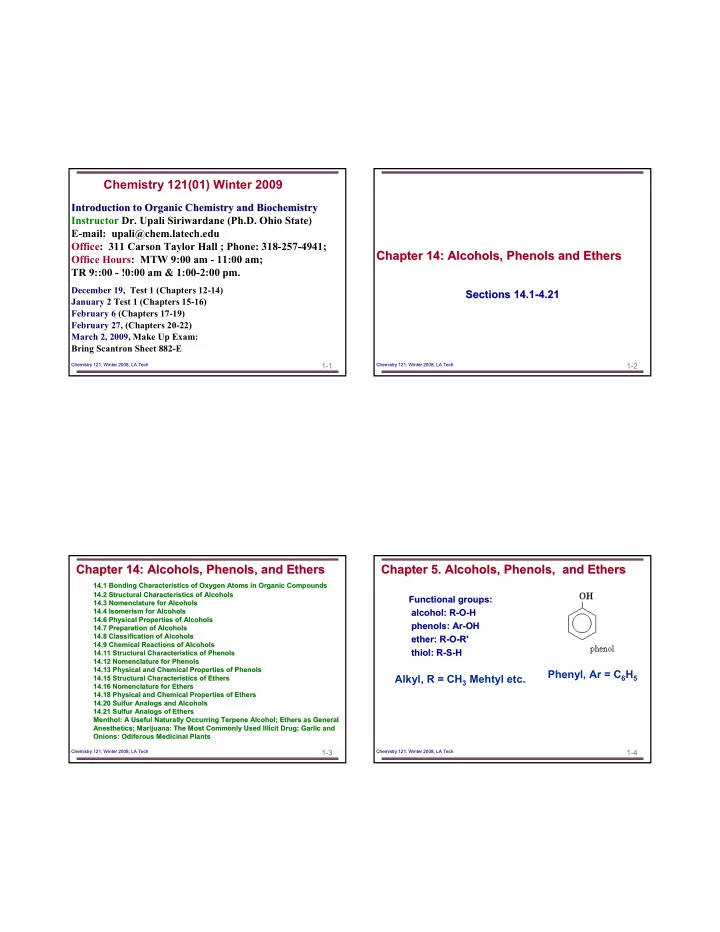
Introduction to Organic Chemistry and Biochemistry Introduction to Organic Chemistry and Biochemistry Instructor Dr. Upali Siriwardane (Ph.D. Ohio State) E-mail: upali@chem.latech.edu Office: 311 Carson Taylor Hall ; Phone: 318-257-4941; Office Hours: MTW 9:00 am - 11:00 am; TR 9::00 - !0:00 am & 1:00-2:00 pm.

December 19, Test 1 (Chapters 12-14) January 2 Test 1 (Chapters 15-16) February 6 (Chapters 17-19) February 27, (Chapters 20-22) March 2, 2009, Make Up Exam: Bring Scantron Sheet 882-E

Chemistry 121(01) Winter 2009

1-2

Chemistry 121, Winter 2008, LA Tech Chemistry 121, Winter 2008, LA Tech

Chapter 14: Chapter 14: Alcohols, Phenols and Ethers Alcohols, Phenols and Ethers

Sections 14.1 Sections 14.1-

  • 4.21

4.21

1-3

Chemistry 121, Winter 2008, LA Tech Chemistry 121, Winter 2008, LA Tech

Chapter 14: Chapter 14: Alcohols, Phenols, and Ethers Alcohols, Phenols, and Ethers

14.1 Bonding Characteristics of Oxygen Atoms in Organic Compound 14.1 Bonding Characteristics of Oxygen Atoms in Organic Compounds s 14.2 Structural Characteristics of Alcohols 14.2 Structural Characteristics of Alcohols 14.3 Nomenclature for Alcohols 14.3 Nomenclature for Alcohols 14.4 Isomerism for Alcohols 14.4 Isomerism for Alcohols 14.6 Physical Properties of Alcohols 14.6 Physical Properties of Alcohols 14.7 Preparation of Alcohols 14.7 Preparation of Alcohols 14.8 Classification of Alcohols 14.8 Classification of Alcohols 14.9 Chemical Reactions of Alcohols 14.9 Chemical Reactions of Alcohols 14.11 Structural Characteristics of Phenols 14.11 Structural Characteristics of Phenols 14.12 Nomenclature for Phenols 14.12 Nomenclature for Phenols 14.13 Physical and Chemical Properties of Phenols 14.13 Physical and Chemical Properties of Phenols 14.15 Structural Characteristics of Ethers 14.15 Structural Characteristics of Ethers 14.16 Nomenclature for Ethers 14.16 Nomenclature for Ethers 14.18 Physical and Chemical Properties of Ethers 14.18 Physical and Chemical Properties of Ethers 14.20 Sulfur Analogs and Alcohols 14.20 Sulfur Analogs and Alcohols 14.21 Sulfur Analogs of Ethers 14.21 Sulfur Analogs of Ethers Menthol: A Useful Naturally Occurring Menthol: A Useful Naturally Occurring Terpene Terpene Alcohol; Ethers as General Alcohol; Ethers as General Anesthetics; Marijuana: The Most Commonly Used Illicit Drug; Gar Anesthetics; Marijuana: The Most Commonly Used Illicit Drug; Garlic and lic and Onions: Odiferous Medicinal Plants Onions: Odiferous Medicinal Plants

1-4

Chemistry 121, Winter 2008, LA Tech Chemistry 121, Winter 2008, LA Tech

Chapter 5. Alcohols, Phenols, and Ethers Chapter 5. Alcohols, Phenols, and Ethers

Functional groups: Functional groups: alcohol: R alcohol: R-

  • O

O-

  • H

H phenols: phenols: Ar Ar-

  • OH

OH ether: R ether: R-

  • O

O-

  • R'

R' thiol thiol: R : R-

  • S

S-

  • H

H

Phenyl, Ar = C6H5 Alkyl, R = CH3 Mehtyl etc.

slide-2
SLIDE 2

1-5

Chemistry 121, Winter 2008, LA Tech Chemistry 121, Winter 2008, LA Tech

Nomenclature of compounds Nomenclature of compounds containing functional groups containing functional groups

The IUPAC system deals with functional The IUPAC system deals with functional groups two different ways. groups two different ways. Modification of the hydrocarbon name to Modification of the hydrocarbon name to indicate the presence of a functional group. indicate the presence of a functional group. alcohol, alcohol, -

  • OH

OH use use -

  • ol
  • l ending.

ending. ether: CH ether: CH3

3CH

CH2

2-

  • O

O-

  • CH

CH3

3

use use methoxy methoxy methoxy methoxy ethane ethane thiol thiol: R : R-

  • S

S-

  • H

H use use -

  • thiol

thiol ending. ending.

1-6

Chemistry 121, Winter 2008, LA Tech Chemistry 121, Winter 2008, LA Tech

Alcohol example Alcohol example

C - C

  • C - C
  • C - C
  • C - O
  • O - H
  • H

Base c contai ains ns 4 ca 4 carb rbon

  • n
  • alka

lkane nam ame is e is but butane

  • rem

emove

  • ve -
  • e

e an and ad d add d -

  • ol
  • l
  • l
  • l

al alcoho cohol n name me

  • butan

anol

  • l

OH is is on

  • n t

the firs first t ca carbon

  • n so

so -

  • 1

1-

  • bu

butanol bu butanol 1-7

Chemistry 121, Winter 2008, LA Tech Chemistry 121, Winter 2008, LA Tech

Alcohols Alcohols -

  • Structure

Structure

The functional group of an alcohol The functional group of an alcohol is an is an -

  • OH group bonded to an

OH group bonded to an sp sp3

3 hybridized carbon

hybridized carbon

  • bond angles about the hydroxyl
  • xygen atom are approximately

109.5°

Oxygen is also Oxygen is also sp sp3

3 hybridized

hybridized

  • two sp3 hybrid orbitals form sigma

bonds to carbon and hydrogen

  • the remaining two sp3 hybrid
  • rbitals each contain an unshared

pair of electrons

1-8

Chemistry 121, Winter 2008, LA Tech Chemistry 121, Winter 2008, LA Tech

Alcohols Alcohols -

  • Nomenclature

Nomenclature

IUPAC names IUPAC names

  • the parent chain is the longest chain that contains the
  • OH group
  • number the parent chain in the direction that gives the
  • OH group the lower number
  • change the suffix -e

e to -ol

  • l

Common names Common names

  • name the alkyl group bonded to oxygen followed by the

word alcohol alcohol

slide-3
SLIDE 3

1-9

Chemistry 121, Winter 2008, LA Tech Chemistry 121, Winter 2008, LA Tech

Alcohols Alcohols -

  • Nomenclature

Nomenclature

Problem: Write the IUPAC name of each alcohol Problem: Write the IUPAC name of each alcohol

OH CH3( CH2)6CH2OH OH (a) (b) (c)

1-10

Chemistry 121, Winter 2008, LA Tech Chemistry 121, Winter 2008, LA Tech

Alcohols Alcohols -

  • Nomenclature

Nomenclature

Compounds containing Compounds containing

  • two -OH groups are named as diols,
  • three -OH groups are named as triols, etc.

CH3 CHCH2 HO OH CH2 CH2 OH OH CH2CHCH2 OH HO HO 1,2-Ethanediol (Ethylene glycol) 1,2-Propanediol (Propylene glycol) 1,2,3-Propanetriol (Glycerol, Glycerin) 1-11

Chemistry 121, Winter 2008, LA Tech Chemistry 121, Winter 2008, LA Tech

Alcohols Alcohols -

  • Nomenclature

Nomenclature

Unsaturated alcohols Unsaturated alcohols

  • the double bond is shown by the infix -en

en-

  • the hydroxyl group is shown by the suffix -ol
  • l
  • number the chain to give OH the lower number

5 2

OH

1 3 4 6

trans-3-hexene-1-ol (E)-3-hexene-1-ol 1-12

Chemistry 121, Winter 2008, LA Tech Chemistry 121, Winter 2008, LA Tech

Alcohols Alcohols -

  • Nomenclature

Nomenclature

Examples: Examples:

Ethanol (Ethyl alcohol) 1-Propanol (Propyl alcohol) 2-Propanol (Isopropyl alcohol) 1-Butanol (Butyl alcohol) OH OH OH OH 2-Butanol (sec-Butyl alcohol) 2-Methyl-1-propanol (Isobutyl alcohol) 2-Methyl-2-propanol (tert-Butyl alcohol) OH Cyclohexanol (Cyclohexyl alcohol) OH OH OH

slide-4
SLIDE 4

1-13

Chemistry 121, Winter 2008, LA Tech Chemistry 121, Winter 2008, LA Tech

Name the alcohol Name the alcohol

1-14

Chemistry 121, Winter 2008, LA Tech Chemistry 121, Winter 2008, LA Tech

Common names Common names

Ethyl alcohol Ethyl alcohol ethylene glycol ethylene glycol glycerol glycerol

1-15

Chemistry 121, Winter 2008, LA Tech Chemistry 121, Winter 2008, LA Tech

Classification of alcohols Classification of alcohols

Primary Primary Secondary Secondary Tertiary. Tertiary.

1-16

Chemistry 121, Winter 2008, LA Tech Chemistry 121, Winter 2008, LA Tech

slide-5
SLIDE 5

1-17

Chemistry 121, Winter 2008, LA Tech Chemistry 121, Winter 2008, LA Tech

1-18

Chemistry 121, Winter 2008, LA Tech Chemistry 121, Winter 2008, LA Tech

1-19

Chemistry 121, Winter 2008, LA Tech Chemistry 121, Winter 2008, LA Tech

1-20

Chemistry 121, Winter 2008, LA Tech Chemistry 121, Winter 2008, LA Tech

Physical Properties Physical Properties

Alcohols are polar compounds Alcohols are polar compounds

  • both the C-O and O-H bonds are polar covalent

δ- δ+ δ+ O H H H C H

slide-6
SLIDE 6

1-21

Chemistry 121, Winter 2008, LA Tech Chemistry 121, Winter 2008, LA Tech

Hydrogen Bonding Hydrogen Bonding

Alcohols associate in the liquid state by hydrogen Alcohols associate in the liquid state by hydrogen bonding bonding Hydrogen bonding: Hydrogen bonding: the attractive force between a the attractive force between a partial positive charge on hydrogen and a partial partial positive charge on hydrogen and a partial negative charge on a nearby oxygen, nitrogen, or negative charge on a nearby oxygen, nitrogen, or fluorine atom fluorine atom

  • the strength of hydrogen bonding in alcohols is

approximately 2 to 5 kcal/mol

  • hydrogen bonds are considerably weaker than covalent

bonds (for example, 110 kcal/mol for an O-H bond)

  • nonetheless, hydrogen bonding can have a significant

effect on physical properties

1-22

Chemistry 121, Winter 2008, LA Tech Chemistry 121, Winter 2008, LA Tech

Hydrogen Bonding Hydrogen Bonding

  • Figure 8.3 shows the association of ethanol molecules

in the liquid state (only two of the three possible hydrogen bonds to the upper oxygen are shown here).

1-23

Chemistry 121, Winter 2008, LA Tech Chemistry 121, Winter 2008, LA Tech

Boiling Points Boiling Points

  • alcohols have higher boiling points and are more

soluble in water than hydrocarbons

CH3CH2 CH2OH CH3CH2 CH2CH3 CH3OH CH3CH3 CH3CH2 OH CH3CH2 CH3 CH3CH2 CH2CH2CH2OH HOCH2CH2CH2CH2 OH CH3CH2 CH2CH2CH2CH3 Structural Formula Name Molecular Weight (g/mol) Boiling Point (°C) Solubility in Water methanol 32 65 infinite ethane 30

  • 89

insoluble ethanol 46 78 infinite propane 44

  • 42

insoluble 1-propanol 60 97 infinite butane 58 insoluble 1-pentanol 88 138 2.3 g/100 g 1,4-butanediol 90 230 infinite hexane 86 69 insoluble 1-24

Chemistry 121, Winter 2008, LA Tech Chemistry 121, Winter 2008, LA Tech

Conversion of ROH to RX Conversion of ROH to RX

  • water-soluble 3° alcohols react very rapidly with HCl,

HBr, and HI

  • low-molecular-weight 1° and 2° alcohols are unreactive

under these conditions

CH3COH CH3 CH3 HCl CH3 CCl CH3 CH3 H2O 2-Chloro-2- methylpropane 2-Methyl-2- propanol 25°C + +

slide-7
SLIDE 7

1-25

Chemistry 121, Winter 2008, LA Tech Chemistry 121, Winter 2008, LA Tech

Conversion of ROH to RX Conversion of ROH to RX

  • water-insoluble 3° alcohols react by bubbling gaseous

HCl through a solution of the alcohol dissolved in diethyl ether or THF

  • 1° and 2° alcohols require concentrated HBr and HI to

form alkyl bromides and iodides + HCl + H2O

OH CH3 0°C ether Cl CH3 1-Chloro-1-methyl cyclohexane 1-Methyl- cyclohexanol OH + HBr

+ H2O

1-Butanol 1-Bromobutane (Butyl bromide) Br 1-26

Chemistry 121, Winter 2008, LA Tech Chemistry 121, Winter 2008, LA Tech

Reaction of a 3 Reaction of a 3° ° ROH with HX ROH with HX

  • Step 2:

Step 2: loss of H2O from the oxonium ion gives a 3° carbocation intermediate

  • Step 3:

Step 3: reaction with halide ion completes the reaction

CH3-C CH3 CH3 O H H CH3 -C+ CH3 CH3 O H H slow, rate determining An oxonium ion + + A 3° carbocation intermediate SN 1 CH3-C+ CH3 CH3 Cl CH3-C Cl CH3 CH3 fast + 2-Chloro-2-methylpropane (tert-Butyl chloride) 1-27

Chemistry 121, Winter 2008, LA Tech Chemistry 121, Winter 2008, LA Tech

Reaction with SOCl Reaction with SOCl2

2

Thionyl Thionyl chloride, SOCl chloride, SOCl2

2, is the most widely used

, is the most widely used reagent for conversion of alcohols to alkyl reagent for conversion of alcohols to alkyl chlorides chlorides

OH SOCl

2

Cl SO2 HCl Thionyl chloride 1-Heptanol 1-Chloroheptane pyridine + + + 1-28

Chemistry 121, Winter 2008, LA Tech Chemistry 121, Winter 2008, LA Tech

Dehydration of Alcohols Dehydration of Alcohols

An alcohol can be converted to an An alcohol can be converted to an alkene alkene by by elimination of H and OH from adjacent carbons (a elimination of H and OH from adjacent carbons (a β β-

  • elimination)

elimination)

  • 1° alcohols must be heated at high temperature in the

presence of an acid catalyst, such as H2SO4 or H3PO4

  • 2° alcohols undergo dehydration at somewhat lower

temperatures

  • 3° alcohols often require temperatures only at or

slightly above room temperature

slide-8
SLIDE 8

1-29

Chemistry 121, Winter 2008, LA Tech Chemistry 121, Winter 2008, LA Tech

Dehydration of Alcohols Dehydration of Alcohols

  • examples:

140oC Cyclohexanol Cyclohexene OH + H 2 O H2 SO4 180oC CH3 CH2 OH H2 SO4 CH2 =CH 2 + H

2 O

+ H2 O CH3 COH CH3 CH3 50oC H2 SO4 CH3 C= CH2 CH3 2-Methylpropene (Isobutylene)

1-30

Chemistry 121, Winter 2008, LA Tech Chemistry 121, Winter 2008, LA Tech

Hydration Hydration-

  • Dehydration

Dehydration

Acid Acid-

  • catalyzed hydration of an

catalyzed hydration of an alkene alkene and and dehydration of an alcohol are competing dehydration of an alcohol are competing processes processes

  • large amounts of water favor alcohol formation
  • scarcity of water or experimental conditions where

water is removed favor alkene formation

An alkene An alcohol C C H OH H2O acid catalyst + C C 1-31

Chemistry 121, Winter 2008, LA Tech Chemistry 121, Winter 2008, LA Tech

Oxidation of Alcohols Oxidation of Alcohols

Oxidation of a 1 Oxidation of a 1° ° alcohol gives an alcohol gives an aldehyde aldehyde or a

  • r a

carboxylic acid, depending on the oxidizing agent carboxylic acid, depending on the oxidizing agent and experimental conditions and experimental conditions

  • the most common oxidizing agent is chromic acid
  • chromic acid oxidation of 1-octanol gives octanoic acid

CrO3 H2O H2SO4 H2CrO4 + Chromic acid Chromium(VI)

  • xide

CH3(CH2)6CH2OH CrO3 H2SO4 , H2O CH3(CH2)6CH O CH3(CH2)6COH O Octanal (not isolated) Octanoic acid 1-Octanol 1-32

Chemistry 121, Winter 2008, LA Tech Chemistry 121, Winter 2008, LA Tech

Oxidation of Alcohols Oxidation of Alcohols

  • to oxidize a 1° alcohol to an aldehyde, use PCC
  • PCC oxidation of geraniol gives geranial

Tertiary alcohols are not oxidized by either of these Tertiary alcohols are not oxidized by either of these reagents; they are resistant to oxidation reagents; they are resistant to oxidation

CrO3 HCl N N H CrO3Cl- Pyridinium chlorochromate (PCC) Pyridine + + +

OH PCC CH2Cl2 H O Geraniol Geranial

slide-9
SLIDE 9

1-33

Chemistry 121, Winter 2008, LA Tech Chemistry 121, Winter 2008, LA Tech

Acidity of Alcohols Acidity of Alcohols

  • pKa values for several low-molecular-weight alcohols

(CH3 )3COH (CH3 )2CHOH CH3 CH2OH H2O CH3 OH CH3 COOH HCl Compound pKa

  • 7

15.5 15.7 15.9 17 18 4.8 hydrogen chloride acetic acid methanol water ethanol 2-propanol 2-methyl-2-propanol Structural Formula Stronger acid Weaker acid *Also given for comparison are pKa values for water, acetic acid, and hydrogen chloride. 1-34

Chemistry 121, Winter 2008, LA Tech Chemistry 121, Winter 2008, LA Tech

Reaction with Active Metals Reaction with Active Metals

Alcohols react with Li, Na, K, and other active Alcohols react with Li, Na, K, and other active metals to liberate hydrogen gas and form metal metals to liberate hydrogen gas and form metal alkoxides alkoxides

  • Na is oxidized to Na+ and H+ is reduced to H2
  • alkoxides are somewhat stronger bases that OH-
  • alkoxides can be used as nucleophiles in nucleophilic

substitution reactions

  • they can also be used as bases in β-elimination

reactions 2CH3CH2OH 2Na 2CH3CH2O-Na+ H2 + + Sodium ethoxide

1-35

Chemistry 121, Winter 2008, LA Tech Chemistry 121, Winter 2008, LA Tech

Conversion of ROH to RX Conversion of ROH to RX

Conversion of an alcohol to an alkyl halide involves Conversion of an alcohol to an alkyl halide involves substitution of halogen for substitution of halogen for -

  • OH at a saturated

OH at a saturated carbon carbon

  • the most common reagents for this purpose are the

halogen acids, HX, and thionyl chloride, SOCl2

1-36

Chemistry 121, Winter 2008, LA Tech Chemistry 121, Winter 2008, LA Tech

Ethers Ethers -

  • Structure

Structure

The functional group of an ether is an oxygen atom The functional group of an ether is an oxygen atom bonded to two carbon atoms bonded to two carbon atoms

  • oxygen is sp3 hybridized with bond angles of

approximately 109.5°

  • in dimethyl ether, the C-O-C bond angle is 110.3°

H H O H C H H H C

slide-10
SLIDE 10

1-37

Chemistry 121, Winter 2008, LA Tech Chemistry 121, Winter 2008, LA Tech

Naming Ethers Naming Ethers

2 2-

  • propoxybutane

propoxybutane 2 2-

  • methoxyphenol

methoxyphenol ethoxycyclopropane ethoxycyclopropane isopropyl isopropyl propyl propyl ether ether methyl phenyl ether methyl phenyl ether

1-38

Chemistry 121, Winter 2008, LA Tech Chemistry 121, Winter 2008, LA Tech

Ethers Ethers -

  • Nomenclature

Nomenclature

IUPAC IUPAC

  • the longest carbon chain is the parent alkane
  • name the -OR group as an alkoxy substituent

Common names: Common names:

  • name the groups bonded to oxygen followed by the word ether

ether CH3 CH3 CH3OCCH3 O Et 2O OH OEt Ethoxyethane (Diethyl ether) 2-Methoxy-2-methylpropane (methyl t ert-butyl ether, MTBE) trans-2-Ethoxycyclohexanol 1-39

Chemistry 121, Winter 2008, LA Tech Chemistry 121, Winter 2008, LA Tech

Ethers Ethers -

  • Nomenclature

Nomenclature

Although cyclic ethers have IUPAC names, their Although cyclic ethers have IUPAC names, their common names are more widely used common names are more widely used

Ethylene

  • xide

Tetrahydro- furan, THF Tetrahydro- pyran 1,4-Dioxane O O O O O 1-40

Chemistry 121, Winter 2008, LA Tech Chemistry 121, Winter 2008, LA Tech

Ethers Ethers -

  • Physical Properties

Physical Properties

Ethers are polar molecules Ethers are polar molecules

  • each C-O bond is polar covalent
  • however, only weak attractive forces exist between

ether molecules

slide-11
SLIDE 11

1-41

Chemistry 121, Winter 2008, LA Tech Chemistry 121, Winter 2008, LA Tech

Ethers Ethers -

  • Physical Properties

Physical Properties

  • boiling points are lower than those of alcohols

CH3CH2 OH CH3OCH3 CH3CH2 CH2CH2CH2OH HOCH2CH2CH2CH2 OH CH3CH2 CH2CH2OCH3 CH3CH2 CH2CH2OH CH3CH2 OCH2CH3 CH3OCH2CH2OCH3 ethylene glycol dimethyl ether 90 84 infinite 8 g/100 g 35 74 diethyl ether 1-butanol 74 117 7.4 g/100 g slight 71 88 butyl methyl ether infinite 230 90 1,4-butanediol 2.3 g/100 g 138 88 1-pentanol 7.8 g/100 g

  • 24

46 dimethyl ether infinite 78 46 ethanol Solubility in Water Boiling Point (°C) Molecular Weight Name Structural Formula 1-42

Chemistry 121, Winter 2008, LA Tech Chemistry 121, Winter 2008, LA Tech

Ethers Ethers -

  • Physical Properties

Physical Properties

  • ethers are hydrogen bond donors

1-43

Chemistry 121, Winter 2008, LA Tech Chemistry 121, Winter 2008, LA Tech

Ethers Ethers -

  • Physical Properties

Physical Properties

  • the effect of hydrogen bonding is illustrated by

comparing the boiling points of ethanol and dimethyl ether

CH3CH2OH CH3OCH3 bp -24°C Ethanol bp 78°C Dimethyl ether

1-44

Chemistry 121, Winter 2008, LA Tech Chemistry 121, Winter 2008, LA Tech

Reactions of Ethers Reactions of Ethers

Ethers resemble hydrocarbons in their resistance Ethers resemble hydrocarbons in their resistance to chemical reaction to chemical reaction

  • they do not react with strong oxidizing agents such as

chromic acid, H2CrO4

  • they are not affected by most acids and bases at

moderate temperatures

Because of their good solvent properties and Because of their good solvent properties and general inertness to chemical reaction, ethers are general inertness to chemical reaction, ethers are excellent solvents in which to carry out organic excellent solvents in which to carry out organic reactions reactions

slide-12
SLIDE 12

1-45

Chemistry 121, Winter 2008, LA Tech Chemistry 121, Winter 2008, LA Tech

Epoxides Epoxides

Epoxide Epoxide: : a cyclic ether in which oxygen is one atom a cyclic ether in which oxygen is one atom

  • f a three
  • f a three-
  • membered

membered ring ring

  • ethylene oxide is synthesized from ethylene and O2

C C O H2C CH2 O CH3CH CH2 O Functional group

  • f an epoxide

Ethylene oxide Propylene oxide CH2=CH2 O

2

Ag CH2 CH2 O + heat Ethylene Ethylene oxide 1-46

Chemistry 121, Winter 2008, LA Tech Chemistry 121, Winter 2008, LA Tech

Epoxides Epoxides

  • other epoxides are synthesized from an alkene and a

peroxycarboxylic acid, RCO3H

RCOOH O CH2Cl2 O H H RCOH O A carboxylic acid 1,2-Epoxycyclohexane (Cyclohexene oxide) A peroxy- carboxylic acid Cyclohexene + + 1-47

Chemistry 121, Winter 2008, LA Tech Chemistry 121, Winter 2008, LA Tech

Reactions of Reactions of Epoxides Epoxides

  • ethers are generally unreactive to aqueous acid
  • epoxides, however, react readily because of the angle

strain in the three-membered ring

  • reaction of an epoxide with aqueous acid gives a glycol

CH2 CH2 O H2O H+ HOCH2CH2OH + 1,2-Ethanediol (Ethylene glycol) Ethylene oxide + H2O H+ 1,2-Epoxycyclopentane (Cyclopentene oxide) trans-1,2-Cyclopentanediol OH OH O H H 1-48

Chemistry 121, Winter 2008, LA Tech Chemistry 121, Winter 2008, LA Tech

A A Cycloalkene Cycloalkene to a Glycol to a Glycol

  • both cis and trans glycols can be prepared

RCO3H OsO4, t-BuOOH O H H H+ OH OH H2O OH OH trans-1,2-Cyclopentanediol cis-1,2-Cyclopentanediol

slide-13
SLIDE 13

1-49

Chemistry 121, Winter 2008, LA Tech Chemistry 121, Winter 2008, LA Tech

Other Other Epoxide Epoxide Ring Openings Ring Openings

  • the value of epoxides lies in the number of

nucleophiles that will bring about ring opening, and the combinations of functional groups that can be synthesized from them

H2O/ H3O+ CH H2C O CH3 Na+SH-/ H2O NH3 A β-mercaptoalcohol Methyloxirane (Propylene oxide) A β-aminoalcohol A glycol HS CH3 OH H2N CH3 OH HO CH3 OH α α α β β β 1-50

Chemistry 121, Winter 2008, LA Tech Chemistry 121, Winter 2008, LA Tech

Epoxides Epoxides as Building Blocks as Building Blocks

  • following are structural formulas for two common

drugs, each synthesized in part from ethylene oxide

O N O CH3 CH3 H2N O N CH3 CH3 Procaine (Novocaine) Diphenhydramine (Benadryl) 1-51

Chemistry 121, Winter 2008, LA Tech Chemistry 121, Winter 2008, LA Tech

Phenols Phenols

The functional group of a phenol is an The functional group of a phenol is an -

  • OH group

OH group bonded to a benzene ring bonded to a benzene ring

1,2-Benzenediol (Catechol) 1,4-Benzenediol (Hydroquinone) 3-Methylphenol (m-Cresol) Phenol OH OH OH OH OH CH3 OH 1-52

Chemistry 121, Winter 2008, LA Tech Chemistry 121, Winter 2008, LA Tech

Phenols Phenols

  • some phenols

OH OH OH OCH3 OH OH Hexylresorcinol Eugenol Urushiol

OH CHO OH OCH3 2-Isopropyl-5-methylphenol (Thymol) 4-Hydroxy-3-methoxybenzaldehyde (Vanillin)

slide-14
SLIDE 14

1-53

Chemistry 121, Winter 2008, LA Tech Chemistry 121, Winter 2008, LA Tech

Acidity of Phenols Acidity of Phenols

Phenols are significantly more acidic than alcohols Phenols are significantly more acidic than alcohols

pKa = 9.95 OH O- Phenol Phenoxide ion + H2O + H3O+ CH3CH2OH H2O CH3CH2O- H3O+ pKa = 15.9 Ethanol Ethoxide ion + + 1-54

Chemistry 121, Winter 2008, LA Tech Chemistry 121, Winter 2008, LA Tech

Naming Phenols Naming Phenols

2 3 4 5 6

  • m
  • m

p

1-55

Chemistry 121, Winter 2008, LA Tech Chemistry 121, Winter 2008, LA Tech

Naming Naming thiols thiols

1-56

Chemistry 121, Winter 2008, LA Tech Chemistry 121, Winter 2008, LA Tech

Thiols Thiols -

  • Structure

Structure

The functional group of a The functional group of a thiol thiol is an is an -

  • SH (

SH (sulfhydryl sulfhydryl) ) group bonded to an group bonded to an sp sp3

3 hybridized carbon

hybridized carbon

slide-15
SLIDE 15

1-57

Chemistry 121, Winter 2008, LA Tech Chemistry 121, Winter 2008, LA Tech

Thiols Thiols -

  • Nomenclature

Nomenclature

IUPAC names: IUPAC names:

  • the parent chain is the longest chain containing the
  • SH group
  • add -thiol

thiol to the name of the parent chain

Common names: Common names:

  • name the alkyl group bonded to sulfur followed by the

word mercaptan mercaptan

  • alternatively, indicate the -SH by the prefix mercapto

mercapto

Ethanethiol (Ethyl mercaptan) 2-Methyl-1-propanethiol (Isobutyl mercaptan) 2-Mercaptoethanol SH SH HS OH 1-58

Chemistry 121, Winter 2008, LA Tech Chemistry 121, Winter 2008, LA Tech

Thiols Thiols -

  • Physical Properties

Physical Properties

Low Low-

  • molecular

molecular-

  • weight

weight thiols thiols have a have a STENCH STENCH

CH3CH=CHCH2 SH CH3CHCH2CH2SH CH3 3-Methyl-1-butanethiol (Isobutyl mercaptan) 2-Butene-1-thiol Present in the scent of skunks: CH3-C-SH CH3 CH3 CH3-CH-CH3 SH Natural gas

  • dorants:

2-Methyl-2-propanethiol (tert-Butyl mercaptan) 2-Propanethiol (Isopropyl mercaptan) 1-59

Chemistry 121, Winter 2008, LA Tech Chemistry 121, Winter 2008, LA Tech

Thiols Thiols -

  • Physical Properties

Physical Properties

The difference in The difference in electronegativity electronegativity between S and H between S and H is 2.5 is 2.5 -

  • 2.1 = 0.4

2.1 = 0.4 Because of their low polarity, Because of their low polarity, thiols thiols

  • show little association by hydrogen bonding
  • have lower boiling points and are less soluble in water

than alcohols of comparable MW

117 78 65 1-butanol ethanol methanol 98 35 6 1-butanethiol ethanethiol methanethiol Alcohol Boiling Point (°C) Thiol Boiling Point (°C) 1-60

Chemistry 121, Winter 2008, LA Tech Chemistry 121, Winter 2008, LA Tech

Acidity of Acidity of Thiols Thiols

Thiols Thiols are stronger acids than alcohols are stronger acids than alcohols Thiols Thiols react with strong bases to form salts react with strong bases to form salts

CH3CH2SH CH3CH2OH H2O H2O CH3CH2S- CH3CH2O- H3O+ H3O+ pKa = 8.5 pKa = 15.9 + + + + CH3CH2SH Na+OH- CH3CH2S-Na+ H2O + + Stronger acid Stronger base Weaker base Weaker acid pKa 8.5 pKa 15.7

slide-16
SLIDE 16

1-61

Chemistry 121, Winter 2008, LA Tech Chemistry 121, Winter 2008, LA Tech

Oxidation of Oxidation of Thiols Thiols

thiols thiols are oxidized by a variety of oxidizing agents, are oxidized by a variety of oxidizing agents, including O including O2

2, to disulfides

, to disulfides disulfides, in turn, are easily reduced to disulfides, in turn, are easily reduced to thiols thiols by by several reagents several reagents

  • this easy interconversion between thiols and disulfides

is very important in protein chemistry

2HOCH2CH2SH HOCH2CH2S-SCH2CH2OH A disulfide

  • xidation

reduction A thiol