Chemical indicators for rapid assessment of human fecal pollution in - - PowerPoint PPT Presentation

chemical indicators for rapid assessment of human fecal
SMART_READER_LITE
LIVE PREVIEW

Chemical indicators for rapid assessment of human fecal pollution in - - PowerPoint PPT Presentation

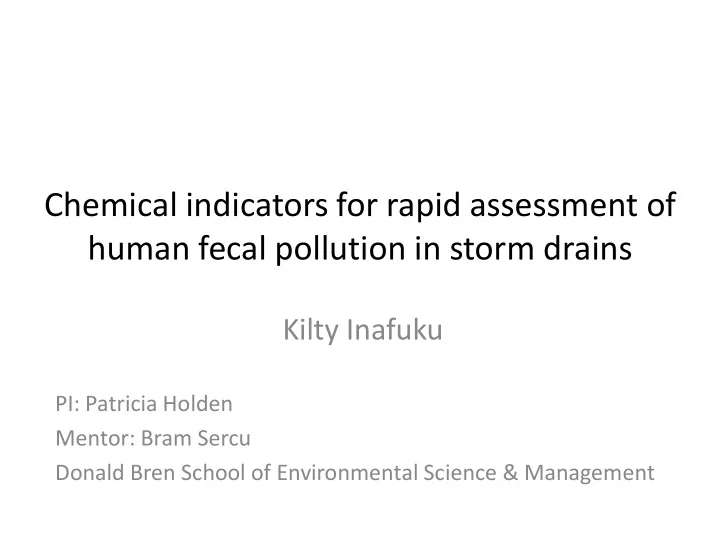
Chemical indicators for rapid assessment of human fecal pollution in storm drains Kilty Inafuku PI: Patricia Holden Mentor: Bram Sercu Donald Bren School of Environmental Science & Management Beach Contamination Historically high fecal


slide-1
SLIDE 1

Chemical indicators for rapid assessment of human fecal pollution in storm drains

Kilty Inafuku

PI: Patricia Holden Mentor: Bram Sercu Donald Bren School of Environmental Science & Management

slide-2
SLIDE 2

Beach Contamination

  • Historically high fecal contamination in dry weather
  • Human fecal pollution most likely to cause illness
slide-3
SLIDE 3
  • Identify sources of human fecal pollution in storm drains
  • Use chemical indicators as a diagnostic

Project Goals

Compare colorimetric, fecal indicator bacteria, & DNA-based methods

slide-4
SLIDE 4
  • 1. Measure chemical indicators
  • 2. Check accuracy of device
  • 3. Check sample matrix interference

Colorimetric Method

  • NH3-N
  • NO3-N
  • Surfactants
  • SO4
  • PO4
slide-5
SLIDE 5
  • 1. Measure fecal indicator bacteria (FIB)
  • 2. Human specific DNA-based method
  • Extract DNA
  • Amplify DNA for Methanobrevibacter smithii nifH (Mnif) gene

Microbiological Methods

slide-6
SLIDE 6

Accuracy of Colorimetric Assay

y = 0.8502x + 0.0724 R² = 0.9998 0.00 0.50 1.00 1.50 2.00 2.50 3.00 3.50 0.00 1.00 2.00 3.00 4.00 Observed Concentration (ppm) Actual Concentration (ppm)

NH3-N Standard Curve

0.00 0.50 1.00 1.50 2.00 2.50 3.00 M9 SC3 SC9 Concentration (ppm)

NH3-N Standard Additions

unspiked spiked expected 1.29% 1.15% 9.50% storm drain 1 creek storm drain 2

slide-7
SLIDE 7

pristine creek ground storm drain creek

  • cean
slide-8
SLIDE 8

0.00 0.10 0.20 0.30 0.40 0.50 0.60 0.70 0.00 1.00 2.00 3.00 4.00 5.00 6.00 7.00 8.00 9.00 10.00 11.00 12.00 M29 M30 M21 M2 M9 M9 M9 M13 M13 M13 M14 M15 M16 M17 M19 M23 M31 M18 M20 M22 M24 M26 M28 M32 M25 M27 Surfactants Concentration (ppm) Concentration (ppm)

Variability in Chemical Indicator Concentrations

NH3-N NO3-N PO4 SO4 Surfactants

  • cean

creek storm drain pristine creek ground

slide-9
SLIDE 9

Chemical indicators are higher in sewage

10 20 30 40 50 60 70

  • 0.5

0.5 1 1.5 2 2.5 3 3.5 Concentration in Sewage (ppm) Concentration (ppm)

NH3-N

1 2 3 4 5 6 7 8 9 10 11 12 13 0.5 1.5 2.5 3.5 4.5 5.5 Concentration (ppm)

PO4

  • 0.5

0.5 1 1.5 2 Concentration (ppm)

Surfactants

slide-10
SLIDE 10
  • 2

2 4 6 8 10 12 14 Concentration (ppm)

NO3-N

500 1000 1500 2000 2500 SO4 Concentration (ppm)

SO4

Chemical indicators NOT higher in sewage

slide-11
SLIDE 11

Mnif Presence

slide-12
SLIDE 12
  • 2.00

0.00 2.00 4.00 6.00 8.00 10.00 Concentration (ppm)

NH3-N

0.00 1.00 2.00 3.00 4.00 5.00 6.00 Concentration (ppm)

PO4

  • 0.4
  • 0.2

0.2 0.4 0.6 0.8 1 1.2 1.4 1.6 Concentration (ppm)

Surfactants

Chemical indicator concentrations vs. Mnif presence/absence

present absent present absent present absent

  • 2.00

0.00 2.00 4.00 6.00 8.00 10.00 12.00 14.00 Concentration (ppm)

NO3-N

present absent

slide-13
SLIDE 13

0.0 0.5 1.0 1.5 2.0 2.5 3.0 3.5 4.0 4.5 5.0 Concentration (ppm)

log (EC)

0.0 0.5 1.0 1.5 2.0 2.5 3.0 3.5 4.0 4.5 5.0 Concentration (ppm)

log (ENT)

present absent present absent

slide-14
SLIDE 14
  • Improve accuracy of colorimetry
  • Using standard curves
  • Matrix interferences
  • Human fecal contamination in several storm drains
  • Highest concentrations of chemical indicators

 sewage pollution

Conclusions

slide-15
SLIDE 15
  • Analyze more samples
  • Use quantitative PCR assay for sewage pollution
  • Include other sewage indicators (caffeine, cotinine)

Future Work

slide-16
SLIDE 16

UC Leadership Excellence through Advanced Degrees (UC LEADS) Arica Lubin Matt Crossley Patricia Holden Bram Sercu Student Academic Preparation and Educational Partnerships (SAPEP) City of Santa Barbara, Creeks Division

Acknowledgements