Captain Accomplishments Jason Lee Straw In 2008 created, developed - - PowerPoint PPT Presentation

captain
SMART_READER_LITE
LIVE PREVIEW

Captain Accomplishments Jason Lee Straw In 2008 created, developed - - PowerPoint PPT Presentation

Captain Accomplishments Jason Lee Straw In 2008 created, developed and implemented a hospital wide up-grade training for USAF, Nurse all in-patient nurses at Travis AFB, California to prepare them to take higher acuity patients and


slide-1
SLIDE 1

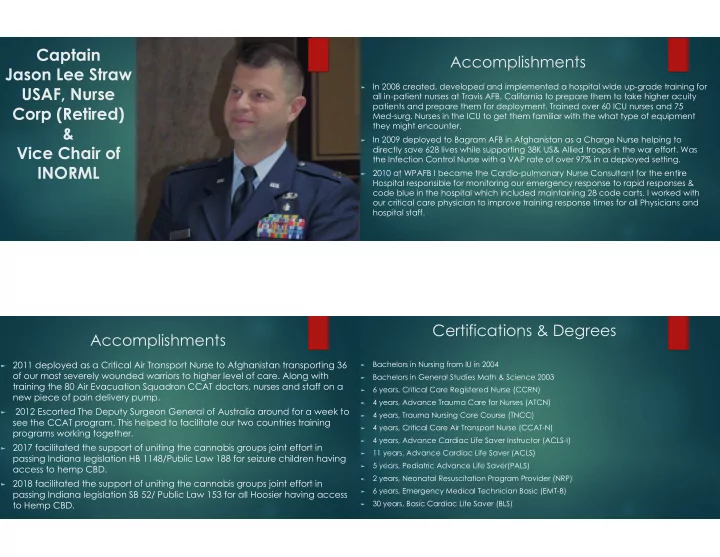
Captain Jason Lee Straw USAF, Nurse Corp (Retired) & Vice Chair of INORML

Accomplishments

In 2008 created, developed and implemented a hospital wide up-grade training for all in-patient nurses at Travis AFB, California to prepare them to take higher acuity patients and prepare them for deployment. Trained over 60 ICU nurses and 75 Med-surg. Nurses in the ICU to get them familiar with the what type of equipment they might encounter.

In 2009 deployed to Bagram AFB in Afghanistan as a Charge Nurse helping to directly save 628 lives while supporting 38K US& Allied troops in the war effort. Was the Infection Control Nurse with a VAP rate of over 97% in a deployed setting.

2010 at WPAFB I became the Cardio-pulmonary Nurse Consultant for the entire Hospital responsible for monitoring our emergency response to rapid responses & code blue in the hospital which included maintaining 28 code carts. I worked with

  • ur critical care physician to improve training response times for all Physicians and

hospital staff.

Accomplishments

► 2011 deployed as a Critical Air Transport Nurse to Afghanistan transporting 36

  • f our most severely wounded warriors to higher level of care. Along with

training the 80 Air Evacuation Squadron CCAT doctors, nurses and staff on a new piece of pain delivery pump.

► 2012 Escorted The Deputy Surgeon General of Australia around for a week to

see the CCAT program. This helped to facilitate our two countries training programs working together.

► 2017 facilitated the support of uniting the cannabis groups joint effort in

passing Indiana legislation HB 1148/Public Law 188 for seizure children having access to hemp CBD.

► 2018 facilitated the support of uniting the cannabis groups joint effort in

passing Indiana legislation SB 52/ Public Law 153 for all Hoosier having access to Hemp CBD.

Certifications & Degrees

Bachelors in Nursing from IU in 2004

Bachelors in General Studies Math & Science 2003

6 years, Critical Care Registered Nurse (CCRN)

4 years, Advance Trauma Care for Nurses (ATCN)

4 years, Trauma Nursing Core Course (TNCC)

4 years, Critical Care Air Transport Nurse (CCAT-N)

4 years, Advance Cardiac Life Saver Instructor (ACLS-I)

11 years, Advance Cardiac Life Saver (ACLS)

5 years, Pediatric Advance Life Saver(PALS)

2 years, Neonatal Resuscitation Program Provider (NRP)

6 years, Emergency Medical Technician Basic (EMT-B)

30 years, Basic Cardiac Life Saver (BLS)

slide-2
SLIDE 2

American Nurses Association

The American Nurses Association (ANA) had an article in November 2019 urging all state nursing association to adopt a policy to address cannabis. (1)

NCSBN Suggestions

1) State Law

2) State/Federal Cannabis Programs

3) Endocannabinoid System

4) Cannabis Pharmacology

5) Safety Concerns

6) Nurses trained to be without judgement of patient choice.

Current Legal Federal & State Cannabis products

1) Federal Medical Marijuana Patients from the IND program. (1978)

2) Marinol (synthetic THC) a schedule 3 FDA approved medication since 1985

3) EPIDIOLEX a hemp plant extract full spectrum CBD schedule 5, FDA approved treatment.

4) Over The Count Hemp products

5) Hemp seeds

Everyone has an Endocannabinoid System (2)

HTTPS://HEALER.COM/THE-EN DOCANNABINOID-SYSTEM/

slide-3
SLIDE 3

CB1 is primarily nervous system. CB2 is primarily immune system (3)

HTTPS://WWW.VITALIBIS.COM /BEWELL/ENDOCANNABINOI D-SYSTEM-OVERVIEW.HTML

► Yet we

didn’t ban grapefruit!? (4)

slide-4
SLIDE 4

You can take cannabis in a similar way to taking your current medications (6)

HTTPS://ALTMEDFLORIDA.CO M/FOR-PHYSICIANS/

Possible side effects at present are much shorter than current FDA approved medication side effects for similar conditions usually. (6)

HTTPS://WWW.INSPIREMALIB U.COM/BLOG/DRUG-ADDIC TION/11-NEGATIVE-SIDE-EFFE CTS-OF-USING-MARIJUANA/

The National Academies of Science, Engineering and Medicine 2017 Report on The Health Effects of Cannabis & Cannabinoids (7)

The Health Effects of Cannabis and Cannabinoids: The Current State of Evidence and Recommendations for Research (2017)

Chapter 4 Conclusions—Therapeutic Effects of Cannabis and Cannabinoids There is conclusive or substantial evidence that cannabis or cannabinoids are effective:

  • For the treatment of chronic pain in adults (cannabis) (4-1)
  • As antiemetics in the treatment of chemotherapy-induced

nausea and vomiting (oral cannabinoids) (4-3)

  • For improving patient-reported multiple sclerosis spasticity

symptoms (oral cannabinoids) (4-7a) There is moderate evidence that cannabis or cannabinoids are effective for:

  • Improving short-term sleep outcomes in individuals with sleep disturbance associated with
  • bstructive sleep apnea syndrome, fibromyalgia, chronic pain, and multiple sclero- sis

(cannabinoids, primarily nabiximols) (4-19) https://download.nap.edu/cart/download.cgi?record_id=24625

slide-5
SLIDE 5

This study reveals that fibromyalgia patients get substantial relief from cannabis 62%

  • ver FDA approved

medications 8 to 10%. (8)

HTTPS://WWW.PRACTICALPAI NMANAGEMENT.COM/TREA TMENTS/PHARMACOLOGIC AL/NON-OPIOIDS/USE-MEDI CAL-MARIJUANA-PAIN-CAN ADA

The reason cannabis seems to be a cure all is because Endocannabinoid system regulates

  • homeostasis. (9)

HTTPS://WWW.WISHINGWELL NESSMEDICAL.COM/BLOGTE MPLATE/2019/4/2/CANNABIS MARIJUANA-HELPING-BABY- BOOMERS-ALLEVIATE-SYMPT OMS-OF-AGING

Indiana State Nurse Association Cannabis Proposed Policy Change Page 1a

8515 Georgia Avenue, Suite 400 Silver Spring, MD 20910 www.nursingworld.org

Therapeutic Use of Marijuana and Related Cannabinoids

Effective Date: 2020

Status: Position Statement

Written by: ISNA Center for Ethics and Human Rights

Adopted by: ISNA Board of Directors

Purpose: The purpose of this statement is to reiterate the Indiana State Nurses Association’s (ISNA) support for the review and reclassification of marijuana’s status from a federal Schedule I controlled substances to facilitate urgently needed clinical research to inform patients and providers on the efficacy of marijuana and related cannabinoids.

slide-6
SLIDE 6

Indiana State Nurse Association Cannabis Proposed Policy Change Page 1b

This position statement speaks only to the use of marijuana and related cannabinoids in the context of health care. It addresses the roles and responsibilities

  • f nurses related to the use of cannabinoids for health
  • care. Statement of ISNA Position Marijuana and its

derivatives continue to be used to alleviate disease-related symptoms and side effects. The findings of anecdotal and controlled studies regarding the efficacy for patient use are mixed. Current federal regulations impede the research necessary to evaluate and determine the therapeutic use of marijuana and related cannabinoids. This position statement does not extend to the current debate on the legalization of marijuana for recreational

  • purposes. The goal is to develop an evidence-based

approach to its use in the treatment of disease and symptom management.

Indiana State Nurse Association Cannabis Proposed Policy Change Page 1c

Recommendations “It is the shared responsibility of professional nursing

  • rganizations to speak for nurses collectively

in shaping health care and to promulgate change for the improvement of health and health care” (ANA, 2015, p. 36).

Therefore, the ISNA strongly supports:

∙ Scientific review of marijuana’s status as a federal Schedule I controlled substance and relisting marijuana as a federal Schedule II or lower controlled substance for purposes of facilitating research.

∙ Development of prescribing standards that includes indications for use, specific dose, route, expected effect and possible side effects, as well as indications for stopping a medication.

∙ Establishing evidence-based standards for the use of marijuana and related cannabinoids.

8515 Georgia Avenue, Suite 400 Silver Spring, MD 20910 www.nursingworld.org

Indiana State Nurse Association Cannabis Proposed Policy Change Page 1d

► Recommendations “It is the shared

responsibility of professional nursing

  • rganizations to speak for nurses

collectively in shaping health care and to promulgate change for the improvement

  • f health and health care” (ANA, 2015, p.

36).

► Therefore, the ISNA strongly supports: ► ∙ Scientific review of marijuana’s status as a

federal Schedule I controlled substance and relisting marijuana as a federal Schedule II or lower controlled substance for purposes of facilitating research.

Indiana State Nurse Association Cannabis Proposed Policy Change Page 2a

Page | 2

Therapeutic Use of Marijuana and Related Cannabinoids

∙ Protection from criminal or civil penalties for patients using therapeutic marijuana and related cannabinoids as permitted under state laws.

∙ For Indiana State Legislative Body to legalize medical marijuana/cannabis to be recommended by a licensed medical provider or nurse practitioner, for the conditions they see fit to further regulated research and provide compassionate treatment for our patients to advance

  • ur scientific knowledge of the benefits of this treatment

modality.

∙ Exemption from criminal prosecution, civil liability, or professional sanctioning, such as loss of licensure or credentialing, for health care practitioners who discuss treatment alternatives concerning marijuana or who prescribe, dispense or administer marijuana in accordance with professional standards and state laws.

► ►

Background

slide-7
SLIDE 7

Indiana State Nurse Association Cannabis Proposed Policy Change Page 2b

Marijuana and related cannabinoids are widely used to treat disease or alleviate symptoms, but their efficacy for specific indications is not clear (Whiting et al., 2015). Marijuana has been used for alleviating symptoms of nausea and vomiting; stimulating appetite in HIV patients; alleviating chronic pain; easing spasticity due to multiple sclerosis; decreasing symptoms of depression, anxiety, sleep disorders and psychosis; and relieving intraocular pressure from glaucoma (Whiting, 2015). Some of these indications have moderate evidence to support treatment with marijuana; however, many do not (Hill, 2015).

Marijuana was widely prescribed in the United States until 1937 when the Marihuana Tax Act of 1937 prohibited its use (Musto, 1972). By 1970, the Controlled Substances Act completely prohibited all therapeutic use of marijuana by making it a Schedule I drug (Public Law 91-513). Schedule I drugs are defined as “drugs with no currently accepted medical use and a high potential for abuse” (Drug Enforcement Agency, 2016).

Indiana State Nurse Association Cannabis Proposed Policy Change Page 2c

► Because of this designation, a limited number

  • f DEA licenses to perform clinical research

using marijuana exist (Nutt, 2015). In addition, the DEA has one single source of marijuana approved for medical research (DEA, 2016). The Food and Drug Administration (FDA) supports scientific research into the use of marijuana and related cannabinoids for medical purposes, but has not approved marijuana as a safe and effective drug for any indication (FDA, 2016). While numerous scholars and organizations have called for an expansion in research, regulatory restrictions have impeded this effort.

Indiana State Nurse Association Cannabis Proposed Policy Change Page 2d

► ISNA recommends additional scientific

research of marijuana and its related cannabinoids in order to guide evidence-based practice for therapeutic use in patients. Thirty-three states and the District

  • f Columbia have legalized the use of

marijuana for some medical purposes. Despite this, the United States Supreme Court voted that Congress had the legal authority to criminalize the use of home-grown marijuana even in states where it is legal for therapeutic purposes (Gonzales, 2005).

► As a result, patients and families who gain

access to or use marijuana for therapeutic purposes in a state that allows for its use are still at risk for criminal consequences.

Indiana State Nurse Association Cannabis Proposed Policy Change Page 2e

► ANA actively supports patients’ rights to

legally and safely use marijuana and related cannabinoids for therapeutic symptom management, as well as the nurse’s promotion of quality of life for patients using such therapy.

► Previous Position Statements The nursing

profession holds that health is a universal right, which includes access to health care and education concerning the prevention

  • f health issues (ANA, 2015).
slide-8
SLIDE 8

Indiana State Nurse Association Cannabis Proposed Policy Change Page 2f

► ANA has supported providing safe access to

therapeutic marijuana and related cannabinoids for over 20 years. In 1996, ANA’s Congress on Nursing Practice supported research and education for evidence-based therapeutic uses of marijuana and related cannabinoids.

► In addition, the ANA House of Delegates has

gone on record as supporting nurses’ advocacy for patients using marijuana and

  • ther related cannabinoids for therapeutic use

► (ANA, 2003). 8515 Georgia Avenue, Suite 400

Silver Spring, MD 20910 www.nursingworld.org

Indiana State Nurse Association Cannabis Proposed Policy Change Page 3a

► Page | 3 ► ► Therapeutic Use of Marijuana and Related

Cannabinoids Supersedes American Nurses

  • Association. (2008).

► Position Statement: ► In support of patients’ safe access to

therapeutic marijuana.

► Silver Spring, MD: author. American Nurses

  • Association. (2004). Position Statement:

Indiana State Nurse Association Cannabis Proposed Policy Change Page 3b

► Providing patients safe access to therapeutic

marijuana/cannabis. Washington, DC: author.

► References American Nurses Association.

(2015).

► Code of ethics for nurses with interpretive

  • statements. Silver Spring, MD:

www.nursingworld.org/Code-of-Ethics. American Nurses Association. (2003).

► Providing patients safe access to therapeutic

marijuana/cannabis. Washington DC: Author. Drug Enforcement Agency. (2016).

Indiana State Nurse Association Cannabis Proposed Policy Change Page 3c

► Drug schedules. Retrieved from

http://www.dea.gov/druginfo/ds.shtml. Gonzales v. Raich 545 U.S. 1 (2005). Hill, K. P. (2015).

► Medical marijuana for treatment of chronic

pain and other medical and psychiatric problems: a clinical review. JAMA, 313(24), 2474-2483. doi:10.1001/jama.2015.6199. Musto,

  • D. F. (1972).

► The marihuana tax act of 1937. Archives of

General Psychiatry, 26(2), 101-108. doi: 10.1001/archpsyc.1972.01750200005002. Nutt,

  • D. (2015).
slide-9
SLIDE 9

Indiana State Nurse Association Cannabis Proposed Policy Change Page 3d

► Illegal drugs laws: Clearing a 50-year-old

  • bstacle to research. PLoS Biol, 13(1), e1002047.

doi:10.1371/journal.pbio.1002047. Pub.L. 91-513, 84 Stat. 1236, enacted 1907-10-27, codified at 21 U.S.C. § 801 et. seq. U.S. Food and Drug

  • Administration. (2016).

► FDA and marijuana. Retrieved from

http://www.fda.gov/NewsEvents/PublicHealthF

  • cus/ucm421163.htm. Whiting, P.F., Wolff, R.F.,

Deshpande, S., DiNisio, M., Duffy, S., Hernandez, A.V., Keurentjes, Lang, S., Misso, K., Ryder, S., Schmidlkofer, S., Westwood, M., & Kleijnen, J. (2015).

► Cannabinoids for medical use: A systematic

review and metaanalysis. JAMA, 313, 2456-2473. doi: 10.1001/jama.2015.6358.

REFERENCES

1) American Nurse Today ANA Magazine November 13, 2019 Vol. 14

  • No. 11

https://www.americannursetoday.com/november-2019-vol-14-no-11/

2) The Endocannabinoid System, The Healer, Dr. Sulak 2019 https://healer.com/the-endocannabinoid-system/

3) Endocannabinoid System Overview - Balance and Homeostasis, Vitalibis 2018-2019 https://www.vitalibis.com/bewell/endocannabinoid-system-overvie w.html

REFERENCES

4) Cannabis and the Heart- Dr. Oh, April 18, 2019 https://www.youtube.com/watch?v=QYCkVjdgDqQ

5) MÜV Florida https://altmedflorida.com/for-physicians/

6) Inspire Malibu, Dr. Akikur Mohammad. 2019 https://www.inspiremalibu.com/blog/drug-addiction/11-negative-si de-effects-of-using-marijuana/

7) The Health Effects of Cannabis and Cannabinoids: The Current State of Evidence and Recommendations for Research January 12, 2017 http://nationalacademies.org/hmd/reports/2017/health-effects-of-c annabis-and-cannabinoids.aspx

REFERENCES

8) The Use of Medical Marijuana for Pain in Canada Volume 16, Issue #6 Medical marijuana (cannabis) is gaining wide acceptance as an effective pain control remedy by physicians in both Canada and in the United States. By Gordon D. Ko, MD, PhD, FRCPC, Bryan Hendin, Sean Mindra, MD and Stanley Jung, DC https://www.practicalpainmanagement.com/treatments/pharmac

  • logical/non-opioids/use-medical-marijuana-pain-canada

9) Wishing Wellness, Dr. Scott Jacobson, 2019 https://www.wishingwellnessmedical.com/blogtemplate/2019/4/2/c annabismarijuana-helping-baby-boomers-alleviate-symptoms-of-agi ng