Charleston County Charleston County Greenbelts Plan Greenbelts - - PowerPoint PPT Presentation

charleston county charleston county greenbelts plan
SMART_READER_LITE
LIVE PREVIEW

Charleston County Charleston County Greenbelts Plan Greenbelts - - PowerPoint PPT Presentation

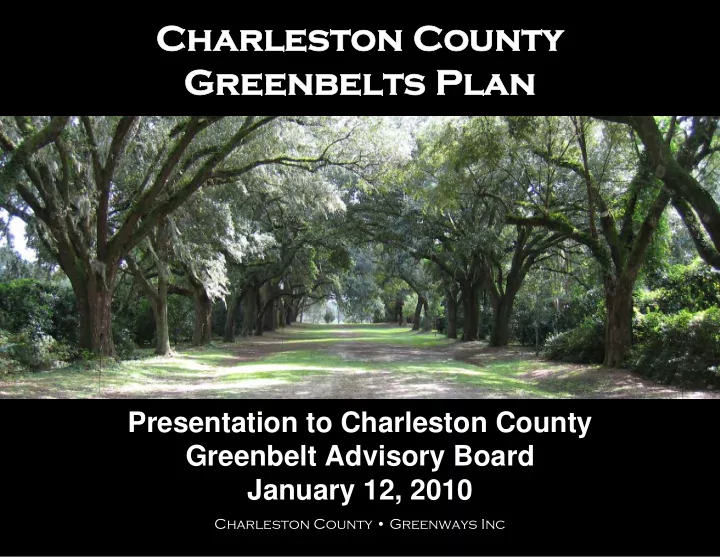
Charleston County Charleston County Greenbelts Plan Greenbelts Plan Presentation to Charleston County Greenbelt Advisory Board January 12, 2010 Charleston County Greenways Inc Charleston County Greenways Inc White & Smith,


slide-1
SLIDE 1

Charleston County • Greenways Inc • White & Smith, llc

Charleston County Charleston County Greenbelts Plan Greenbelts Plan

Presentation to Charleston County Greenbelt Advisory Board January 12, 2010

Charleston County • Greenways Inc
slide-2
SLIDE 2

Charleston County • Greenways Inc

Greenbelts Advisory Board

slide-3
SLIDE 3

What is a “Greenbelt?”

Charleston County • Greenways Inc

slide-4
SLIDE 4

Charleston County • Greenways Inc

Types of Green Space

Greenbelt Greenway Open Space

slide-5
SLIDE 5

Charleston County • Greenways Inc

Functions of Greenspace

  • Hazard Reduction and Public Safety
  • Urban Resource Protection
  • View Preservation
  • Solace and Link to Nature
  • Health and Fitness
  • Access and Linkage
  • Wildlife Protection
  • Landscape Preservation
  • Agricultural Lands Preservation
  • Economic Value
  • Community Identity and Character
  • Heritage/Cultural Landscapes

Flooded Greenspace Dry Greenspace

slide-6
SLIDE 6

Charleston County • Greenways Inc

What types of greenspace do you value the most for conservation?

  • Forests (upland forests and swamp forests)
  • Wetlands (swamps, marshes, bogs, Carolina Bays, marsh islands)
  • Creeks and Floodplains
  • Productive Landscapes (lands used for agriculture, silviculture and

mariculture)

  • Heritage Landscapes (cultural and historical sites unique to the region)
  • Scenic Corridors (canopy roadways)
  • Reclamation Sites (environmentally degraded sites in need of rehabilitation)
  • Other
slide-7
SLIDE 7

Charleston County • Greenways Inc

Greenspace Glossary

slide-8
SLIDE 8

Charleston County • Greenways Inc

Where would you most like to see greenspaces protected?

  • Charleston Peninsula
  • North Charleston
  • West Ashley
  • Johns Island
  • James Island
  • Mt. Pleasant/East Cooper
  • East County
  • West County
  • Edisto Island/Wadmalaw Island
slide-9
SLIDE 9

Charleston County • Greenways Inc

Planning Area

slide-10
SLIDE 10

Charleston County • Greenways Inc

Existing Greenspace

slide-11
SLIDE 11

Charleston County • Greenways Inc

Current LOS

slide-12
SLIDE 12

Charleston County • Greenways Inc

Urban vs. Rural

slide-13
SLIDE 13

Charleston County • Greenways Inc

Urban vs. Rural Map

slide-14
SLIDE 14

Charleston County • Greenways Inc

Greenbelt Vision

The Future of Greenspace Conservation in Charleston County

slide-15
SLIDE 15

Charleston County • Greenways Inc

Working Definition

For the purpose of the Charleston County Greenbelts Plan, the term greenbelts will be used to describe a variety of land

  • types. Greenbelts may include public or private lands in rural, suburban and urban settings. Access to greenbelts may

also be public or private. The various types of greenbelts are listed below. They may include, but are not limited to, their subcategories:

  • Passive greenspace: Trails, greenways, and interpretive parks
  • Active greenspace: Low-impact play fields and parks, including areas for fishing, crabbing, boating,

etc.

  • Lowcountry ecosystems: Upland forests, swamps, bogs, brackish and freshwater wetlands, Carolina

bays, marsh islands, and cypress, backwater, and saltwater marshes

  • Productive landscapes: Lands used for agriculture, silviculture, and mariculture
  • Heritage landscapes: Irreplaceable cultural and historical landscapes unique to the County
  • Corridors: Scenic roadways, abandoned rail lines, and utility corridors
  • Natural infrastructure: Floodplains, wildlife habitat, recharge zones, and lands critical to clean water
  • Reclaimed greenspace: Brownfields, abandoned sites, and other green infill projects

These greenbelts collectively form a protected living system of landscapes that serve the residents, businesses, visitors, and future generations of Charleston County by preserving and improving the health and quality of life for all.

slide-16
SLIDE 16

Charleston County • Greenways Inc

Greenbelts Vision

  • Cities and Villages Surrounded by Green

– Rural landscape preservation – Public access to water, not necessarily by boat ramps – Public access to greenspace and parkland – Balance development and greenspace – Reclaim brownfields – Set aside as much greenspace as possible – Include passive recreation greenspace – Link greenspace with trails, not necessarily along roads – Develop bike paths as part of Greenbelts Plan – Leverage funds to maximize buying power – Plan for both urban and rural areas of the County

slide-17
SLIDE 17

Charleston County • Greenways Inc

Hub + Spokes Concept

slide-18
SLIDE 18

Charleston County • Greenways Inc

Greenbelts Vision

“Cities and Villages Surround by Green”

slide-19
SLIDE 19

Charleston County • Greenways Inc

Charleston County Greenbelts Master Plan Needs Assessment

slide-20
SLIDE 20

Charleston County • Greenways Inc

Current Greenspace

slide-21
SLIDE 21

Charleston County • Greenways Inc

Current Greenspace in Charleston County

  • Local Government greenspace -

6,683 acres

  • State and Federal greenspace -

128,916 acres

  • Private greenspace -

25,785 acres

Totals 161,384 acres

Data Source: Greenways Incorporated 2005

slide-22
SLIDE 22

Charleston County • Greenways Inc

  • Determining a “Level of Service” - LOS
  • Why? Provide adequate supply of greenspace, resources to

serve the public health, safety and welfare needs of County residents.

  • Proper balance of greenspace and developed land.
  • Proximity and accessibility are key elements of satisfying

needs of residents.

  • Barriers to access and use must be considered.

Needs Assessment

slide-23
SLIDE 23

Charleston County • Greenways Inc

NRPA Standards Adopted Policies Demographic Trends Leisure Activity Trends Prior Planning Efforts Statistical Surveys Opinion Surveys Public Input Market Reckoning Benefits of Greenspace Community Comparison

Determining a LOS for Charleston County

Needs Assessment

slide-24
SLIDE 24

Charleston County • Greenways Inc

Needs Assessment

  • Charleston County

Parks & Recreation Commission conducted an Open Space Analysis for the period between 2002 and 2015

slide-25
SLIDE 25

Charleston County • Greenways Inc

PRC Open Space Needs

  • Regional Park Needs

– East Cooper - 1, 380 acres – West Ashley - 1, 240 acres – North Charleston - 1,104 acres – Charleston Peninsula - 630 acres – James Island - 428 acres – West County - 270 acres – East County - 110 acres Totals 5,162 acres

slide-26
SLIDE 26

Charleston County • Greenways Inc

Community Comparison

  • Wake County, NC - Target 165,000 acres
  • f greenspace, population 750,000, land

area 860 square miles.

  • Gwinnett County, GA - Target 50,000

acres of greenspace, population 700,000, land area 477 square miles.

  • Jefferson County, CO - Target 100,000

acres of greenspace, population 527,000, land area 774 square miles.

slide-27
SLIDE 27

Charleston County • Greenways Inc

What if We Define a Specific Numeric Goal?

  • What if the numeric goal is a 20%, 30%
  • r 40% target for conservation and

protection -- that is, a percentage of the total land, water and salt marsh landscape to be conserved in the future.

  • Why would we choose 20%, 30% or

40% as a target?

slide-28
SLIDE 28

Charleston County • Greenways Inc

What is the Most What is the Most Appropriate Goal? Appropriate Goal?

Land Category to be protected

Percentage Goals

20 Percent 30 Percent 40 Percent Flood Prone Land Protected

Yes Yes Yes

Water Quality, recreation, wildlife

No Yes Yes

Conservation through development

No Yes Yes

State and federal forest and game lands

No No Yes

Narrative Description Protects all flood prone land and does little else Protects all flood prone lands, targets ecologically sensitive land, greenway connectors, acquire land for parks, protects prime farmland Does the same as the 30% goal, but also adds state or federal lands, including game lands, state and federal forests or parks.

slide-29
SLIDE 29

Charleston County • Greenways Inc

Conservation Goals Conservation Goals

  • 1,046 square miles (includes land, water and

salt marsh)

  • 669,311 acres of county land
  • 20% as protected greenspace = 134,000

acres

  • 30% as protected greenspace = 200,000

acres

  • 40% as protected greenspace = 267,724

acres

slide-30
SLIDE 30

Charleston County • Greenways Inc

Defining a Goal for Greenspace Conservation

  • Current greenspace - 162,000 acres
  • Assess Need for the next 25 years
  • Define minimum goal to meet this need
  • 30% Goal - minimum amount needed to

satisfy demand (200,000 acres)

  • Need an additional 40,000 acres of

protected greenspace to meet the goal

slide-31
SLIDE 31

Charleston County • Greenways Inc • White & Smith, llc

Public Open House Meetings

  • Charleston County Public

Services Building - 98

  • Mt. Pleasant Library - 102
  • Johns’ Island Library - 123
  • Total - 323
slide-32
SLIDE 32

Charleston County • Greenways Inc • White & Smith, llc

Public Comment Form

  • Question 2 : Which of these do you feel

is important to be part of the Greenbelt program?

2 ) W hich of these do you feel is im portan to be part of the greenbelts program ? 100 200 300 400 500 600 700 800 900 1000 Other Reclaimed Greenspace Productive Landscapes Active Greenspace Corridors Natural Infrastructure Heritage Landscapes Low Country Natural Resources Passive Greenspace Points Awarded

Weighted point total

slide-33
SLIDE 33

Charleston County • Greenways Inc

FINAL Comprehensive Greenbelt Plan

June 2006

slide-34
SLIDE 34

Charleston County • Greenways Inc

Key Elements of the Plan

Vision:

“Cities and Villages Surrounded by Green”

Final Greenbelt Plan

GAB: Working Definition Public Input &

Needs Assessment

Policies:

Allocation of Sales Tax Proceeds

Policies:

Prioritization Criteria

Policies:

Conservation Toolbox

slide-35
SLIDE 35
slide-36
SLIDE 36

Charleston County • Greenways Inc

Supplemental Report

  • Regulatory Analysis for the purposes of

Greenbelts Implementation

  • Legal Framework and Basis for

Implementing the Greenbelt Plan

  • Stewardship and Operations of the

Greenbelt Program

  • GIS-Based Property Management

Recommendations

slide-37
SLIDE 37

Charleston County • Greenways Inc

Components of the Greenbelt System

Charleston County’s treasured resources

slide-38
SLIDE 38

Charleston County • Greenways Inc

Greenbelt System Components

  • Charleston County Greenbelt System

would be comprised of six principal landscape types:

– Rural Greenbelt Lands – Francis Marion Forest – Lowcountry Wetlands – PRC Regional Parks – Urban Greenbelt Lands – Greenway Corridors

slide-39
SLIDE 39

Charleston County • Greenways Inc

Greenbelt System Components

Component Description Target Acres Percent of Goal Rural Greenbelt Lands

  • Represents a minimum “target” recommendation by

Greenways Incorporated, desired acreage would be conserved through variou acquisition methods using Conservation Toolbox and Sales Tax proceeds, specifically targeting lands noted in the Comprehensive Plan as high priority natural resource areas. 16,240 41% Francis Marion Forest

  • Based on multi-agency MOU that identifies this as th

amount of private land holdings in the forest. 10,275 26% Lowcountry Wetlands

  • Represents an “infill” and “as needed”

recommendation by Greenways Incorporated for both rural and urban landscapes where additional wetland protection is needed. 5,610 14% PRC Regional Parks

  • Based on PRC Open Space Analysis.

4,675 11% Urban Greenbelt Lands

  • Represents a minimum "target" recommendation by

Greenways Incorporated, takes into account wish lists provided by North Charleston, Mt. Pleasant, Charleston and beach communities. Also based on PRC Open Space Analysis for urban areas. 2,000 5% Greenway Corridors

  • Based on a 200 mile system of greenways throughout

the County. Greenways would be 50-foot wide corridors. 1,200 3% Total Targeted Greenspace (25 year projection) 40,000 100% Charleston County Greenbelt System Components

slide-40
SLIDE 40

Charleston County • Greenways Inc

Rural Greenbelt Lands

  • Minimum goal 16,240 acres:

– Productive Lands – Cultural/Historic Sites – Village Parks – Waterway Access

slide-41
SLIDE 41

Charleston County • Greenways Inc

Rural Greenbelt Lands

slide-42
SLIDE 42

Charleston County • Greenways Inc

Francis Marion Forest

  • Minimum goal is to conserve

and protect the 10,275 acres in private ownership

slide-43
SLIDE 43

Charleston County • Greenways Inc

Francis Marion Forest

slide-44
SLIDE 44

Charleston County • Greenways Inc

Lowcountry Wetlands

  • Minimum goal is to protect

an additional 5,600 acres in rural and urban landscapes

slide-45
SLIDE 45

Charleston County • Greenways Inc

Lowcountry Wetlands

slide-46
SLIDE 46

Charleston County • Greenways Inc

PRC Regional Parks

  • Based on PRC Analysis,

goal is to acquire 4,675 additional acres for regional parks.

slide-47
SLIDE 47

Charleston County • Greenways Inc

PRC Regional Parks

slide-48
SLIDE 48

Charleston County • Greenways Inc

PRC Boat Landings

slide-49
SLIDE 49

Charleston County • Greenways Inc

Urban Greenbelt Lands

  • Minimum target of 2,000

acres of additional parkland and greenspace is the goal.

slide-50
SLIDE 50

Charleston County • Greenways Inc

Urban Greenbelt Lands

slide-51
SLIDE 51

Charleston County • Greenways Inc

Greenway Corridors

  • Minimum target goal is

1,200 acres based on a 200-mile network of greenways and trails.

slide-52
SLIDE 52

Charleston County • Greenways Inc

Greenway Corridors

slide-53
SLIDE 53

Charleston County • Greenways Inc

Greenbelt System Map

slide-54
SLIDE 54

Charleston County • Greenways Inc

Tools for Conserving Greenspace

Non-funding tools for Conservation

  • f Greenspace
slide-55
SLIDE 55

Charleston County • Greenways Inc

Conservation Toolbox

slide-56
SLIDE 56

Charleston County • Greenways Inc

Conservation Toolbox

slide-57
SLIDE 57

Charleston County • Greenways Inc

Conservation Toolbox

slide-58
SLIDE 58

Charleston County • Greenways Inc

Conservation Toolbox

slide-59
SLIDE 59

Charleston County • Greenways Inc

Organizational Framework

slide-60
SLIDE 60

National Trends In Greenspace Conservation

Charleston County • Greenways Inc

slide-61
SLIDE 61

Trends

  • More American counties and communities are

completing open space/greenspace plans.

  • Conservation easements are one of the most

favored tools among both landowners and conservation organizations/agencies.

  • Public access and public benefit – widely debated

issues for programs funded by tax dollar

  • Economics of the past decade (2001-2009) have

created both opportunities and challenges for land conservation.

Charleston County • Greenways Inc

slide-62
SLIDE 62

Conservation Easements vs. Fee Simple Purchase

Charleston County • Greenways Inc

slide-63
SLIDE 63

Easement vs. Fee-Simple

  • Concern generally involves “taxpayer value”
  • Strategically decide where fee-simple acquisition

is appropriate.

  • Do not create “unfunded mandates” for future

community leaders to resolve.

  • Conservation easements provide ample public

benefit without including the right of public access and use.

  • Conserved land is not a drain on public services –

least expensive land to be served

Charleston County • Greenways Inc

slide-64
SLIDE 64

Public Benefit of Conservation Easements

  • Clean air (protects ecological function)
  • Clean water (protects source waters)
  • Aquifer recharge (the set aside of undisturbed lands)
  • Flood management (critical for coastal areas)
  • Wildlife and plan habitat (biodiversity)
  • Buffering of adjacent land uses
  • Conservation of scenic and heritage

landscapes/resources

  • Sustain quality of life and lifestyle

Charleston County • Greenways Inc

slide-65
SLIDE 65

Public Benefit of Conservation Easements

  • Protect the “low country” way of life

Charleston County • Greenways Inc

slide-66
SLIDE 66

Impact associated with Right

  • f Public Access and Use
  • Impacts to native soils, vegetation, wildlife and
  • watershed. Stewardship, operations and

management is needed to mitigate impact.

  • Accommodation of human use normally includes:
  • automobile parking
  • potable water
  • sewer
  • stormwater management
  • trash collection
  • hazards management
  • safety and security
  • facility development and facility repair

Charleston County • Greenways Inc

slide-67
SLIDE 67

Cost of Public Access

  • Jeffco reports a $30-40 million backlog of unmet need

with regard to accommodating public access and use on its open space lands.

Charleston County • Greenways Inc

slide-68
SLIDE 68

An Overview of Other National Greenspace Programs

Charleston County • Greenways Inc

slide-69
SLIDE 69

Las Vegas/Southern Nevada

Charleston County • Greenways Inc

Nevada Chapter ASLA Award of Excellence

slide-70
SLIDE 70

Archuleta County, Colorado

Charleston County • Greenways Inc

Colorado Chapter APA Outstanding Planning Award

slide-71
SLIDE 71

Arapahoe County, Colorado

Charleston County • Greenways Inc

slide-72
SLIDE 72

Chuck’s Trip to China

Charleston County • Greenways Inc

slide-73
SLIDE 73

Chuck’s Trip to China

Charleston County • Greenways Inc

slide-74
SLIDE 74

Chuck’s Trip to China

Charleston County • Greenways Inc

slide-75
SLIDE 75

Exemplary Programs

  • Suffolk County, New York (14,000 acres)
  • Wake County, North Carolina (15,000 acres)
  • King County, Washington (25,000 acres)
  • Lake County, Illinois (26,000 acres)
  • Montgomery County, Maryland (50,000 acres)
  • Jefferson County, Colorado (52,000 acres)
  • Sonoma County, California (70,000 acres)
  • Albequerque, New Mexico (28,000 acres)
  • Austin, Texas (40,000 acres)
  • San Francisco, California (POST) (63,000 acres)

Charleston County • Greenways Inc

slide-76
SLIDE 76

Exemplary Greenspace Programs

  • Open Space/Greenspace planning a unique

endeavor.

  • Greenspace programs funded at $100

million plus are rare; $200 million plus extremely rare.

  • Programs that have aggregated more than

10,000 in protected acreage in a 3-5 year period are extremely rare.

Charleston County • Greenways Inc

slide-77
SLIDE 77

Charleston County Greenbelt Program

  • Rural Lands – 6,738

acres (41% of goal)

  • National Forest –

3,270 acres (32% of goal)

  • Wetlands – 4,737

acres (84% of goal)

  • Urban Lands - 182

acres (9% of goal)

  • Greenways – 5 acres

(9% of goal)

  • Totals 16,976 acres -

(42% of goal)

Charleston County • Greenways Inc

slide-78
SLIDE 78

Expenditure of Expenditure of Greenbelt Funds Greenbelt Funds

$221 Million Original Allocation

  • 60 Million CCPRC Allocation & Debt Service

$161 Million

  • 11 Million Administration ($440,000/year)

$150 Million

  • 55 Million Estimated Debt Service

$ 95 Million Available for Rural & Urban Programs

  • 59 Million Awarded by County Council

$ 36 Million Remaining

slide-79
SLIDE 79

Projects 58% Projects 42% Acres 35% Acres 65% Funds 78% Funds 22% 0% 10% 20% 30% 40% 50% 60% 70% 80% 90% Public Access Conservation Easements Projects Acres Funds

Two Pines & Birds of Prey are easement projects with public access and are included in public access numbers.

slide-80
SLIDE 80

Expenditures To Date

Greenbelt Funds (In Millions)

$66.5 $28.5 $11.0 $22.4 $42.8 $16.0 $1.0 $36.0 $- $10.0 $20.0 $30.0 $40.0 $50.0 $60.0 $70.0 PRC Rural Urban Admin Allocation Awarded/Expended 62% 64% 56% 9%

slide-81
SLIDE 81

Greenbelt Funds Greenbelt Funds Greenbelt Funds Match Match Match $- $20,000,000 $40,000,000 $60,000,000 $80,000,000 $100,000,000 $120,000,000 Fee Simple Easements Total

To Date $99.9 Million in Match

$32.4 $39.7 $19.2 $67.5 $58.9 $99.9

slide-82
SLIDE 82

Acres Protected, 42% Funds Awarded, 62% 0% 10% 20% 30% 40% 50% 60% 70%

Greenbelt Program Status

slide-83
SLIDE 83

South Carolina APA Award

Charleston County • Greenways Inc

slide-84
SLIDE 84

Summary

  • Charleston County’s Greenbelt Program is one of

the top 5 in the nation – based on vision and accomplishments

  • Stay the course with the Greenbelt Plan, it is

achieving what the voters asked for in 2004

  • Reaffirm for County Council the vision, goals,
  • bjectives and implementation of the Greenbelt

Plan.

  • Begin working on a Plan update and complete this

in 2011/second round of bonds

Charleston County • Greenways Inc

slide-85
SLIDE 85

CONGRATULATIONS ON CONGRATULATIONS ON YOUR PHENOMENAL YOUR PHENOMENAL SUCCESS ! SUCCESS !

Charleston County • Greenways Inc

slide-86
SLIDE 86

Charleston County • Greenways Inc

Questions/Comments

slide-87
SLIDE 87