Charles Charleston County on County Greenbelt Plan Greenbelt Plan - - PowerPoint PPT Presentation

charles charleston county on county greenbelt plan
SMART_READER_LITE
LIVE PREVIEW

Charles Charleston County on County Greenbelt Plan Greenbelt Plan - - PowerPoint PPT Presentation

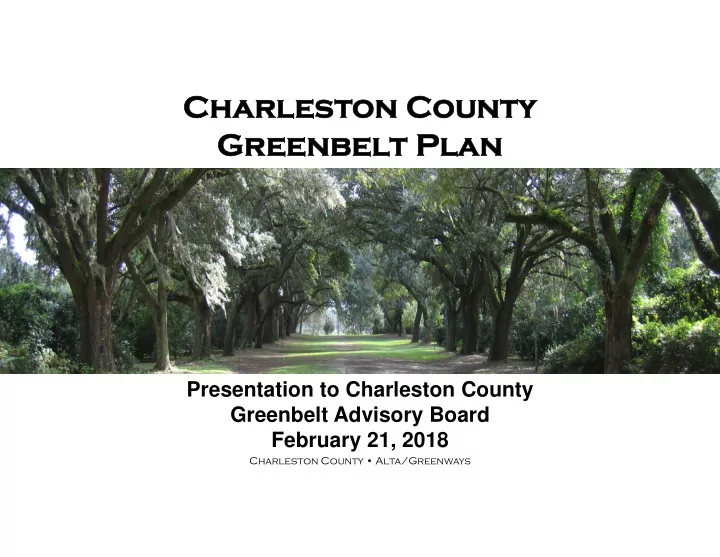
Charles Charleston County on County Greenbelt Plan Greenbelt Plan Presentation to Charleston County Greenbelt Advisory Board February 21, 2018 Charleston County Alta/Greenways Gr Greenbelt eenbelt Pl Plan an Re Review Ta Tasks 1.


slide-1
SLIDE 1

Charles Charleston County

  • n County

Greenbelt Plan Greenbelt Plan

Presentation to Charleston County Greenbelt Advisory Board February 21, 2018

Charleston County • Alta/Greenways
slide-2
SLIDE 2

Gr Greenbelt eenbelt Pl Plan an Re Review Ta Tasks

  • 1. Criteria Approved by the GAB at January 2018 meeting
  • 2. Criteria to review and approve
  • 3. Formulate Recommendations based on Public Input:
  • Greenbelt Definition – completed
  • Greenbelt Vision – completed
  • Greenbelt Priorities & Criteria – currently under review/need vote
  • Bonding of Greenbelt Funds – need vote
  • Rural/Urban Allocation – need vote
  • Greenbelt Board structure – need vote
slide-3
SLIDE 3

Dr Draf aft Gr Greenbel eenbelt Crit iteria ia Appr Approv

  • ved

ed by by the the GAB GAB at at Januar January 2018 2018 me meet eting

slide-4
SLIDE 4

Gr Greenbelt eenbelt Defin finitio tion – appr pproved ed by by GAB GAB

  • Passive greenspace: Trails, greenways, interpretive parks, and access points for water activities, such

as fishing, crabbing, boating, etc.

  • Active greenspace: Play fields and parks with low environmental impact
  • Lowcountry natural resources: Upland forests, swamps, bogs, brackish and freshwater wetlands,

Carolina bays, marsh islands, and cypress, backwater, and saltwater marshes

  • Productive landscapes: Lands used for agriculture, silviculture, and mariculture
  • Heritage landscapes: Irreplaceable cultural and historical landscapes unique to the County
  • Corridors: Scenic roadways, abandoned rail lines, utility corridors, and scenic waterways
  • Natural infrastructure: Floodplains, wildlife habitat, riparian zones, and lands critical to clean water
  • Reclaimed greenspace: Brownfields, abandoned sites, and other green infill projects
slide-5
SLIDE 5

Dr Draf aft Cri Criteri eria – Greenbelt eenbelt Defin finitio tion

(GAB motion to accept the ranking of criteria for the Greenbelt Definition was approved) Greenbelt Definition?

  • Passive greenspace
  • Lowcountry natural resources
  • Natural infrastructure
  • Heritage landscapes
  • Corridors
  • Active greenspace
  • Reclaimed greenspace
  • Productive landscapes

(Ranked based on the Public’s response to Question 4 of the Survey)

slide-6
SLIDE 6

Januar January Dr Draf aft Cri Criteri eria – Issue ssue of

  • f Connectivity

Connectivity

Meets the Greenbelt vision for connectivity:

  • Trail/corridor connected to a greenspace
  • Trail/corridor connected to another trail/corridor
  • Trail/corridor connected to a neighborhood and/or school
  • Trail connecting to a retail or jobs center
  • Trail where none currently exists (none exists within ??? miles)
  • Provides linkage to a blue trail
  • Greenspace connected to a trail/corridor
  • Greenspace connected to another greenspace
  • Greenspace connected to a neighborhood and/or school
  • Greenspace connected to a retail or jobs center
  • Protected greenspace where none currently exists (none exists within ??? miles)

(Ranked on public’s, municipalities’ and GAB’s stated desires for connectivity issues to be addressed.)

slide-7
SLIDE 7

Re Revised Dr Draf aft Cri Criteri eria – Issue ssue of

  • f Connectivity

Connectivity

(GAB motion to include connectivity as part of Criteria was approved) (Per request of GAB, staff has consolidated as follows) Meets the Greenbelt vision for connectivity:

  • Trail/corridor connected to either a greenspace; trail/corridor;

neighborhood; or retail/jobs center.

  • Provides linkage to a blue trail.
  • Greenspace connected to a trail/corridor; another greenspace;

neighborhood; school; retail or jobs center. (Ranked on public’s, municipalities’ and GAB’s stated desires for connectivity issues to be addressed.)

slide-8
SLIDE 8

Januar January Dr Draf aft Cri Criteri eria – P – Public Access Access and and Use Use

Addresses public access and use?

  • Passive park, greenspace or trail with full public access
  • Passive greenspace with limited public access
  • Provides access to waterway for kayaking and/or canoeing
  • Provides access to waterway via a boat ramp
  • Provides access to waterway for fishing, shrimping, crabbing
  • Active park with full public access
  • Active park with limited public access
  • Private Property with Limited public access
  • No public access

(Ranked based on public’s response to Questions 5 and 7)

slide-9
SLIDE 9

Re Revised Dr Draf aft Cri Criteri eria – Pub ublic lic Access Access and and Use Use

(GAB motion to include public access and use as part of Criteria was approved) (Per request of GAB, staff has consolidated as follows) Addresses public access and use?

  • Greenspace with full public access
  • Public waterway access and use (fishing, crabbing, canoeing and/or

kayaking) – Needs GAB approval

  • Greenspace with partial public access (partial = land manager restricts

days/hours of week)

  • Greenspace with limited public access (limited = access by landowner

invitation at least once annually)

  • No public access

(Ranked based on public’s response to Questions 5 and 7)

slide-10
SLIDE 10

Clarific arificatio ion – Access ccess and and Impr provem emen ents ts

  • What the Greenbelt Plan says regarding ”improvements:”
  • Minor improvements will be limited to: boardwalks, foot bridges, unpaved

trails, unpaved roadways, and unpaved small parking areas. The cost of these improvements should be included in any proposal submitted for the acquisition of sites. Other improvements may be included in a particular project but can not be funded with Greenbelt proceeds.” (Pages 5‐6 and 5‐8)

  • Not saying that another funding source or project partner can’t make

improvements on the land.

  • Another partner can make improvements, just can’t use Greenbelt

funds to accomplish those improvements if they go beyond what is allowed under “minor improvements.”

slide-11
SLIDE 11

Dr Draf aft Gr Greenbel eenbelt Crit iteria ia To To be be re reviewed and and appr approv

  • ved

ed by by the the GAB GAB

slide-12
SLIDE 12

Dr Draf aft Cri Criteri eria – S – Size and and Loc Location tion

Location and size of the project?

  • 100+ acres in rural area
  • 11 – 100 acres in rural area
  • 1 – 10 acres in rural area
  • <1 acre in rural area
  • 100+ acres in urban area
  • 11 – 100 acres in urban area
  • 1 – 10 acres in urban area
  • <1 acre in urban area
  • 100+ acres in urban unincorporated area
  • 11 – 100 acres in urban unincorporated area
  • 1 – 10 acres urban unincorporated area
  • <1 acre in urban unincorporated area

(GAB needs to decide on priorities for size and location.)

slide-13
SLIDE 13

Pu Public Sur Survey Re Results – Wild ildlif life Habi Habitat Pr Protection, Na Natural Resour sources, ces, In Infr fras astructur tructure

43% 17% 17% 8% 6% 3% 3% 2% Protection of wildlife habitats, wetlands, marshland, etc. Acquisition of lands for walking and biking trails Rural greenspace protection and preservation Acquisition of frequently flooded properties Acquisition of future passive parks Waterway access Acquisition of lands for future recreation and sports fields Other (please specify) 0% 5% 10% 15% 20% 25% 30% 35% 40% 45% 50%

Where should Charleston County direct most of the funding for the Greenbelt Program? (Select one)

slide-14
SLIDE 14

Dr Draf aft Cri Criteri eria – P – Protection of

  • f Wild

ldlif life Habi Habitat

Protection of wildlife habitat?

  • Protects wildlife habitat of endangered or threatened species
  • Protects wildlife habitat of any species
  • No wildlife habitat protection

(Ranked based on public’s response to Question 8 of the survey)

slide-15
SLIDE 15

Clarific arificatio ion: Wild ldlif life habit habitat

  • Biggest concern of public is loss of land and habitat for wildlife
  • Public concerned about “road kill” – evidence of problem
  • Difference between “Edge” species and “Interior” species
  • Francis Marion Forest most likely the only landscape that could support

Interior species

  • Edge species wildlife are the animals most people are familiar with
  • Wildlife habitat currently exists in urban landscapes
  • Can and should be protected as part of Greenbelt Program
  • Can be a buffer of trees, wetlands, marshland
  • Can be a restored abandoned property – industrial, commercial, residential
slide-16
SLIDE 16

Dr Draf aft Cri Criteri eria – P – Protection of

  • f Na

Natural Re Resources and and In Infr fras astructur tructure

Protection of Lowcountry Natural Resources and Natural Infrastructure:

  • Upland forests
  • Fresh water wetlands or forested wetlands
  • Saltwater marsh, marsh and/or marsh islands
  • Riparian zones
  • Floodplains
  • Land critical to clean water
  • Long Leaf Pine forest

(Ranked based on public’s response to Question 8 of the survey)

slide-17
SLIDE 17

Clarific arificatio ion – I – Impacts fr from

  • m Flooding

Flooding

  • Charleston County vulnerable to increased flooding resulting from

rising sea levels, increased intense rainfall events, and more frequent large storm events (i.e. hurricanes, noreasters).

  • Greenbelt funds can be used to purchase land that mitigates impact

from flooding

  • Examples from other communities
  • Greenbelt funds can not be used for following:
  • Purchasing homes or businesses or buildings that have been flooded
  • Building drainage ditches (facility)
  • Building drainage pipes or improving existing drainage infrastructure (facility)
  • Improvements to roadways that are habitually flooded (facility)
  • Use of fill dirt to raise property above changing floodplain
  • Beach renourishment program
slide-18
SLIDE 18

Her Heritage Landsc Landscapes pes – R – Ranked #4 #4

4.57% 24.75% 36.31% 41.56% 48.35% 57.83% 70.88% 72.02% 77.81% Other Productive Landscapes Reclaimed Greenspace Active Greenspace Corridors Heritage Landscapes Natural Infrastructure Lowcountry Natural Resources Passive Greenspace 0% 10% 20% 30% 40% 50% 60% 70% 80% 90%

Which of the following landscapes do you feel are most important for the Greenbelt Program? (Select all that apply)

slide-19
SLIDE 19

Dr Draf aft Cri Criteri eria – H – Historical and and Cul Cultur ural al Fe Feat atures

Historical and cultural features:

  • Existing remains of buildings, earthworks or historical significance
  • Documented historical event occurrence
  • Culturally significant land
  • Oral tradition of historical occurrence
  • No historical or cultural significance

(Heritage Landscapes ranked 4th in Q4 of Public Survey)

slide-20
SLIDE 20

Dr Draf aft Cri Criteri eria – T – Threat of

  • f Loss

Loss

Threat of Loss:

  • Protects endangered/threatened wildlife habitat under immediate threat of loss
  • Protects land under immediate threat of loss to development
  • Protects wetlands/marsh under threat of loss to development or rising tides
  • Protects culturally significant lands under threat of loss
  • Protects productive lands under threat of loss
  • Project poses unique opportunity not likely to present itself again
  • No threat of loss

(Ranked based on public’s response to Question 8 of the survey, as well as survey comments regarding curbing development)

slide-21
SLIDE 21

Dr Draf aft Cri Criteri eria – C – Consistent wi with Adopted Adopted Pl Plans ans

Consistent with Adopted Plans:

  • Greenbelt Plan
  • County’s Comp Plan
  • Regional Bike/Ped Plans
  • Municipal Plan
  • Other

(Part of the Original Criteria)

slide-22
SLIDE 22

Dr Draf aft Cri Criteri eria – R – Ready fo for Im Immediate Act Action

  • n
  • Project is ready for immediate action:
  • Acquisition will take place within 6 months of approval
  • Acquisition will take place more than 6 months of approval
  • Property will be open to the public immediately
  • Property will be open to the public within 1 year
  • Property will be open to the public within 5 years
  • Property will be open to the public more than 5 years

(Part of the Original Criteria)