Character Data Type Chapter 4: Mathematical Four hexadecimal - - PDF document

character data type chapter 4 mathematical
SMART_READER_LITE
LIVE PREVIEW

Character Data Type Chapter 4: Mathematical Four hexadecimal - - PDF document

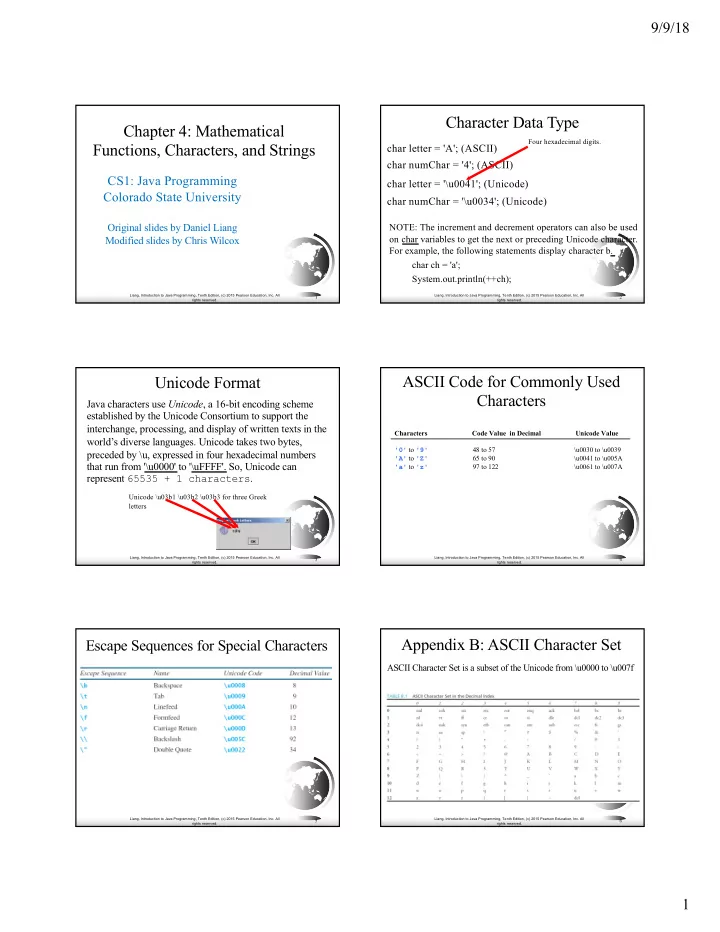
9/9/18 Character Data Type Chapter 4: Mathematical Four hexadecimal digits. Functions, Characters, and Strings char letter = 'A'; (ASCII) char numChar = '4'; (ASCII) CS1: Java Programming char letter = '\u0041'; (Unicode) Colorado State


slide-1
SLIDE 1

9/9/18 1

Liang, Introduction to Java Programming, Tenth Edition, (c) 2015 Pearson Education, Inc. All rights reserved.

1

Chapter 4: Mathematical Functions, Characters, and Strings

CS1: Java Programming Colorado State University

Original slides by Daniel Liang Modified slides by Chris Wilcox

Liang, Introduction to Java Programming, Tenth Edition, (c) 2015 Pearson Education, Inc. All rights reserved.

2

Character Data Type

char letter = 'A'; (ASCII) char numChar = '4'; (ASCII) char letter = '\u0041'; (Unicode) char numChar = '\u0034'; (Unicode)

Four hexadecimal digits.

NOTE: The increment and decrement operators can also be used

  • n char variables to get the next or preceding Unicode character.

For example, the following statements display character b. char ch = 'a'; System.out.println(++ch);

Liang, Introduction to Java Programming, Tenth Edition, (c) 2015 Pearson Education, Inc. All rights reserved.

3

Unicode Format

Java characters use Unicode, a 16-bit encoding scheme established by the Unicode Consortium to support the interchange, processing, and display of written texts in the world’s diverse languages. Unicode takes two bytes, preceded by \u, expressed in four hexadecimal numbers that run from '\u0000' to '\uFFFF'. So, Unicode can represent 65535 + 1 characters.

Unicode \u03b1 \u03b2 \u03b3 for three Greek letters

Liang, Introduction to Java Programming, Tenth Edition, (c) 2015 Pearson Education, Inc. All rights reserved.

4

ASCII Code for Commonly Used Characters

Characters Code Value in Decimal Unicode Value

'0' to '9' 48 to 57 \u0030 to \u0039 'A' to 'Z' 65 to 90 \u0041 to \u005A 'a' to 'z' 97 to 122 \u0061 to \u007A

Liang, Introduction to Java Programming, Tenth Edition, (c) 2015 Pearson Education, Inc. All rights reserved.

5

Escape Sequences for Special Characters

Liang, Introduction to Java Programming, Tenth Edition, (c) 2015 Pearson Education, Inc. All rights reserved.

6

Appendix B: ASCII Character Set

ASCII Character Set is a subset of the Unicode from \u0000 to \u007f

slide-2
SLIDE 2

9/9/18 2

Liang, Introduction to Java Programming, Tenth Edition, (c) 2015 Pearson Education, Inc. All rights reserved.

7

ASCII Character Set, cont.

ASCII Character Set is a subset of the Unicode from \u0000 to \u007f

Liang, Introduction to Java Programming, Tenth Edition, (c) 2015 Pearson Education, Inc. All rights reserved.

8

Casting between char and Numeric Types

int i = 'a'; // Same as int i = (int)'a'; char c = 97; // Same as char c = (char)97;

Liang, Introduction to Java Programming, Tenth Edition, (c) 2015 Pearson Education, Inc. All rights reserved.

9

Comparing and Testing Characters

if (ch >= 'A' && ch <= 'Z') System.out.println(ch + " is an uppercase letter"); else if (ch >= 'a' && ch <= 'z') System.out.println(ch + " is a lowercase letter"); else if (ch >= '0' && ch <= '9') System.out.println(ch + " is a numeric character");

Liang, Introduction to Java Programming, Tenth Edition, (c) 2015 Pearson Education, Inc. All rights reserved.

10

Methods in the Character Class

Method Description isDigit(ch) Returns true if the specified character is a digit. isLetter(ch) Returns true if the specified character is a letter. isLetterOfDigit(ch) Returns true if the specified character is a letter or digit. isLowerCase(ch) Returns true if the specified character is a lowercase letter. isUpperCase(ch) Returns true if the specified character is an uppercase letter. toLowerCase(ch) Returns the lowercase of the specified character. toUpperCase(ch) Returns the uppercase of the specified character.

Liang, Introduction to Java Programming, Tenth Edition, (c) 2015 Pearson Education, Inc. All rights reserved.

11

The String Type

The char type only represents one character. To represent a string

  • f characters, use the data type called String. For example,

String message = "Welcome to Java"; String is actually a predefined class in the Java library just like the System class and Scanner class. The String type is not a primitive

  • type. It is known as a reference type. Any Java class can be used

as a reference type for a variable. Reference data types will be thoroughly discussed in Chapter 9, “Objects and Classes.” For the time being, you just need to know how to declare a String variable, how to assign a string to the variable, how to concatenate strings, and to perform simple operations for strings.

Liang, Introduction to Java Programming, Tenth Edition, (c) 2015 Pearson Education, Inc. All rights reserved.

12

Simple Methods for String Objects

Method Description

Returns the number of characters in this string. Returns the character at the specified index from this string. Returns a new string that concatenates this string with string s1. Returns a new string with all letters in uppercase. Returns a new string with all letters in lowercase. Returns a new string with whitespace characters trimmed on both sides. length() charAt(index) concat(s1) toUpperCase() toLowerCase() trim()

slide-3
SLIDE 3

9/9/18 3

Liang, Introduction to Java Programming, Tenth Edition, (c) 2015 Pearson Education, Inc. All rights reserved.

13

Simple Methods for String Objects

Strings are objects in Java. The methods in the preceding table can only be invoked from a specific string instance. For this reason, these methods are called instance methods. A non-instance method is called a static method. A static method can be invoked without using an object. All the methods defined in the Math class are static methods. They are not tied to a specific object instance. The syntax to invoke an instance method is referenceVariable.methodName(arguments).

Liang, Introduction to Java Programming, Tenth Edition, (c) 2015 Pearson Education, Inc. All rights reserved.

14

Getting String Length

String message = "Welcome to Java"; System.out.println("The length of " + message + " is " + message.length());

Liang, Introduction to Java Programming, Tenth Edition, (c) 2015 Pearson Education, Inc. All rights reserved.

15

Getting Characters from a String

String message = "Welcome to Java"; System.out.println("The first character in message is " + message.charAt(0));

Liang, Introduction to Java Programming, Tenth Edition, (c) 2015 Pearson Education, Inc. All rights reserved.

16

Converting Strings

"Welcome".toLowerCase() returns a new string, welcome. "Welcome".toUpperCase() returns a new string, WELCOME. " Welcome ".trim() returns a new string, Welcome.

Liang, Introduction to Java Programming, Tenth Edition, (c) 2015 Pearson Education, Inc. All rights reserved.

17

String Concatenation

String s3 = s1.concat(s2); or String s3 = s1 + s2; // Three strings are concatenated String message = "Welcome " + "to " + "Java"; // String Chapter is concatenated with number 2 String s = "Chapter" + 2; // s becomes Chapter2 // String Supplement is concatenated with character B String s1 = "Supplement" + 'B'; // s1 becomes SupplementB

Liang, Introduction to Java Programming, Tenth Edition, (c) 2015 Pearson Education, Inc. All rights reserved.

18

Reading a String from the Console

Scanner input = new Scanner(System.in); System.out.print("Enter three words separated by spaces: "); String s1 = input.next(); String s2 = input.next(); String s3 = input.next(); System.out.println("s1 is " + s1); System.out.println("s2 is " + s2); System.out.println("s3 is " + s3);

slide-4
SLIDE 4

9/9/18 4

Liang, Introduction to Java Programming, Tenth Edition, (c) 2015 Pearson Education, Inc. All rights reserved.

19

Reading a Character from the Console

Scanner input = new Scanner(System.in); System.out.print("Enter a character: "); String s = input.nextLine(); char ch = s.charAt(0); System.out.println("The character entered is " + ch);

Liang, Introduction to Java Programming, Tenth Edition, (c) 2015 Pearson Education, Inc. All rights reserved.

20

Comparing Strings

Method Description

Returns true if this string is equal to string s1. Returns true if this string is equal to string s1; it is case insensitive. Returns an integer greater than 0, equal to 0, or less than 0 to indicate whether this string is greater than, equal to, or less than s1. Same as compareTo except that the comparison is case insensitive. Returns true if this string starts with the specified prefix. Returns true if this string ends with the specified suffix. equals(s1) equalsIgnoreCase(s1) compareTo(s1) compareToIgnoreCase(s1) startsWith(prefix) endsWith(suffix)

OrderTwoCities Run

Liang, Introduction to Java Programming, Tenth Edition, (c) 2015 Pearson Education, Inc. All rights reserved.

21

Obtaining Substrings

Method Description

Returns this string’s substring that begins with the character at the specified beginIndex and extends to the end of the string, as shown in Figure 4.2. Returns this string’s substring that begins at the specified beginIndex and extends to the character at index endIndex – 1, as shown in Figure 9.6. Note that the character at endIndex is not part of the substring. substring(beginIndex) substring(beginIndex, endIndex)

Liang, Introduction to Java Programming, Tenth Edition, (c) 2015 Pearson Education, Inc. All rights reserved.

22

Finding a Character or a Substring in a String

Method Description

Returns the index of the first occurrence of ch in the string. Returns -1 if not matched. Returns the index of the first occurrence of ch after fromIndex in the string. Returns -1 if not matched. Returns the index of the first occurrence of string s in this string. Returns -1 if not matched. Returns the index of the first occurrence of string s in this string after

  • fromIndex. Returns -1 if not matched.

Returns the index of the last occurrence of ch in the string. Returns -1 if not matched. Returns the index of the last occurrence of ch before fromIndex in this

  • string. Returns -1 if not matched.

Returns the index of the last occurrence of string s. Returns -1 if not matched. Returns the index of the last occurrence of string s before fromIndex. Returns -1 if not matched. indexOf(ch) indexOf(ch, fromIndex) indexOf(s) indexOf(s, fromIndex) lastIndexOf(ch) lastIndexOf(ch, fromIndex) lastIndexOf(s) lastIndexOf(s, fromIndex)

Liang, Introduction to Java Programming, Tenth Edition, (c) 2015 Pearson Education, Inc. All rights reserved.

23

Finding a Character or a Substring in a String

int k = s.indexOf(' '); String firstName = s.substring(0, k); String lastName = s.substring(k + 1);

Liang, Introduction to Java Programming, Tenth Edition, (c) 2015 Pearson Education, Inc. All rights reserved.

24

Mathematical Functions

Java provides many useful methods in the Math class for performing common mathematical functions.

slide-5
SLIDE 5

9/9/18 5

Liang, Introduction to Java Programming, Tenth Edition, (c) 2015 Pearson Education, Inc. All rights reserved.

25

The Math Class

✦ Class constants:

– PI – E

✦ Class methods:

– Trigonometric Methods – Exponent Methods – Rounding Methods – min, max, abs, and random Methods

Liang, Introduction to Java Programming, Tenth Edition, (c) 2015 Pearson Education, Inc. All rights reserved.

26

Trigonometric Methods

✦ sin(double a) ✦ cos(double a) ✦ tan(double a) ✦ acos(double a) ✦ asin(double a) ✦ atan(double a)

Radians toRadians(90)

Examples: Math.sin(0) returns 0.0 Math.sin(Math.PI / 6) returns 0.5 Math.sin(Math.PI / 2) returns 1.0 Math.cos(0) returns 1.0 Math.cos(Math.PI / 6) returns 0.866 Math.cos(Math.PI / 2) returns 0

Liang, Introduction to Java Programming, Tenth Edition, (c) 2015 Pearson Education, Inc. All rights reserved.

27

Exponent Methods

✦ exp(double a) Returns e raised to the power of a. ✦ log(double a) Returns the natural logarithm of a. ✦ log10(double a) Returns the 10-based logarithm of a. ✦ pow(double a,

double b)

Returns a raised to the power of b. ✦ sqrt(double a) Returns the square root of a.

Examples:

Math.exp(1) returns 2.71 Math.log(2.71) returns 1.0 Math.pow(2, 3) returns 8.0 Math.pow(3, 2) returns 9.0 Math.pow(3.5, 2.5) returns 22.91765 Math.sqrt(4) returns 2.0 Math.sqrt(10.5) returns 3.24

Liang, Introduction to Java Programming, Tenth Edition, (c) 2015 Pearson Education, Inc. All rights reserved.

28

Rounding Methods

✦ double ceil(double x) x rounded up to its nearest integer. This integer is returned as a double value. ✦ double floor(double x) x is rounded down to its nearest integer. This integer is returned as a double value. ✦ int round(float x) Return (int) Math.floor(x+0.5). ✦ long round(double x) Return (long) Math.floor(x+0.5).

Liang, Introduction to Java Programming, Tenth Edition, (c) 2015 Pearson Education, Inc. All rights reserved.

29

Rounding Methods Examples

Math.ceil(2.1) returns 3.0 Math.ceil(2.0) returns 2.0 Math.ceil(-2.0) returns –2.0 Math.ceil(-2.1) returns -2.0 Math.floor(2.1) returns 2.0 Math.floor(2.0) returns 2.0 Math.floor(-2.0) returns –2.0 Math.floor(-2.1) returns -3.0 Math.rint(2.1) returns 2.0 Math.rint(2.0) returns 2.0 Math.rint(-2.0) returns –2.0 Math.rint(-2.1) returns -2.0 Math.rint(2.5) returns 2.0 Math.rint(-2.5) returns -2.0 Math.round(2.6f) returns 3 Math.round(2.0) returns 2 Math.round(-2.0f) returns -2 Math.round(-2.6) returns -3

Liang, Introduction to Java Programming, Tenth Edition, (c) 2015 Pearson Education, Inc. All rights reserved.

30

min, max, and abs

✦ max(a, b)and

min(a, b)

Returns the maximum or minimum of two parameters. ✦ abs(a) Returns the absolute value of the parameter. ✦ random() Returns a random double value in the range [0.0, 1.0).

Examples: Math.max(2, 3) returns 3 Math.max(2.5, 3) returns 3.0 Math.min(2.5, 3.6) returns 2.5 Math.abs(-2) returns 2 Math.abs(-2.1) returns 2.1

slide-6
SLIDE 6

9/9/18 6

Liang, Introduction to Java Programming, Tenth Edition, (c) 2015 Pearson Education, Inc. All rights reserved.

31

The random Method

Generates a random double value greater than or equal to 0.0 and less than 1.0 (0 <= Math.random() < 1.0).

Examples: (int)(Math.random() * 10) Returns a random integer between 0 and 9. 50 + (int)(Math.random() * 50) Returns a random integer between 50 and 99. In general, a + Math.random() * b Returns a random number between a and a + b, excluding a + b.