arrays and strings: pointers and memory allocation Why not rely - - PowerPoint PPT Presentation

arrays and strings pointers and memory allocation
SMART_READER_LITE
LIVE PREVIEW

arrays and strings: pointers and memory allocation Why not rely - - PowerPoint PPT Presentation

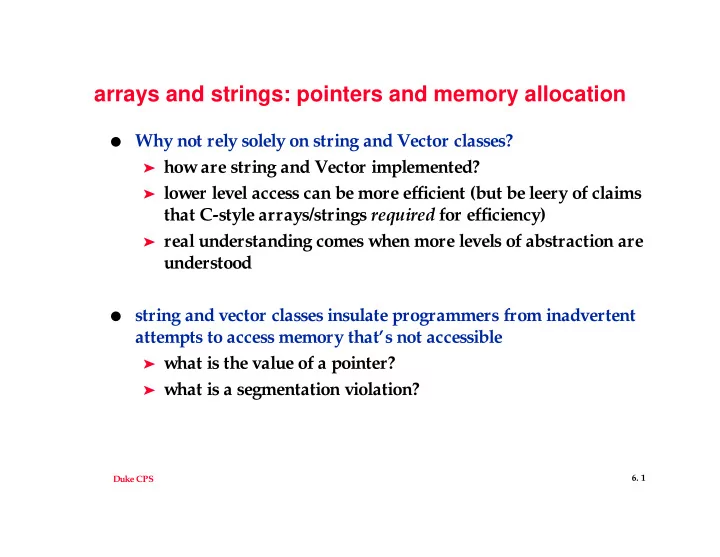
arrays and strings: pointers and memory allocation Why not rely solely on string and Vector classes? how are string and Vector implemented? lower level access can be more efficient (but be leery of claims that C-style arrays/strings


slide-1
SLIDE 1

Duke CPS

  • 6. 1

arrays and strings: pointers and memory allocation

  • Why not rely solely on string and Vector classes?

➤ how are string and Vector implemented? ➤ lower level access can be more efficient (but be leery of claims

that C-style arrays/strings required for efficiency)

➤ real understanding comes when more levels of abstraction are

understood

  • string and vector classes insulate programmers from inadvertent

attempts to access memory that’s not accessible

➤ what is the value of a pointer? ➤ what is a segmentation violation?

slide-2
SLIDE 2

Duke CPS

  • 6. 2

Contiguous chunks of memory

  • In C++ allocate using array form
  • f new

int * a = new int[100]; double * b = new double[300];

  • new [] returns a pointer to a block
  • f memory

➤ how big? where?

  • size of chunk can be set at runtime,

not the case with

int a[100]; cin >> howBig; int a[howBig];

  • delete [] a; // storage returned

int * a = new int[100];

1 99 32 33 98

a is a pointer *a is an int a[0] is an int (same as *a) a[1] is an int a+1 is a pointer a+32 is a pointer *(a+1) is an int (same as a[1]) *(a+99) is an int *(a+100) is trouble a+100 is valid for comparison

slide-3
SLIDE 3

Duke CPS

  • 6. 3

C-style contiguous chunks of memory

  • In C, malloc is used to allocate

memory

int * a = (int *) malloc(100 * sizeof(int)); double * d = (double *) malloc(200 * sizeof(double));

  • malloc must be cast, is NOT type-

safe (returns void *)

➤ void * is ‘generic’ type, can be

cast to any pointer type

  • free(d); // return storage

int * a = (int *) malloc(100*sizeof(int));

1 99 32 33 98

a is a pointer *a is an int a[0] is an int (same as *a) a[1] is an int a+1 is a pointer a+32 is a pointer *(a+1) is an int (same as a[1]) *(a+99) is an int *(a+100) is trouble a+100 is valid for comparison

slide-4
SLIDE 4

Duke CPS

  • 6. 4

Address calculations, what is sizeof(…)?

  • x is a pointer, what is x+33?

➤ a pointer, but where? ➤ what does calculation depend

  • n?
  • result of adding an int to a

pointer depends on size of object pointed to

  • result of subtracting two pointers

is an int:

(d + 3) - d == _______ int * a = new int[100];

1 99 32 33 98

a[33] is the same as *(a+33) if a is 0x00a0, then a+1 is 0x00a4, a+2 is 0x00a8 (think 160, 164, 168)

1 33 199

double * d = new double[200]; *(d+33) is the same as d[33] if d is 0x00b0, then d+1 is 0x00b8, d+2 is 0x00c0 (think 176, 184, 192)

slide-5
SLIDE 5

Duke CPS

  • 6. 5

More pointer arithmetic

  • address one past the end of an

array is ok for pointer comparison

  • nly
  • what about *(begin+44)?
  • what does begin++ mean?
  • how are pointers compared using <

and using == ?

  • what is value of end - begin?

char * a = new int[44]; char * begin = a; char * end = a + 44; while (begin < end) { *begin = ‘z’; begin++; // *begin++ = ‘z’ }

1 43 15 16 42

slide-6
SLIDE 6

Duke CPS

  • 6. 6

What is a C-style string?

  • array of char terminated by sentinel ‘\

0’ char

➤ sentinel char facilitates string functions ➤ ‘\

0’ is nul char, unfortunate terminology

➤ how big an array is needed for string “hello”?

  • a string is a pointer to the first character just as an array is a

pointer to the first element

➤ char * s = new char[6]; ➤ what is the value of s? of s[0]?

  • char * string functions in <string.h>
slide-7
SLIDE 7

Duke CPS

  • 6. 7

C style strings/string functions

  • strlen is the # of characters in a

string

➤ same as # elements in char

array?

int strlen(char * s) // pre: ‘\0’ terminated // post: returns # chars { int count=0; while (*s++) count++; return count; }

  • Are these less cryptic?

while (s[count]) count++; // OR, is this right? char * t = s; while (*t++); return t-s;

  • what’s “wrong” with this code?

int countQs(char * s) // pre: ‘\0’ terminated // post: returns # q’s { int count=0; for(k=0;k < strlen(s);k++) if (s[k]==‘q’) count++; return count; }

  • how many chars examined for 10

character string?

  • solution?
slide-8
SLIDE 8

Duke CPS

  • 6. 8

More string functions (from < string.h>)

  • strcpy copies strings

➤ who supplies storage? ➤ what’s wrong with s = t? char s[5]; char t[6]; char * h = “hello”; strcpy(s,h); // trouble! strcpy(t,h); // ok char * strcpy(char* t,char* s) //pre: t, target, has space //post: copies s to t,returns t { int k=0; while (t[k] = s[k]) k++; return t; }

  • strncpy copies n chars (safer?)
  • what about relational operators

<, ==, etc.?

  • can’t overload operators for

pointers, no overloaded

  • perators in C
  • strcmp (also strncmp)

➤ return 0 if equal ➤ return neg if lhs < rhs ➤ return pos if lhs > rhs if (strcmp(s,t)==0) // equal if (strcmp(s,t) < 0)// less if (strcmp(s,t) > 0)// ????

slide-9
SLIDE 9

Duke CPS

  • 6. 9

Arrays and pointers

  • These definitions are related, but not the same

int a[100]; int * ap = new int[10];

  • both a and ap represent ‘arrays’, but ap is an lvalue
  • arrays converted to pointers for function calls:

char s[] = “hello”; // prototype: int strlen(char * sp); cout << strlen(s) << endl;

  • multidimensional arrays and arrays of arrays

int a[20][5]; int * b[10]; for(k=0; k < 10; k++) b[k] = new int[30];

slide-10
SLIDE 10

Duke CPS

  • 6. 10

Microsoft question

  • Write atoi, write itoa, which is harder?
  • Questions? Issues? Problems?

int atoi(const char * sp); char * itoa(int num);

  • Difference between const char * p and char * const p

➤ one is a pointer to a constant character ➤ one is a constant pointer to a character