Hard diffraction/rapidity gap physics at the LHC (theory) LISHEP - - PowerPoint PPT Presentation

hard diffraction rapidity gap physics at the lhc theory
SMART_READER_LITE
LIVE PREVIEW

Hard diffraction/rapidity gap physics at the LHC (theory) LISHEP - - PowerPoint PPT Presentation

Hard diffraction/rapidity gap physics at the LHC (theory) LISHEP 2011, Rio de Janeiro, July 7, 2011 Jochen Bartels, Hamburg University Connection with other theory talks on diffraction: Maor, Ducati hard diffraction: soft diffraction: small


slide-1
SLIDE 1

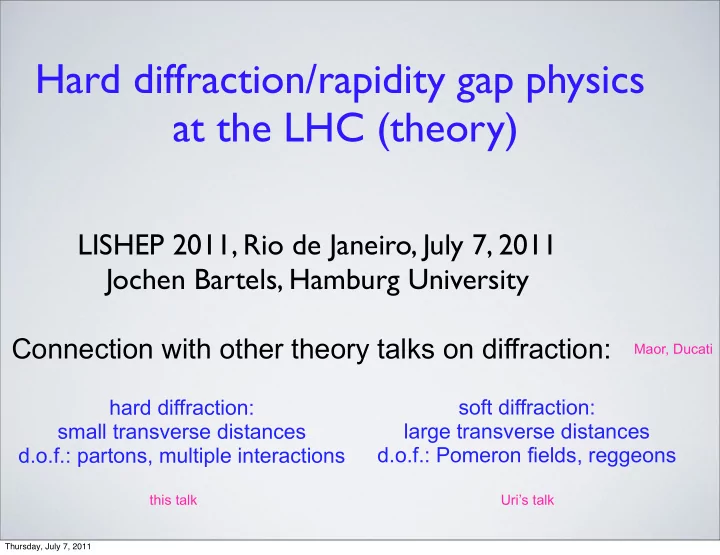
Hard diffraction/rapidity gap physics at the LHC (theory)

LISHEP 2011, Rio de Janeiro, July 7, 2011 Jochen Bartels, Hamburg University

Connection with other theory talks on diffraction:

soft diffraction: large transverse distances d.o.f.: Pomeron fields, reggeons hard diffraction: small transverse distances d.o.f.: partons, multiple interactions

Uri’s talk this talk Maor, Ducati

Thursday, July 7, 2011

slide-2
SLIDE 2

LHC is:

  • Discovery machine

(waiting for discovery)

  • QCD machine

(QCD is always present) (Hard) Diffraction is:

  • Vital Aspect of QCD (Strong interactions)
  • Place to look for New Physics

Thursday, July 7, 2011

slide-3
SLIDE 3

LHC data on hard diffraction have started to be analyzed So far: mainly comparison with Monte Carlo In recent years: very intense cross talk between diffraction at HERA and Tevatron This talk: Overview of our current (theoretical) understanding

  • Theory: multiparton physics
  • Some particular final states (QCD)
  • Some particular final states (new physics)

Thursday, July 7, 2011

slide-4
SLIDE 4

Introduction: physics of multiple interactions

‘Definition’ of hard diffraction: a heuristic picture of an event structure in pp collisions: Valid only for ‘hard’ partons; Ordering in scale and momentum fraction (rapidity) Initial state interaction (absorption) tends to lower the cross section Missing: final state hadronization

partons (quarks, gluons) remnant remnant + final state radiation, hadronization

Thursday, July 7, 2011

slide-5
SLIDE 5

Notations:

X

closer to Feynman diagrams, this talk maybe more intuitive

Thursday, July 7, 2011

slide-6
SLIDE 6

Number of chains varies from event to event. Presence of second chain firmly established at the Tevatron (R.Field) Confirmed at HERA, LHC. Number of chains grows with energy

  • r

x y

Thursday, July 7, 2011

slide-7
SLIDE 7

How to get to the standard ‘collinear factorization’: sum over events single inclusive cross section parton can come from any chain sum over the number of chains connection with initial state interaction single chain (factorization, AGK rules)

➔ ➔

Thursday, July 7, 2011

slide-8
SLIDE 8

Double inclusive cross section: sum over events

double inclusive cross section Leads to corrections to multijet cross sections Potentially important in search for new physics

(Treleani; Kulesza, Stirling; Diehl,Schaefer)

+

Thursday, July 7, 2011

slide-9
SLIDE 9

So far: simplified picture, eikonal model (elastic and quasi-elastic re-scattering) guideline for many MC’s

=

...

Connection between ‘cut’ and ‘uncut’ ladder

Thursday, July 7, 2011

slide-10
SLIDE 10

Steps of improvements: A.‘cross talk’ between different chains, multiparton evolution

Flensburg,Gustafson JB,Ryskin B.Blok et al: Kulesza, Stirling, Golec-Biernat et al. Diehl, Schaefer

X X

no communication number changing vertex recombination (swing)

X X X X

double DGLAP

beyond the eikonal picture

  • B. Include hard diffraction

Thursday, July 7, 2011

slide-11
SLIDE 11

‘Soft’ diffraction is included but not visible : single chain, HERA

Collins et al.

Factorization theorem ‘Soft’ gap: below initial scale of DGLAP-evolution HERA: diffraction more than 10%

contains Q 0

2

Q 0

2

Q2

Thursday, July 7, 2011

slide-12
SLIDE 12

BUT: second, third... chain may fill the gap, less diffraction

remnant remnant contains diffraction contains diffraction soft gap soft gap

LHC, single chain is analogous to DIS:

Thursday, July 7, 2011

slide-13
SLIDE 13

Radiation off a parton chain suppresses large rapidity gaps:

color singlet exchange favors gap color octet: radiation fills the gap

Need to include new contributions into the previous picture: Hard diffraction is not included:

Thursday, July 7, 2011

slide-14
SLIDE 14

+

gap

Sum over all rescattering effects: lowers the probability of rapidity gaps Define ‘survival probability’ as suppression factor: diffract.cross section = S hard cross section (in b-space) S is ‘effective’ parameter. Formula works surprisingly well. But: S is not universal (depends upon final state), spoils the eikonal picture

=

gap

Thursday, July 7, 2011

slide-15
SLIDE 15

After squaring: ‘ladder graphs’

gap 2

=

X

Beginning of ‘Pomeron’ graphs soft diffraction

Thursday, July 7, 2011

slide-16
SLIDE 16

Conclusions of this ‘introductory’ part: structure of a single (nondiffractive) event can be rather complex - simplicity returns when inclusive cross sections are considered Diffractive events: experimentally attractive ‘approximate simplicity’: hard soft rescattering (survival prob.) but: subtleties are encoded in the survival probability - nonuniversal. need to be measured!

Thursday, July 7, 2011

slide-17
SLIDE 17

Diffractive processes - QCD dynamics

  • 1. Diffractive parton densities

also called ‘Pomeron’ structure function

Ingelman, Schlein

jet jet gap jet jet gap

  • r

Thursday, July 7, 2011

slide-18
SLIDE 18

The analogue at HERA: diffractive parton densities Diffractive parton densitites follow DGLAP evolution, are universal. But: cannot be transported to pp-collisions (survival probability)

jet jet gap jet jet gap

  • r

Thursday, July 7, 2011

slide-19
SLIDE 19

Comparison with HERA data: Is the survival probability simply a constant (in b-space)? Does it depend upon ?

β, ET

Thursday, July 7, 2011

slide-20
SLIDE 20

Survival probability could have other contributions: ‘Semihard’ rescattering corrections (are not small)

jet jet gap jet jet gap

Thursday, July 7, 2011

slide-21
SLIDE 21

Space-time picture of the ‘Pomeron’ structure function: Pomeron is part of the proton

Pomeron remnant at rest time time

Thursday, July 7, 2011

slide-22
SLIDE 22
  • 2. Double diffractive final states

‘Production out of pure glue’: e.g. as signal for the odderon

J/Ψ

pp → ppV, V = J/Ψ, Υ

J/Psi Pomeron Odderon J/Psi Pomeron photon

In SU(3) gauge theory: BFKL (2 gluons) and Odderon (3 gluons) are fundamental configurations.

Thursday, July 7, 2011

slide-23
SLIDE 23
  • 3. Jet-gap-jet (hard color singlet exchange)

dσpp dx1dx2dE2

T

= Sf(x1, ET )f(x2, eT )dσqq→JJ(η, ET ) dE2

T

BFKL needs all conformal spins Survival factor S: Modelled by Monte Carlo

Cox,Forshaw,Lonnblad; Enberg,Ingelman, Motyka; Royon

BFKL

Thursday, July 7, 2011

slide-24
SLIDE 24
  • 4. Saturation: forward Drell-Yan

Motivation: parton densities at small-x.

x 1 x 2

x2 ≪ x1

Signals for saturation at the LHC:

  • ridge effect,
  • charged multiplicity,
  • scaling in

dN dydp2

t

= F(p2

t/Q2 s)

Q2

Thursday, July 7, 2011

slide-25
SLIDE 25

x 1 x 2

gap

Motivation: HERA observation :

σdiff σtot

Thursday, July 7, 2011

slide-26
SLIDE 26

Diffractive/rapidity gap processes: new physics

  • 1. Double diffractive production of Higgs, SUSY,....

Topic of intense discussion

(Bialas,Landshoff; ... ;Durham group)

Experimental aspects: clean signal, precise mass determination Theoretical ingredients: parton densities, Sudakov factor, suppression rules, survival probability

Sudakov Survival probability

H or SUSY; candles

Thursday, July 7, 2011

slide-27
SLIDE 27

Theoretical uncertainty: survival probability Standard calculation based upon eikonal approximation, however, it could be more complicated, e.g.: Corrections are large and need to be resummed Very difficult problem Help from experiment: (Tevatron) measure production of other final states (candles) e.g. jet-jet, γγ, χc

Sudakov

H or SUSY; candles +

Sudakov Survival probability

H or SUSY; candles

Thursday, July 7, 2011

slide-28
SLIDE 28

Estimates (from Royon, 2010):

Thursday, July 7, 2011

slide-29
SLIDE 29
  • 2. Rapidity gaps and Electroweak physics

Why do we need a Higgs: a) high energy behavior vector-vector scattering b) renormalizability of electroweak theory

W L W L W L W L

= +...+ +

Bad high energy behavior (violation of unitartiy bounds), near 1 Tev: ‘WW scattering is the primary place to search for Higgs bosons’ Similarly in other VV VV processes, but at higher order (energies). New physics maybe encoded in anomalous coupling.

γ + γ → WW, ZZ

Thursday, July 7, 2011

slide-30
SLIDE 30

What can be done in pp-scattering: photon-photon induced interactions

(Pierzchala,Piotrzkowski,; Chapon,Kepka,Royon; D0)

Bounds on anomalous quartic gauge coupling can be improved Unitarity violations in VV scattering around Need to go to small t.

Wγγ = 2 TeV Wγγ ≤ 1.8 TeV

Thursday, July 7, 2011

slide-31
SLIDE 31

Conclusions

Theory of hard diffraction:

  • theory of multiparton interactions (only at the beginning)
  • convenient parametrization: survival probability (nonuniversal)
  • connection with soft (=long distance) diffraction

S2

Specific final states:

  • aspects of QCD dynamics

diffractive parton densities jet gap jet (BFKL)

  • search for new physics

double diffractive Higgs electroweak

Thursday, July 7, 2011