
SLIDE 1
Duke CPS 108 7.1
Arrays/strings: pointers and memory allocation
- Why not rely solely on string and vector classes?
➤ how are string and vector implemented? ➤ lower level access can be more efficient (but be leery of
claims that C-style arrays/strings required for efficiency)
➤ real understanding comes when more levels of abstraction
are understood
- string and vector classes insulate programmers from
inadvertent attempts to access memory that’s not accessible
➤ what is the value of a pointer? ➤ what is a segmentation violation?
Duke CPS 108 7.2
Contiguous chunks of memory
- In C++ allocate using array form
- f new
int * a = new int[100]; double * b = new double[300];
- new [] returns a pointer to a
block o f memory
➤ how big? where?
- size of chunk can be set at
runtime, not the case with
int a[100]; cin >> howBig; int a[howBig];
- delete [] a; // storage returned
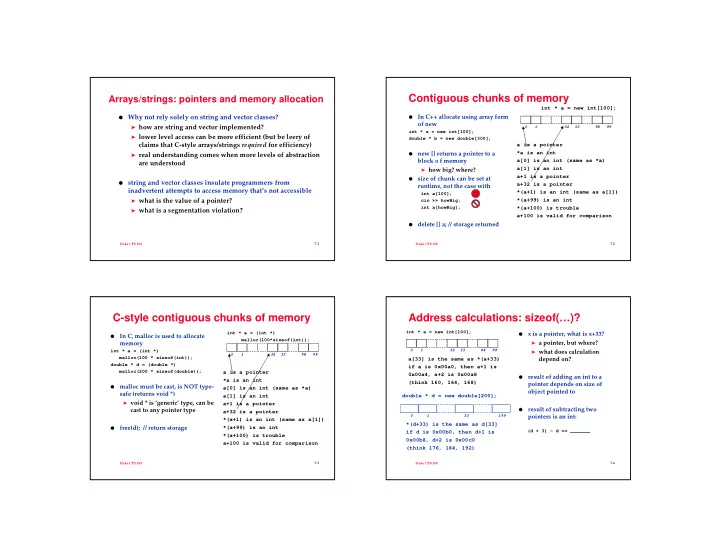
int * a = new int[100];
1 99 32 33 98
a is a pointer *a is an int a[0] is an int (same as *a) a[1] is an int a+1 is a pointer a+32 is a pointer *(a+1) is an int (same as a[1]) *(a+99) is an int *(a+100) is trouble a+100 is valid for comparison
Duke CPS 108 7.3
C-style contiguous chunks of memory
- In C, malloc is used to allocate
memory
int * a = (int *) malloc(100 * sizeof(int)); double * d = (double *) malloc(200 * sizeof(double));
- malloc must be cast, is NOT type-
safe (returns void *)
➤ void * is ‘generic’ type, can be
cast to any pointer type
- free(d); // return storage
int * a = (int *) malloc(100*sizeof(int));
1 99 32 33 98
a is a pointer *a is an int a[0] is an int (same as *a) a[1] is an int a+1 is a pointer a+32 is a pointer *(a+1) is an int (same as a[1]) *(a+99) is an int *(a+100) is trouble a+100 is valid for comparison
Duke CPS 108 7.4
Address calculations: sizeof(…)?
- x is a pointer, what is x+33?
➤ a pointer, but where? ➤ what does calculation
depend on?
- result of adding an int to a
pointer depends on size of
- bject pointed to
- result of subtracting two
pointers is an int:
(d + 3) - d == _______ int * a = new int[100];
1 99 32 33 98
a[33] is the same as *(a+33) if a is 0x00a0, then a+1 is 0x00a4, a+2 is 0x00a8 (think 160, 164, 168)
1 33 199