Chapter 8 Forecasting Demand Qualitative Forecasting Methods Moving - - PDF document

chapter 8 forecasting demand
SMART_READER_LITE
LIVE PREVIEW

Chapter 8 Forecasting Demand Qualitative Forecasting Methods Moving - - PDF document

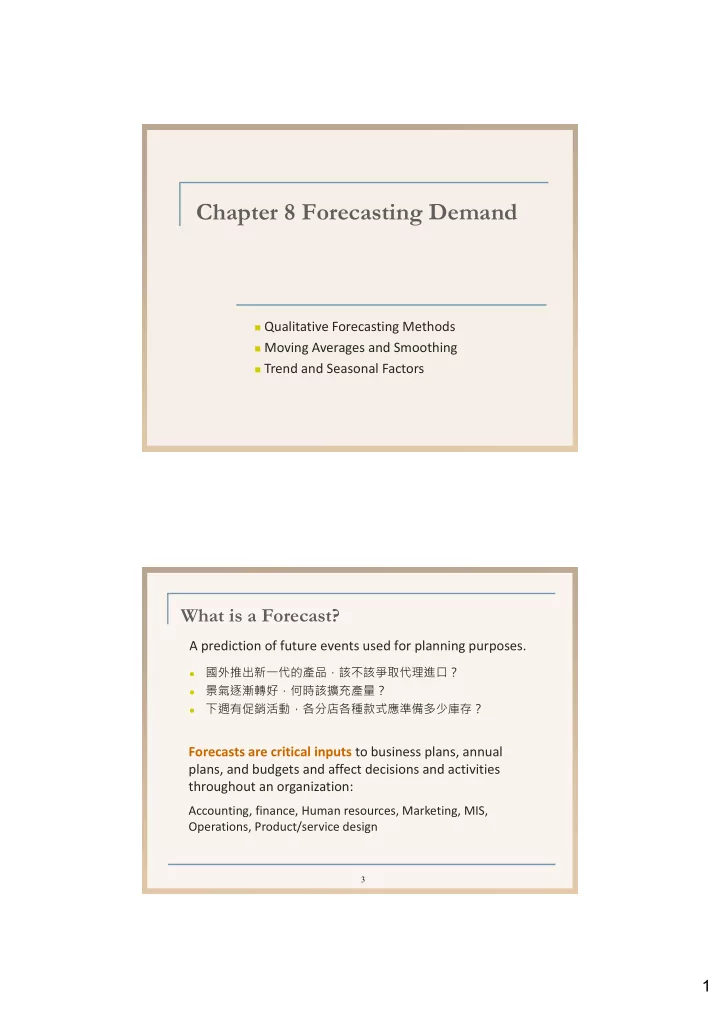
Chapter 8 Forecasting Demand Qualitative Forecasting Methods Moving Averages and Smoothing Trend and Seasonal Factors What is a Forecast? A prediction of future events used for planning purposes.


slide-1
SLIDE 1

1

Chapter 8 Forecasting Demand

 Qualitative Forecasting Methods  Moving Averages and Smoothing  Trend and Seasonal Factors

What is a Forecast?

A prediction of future events used for planning purposes.

國外推出新一代的產品,該不該爭取代理進口?

景氣逐漸轉好,何時該擴充產量?

下週有促銷活動,各分店各種款式應準備多少庫存?

3

Forecasts are critical inputs to business plans, annual plans, and budgets and affect decisions and activities throughout an organization:

Accounting, finance, Human resources, Marketing, MIS, Operations, Product/service design

slide-2
SLIDE 2

2

Demand Patterns

Quantity Time Quantity Time Quantity

| | | | | | | | | | | |

J F M A M J J A S O N D

Months

Year 1 Year 2

Quantity

| | | | | | 1 2 3 4 5 6

Years

noise trend+noise season+noise cycle

4

Demand Management Options

 The process of changing demand patterns using one or more

demand options 主動影響市場需求

 Complementary Products  Promotional Pricing  Revenue Management  Prescheduled Appointments  Reservations  Backlogs  Backorders and Stockouts

6

supply demand

slide-3
SLIDE 3

3

Key Decisions on Making Forecasts

 Deciding What to Forecast

 Level of aggregation: clustering several similar services or

products so that forecasts are more accurate.

 Choosing the Type of Forecasting Technique

 Judgment methods, Causal methods, Time‐series analysis

Rules of Forecasting

 Forecasts are not perfect. 預測永遠是錯誤的  Forecasts for groups of items tend to be

more accurate 整體預測較準確

 Forecast accuracy decreases as the time

horizon increases. 越久遠的預測越不準確

7

Judgment (Qualitative) Methods

 Forecasts based on contextual knowledge gained

through experience.

 Salesforce estimates  Executive opinion  Market research  Delphi method

Strengths

  • 可針對缺乏市場數據的新產品進行預測
  • 可加入無法量化的資訊

Weaknesses

  • 需要良好的問卷設計與調查方式
  • 意見可能偏頗、分歧、或受到不當影響

8

slide-4
SLIDE 4

4

Forecast Error

 It is important to measure and monitor the accuracy of forecasts.  Forecast error for a given period:

Ft = forecast for period t, Dt = actual demand in period t Et = Dt – Ft

Mean Absolute Deviation = Mean Absolute Percentage Error =

n F D

n t t t

1

% 100

1

 

n D F D

n t t t t

9 10

Causal Forecasting (using Linear Regression)

估計可事先觀察的因素對於需求或銷售的影響程度 假設兩者的因果關係為線性變化  Y = a + bX

(x1, …, xn) (y1, …, yn)

可事先觀察的數值 如房地產銷售 要預測的數值 如家電銷售

2 2

x n x y x n y x b

i i i i i

   

影響程度(斜率)

x b y a  

slide-5
SLIDE 5

5

Linear Regression

Dependent variable Independent variable X Y Forecast of y from regression equation Regression equation: Y = a + bX Actual Value of y Value of x used to forecast y Forecast error

11

Example 8.2

A manager seeks to forecast the demand for door hinges and believes that the demand is related to advertising expenditures.

Month Sales (thousands of units) Advertising (thousands of $) 1 264 2.5 2 116 1.3 3 165 1.4 4 101 1.0 5 209 2.0

The company will spend $1,750 next month on advertising for the

  • product. Use causal method to develop a forecast for this product.

12

slide-6
SLIDE 6

6

Example 8.2

Y = –8.135 + 109.229X

| |

1.0 2.0

Advertising ($000)

250 – 200 – 150 – 100 – 50 – 0 –

Sales (000 units)

X X X X X

Forecast for next month : Y = –8.135 + 109.229(1.75) = 183.016 135 . 8 229 . 109 ) 64 . 1 ( 5 9 . 14 171 64 . 1 5 8 . 1560

2

         a b

13 14

Correlation  Cause

slide-7
SLIDE 7

7

15

Time Series Forecasting

These methods assume that the past demand pattern will continue in the future. 過去的銷售變化型態會持續到未來 Time‐series analysis identifies underlying patterns of demand that combine to a model to forecast future demands.

17

Naïve Forecast

 Stable time series data

F(t+1) = D(t)

 Seasonal variations

F(t+1) = D(t+1‐n)

 Data with trends

F(t+1) = D(t) + (D(t) – D(t‐1))

The forecast for the next period equals the demand for the current period.

外插法

Works best when the horizontal, trend, or seasonal patterns are stable and random variation is small.

slide-8
SLIDE 8

8

18

Horizontal Patterns: Simple Moving Averages

Ft+1 = = Sum of last n demands n Dt + Dt-1 + Dt-2 + … + Dt-n+1 n Example 8.3

Week Patient Arrivals 1 400 2 380 3 411

  • a. Compute a three‐week moving average forecast for week 4.
  • c. If the actual number of patient arrivals in week 4 is 415,

what is the forecast for week 5?

19

Large values of n should be used for demand series that are stable, and small values of n should be used for those that are susceptible to changes in the underlying average.

slide-9
SLIDE 9

9

Horizontal Patterns: Weighted Moving Averages

Ft+1 = W1 Dt + W2 Dt-1 + … + Wn Dt-n+1 Assumption: 近期的數據有較高的參考價值

Ft = 0.5 Dt‐1+ 0.3 Dt‐2+ 0.2 Dt‐3  F4 = 0.50(411)+0.30(380)+0.20(400) = 399.5

ΣWi=1 W1 > W2 >…> Wn Week Patient Arrivals 1 400 2 380 3 411

Example 3:

W1 =0.5, W2 =0.3, W3 =0.2

20

Horizontal Patterns: Exponential Smoothing

 A sophisticated weighted moving average that calculates the

average of a time series by implicitly giving recent demands more weight than earlier demands 由複雜的加權平均演化而成

 Requires only three items of data

 The last period’s forecast  The demand for this period  A smoothing parameter, alpha (α), where 0 ≤ α ≤ 1.0

Ft+1 = α (Demand this period) + (1–α)(Forecast calculated last period) = α Dt + (1 – α)Ft = Ft + α ( Dt –Ft )

21

slide-10
SLIDE 10

10

Example 8.4

Calculate the exponential smoothing forecast ( = 0.10) for week 4. Week Patient Arrivals 1 400 2 380 3 411 F4 = α D3 + (1 – α)F3 = 0.10(411) + 0.90(390) = 392.1 F5 = 0.10(415) + 0.90(392.1) = 394.4 If the actual demand for week 4 turned out to be 415, what is the forecast for week 5? Assume F3=(D1+D2)/2=390

22 23

Using Exponential Smoothing

Approaches to obtain an initial forecast F1=前一期的銷售量 F1=先前幾期的平均銷售量 F1=a subjective estimate

smoothing constant α

 Larger α values emphasize recent levels of demand and result in

forecasts more responsive to changes in the underlying average.

 Smaller α values treat past demand more uniformly and result in

more stable forecasts. Ft+1 = α Dt + (1 – α)Ft

slide-11
SLIDE 11

11

24

Trend Patterns using Linear Regression

A trend in a time series is a systematic increase or decrease in the average of the series over time.

  • Indep. variable X (time)  dependent variable Y (demand)

Regression估計市場需求(Y)隨著時間(X)演進的線性關係

Y = a + bX

要預測之未來 的時期編號 該期的產品 需求預測

x b y a x n x y x n y x b

i i i i i

     

2 2

趨勢(斜率)

Example 8.5

Week Arrivals Week Arrivals 1 28 9 61 2 27 10 39 3 44 11 55 4 37 12 54 5 35 13 52 6 53 14 60 7 38 15 60 8 57 16 75

Arrivals at Medanalysis, Inc.

What is the forecasted demand for the next three periods?

25

slide-12
SLIDE 12

12

Example 8.5

26

10 20 30 40 50 60 70 80 5 10 15 20

x b y a x n x y x n y x b

i i i i i

     

2 2

y=28.5+2.3456x

Forecast for next 3 months: Y17 = 28.5 + 2.3456(17) = 68.375 Y18 = 28.5 + 2.3456(18) = 70.721 Y19 = 28.5 + 2.3456(19) = 73.066

Seasonal Patterns: Using Seasonal Factors

Additive seasonal method Add a constant to the estimate of average demand per season. Multiplicative seasonal method Seasonal factors are multiplied by an estimate of average demand Seasonal patterns are regularly repeating upward or downward movements in demand measured in periods of less than one year (hours, days, weeks, months, or quarters).

27

slide-13
SLIDE 13

13

Multiplicative Seasonal Method

  • 1. For each year, calculate the average demand for each season by

dividing annual demand by the number of seasons per year.

  • 2. For each year, divide the actual demand for each season by the

average demand per season, resulting in a seasonal factor for each season.

  • 3. Calculate the average seasonal factor for each season using the

results from Step 2.

  • 4. Calculate each season’s forecast for next year.

設次年的全年 預測=1100 第1季 2750.8=220 第2季 2751.4=385 第3季 2751.2=330 第4季 2750.6=165 第1季 第2季 第3季 第4季 200 350 300 150 0.8 1.4 1.2 0.6

28

Example 8.6

The carpet cleaning business is seasonal, with a peak in the third quarter and a trough in the first quarter.

YEAR 1 YEAR 2 YEAR 3 YEAR 4 Q1 45 70 100 100 Q2 335 370 585 725 Q3 520 590 830 1160 Q4 100 170 285 215 Total 1,000 1,200 1,800 2,200

The manager wants to forecast demand for each quarter of year 5.

29

slide-14
SLIDE 14

14

Example 8.6

YEAR 1 YEAR 2 Q Demand Seasonal Factor (1) Demand Seasonal Factor (2) 1 45

45/250 =

0.18 70

70/300 =

0.23 2 335

335/250 =

1.34 370

370/300 =

1.23 3 520

520/250 =

2.08 590

590/300 =

1.97 4 100

100/250 =

0.40 170

170/300 =

0.57 Total 1,000 1,200 Average 1,000/4 = 250 Average 300 YEAR 3 YEAR 4 Demand Seasonal Factor (3) Demand Seasonal Factor (4) 100

100/450 =

0.22 100

100/550 =

0.18 585

585/450 =

1.30 725

725/550 =

1.32 830

830/450 =

1.84 1160

1160/550 =

2.11 285

285/450 =

0.63 215

215/550 =

0.39 1,800 2,200 Average 450 Average 550

30

Example 8.6

Year Total Demand 1 1000 2 1200 3 1800 4 2200

y = 500 + 420x

500 1000 1500 2000 2500 1 2 3 4 5

Total Demand for Year 5 = 500 + 4205 = 2600

使用其他預測方法對全年的總需求進行預測

31

slide-15
SLIDE 15

15

Example 8.6

Quarterly Forecasts for Year 5

Quarter Forecast 1 650 x 0.2043 = 132.795 2 650 x 1.2979 = 843.635 3 650 x 2.001 = 1,300.06 4 650 x 0.4977 = 323.505 Quarter Average Seasonal Factor 1 0.2043 2 1.2979 3 2.0001 4 0.4977

Average Seasonal Factor

32

Criteria for Selecting Time-Series Method

 Minimizing MAPE or MAD  Using a holdout sample analysis: actual

demands from more recent time periods are set aside to test different models developed from earlier time periods.

 Using a tracking signal*  Meeting managerial expectations of changes in the

components of demand.

 Minimizing the forecast errors in recent periods.

33

slide-16
SLIDE 16

16

Monitoring the Forecast

34

Practical Approaches to Demand Forecasting

 Combination forecasts: averaging independent forecasts based

  • n different methods, different sources, or different data

 Judgmental adjustments: an adjustment made to forecasts from

quantitative models that takes into account contextual information.

 Focus forecasting: A method of forecasting that selects the best

forecast from a group of forecasts based on past error measures.

 Collaborative Forecasting: part of Collaborative Planning,

Forecasting, & Replenishment (CPFR) that allows a supplier and its customers to collaborate on making the forecast.

35