
SLIDE 1
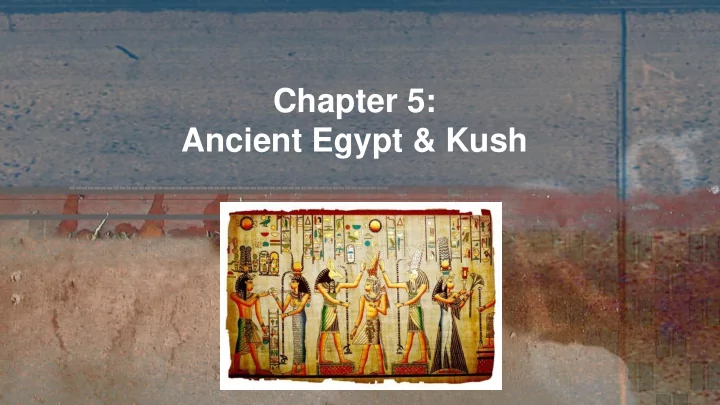
Chapter 5: Ancient Egypt & Kush The Nile River Valley As - - PowerPoint PPT Presentation
Chapter 5: Ancient Egypt & Kush The Nile River Valley As empires were flourishing and falling in Mesopotamia, two new civilizations, Egypt and Kush were emerging in Africa , in the Nile River Valley. The Nile River Valley
empires were flourishing and falling in Mesopotamia, two new civilizations, Egypt and Kush were emerging in Africa, in the Nile River Valley.
because of its fertile land. Early hunters and gatherers arrived around 5000 B.C. and built permanent settlements in the Nile River valley.
Kushites.
River Valley and called their land Kemet, meaning “black land”, after the dark, rich soil.
reasons many of Egypt’s ancient structures were able to survive.
little rainfall, Egyptians depended on the Nile River as their source of water for drinking, bathing and watering their crops.
longest river, flowing north about 4,000 miles from central Africa to the Mediterranean Sea.
separate rivers, the Blue Nile and the White Nile, before joining just South of Egypt.
together, steep cliffs and boulders create fast moving waters called cataracts.
valley.
many branches that resemble a plants bloom. These waterways form a fan-shaped fertile marshland known as a Delta.
deserts that stretch on either side of the river.
largest deserts in the world.
desert, which forms part of the Sahara.
Desert which extends to the Red Sea.
favorable to humans and animals, and kept Egypt isolated from outside invaders.
attacking.
invaders sailing from the Mediterranean Sea.
gave Egyptians an advantage that the Mesopotamian people lacked.
used wind patterns to use sail boats to trade with other regions.
Mesopotamian people had to learn to control the flooding of the Tigris and Euphrates rivers, but in Egypt the flooding of the Nile was seasonal, so the Egyptians did not face the same challenges.
heavy tropical rains in central Africa as well as melting snow from mountains in Eastern Africa causes the Nile to overflow its banks.
normal level in late fall, thick deposits of fertile soil remained.
Egyptians planted wheat, barley and flax seeds while the soil was still wet.
irrigated their crops by scooping
in the earth to store river water, which they connected to their fields using canals.
new tool to make their work easier, a shadoof, was a bucket attached to a pole that could be used to lift water from the Nile and empty it into basins.
lands and determine boundary lines after flood waters washed away markers, Egyptians used geometry to recalculate where one field ended and another began.
Egyptians used papyrus, a reed plant that grew along the Nile to weave rope, sandals, baskets and river rafts. Later, Egyptians soaked strips of the stalk in water then pounded the strips together to make sheets of paper.
How did the Egyptians Write?
their own system of writing, first by using symbols to represent words, and later by developing symbols that represented sounds.
sound symbols created a complex writing system of writing called hieroglyphics.
schools to train as scribes.
clay tablets, Egyptian scribes wrote or painted on papyrus. However, Egyptian scribes did carve hieroglyphics into stone walls and monuments.
with Nubia, Mesopotamia, and other places
increasingly important as farming and trade increased.
construction of irrigation systems and dams, to develop a process for storing and distributing grain during famine, and settle conflicts over land
Over time villages formed small kingdoms, which were ruled
stronger ones, and by 4000 B.C., Egypt was made up of two kingdoms.
and he married one of their princesses, which unified the kingdoms.
city on the border of the two kingdoms, and he governed both sides of the kingdom from there.
rule was passed from father to son to grandson.
dynasty.
Around 2600 B.C., the Egyptian Civilization entered what was known as the Old Kingdom. For their government, they developed a theocracy, a government in which the same person is both the political and religious leader.
At first the Egyptian leader was called a king. Later, the king was known as a pharaoh, meaning “great house” – referring to the palace where the king and his family lived. Pharaohs held total power
Egyptians believed that his wise, and far-reaching leadership would enable them to survive.
The Pharaoh appointed bureaucrats to carry out his orders, oversee building projects, and collect taxes.
The Pharaoh owned all the land in Egypt. Sometimes the pharaoh distributed land to officials, priests, and wealthy Egyptians whom he favored.
Egyptians believed the pharaoh was the son of Re, the Egyptian sun god. They believed the pharaoh was a god on earth who protected Egypt. As their religious leader, the pharaoh participated in ceremonies to help the kingdom thrive such as being the first person to cut the grain at harvest time.
Egyptians worshipped many gods, whom they believed controlled natural forces as well as human activities. Egyptians depended on the sun and river to harvest their crops, so their most important gods were Re (the sun god) and Hapi (the river god).
Egyptians believed life after death was better than the present life. One of the most important writings in ancient Egypt was The Book of the Dead, which explained what a person can expect in the afterlife.
Earliest Egyptians believed only the pharaoh could enjoy the afterlife. They believed his soul resided in his body and had to be protected in order for him to complete the journey to the afterlife and continue to watch
Em Emba balm lming ing emerged so Egyptians could protect bodies for the afterlife.
removed the body’s orga gans to be stored in special jars and buried with the body (Canopic jars).
salt called natron n and stored for many days to dry up the remaining water in the body.
was wrapped in strips of linen and sealed in a coffin.
The wealthy had their coffins sealed inside tombs bs, while poorer people had their coffins buried in caves or in the sand. Egyptians viewed animals not
acred ed
em embalm lmed ed.
Egyptians learned about the human body through embalming, and became the first to learn how to sew w
brok
en bones. They wrote down their medical information on papyrus, and these became the world’s first me medi dical cal bo books. ks.
To honor their pharaohs, Egyptians built giant burial tombs called pyramid ids. s. Inside the tombs, Egyptians placed clothing, jewelry, furniture, and
for the pharaoh to use in the after erli life. e.
Building the pyramids took thousands usands of workers.
Surveyors, carpenters, architects, and engineers were needed, as well as farmer rmers s during the summer months when the Nile River was flooded and they were unable to farm.
Workers searched the Nile River Valley for stones to be used in building the pyramids. Artisans would use copp pper er tools to cut the stones into huge blocks, then workers moved the stones using wooden sled eds and pulley systems.
Egyptians wanted the entrance to each pyramid to face no
studied the skies and developed an understanding
Using this knowledge, they developed a 365 65-day calendar, which is the basis of
Advances were also made in ma
math thema ematic
to study angles and calculate the number of blocks it would take to build a pyramid.
They developed a system of written numbers based on ten, and
created fracti ctions
Around the height of a 48-story building, the pyramid stands 500 00 feet above the desert. More than 2 2 million stone blocks were used in the construction, each weighing on average 2.5 tons. The pyramid extends over an area of about 9 9 football fields.
At its peak, Egypt was home to about 5 million – about the number in Colorado today. Most lived in the fertile Nile Valley and Delta –about 3% of Egypt’s land mass.
Highest Class: Pharaoh and his family Upper Class: Priests, nobles, army commanders Middle Class: Artisans and
Lower Class: Farmers and herders Lowest Class: unskilled workers and enslaved people
Upper class Egyptians had homes along the Nile River, some 2-3 stories tall and constructed of wood and sun-dried mud bricks. The Upper class dressed in white linen clothing and wore dark eye makeup.
Mi Middle le Cla lass s (artisans and skilled workers) lived in smaller homes and dressed more simply than the upper class.
The Lower classes: farmers, herders, unskilled workers, and enslaved people made up the majori jority of the population.
Farmers rented their land from wealthy nobles and lived in small, usually one room homes made from mud bricks with palm leaf roofs. Unskilled workers performed manual ual labor such as loading and transporting cargo.
Most unskilled workers settled in crowded ed city neighborhoods in small mud-brick houses with dirt floors. Families often gathered on rooftops ps to socialize and, because of the hot Egyptian climate, they cooked on their rooftops to help keep the home cooler. Some of the unskilled workers were ensla laved ed people, and many could earn their freedom over time.
Women had more rights than in the past and could own land, and obtain a divorce. Wealthy women sometimes served as priests. Wives of farmers worked in the fields with their husbands. Women of higher social class stayed home.
Few Egyptian children attended school. They had time to play board games, with dolls, balls and spinning tops. Girls ls learned to sew, cook and run the household from their mother. Boys learned a tr trad ade e from their father.
Boys and girls were expected to marry and begin a family in their tee eena nage ge years. People generally lived in nuclea ear r family households, but some farm families lived as extended families. The olde dest son, or sometimes oldest daughter, was expected to take care of the pa paren ents when they became too old or sick. This included giving the parents a proper buria ial.
Around 2200 B.C., ruling Pharaohs in Memphis began to weaken, and nobles began to struggle for control of Egypt. Finally, a new dynasty of Pharaohs came to power and moved the capitol from Memphis to Thebes. This began a new period of peace known as the Middle Kingdom.
During the Middle Kingdom, Egypt conquered and expanded to Nubia in the south, and to the northeast into present–day Syria. They also required tribute, or payments, from the people they conquered.
increase crop production.
supply water to the population.
Nile River and the Red Sea to be used for sea trade.
Tombs were decorated with colorful paintings depicting the stories of deities and scenes from everyday life. Sculptors carved hunting, fishing, and battle scenes onto stone walls. Pharaohs stopped building pyramids and had their tombs constructed by carving
the Kings.
During the 1600s, Egyptian nobles challenged the
Asia, known as the Hyksos, swept into Egypt.
The methods of the
Hyksos were unknown to
horse-drawn carriages and used sturdier weapons made of bronze and iron. The Hyksos used this technology to take control of Egypt.
Hyksos ruled Egypt for
remained separate from the Egyptians. Meanwhile, Egyptians learned to use this new technology and around 1550 B.C., Egyptian prince, Ahmose, formed an army and drove the Hyksos out.
Ahmose began a new empire and began a new period of rule from 1550 B.C. to 1070 B.C. known as the New Kingdom.
A queen named Hatshepsut came to power around 1473 B.C. when her husband, the Pharaoh, died and she ruled on behalf of her young nephew. Because the title Pharaoh was reserved for a man she dressed in men’s clothing and wore the fake beard to copy the one worn by male Egyptian kings. She built magnificent kingdoms and restored old monuments.
l Hatshepsut valued trade over going to war. l During her reign, she made efforts to restore trade relations lost during the Hyksos invasion. l Sailors traveled to ports in Arabia and East Africa to exchange Egyptian beads, metal tools, and weapons for gold, ivory, ebony wood, and incense.
l For wood products, Egyptian traders travelled to the East of the Mediterranean Sea where present day Lebanon is located.
called Phoenicians, and culturally had a large impact
invention of an alphabet and a system of writing different from other regions.
Egyptians traded wheat, paper, gold, copper, tin, and tools to the Phoenicians for purple dye, wood, and furniture. In turn, Phoenicians traded Egyptian goods with other people, which spread Egyptian goods and foods across Asia. This trade helped make Egypt wealthier, which Hatshepsut used to build monuments.
The Egyptian kingdom also developed ties with other nations such as the Babylonian Empire in Mesopotamia, the Mittani in Syria, and the Hittite Empire in Anatolia by treaty or by marriage. To maintain close ties, Pharaoh’s and rulers also traded envoys. This was the first time in history a group of nations worked together to reach common goals.
When Hatshepsut died, her nephew, Thutmose III, became Pharaoh and began expanding Egypt’s control north to the Euphrates River in Mesopotamia and south to Nubia, which had
As Egypt’s armies conquered more area, the empire grew wealthy as slavery became more common and Egypt acquired gold, copper, ivory, and other valuable goods from the conquered people.
Tutankhamen
Amenhotep IV
During the New Kingdom, two Pharaohs: Amenhotep IV and Tutankhamen would come to power and their actions would set them apart from other Egyptian rulers in history.
Fearing the power of Egypt’s priests, Amenhotep introduced the new religion of worshiping Aton, the sun god as Egypt’s only god. He also removed the priests who
their lands.
He also changed his name to Akhenaton and moved the capitol of Egypt to Akhetaton, a city north of Thebes.
Many Egyptians opposed this change in religion and continued to worship many
loss of power, and army leaders lost faith in the Pharaoh’s rule. Under Akhenaton’s weak rule, Egypt would lose most
Tutankhamun was the nephew of Akhenaton who took over as Pharaoh at the age of ten. He ruled based on the advice of priests and immediately restored the tradition of polytheism.
King Tutankhamun died unexpectedly after ruling for nine years. His tomb was discovered in 1922, perfectly preserved and undisturbed by Howard Carter. Most tombs of the Pharaohs have been robbed by thieves.
During the 1200s B.C., the pharaohs worked to
restore Egypt’s greatness.
Ramses II ruled from 1279-1213 B.C., he conquered the region of Canaan and fought with the Hittites. He had many new temples built throughout Egypt. One of the most famous was in Thebes, called Karnak. Temples were used for special
and as banks.
In the 900s B.C., the Libyans conquered Egypt.
Next, Kush seized power. Finally, in 670 B.C., Egypt was taken over by Assyrians from Mesopotamia.
Nubia, which would later be known as Kush.
along the Nile River in present day Sudan.
to arrive in this region. Later, farming villages developed along the Nile river.
to rely on the flooding
Egyptians, because they received rainfall all year long.
formed the kingdom of Kerma.
Nile River made it an important trade link between Egypt and Southern Africa.
rule, Nubians adopted many beliefs and customs from the Egyptians:
goddesses.
tools.
fit their own language and alphabet.
developed an independent kingdom called Kush.
Kush, was located where trade caravans crossed the upper Nile River.
the traders and kings of Kush.
Egyptian culture.
in Egypt.
their rulers.
in 671 B.C., the Assyrians, armed with iron weapons were able to defeat the Kush who fled from Egypt and returned to their homeland.
learned how to make iron and were able to use this to make better tools for farming.
great cities, Meroë had a temple dedicated to the god Amon-Re. Walls and palaces were decorated with paintings, and small pyramids stood in the royal graveyard.
received leopard skins and valuable wood.
well as enslaved workers, and their own iron products to places as far away as Arabia, India, China, and Rome. In return, they brought back cotton, textiles, and other goods.
trade kingdom for nearly 600 years before the kingdom of Axum arose near the Red Sea in Eastern Africa.
and around A.D. 350, invaded Kush and destroyed Meroë.