SLIDE 1
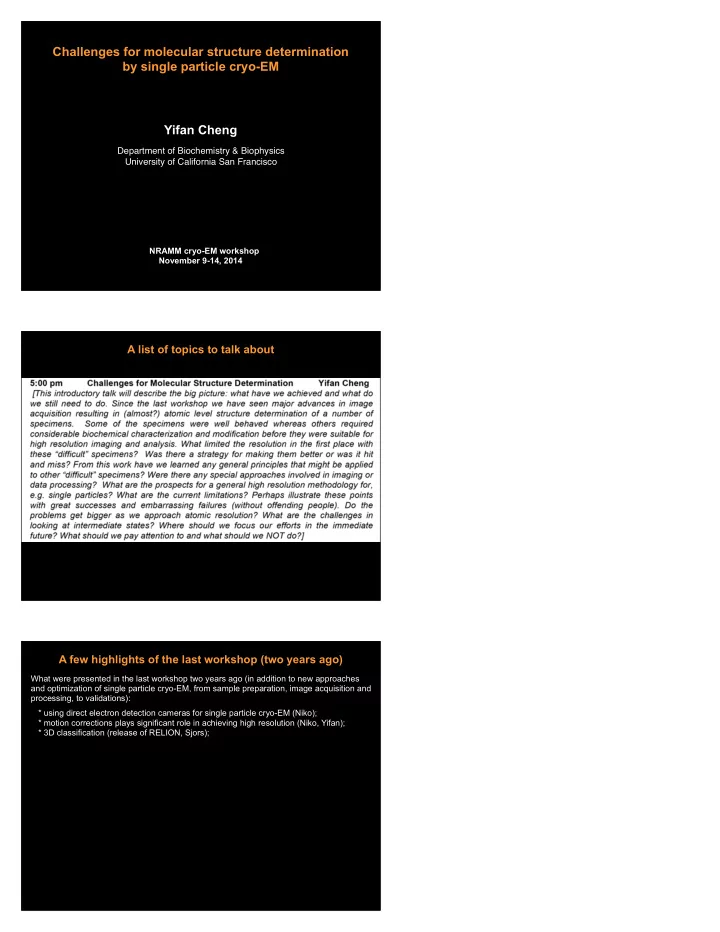
Challenges for molecular structure determination by single particle cryo-EM
NRAMM cryo-EM workshop November 9-14, 2014
Yifan Cheng
Department of Biochemistry & Biophysics University of California San Francisco
A list of topics to talk about A few highlights of the last workshop (two years ago)
What were presented in the last workshop two years ago (in addition to new approaches and optimization of single particle cryo-EM, from sample preparation, image acquisition and processing, to validations): * using direct electron detection cameras for single particle cryo-EM (Niko); * motion corrections plays significant role in achieving high resolution (Niko, Yifan); * 3D classification (release of RELION, Sjors);
SLIDE 2 What were presented in the last workshop two years ago (in addition to new approaches and optimization of single particle cryo-EM, from sample preparation, image acquisition and processing, to validations): * using direct electron detection cameras for single particle cryo-EM (Niko); * motion corrections plays significant role in achieving high resolution (Niko, Sjors, Yifan); * 3D classification (release of RELION, Sjors);
* Brilot et al. “Beam-induced motion of vitrified specimen on holey carbon film” J.
* Campbell et al. “Movies of ice-embedded particles enhances resolution of electron cryo-microscopy”, Structure (2012) Motion correction was first demonstrated by Grigorieff and Carragher Labs with icosahedral viral particles:
A few highlights of the last workshop (two years ago) General applications of motion correction
Whole frame motion correction correct for globe and partial local motion, and restore image Thon ring to high-resolution. perfect image typical image Li et al. (2013) Nature Methods * We determined a 3D reconstruction of archaeal 20S proteasome to the resolution of ~3.3 Å, comparable to the resolution of X-ray crystal structure, 3.4Å. Li et al. (2013) Nature Methods
Single particle cryo-EM at crystallographic resolution
SLIDE 3 Scheres “RELION: Implementation of a Bayesian approach to cryo-EM structure determination”,
Maximum likelihood based classification
Sjors Scheres. “Optimizing image processing”, 2012 NRAMM Workshop. Lyumkis et al. “Likelihood-based classification of cryo-EM images using FREALIGN”,
Scheres Lab: Bai et al. “Ribosome structures at near-atomic resolution from thirty thousand cryo- EM particles”, eLife (2013)
General applications of motion correction
Agard and Cheng labs: Li et al. “Electron counting and beam-induced motion correction enable near-atomic-resolution single particle cryo-EM”, Nature Method (2013) Bai et al. (2013) eLife
What have “single particle cryo-EM” achieved since then:
- Direct detection camera is being used to produce a number of near atomic
resolution reconstructions: “Resolution Revolution”
- Dose fractionation image acquisition and motion correction become standard
procedures.
Werner Kuhlbrandt “The Resolution Revolution”, Science (2014)
Yeast mitochondrial ribosome, 3.2Å rat TRPV1 ion channel, 3.4Å F420-reducing hydrogenase, 3.4Å
SLIDE 4 Membrane protein structure determination is particularly challenging for X-ray
- crystallography. It is also challenging for cryo-EM.
Bacteriorhodopsin Light driven H+ pump Aquaporin 0 water channel
* Electron crystallography - 2D and helical crystals;
Electron crystallography of membrane proteins
* Crystallographic approach is well-established; * Most time produced very good structures of membrane proteins at various resolutions. * Resolution is limited mostly by the quality of crystallinity, and crystallization is still an art. A long journey that is full of hopes and excitements.
Single particle cryo-EM of membrane proteins
Single particle cryo-EM of ryanodine receptor at ~ 30Å resolution.
Radermacher et al. (1994)
- J. Cell Biol., 127: 411-423
Serysheva et al. (1995)
- Nat. Struct. Biol., 2: 18-24
But also with embarrassments!
Insoitol 1,4,5-trisphosphate receptor contains multiple cavities and L-shaped Ligand-binding domains. JMB 2004, 336, 155-64. Structure of the type 1 onsoitol 1,4,5-trisphosphate receptor revealed by electron cryomicroscopy. JBC 2003, 278, 21319-22.
Single particle cryo-EM of membrane proteins
SLIDE 5
Validation of Cryo-EM structure of IP3R1 channel. Structure 2013, 21, 900-909.
Developments of validation tools!
Single particle cryo-EM of membrane proteins
H+-driven ATP synthase (9.7Å) (Lau, et. al. 2011, Nature)
Single particle cryo-EM of membrane protein at sub-nanometer resolution 3D reconstruction of TRPV1 ion channel
!"#$%&$'()*+,-$."/$#+,012,$")-$.1'+34"51)$ 67(*18251)$38,(7+)9$")'$:;<"4,17$*0"7/()+)9=>$ ?0($7(*18251)$+*$(*5.",('$",$%>@A>
Liao, Cai, et al (2013) Nature
SLIDE 6 Other recent progresses in membrane proteins
Unpublished, Nieng Yan
- RyR receptor: Rouslan Efremov and Raunser;
Joachim Frank and Anrew Marks; Sjors Scheres, Yigong Shi and Nieng Yan;
- !-secretase: Sjors Scheres and Yigong Shi (4 ~ 5Å);
- Mammalian respiratory complex I: Judy Hirst (5Å);
Other progresses in membrane proteins
- Glutamate receptor: Sriram Subramaniam and Mark Mayer (7.6 Å);
- ABC exporter: (8.3 Å);
What contributed to TRPV1 structure determination
Contributing factors:
- Production of high quality and biochemically stable proteins;
- Available and well characterized pharmacological reagents;
- Camera related new technologies: high-DQE and dose fractionation;
- Classification of heterogeneous particles;
For ABC exporter reconstruction
- Fab assisted cryo-EM to study small integral membrane proteins;
SLIDE 7 Erhu Cao David Julius Lab, UCSF Minimum functional Rat TRPV1 construct
Cap (1!M)
Ca2+ image Expressed and purified from HEK293S patch clamp of purified TRPV1 reconstituted into liposome
Liao, Cao, et al (2013) Nature
Expression and characterization of rat TRPV1
Dose-responsive curve for minimal and full length (red) TRPV1
b c d a
Minimal TRPV1 is fully functional
Well-behaved TRPV1 proteins
Size exclusion chromatography
Liao, Cao, et al (2013) Nature
! Tecnai TF20 microscope operated at 200kV, TVIPS 8K x 8K scintillator based CMOS camera; ! Image recorded with a defocus of 3.1!m; Thon ring visible at ~8Å resolution;
Single particle cryoEM of TRPV1
Liao, Cao, et al (2013) Nature
SLIDE 8 Conformational classification using RELION
Sjors Scheres: “RELION: Implementation of a Bayesian approach to cryo-EM structure determination”, J. Struct. Biol. (2012)
(22.7%) (21%) (8.3%) (25.5%) (11.6%) (10.9%)
Single particle cryoEM of TRPV1
Liao, Cao, et al (2013) Nature ! Tecnai Polara microscope operated at 300kV, K2 Summit camera; ! dose fractionation and whole frame motion correction; ! 6 sec exposure, 0.2 sec frame accumulation (30 subframes per image), total dose: 41e-/Å2; ! Image recorded with a defocus of 1.7!m; Thon ring visible at close to 3Å resolution;
Single particle cryoEM of TRPV1
- using new camera technology
Liao, Cao, et al (2013) Nature
SLIDE 9 K2 Summit, whole frame motion correction TVIPS 8K scintillator based CMOS camera
Significant improvement of data quality
Liao, Cai, et al (2013) Nature
!
Single particle cryoEM of TRPV1
- using new camera technology
Liao, Cao, et al (2013) Nature
Structure of TRPV1
Liao, Cao, et al (2013) Nature
SLIDE 10 Double Knot Toxin (DkTx)
Julius Lab Bohlen, et al. (2010) Cell
- DkTx binds to and trap TRPV1 in open state.
- DkTx targets the outer pore domain of TRPV1.
Ornithoctonus huwena (Chinese Bird Spider) (Earth Tiger Tarantula)
Structure of TRPV1-DkTx-RTX complex
Binding sites of DkTx and RTX in TRPV1 channel.
Cao, Liao, et al (2013) Nature
Available and well-characterized pharmacological reagents made it possible to determine and relate the structures to its functional states.
TRPV1 in three distinct pore conformations
* Binding of capsaicin opens lower gate; * Binding of both DkTx and RTX opens both lower gate and upper selectivity filter;
Cao, Liao, et al (2013) Nature
SLIDE 11 A typical flow chart of determining membrane protein structure by single particle cryo-EM
- I. Protein productions: expression, purification,
- ptimizations for biochemical conditions;
- II. Single particle cryo-EM: data acquisition,
image processing -> final 3D reconstruction;
de novo model building and refinement;
to publish or not yet to publish? to publish a structure or to tell a story?
How to handle difficult membrane proteins?
* Optimize purification protocol - to generate homogeneous and stable proteins; * Optimize protein expressions and purifications - test different orthologs: using Fluorescence-detection size exclusion chromatography (FSEC); Recombinant proteins:
- - Our experience: Good SEC profile is required but not sufficient. In
addition, every prep needs to be checked by negative stain EM; Endogenous proteins: * Optimize protein solubility, homogeneity and stability - test different detergents, protocols, etc, to generate homogeneous and stable proteins: combining SEC and negative stain EM;
- - It is critical to establish function assays to ensure that purified proteins
are functional, and to provide means to for validating hypothesis generated from structures; Optimizations: * Tetramer MW: 73 kD x 4 = 292 kD; * C4 symmetry * Rat TRPV1 was expressed in mammalian expression system (HEK293S); * Solubilized and purified in the presence of detergent;
Size exclusion chromatography
Negative stain EM
Detergent solubilized rat TRPV1
Liao, Cao, et al (2013) Nature
SLIDE 12
BC;%D
TRPV1 in amphipols
* Detergent was substituted with amphipols - leads to stable proteins for structural analysis.
Tribet, et al. “Amphipols: Polymers that keep membrane proteins soluble in aqueous solutions”, PNAS (1996). Althoff et al. “Arrangement of electron transport chain components in bovine mitochondrial supercomplex”, EMBOJ (2011). Size exclusion chromatography
Liao, Cao, et al (2013) Nature
TRPV1 in amphipols
* Detergent was substituted with amphipols - leads to stable proteins for structural analysis.
Size exclusion chromatography
Liao, Cao, et al (2013) Nature
TRPV1 TRPV2 At low resolution
Be Aware!
* For membrane proteins: an often encountered problem is that the density of transmembrane domain is much weaker than soluble domain. Not every sample goes to high resolution! Having biochemically well-characterized and well-behaved proteins is not a guaranty to produce high resolution structures.
SLIDE 13 !-secretase, 4 ~ 5Å GluR, 7.6Å Or at high resolution
Be Aware!
* For membrane proteins: an often encountered problem is that the density of transmembrane domain is much weaker than soluble domain. Not every sample goes to high resolution! Having biochemically well-characterized and well-behaved proteins is not a guaranty to produce high resolution structures. * For membrane proteins: an often encountered problem is that the density of transmembrane domain is much weaker than soluble domain. Not every sample goes to high resolution! Having biochemically well-characterized and well-behaved proteins is not a guaranty to produce high resolution structures. The cause must be conformational heterogeneity in transmembrane domain, even when soluble domain is conformational homogeneous.
It is a good sign to see detailed features in transmembrane domain in 2D class averages.
Be Aware!
* For membrane proteins: an often encountered problem is that the density of transmembrane domain is much weaker than soluble domain. Not every sample goes to high resolution! Having biochemically well-characterized and well-behaved proteins is not a guaranty to produce high resolution structures. The cause must be conformational heterogeneity in transmembrane domain, even when soluble domain is conformational homogeneous.
- Potential solution B: sort out homogeneous conformation computationally!
Better classification algorithms to sort out different conformations. (What is the physiologically relevant conformation?)
- Potential solution A: go back to biochemistry!
Screen for different orthologous; Using additives to stabilize transmembrane domains; Lipid nanodisc to keep protein in lipid bi-layer environment; Importantly, better classification algorithms cannot substitute better biochemistry to produce better proteins to start with!
Be Aware!
SLIDE 14
- II. Cryo-EM data acquisition and processing
Good news: Data acquisition and processing is better established, more robust and more efficient; * Direct detection camera is widely used, dose fractionation data acquisition is now “standard” procedure, motion corrections (both globe and local) are routinely applied; * Automated or semi-automated data acquisitions enable novice users to collect high quality data; * Automated particle picking making it possible to generate very large dataset within a reasonable time frame. * Streamlined data processing enables novice user to determine high- resolution structures in a short period of times. Bad news: Very psychologically stressful! * Ideally, when all the resources are available, a typical cycle of determining a reconstruction, from data acquisition to final reconstruction, takes about a week. * High efficiency made it possible to test samples prepared under different biochemical conditions.
- III. Model building and refining
* De novo model building is new for many of us, and it is still very challenging for most structures.
- For maps with resolutions at borderline, or even some “near atomic
resolution” maps: de novo model building is very challenging and time consuming. We used to worry about “if my map is correct or not?”
- map validation methods: tilt pair, phase randomization, gold-standard
refinement, etc. Now we also worry (even more) about “if my atomic structure is correct, even my map is fine?”
- how to properly validate atomic structures?
Check and validation
Computational refinement of atomic structures to ensure correct geometry * How to adapt and modify existing X-ray crystallographic refinement methods for refining atomic structures built on cryo-EM maps? * What is the definition of over-fitting and how to avoid it? Validating atomic structures by cysteine cross-linkings.
SLIDE 15 Structure validation by cysteine cross-linking
* NBDs of TmrAB are in close contact at nucleotide free state; * Cys cross-linking confirms such close contact in solution;
Kim, Wu, Tomasiak et al (2014) Nature
Question: what should we publish? A structure or a story? Lesson learnt from TRPV1: Available of well characterized pharmacological reagents enabled trapping protein in specific functional states.
What are current limitations?
* Not every sample will go to high resolution. Why and how to change it?
- Heterogeneity (both conformational and compositional)
- Other limiting factors?
SLIDE 16
Influence of ice thickness
There is a strong correlation between visibility of Thon ring with the thickness of ice.
Estimated ice thickness: 3: ~903Å, 4: ~420Å, 5: ~220Å, and 6: ~380Å;
One possible explanation
Average of particles with different defocuses dampens the high-frequency Thon ring. Simulation with 300kV, -2um defocus and different ice thickness.
Acknowledgement
Current members: Shenping Wu, Jean-Paul Armache, David Bulkley, Yuan Gao, Ruchika, Shangyu Dang Funding: NSF: DBI-0960271 (MRI-consortium, K2 development); NIH: R01GM098672 (EUREKA), P50GM082250 (HARC Center); UCSF Program for Breakthrough Biomedical Research; Former members: Yadong Yu Homin Kim (KAIST, Korea) Agustin Avila-Sakar (Gatan, Inc.) Xueming Li (Tsinghua University, China) Maofu Liao (Harvard Medical School) David Booth, Kiyoshi Egami, Maggie Yang K2 Project: Agard Lab: David Agard, Shawn Zheng, Michael Braunfeld; TRP ion channel: Julius Lab: David Julius, Erhu Cao, Jeremiah Osteen, Candice Paulsen ABC transporter: Craik Lab: Charles Craik, JungMin Kim, Michael Winter Stroud Lab: Robert Stroud, Thomas Tomasiak Robert Tampe