Centre of Human & Aerospace Physiological Sciences (CHAPS) - - PowerPoint PPT Presentation

centre of human amp aerospace physiological sciences
SMART_READER_LITE
LIVE PREVIEW

Centre of Human & Aerospace Physiological Sciences (CHAPS) - - PowerPoint PPT Presentation

Centre of Human & Aerospace Physiological Sciences (CHAPS) https://www.kcl.ac.uk/schools/biohealth/research/chaps C entre of H uman & A erospace Harridge Newham Thackert P hysiological S ciences Pavlou Green Rowlerson Insert


slide-1
SLIDE 1

1 /

Centre of Human & Aerospace Physiological Sciences (CHAPS) https://www.kcl.ac.uk/schools/biohealth/research/chaps

Harridge Newham Thackert Pavlou Green Rowlerson

Centre of Human & Aerospace Physiological Sciences

1 /

Insert your picture here

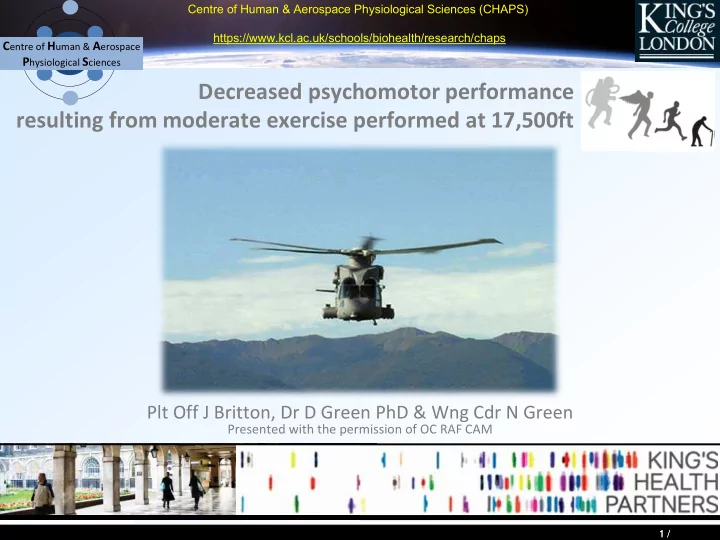
Decreased psychomotor performance resulting from moderate exercise performed at 17,500ft

Plt Off J Britton, Dr D Green PhD & Wng Cdr N Green

Presented with the permission of OC RAF CAM

slide-2
SLIDE 2

2 /

Centre of Human & Aerospace Physiological Sciences (CHAPS) https://www.kcl.ac.uk/schools/biohealth/research/chaps

Harridge Newham Thackert Pavlou Green Rowlerson

Centre of Human & Aerospace Physiological Sciences

Decremented psychomotor performance resulting from moderate exercise performed at 17,500ft

Background

  • Increased altitude = decreased alveolar oxygen
  • At ≈10,000ft ventilation increases
  • This causes a deviation of the curve
  • And also results in a fall in carbon dioxide

Ernsting’s Aviation Medicine p44

slide-3
SLIDE 3

3 /

Centre of Human & Aerospace Physiological Sciences (CHAPS) https://www.kcl.ac.uk/schools/biohealth/research/chaps

Harridge Newham Thackert Pavlou Green Rowlerson

Centre of Human & Aerospace Physiological Sciences

Decremented psychomotor performance resulting from moderate exercise performed at 17,500ft

Background

  • Decreased carbon dioxide causes hypocapnic cerebral vasoconstriction

http://depts.washington.edu/uwtcdlab/co2.html

Normocapnia Hypercapnia Hypocapnia

  • This decreases cerebral perfusion
  • Oxygen supply to the brain is therefore relative not only to hypoxia but also to

carbon dioxide

slide-4
SLIDE 4

4 /

Centre of Human & Aerospace Physiological Sciences (CHAPS) https://www.kcl.ac.uk/schools/biohealth/research/chaps

Harridge Newham Thackert Pavlou Green Rowlerson

Centre of Human & Aerospace Physiological Sciences

  • Some debate over what altitude causes a dangerous reduction in pyschomotor

performance

  • Recommendations for pilots place 10,000ft as a maximum operating altitude without

supplementary oxygen

  • Current/future operations may require the use of helicopters above 10,000ft

LIFE.com

Decremented psychomotor performance resulting from moderate exercise performed at 17,500ft

Background

slide-5
SLIDE 5

5 /

Centre of Human & Aerospace Physiological Sciences (CHAPS) https://www.kcl.ac.uk/schools/biohealth/research/chaps

Harridge Newham Thackert Pavlou Green Rowlerson

Centre of Human & Aerospace Physiological Sciences

  • For pilots performing a low‐moderate exercise rate (27W)1

with a demand regulator this is not an issue2

  • However, different story for aircrew performing higher rates of

exercise

  • The oxygen system for these aircrew is to be replaced. Full understanding of the physiology

involved is key to optimising the new system

LIFE.com

Decremented psychomotor performance resulting from moderate exercise performed at 17,500ft

Background

1 Norris P. Pilots' Respiration During a Standard Flight Profile. London: Ministry of Defence (Air), RAF Institute of Aviation Medicine, 1964; Report No. 271. 2 Unpublished Study, RAF CAM and KCL – No effect of 30W exercise at 17,500ft on pyschomotor performance
slide-6
SLIDE 6

6 /

Centre of Human & Aerospace Physiological Sciences (CHAPS) https://www.kcl.ac.uk/schools/biohealth/research/chaps

Harridge Newham Thackert Pavlou Green Rowlerson

Centre of Human & Aerospace Physiological Sciences

  • Exercise complicates the issue of cerebral oxygen supply
  • The increased metabolism of skeletal muscles causes a higher oxygen demand and

redirection of blood flow

  • ...but also produced carbon dioxide at an increased rate

LIFE.com

Decremented psychomotor performance resulting from moderate exercise performed at 17,500ft

Background

  • Few conclusive studies to examine the effect of this balance on

psychomotor performance

  • If decreased, there could be a reduction in ability to perform necessary safety actions
slide-7
SLIDE 7

7 /

Centre of Human & Aerospace Physiological Sciences (CHAPS) https://www.kcl.ac.uk/schools/biohealth/research/chaps

Harridge Newham Thackert Pavlou Green Rowlerson

Centre of Human & Aerospace Physiological Sciences

  • Hence:
  • To investigate whether moderate exercise at 17,500ft causes a further reduction in

pyschomotor performance than exposure to altitude alone

LIFE.com

Decremented psychomotor performance resulting from moderate exercise performed at 17,500ft

Aim

slide-8
SLIDE 8

8 /

Centre of Human & Aerospace Physiological Sciences (CHAPS) https://www.kcl.ac.uk/schools/biohealth/research/chaps

Harridge Newham Thackert Pavlou Green Rowlerson

Centre of Human & Aerospace Physiological Sciences

  • 12 subjects (8 ♂. 1747 cm; 71.49.4 kg; 221 yrs)

Decremented psychomotor performance resulting from moderate exercise performed at 17,500ft

Methods

  • Preparation
  • Medical clearance
  • Hypoxia training given in advance at RAF CAM with rapid decompression to 25,000ft
  • Training on CogScreen Hypoxia Edition (HE) to prevent test learning during expt
  • Subjects agreed to comply with alcohol restrictions in line with current Air Staff

Instruction for pilots (<3 units within 24 hours, none within 10)

  • Medical check on day of tests
  • Altitude Exposure
  • 17,500ft equivalent altitude using a hypobaric chamber at RAF CAM
  • Both ground runs and altitude runs were performed in the same environment
slide-9
SLIDE 9

9 /

Centre of Human & Aerospace Physiological Sciences (CHAPS) https://www.kcl.ac.uk/schools/biohealth/research/chaps

Harridge Newham Thackert Pavlou Green Rowlerson

Centre of Human & Aerospace Physiological Sciences

  • Protocol (Randomised)

Decremented psychomotor performance resulting from moderate exercise performed at 17,500ft

Methods

= Four Runs: Ground + Rest, Ground + 70W exercise Altitude + Rest, Altitude + 70W exercise

Test Test Test Test

slide-10
SLIDE 10

10 /

Centre of Human & Aerospace Physiological Sciences (CHAPS) https://www.kcl.ac.uk/schools/biohealth/research/chaps

Harridge Newham Thackert Pavlou Green Rowlerson

Centre of Human & Aerospace Physiological Sciences

Decremented psychomotor performance resulting from moderate exercise performed at 17,500ft

Methods

  • Physiological Variables

Variable Equipment O2 Saturation Ear lobe pulse oximeter (Kontron) Heart Rate Ear lobe pulse oximeter (Kontron) End tidal O2 and CO2 concentration LR‐1 respiratory mass spectrometer Inspiratory Flow Fleisch flowmeter Inspiratory gas volume Integrated flow data (Hugo Sachs Electronik) Continuous arterial blood pressure waveform Finometer (referenced to heart level) Altitude Celesco differential pressure transducer Cognitive Function CogScreen Hypoxia Edition (HE) Temperature and Humidity Digital thermometer Symptoms of hypoxia Symptom questionnaire

slide-11
SLIDE 11

11 /

Centre of Human & Aerospace Physiological Sciences (CHAPS) https://www.kcl.ac.uk/schools/biohealth/research/chaps

Harridge Newham Thackert Pavlou Green Rowlerson

Centre of Human & Aerospace Physiological Sciences

Decremented psychomotor performance resulting from moderate exercise performed at 17,500ft

Methods

  • Pyschomotor Performance
  • CogScreen HE
  • Battery of tests
  • Data output for reaction time, accuracy and throughput (correct

responses/min)

  • Individual test results to be published

Visual Sequence Comparison Divided Attention Tests (1) Divided Attention Test (2) Pathfinder Match to Sample

slide-12
SLIDE 12

12 /

Centre of Human & Aerospace Physiological Sciences (CHAPS) https://www.kcl.ac.uk/schools/biohealth/research/chaps

Harridge Newham Thackert Pavlou Green Rowlerson

Centre of Human & Aerospace Physiological Sciences

  • Four Way Anova

Decremented psychomotor performance resulting from moderate exercise performed at 17,500ft

Statistics

Rest Exercise Ground Altitude

  • T tests where applicable

Exercise Altitude Interaction ≤0.05 0.051‐0.07 >0.07 Anova

slide-13
SLIDE 13

13 /

Centre of Human & Aerospace Physiological Sciences (CHAPS) https://www.kcl.ac.uk/schools/biohealth/research/chaps

Harridge Newham Thackert Pavlou Green Rowlerson

Centre of Human & Aerospace Physiological Sciences

Decremented psychomotor performance resulting from moderate exercise performed at 17,500ft

Physiological Results

slide-14
SLIDE 14

14 /

Centre of Human & Aerospace Physiological Sciences (CHAPS) https://www.kcl.ac.uk/schools/biohealth/research/chaps

Harridge Newham Thackert Pavlou Green Rowlerson

Centre of Human & Aerospace Physiological Sciences

Decremented psychomotor performance resulting from moderate exercise performed at 17,500ft

Results: Heart Rate

Exercise Altitude Interaction <0.001 <0.001 0.057

p<0.001 p<0.001

Anova

Normal limit @ rest (100bpm)

slide-15
SLIDE 15

15 /

Centre of Human & Aerospace Physiological Sciences (CHAPS) https://www.kcl.ac.uk/schools/biohealth/research/chaps

Harridge Newham Thackert Pavlou Green Rowlerson

Centre of Human & Aerospace Physiological Sciences

Decremented psychomotor performance resulting from moderate exercise performed at 17,500ft

Results: Oxygen Saturation

Exercise Altitude Interaction <0.001 <0.001 0.001 Anova

p = 0.003 p = 0.001

Normal limit @ rest (95%)

slide-16
SLIDE 16

16 /

Centre of Human & Aerospace Physiological Sciences (CHAPS) https://www.kcl.ac.uk/schools/biohealth/research/chaps

Harridge Newham Thackert Pavlou Green Rowlerson

Centre of Human & Aerospace Physiological Sciences

Decremented psychomotor performance resulting from moderate exercise performed at 17,500ft

Results: Ventilation

Exercise Altitude Interaction <0.001 0.001 <0.001 Anova

p < 0.001 p = 0.001

Normal range @ rest (5‐8 L.min‐1)

slide-17
SLIDE 17

17 /

Centre of Human & Aerospace Physiological Sciences (CHAPS) https://www.kcl.ac.uk/schools/biohealth/research/chaps

Harridge Newham Thackert Pavlou Green Rowlerson

Centre of Human & Aerospace Physiological Sciences

Decremented psychomotor performance resulting from moderate exercise performed at 17,500ft

Results: End Tidal CO2

Exercise Altitude Interaction <0.001 <0.001 <0.001 Anova

p < 0.001 p = 0.634

Normal range (35‐45 mmHg)

slide-18
SLIDE 18

18 /

Centre of Human & Aerospace Physiological Sciences (CHAPS) https://www.kcl.ac.uk/schools/biohealth/research/chaps

Harridge Newham Thackert Pavlou Green Rowlerson

Centre of Human & Aerospace Physiological Sciences

Decremented psychomotor performance resulting from moderate exercise performed at 17,500ft

Pyschomotor Results

slide-19
SLIDE 19

19 /

Centre of Human & Aerospace Physiological Sciences (CHAPS) https://www.kcl.ac.uk/schools/biohealth/research/chaps

Harridge Newham Thackert Pavlou Green Rowlerson

Centre of Human & Aerospace Physiological Sciences

Decremented psychomotor performance resulting from moderate exercise performed at 17,500ft

Results: Mean Accuracy

Exercise Altitude Interaction 0.331 0.027 0.605 Anova

p = 0.625 p = 0.409

slide-20
SLIDE 20

20 /

Centre of Human & Aerospace Physiological Sciences (CHAPS) https://www.kcl.ac.uk/schools/biohealth/research/chaps

Harridge Newham Thackert Pavlou Green Rowlerson

Centre of Human & Aerospace Physiological Sciences

Decremented psychomotor performance resulting from moderate exercise performed at 17,500ft

Results: Mean Reaction Time

Exercise Altitude Interaction 0.016 0.085 0.125 Anova

p = 0.415 p < 0.05

slide-21
SLIDE 21

21 /

Centre of Human & Aerospace Physiological Sciences (CHAPS) https://www.kcl.ac.uk/schools/biohealth/research/chaps

Harridge Newham Thackert Pavlou Green Rowlerson

Centre of Human & Aerospace Physiological Sciences

Decremented psychomotor performance resulting from moderate exercise performed at 17,500ft

Results: Mean Throughput

Exercise Altitude Interaction <0.001 0.066 0.031 Anova

p = 0.286 p 0.001

slide-22
SLIDE 22

22 /

Centre of Human & Aerospace Physiological Sciences (CHAPS) https://www.kcl.ac.uk/schools/biohealth/research/chaps

Harridge Newham Thackert Pavlou Green Rowlerson

Centre of Human & Aerospace Physiological Sciences

Decremented psychomotor performance resulting from moderate exercise performed at 17,500ft

Discussion

  • Decrease in oxygen saturation was significantly greater when exercising at 17,500ft than at

ground level

  • Increased in pulmonary ventilation was significantly greater when exercising at 17,500ft

than at ground level

  • End tidal CO2

increased when exercising at ground level

  • But did not increase when exercising at altitude

Physiological Summary:

slide-23
SLIDE 23

23 /

Centre of Human & Aerospace Physiological Sciences (CHAPS) https://www.kcl.ac.uk/schools/biohealth/research/chaps

Harridge Newham Thackert Pavlou Green Rowlerson

Centre of Human & Aerospace Physiological Sciences

Decremented psychomotor performance resulting from moderate exercise performed at 17,500ft

Discussion

Hence:

  • Increase in hypoxia greater when exercising at altitude
  • The increased ventilation caused by exercising at altitude balances any induced increase

in CO2 production

  • The state of hypocapnia seen at 17,500ft at rest is not significantly affected by exercise at

this altitude. In both cases below normal levels of CO2 are seen

slide-24
SLIDE 24

24 /

Centre of Human & Aerospace Physiological Sciences (CHAPS) https://www.kcl.ac.uk/schools/biohealth/research/chaps

Harridge Newham Thackert Pavlou Green Rowlerson

Centre of Human & Aerospace Physiological Sciences

Decremented psychomotor performance resulting from moderate exercise performed at 17,500ft

Discussion

  • Hypocapnic vasoconstriction is not improved by 70W exercise at 17,500ft
  • But

hypoxia is more severe Therefore:

http://depts.washington.edu/uwtcdlab/co2.html

Normocapnia Hypercapnia Hypocapnia

  • Therefore there is a greater decrease in cerebral oxygenation when exercising at altitude
slide-25
SLIDE 25

25 /

Centre of Human & Aerospace Physiological Sciences (CHAPS) https://www.kcl.ac.uk/schools/biohealth/research/chaps

Harridge Newham Thackert Pavlou Green Rowlerson

Centre of Human & Aerospace Physiological Sciences

Decremented psychomotor performance resulting from moderate exercise performed at 17,500ft

Discussion

  • Reaction time increased with 70W exercise but not altitude equivalent to 17,500ft
  • Some decrease in oxygen saturation seen on exercise
  • But no effect on reaction time with severe hypoxia on ascent
  • Hence possibly due to distraction/mechanical restrictions (Yerkes‐Dodson Law)
  • Accuracy was decreased at 17,500ft but was not effected by 70W exercise
  • Due to hypoxia and hypocapnic cerebral vasoconstriction

Pyschomotor Summary:

  • Throughput decreased with exercise, showed a trend towards decreasing with altitude,

with the effect significantly greater when exercising at altitude when compared to exercising at ground level

  • The combination of altitude and exercise had a compounding effect
  • Due to increasing hypoxia and maintained hypocapnia when exercising at altitude
slide-26
SLIDE 26

26 /

Centre of Human & Aerospace Physiological Sciences (CHAPS) https://www.kcl.ac.uk/schools/biohealth/research/chaps

Harridge Newham Thackert Pavlou Green Rowlerson

Centre of Human & Aerospace Physiological Sciences

Decremented psychomotor performance resulting from moderate exercise performed at 17,500ft

Limitations

  • Small, varied group
  • Highly individual responses to hypoxia
  • Different levels of fitness with a set workload, not %Vmax
  • Tests within a run always performed in same order
  • Mental fatigue towards the end of exercise tests may have had an effect
  • CogScreen’s ceiling effect1
  • Designed to identify cognitive defects in aviators not fine variations
  • Tests so simple that very high marks (95‐100%) were often reached, even under

adverse conditions

  • May reduce the significance of results

1Callister JD, King RE, Retzlaff PD (1996). Cognitive assessment of USAF pilot training

  • candidates. Aviation Space Environ Med 6 7 , 1124-1129.
slide-27
SLIDE 27

27 /

Centre of Human & Aerospace Physiological Sciences (CHAPS) https://www.kcl.ac.uk/schools/biohealth/research/chaps

Harridge Newham Thackert Pavlou Green Rowlerson

Centre of Human & Aerospace Physiological Sciences

Decremented psychomotor performance resulting from moderate exercise performed at 17,500ft

Further Studies

  • Evaluation of sub‐tests underway
  • Will show which areas of cognition affected most
  • Further studies with different workloads and altitudes
  • Previous KCL study showed that 30W at 17,500ft had no effect
  • Suggests an incremental effect. Find threshold and crew average

workloads

  • Investigate whether there is an workload at which increased ventilation no longer

compensates for increased CO2 production

slide-28
SLIDE 28

28 /

Centre of Human & Aerospace Physiological Sciences (CHAPS) https://www.kcl.ac.uk/schools/biohealth/research/chaps

Harridge Newham Thackert Pavlou Green Rowlerson

Centre of Human & Aerospace Physiological Sciences

Decremented psychomotor performance resulting from moderate exercise performed at 17,500ft

Conclusions

  • Pyschomotor performance is adversely affected by moderate exercise at 17,500ft
  • In an environment when decisions must be made and enacted within split‐seconds, this

could have serious ramifications

  • Any changes in supplementary oxygen systems must take this into

account to achieve

  • ptimum performance and safety

Armymomstrong.com

slide-29
SLIDE 29

29 /

Centre of Human & Aerospace Physiological Sciences (CHAPS) https://www.kcl.ac.uk/schools/biohealth/research/chaps

Harridge Newham Thackert Pavlou Green Rowlerson

Centre of Human & Aerospace Physiological Sciences

Decremented psychomotor performance resulting from moderate exercise performed at 17,500ft

Thank You

Any Questions?