
SLIDE 1
Molecular Cell Biology (Bio 5068) Cell Cycle I Ron Bose, MD PhD
November 13, 2018
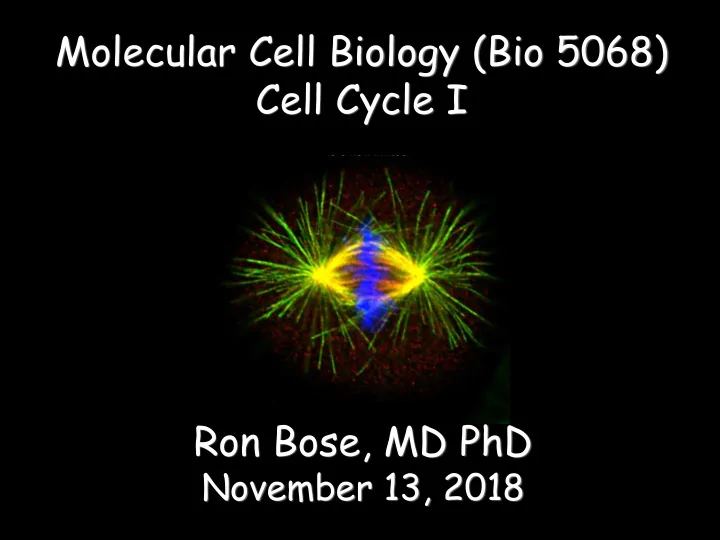
Cell Cycle I Ron Bose, MD PhD November 13, 2018 CELL DIVISION - - PowerPoint PPT Presentation
Molecular Cell Biology (Bio 5068) Cell Cycle I Ron Bose, MD PhD November 13, 2018 CELL DIVISION CYCLE M G2 G1 S DISCOVERY AND NAMING OF CYCLINS MARINE INVERTEBRATES ( sea urchin, clam & starfish) 1983: Evans & Hunt. sea urchin
Molecular Cell Biology (Bio 5068) Cell Cycle I Ron Bose, MD PhD
November 13, 2018
G1 M G2 S
CELL DIVISION CYCLE
MARINE INVERTEBRATES (sea urchin, clam & starfish) 1983: Evans & Hunt. sea urchin egg (completed meiosis and arrested in G1) 35S-methionine fertilize remove samples every 10 min. examine for protein synthesis in first few cell cycles of sea urchin egg Saw 55kDa protein= sea urchin cyclin (periodic protein synthesized throughout the cell cycle but degraded at the end of mitosis:
DISCOVERY AND NAMING OF CYCLINS
A protein (called “cyclin”) was observed to increase as cells approached mitosis, peak in mitosis and then precipitously disappear as cells exited mitosis.
Two proteins (cyclins A and B) increased as cells approached mitosis, peaked in mitosis and precipitously disappeared as cells exited mitosis.
The cell cycle is primarily regulated by cyclically activated protein kinases
Figure 17-15, 17-16 Molecular Biology of the Cell, 4th Edition
Table 17-1. Molecular Biology of the Cell, 4th Edition
Overview of major cyclins and Cdks of vertebrates and yeast
Malumbres M, Nature Reviews Cancer 2009
Evolution of cell cycle control: from yeast to humans
Cdk activity is regulated by inhibitory phosphorylation and inhibitory proteins
Figure 17-18, 17-19. Molecular Biology of the Cell, 4th Edition
Why is cell cycle progression governed primarily by inhibitory regulation?
Figure 17-20. Molecular Biology of the Cell, 4th Edition
Cell cycle control depends on cyclical proteolysis
UBIQUITIN-MEDIATED PROTEOLYIS
E1 (Ubiquitin activating enzyme) Binds to Ubiquitin in an ATP-dependent manner Passes Ubiquitin to E2 E2(Ubiquitin conjugating enzyme or UBC) At least 12 in yeast some are specific to a given target E3 (ubiquitin protein ligase) Large complex in both clam (cyclosome) and in frog (APC = anaphase promoting complex). Final transfer of ubiquitin to substrate can be mediated by E2 alone or E2 acting in concert with E3 Proteosome (26S complex) Structure from archaebacterium solved.
Deshaies RJ and Joazeiro CA. Annu Rev Biochem. 2009
UBIQUITIN-MEDIATED PROTEOLYSIS
APC =Anaphase Promoting Complex Required for degradation of substrates at Metaphase to Anaphase transition ( ie: B-type Cyclins and securin) Cdc20 : targets cyclin A and B-type Cyclins, securin Cdh1/ Hct1 : targets Plk1 and B-type cyclins substrate Ring finger UBC (E2) for ubiquitination Apc10 Cdc20 Apcx Apc4 Apc5 Apc7 Cdc27 Apc3 Apc1/ BimE Cdc23 Apc8 Cdc16 Apc6 Have D or KEN Box Cullin = Apc2 Apc11
Cdh1 / Hct1 WDrepeat- containing proteins
Ubiq Ubiq Ubiq Ubiq
Components: F Box: adapter Brings substrate to E3 ligase. F-box binds to Skp1 Additional protein interaction domains (PID: WD repeat, leucine-rich repeat) binds to substrate E2:
Skp1: Bridges F-box to cullin Cullin: Organizes and activates E3 complex Recruits E2-UBIQ conjugating enzyme Ring finger protein Participates in E2 binding and catalysis
SCF Ubiquitin Ligases
O'Connell BC, Harper JW. Curr Opin Cell Biol. 2007
SCF E3 Ubiquitin Ligases
CELL CYCLE REGULATION OF Cdc2
Phosphatase(s) P T161 P P P T14 Y15 T161 Cyclin B Cdc2 Inhibitory kinase(s) Activating Kinase(s) Cyclin B Cdc2 Cyclin B Cdc2 Cdc2 Cyclin B Cdc2
INACTIVE INACTIVE INACTIVE INACTIVE ACTIVE
Protein-protein interactions Reversible phosphorylation
Ubiquitin- mediated proteolyis
Cyclin-dependent Kinase Inhibitor Proteins (CKI’s)
a. Binds to Cdk2 and inhibits activity. b. Binds Cdk4/6 and helps assemble complexes with cyclins.
a. Specific for Cdk4 and Cdk6. b. Binds Cdk subunit alone and prevents cyclin binding c. Bind and inhibit Cdk4/6-Cyclin D heterodimers.
G1 Control
Cdk 4 & 6 Cyclin D1, 2, 3 Cdk2 Cyclin E G1 M G2 S Cip/Kip proteins (p21, p27, p57) INK4a proteins (p15,16, 18, 19) Assembly & Sequestration
Mechanisms controlling G1/S-phase transition
Figure 17-30. Molecular Biology of the Cell, 4th Edition MITOGENIC
HORMONAL SIGNALS CYCLIN D Stability and CYCLIN D-dependent Kinases (Cdk4/Cdk6)
Rb1 E2F Transcription factor
CELL CYCLE GENE
RETINOBLASTOMA PROTEIN
E2F1
HDACs hSWI/SNF
Rb binds to histone deacetylases (HDACs) and ATP-dependent nucleosome remodeling complexes (hSWI/SNF) thereby promoting nucleosome assembly and inhibiting transcription. Phosphorylation by cyclin D/Cdk4 and Cyclin E/Cdk2 displace HDACs and hSWI/SNF from Rb, respectively.
MITOGENIC SIGNALS CYCLIN D STABILITY CYCLIN D-DEPENDENT KINASES (Cdk4/Cdk6) RB E2F E2F CYCLIN E CYCLIN E CDK2 CYCLIN A & S-PHASE GENES S-Phase S-PHASE GENES Relief of Rb- mediated transcriptional repression S-Phase
MITOGENIC SIGNALS CYCLIN D STABILITY CYCLIN D-DEPENDENT KINASES (Cdk4/Cdk6) RB E2F E2F CYCLIN E CYCLIN E CDK2 CYCLIN A & S-PHASE GENES p27KIP1 p27KIP1-Phosphorylation Ubiq-Mediated proteolysis Assembly & Sequestration S-Phase S-PHASE GENES Relief of Rb- mediated transcriptional repression S-Phase
What are they? How were they defined? How does their derailment contribute to cancer?
CHECKPOINTS
G1 G1 M M G2 G2 S S DNA DAMAGE DNA DAMAGE UNREPLICATED DNA IMPROPER SPINDLE ASSEMBLY
Checkpoints: intracellular signaling pathways that determine if previous steps are complete before proceeding onto the next stage (complete DNA synthesis before entering mitosis; spindles must be assembled before exiting metaphase and entering into anaphase) and whether there has been any damage to the DNA. DNA damage checkpoint: integrity of DNA DNA damage is repaired before entering S, completing S or entering M. DNA replication checkpoint: replication state of DNA Complete DNA synthesis before mitosis. Spindle assembly checkpoint: integrity of spindle spindles must be assembled before exiting metaphase into anaphase.
G1 M G2 S
G1-PHASE CHECKPOINT S-PHASE CHECKPOINT G2-PHASE CHECKPOINT
DNA DAMAGE RESPONSE PATHWAY
CELLULAR RESPONSES TO CHECKPOINT ACTIVATION (IR, etoposide, HU, gemcitibine, irinotecan, carboplatin…) G1 S G2 M CHECKPOINTS APOPTOSIS SENESCENCE TEMPORARY CELL CYCLE ARREST
& activation of DNA repair pathways
IR Etoposide Gemcitabine Cytarabine 5-Fluorouracil Irinotecan Topotecan Cisplatin Carboplatin ATM ATR CHK2 p53 CHK1 RAD51 FAND2 FANCE p21 14-3-3s BAX PUMA CDC25A Apoptosis Cell Cycle Arrest DNA Repair
Signaling Cascade Cellular Response Chemo- & Radio-therapy Signal
Senescence
DNA DAMAGE CHECKPOINTS
Chk1 CyclinE / Cdk2 G1 S G2
G1-checkpoint S-phase checkpoint G2 checkpoint
M
DEATH
Cdc25A DNA DSBs ssDNA ATM Mdm2 p53 p21, 14-3-3s
IR/VP16 replication stress
ATR Chk2 Cyclin B/Cdk1 Overproduced in certain cancers. Inactivated in certain cancers.
DNA damage leads to cell cycle arrest in G1
Figure 17-33. Molecular Biology of the Cell, 4th Edition
Figure 17-41. Molecular Biology of the Cell, 4th Edition
Mitogens stimulate cell division
Figure 17-42. Molecular Biology of the Cell, 4th Edition
Excessive stimulation of mitogenic pathways can lead to cell cycle arrest or cell death
Figure 17-47. Molecular Biology of the Cell, 4th Edition
Extracellular Survival Factors Suppress Apoptosis
Malumbres M, Nature Reviews Cancer 2001
Cell cycle regulators are frequently disrupted in cancer
O’Leary et al., Nature Reviews Clinical Oncology 2016
Overview of CDK inhibitors in clinical development for cancer therapy
Turner et al, NEJM 2015
NEJM Nov. 3, 2016
Conclusions
process to ensure the successful replication of the cell.
1. Synthesis of Cyclins. 2. Reversible phosphorylation/dephosphorylation of stimulatory and inhibitory sites on CDK. 3. Ubiquitin mediated degradation of Cyclins. 4. CDK inhibitors – INK4 and CIP/KIP families.
been properly completed.
and selective CDK4/6 inhibitors are now used in cancer treatment.
Which 3 non-mammalian species were instrumental in our understanding of the cell cycle?