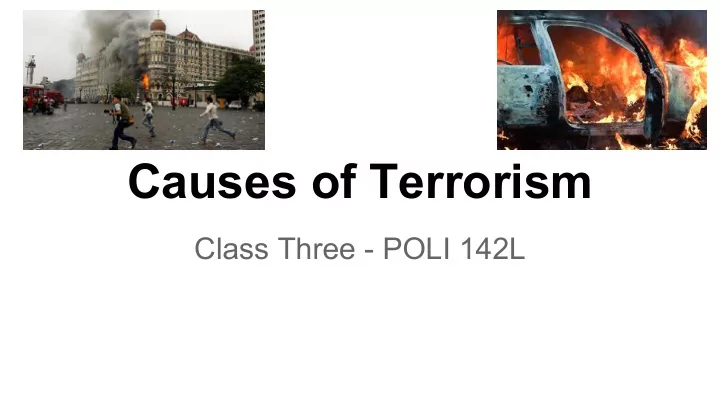
SLIDE 1
Causes of Terrorism
Class Three - POLI 142L
SLIDE 2 Review
- Definition of Terrorism
- Goals of Terrorist Movements
- Characteristics of Terrorist Movements
SLIDE 3
Terrorism in History: Anarchist
SLIDE 4
Second Wave: Ethno-nationalist
SLIDE 5
Third Wave: Left-Wing
SLIDE 6
Fourth Wave: Religious/Islamist
SLIDE 7 Two ways of approaching causality
○ Set stage in long run, but don’t necessarily cause anything.
○ Direct causes of the activation of movements.
SLIDE 8
Crenshaw’s three causes...
SLIDE 9 Crenshaw’s three causes...
○ i.e. discrimination ○ Not a necessary condition
- Lack of political opportunity
○ Paired with ineffective repression.
○ “Passive masses” ○ Terrorism to mobilize support.
SLIDE 10 Oppression is not needed for terrorism
support through attacks.
government to use repressive tactics.
○ This mobilizes more supporters.
SLIDE 11 Nationalism and Colonialism - Hoffman
independence demands from British and French colonies.
former fighters carry out attacks against colonizers
SLIDE 12 Three Examples
- Irgun in British Palestine
- FLN in French Algeria
- EOKA in British Cyprus
SLIDE 13 Tactics of Nationalist Terrorists
- Attack targets symbolic of
colonialism
- Provoke occupier into repression
- f civilian population.
- Assure negative public opinion
in home country.
SLIDE 14 Democracy and Terrorism
- Statistically, democracies experience more
terrorist attacks than non-democracies (Eubank and Weinberg 1994; 2001; Li 2005)
- Theoretical explanations crop up to explain.
What are some potential problems with that statistical conclusion?
SLIDE 15 Enders and Sandler (2006)
Characteristics of liberal democracies:
- Rule of Law
- Freedom of Speech
- Freedom of Movement
- Electoral representation.
How do these apparently contribute to terrorism?
SLIDE 16 Democratic Dilemma
- Respond slowly and lose legitimacy, respond
too quickly and lose support.
- Violations of civil rights “needed” to fight
terrorism are domestically unpopular.
SLIDE 17
Terrorist Movements can use free media
SLIDE 18
Discussion: Is democratic dilemma credible? How does it speak to grievance or nationalism explanations?
SLIDE 19 Discussion II:
- What do you think leads to terrorism?
Political liberalism or political exclusion?
- Were colonial powers that were democracies
at home restrained in fighting terrorist movements abroad? Why might fighting domestic movements be different?
SLIDE 20
Case: Northern Ireland
The Troubles
SLIDE 21 Background: Ireland as part of UK
- Britain ruled Ireland for
centuries until the early 1900s.
population) faced legal and then informal discrimination.
SLIDE 22 Easter Rising and Independence War
- 1916: Easter Rising against British Rule put
down.
- 1919-1921: War of Independence. IRA
secures home rule for Southern Ireland.
SLIDE 23 Northern Ireland remains part of UK
- Six northern counties don’t
secede.
loyalists to the crown.
○ Catholic minority.
through local parliament in Belfast.
SLIDE 24 NI society dominated by Protestants
- Catholics discriminated from
public housing, employment.
- RUC (police) dominated by
loyalists.
- Elections for local parliament
gerrymandered, malapportioned.
SLIDE 25 Civil rights movement in 1960s
political and social rights.
emerge to attack protesters.
SLIDE 26 Actors in the Troubles
Irish Republican Army and splinter groups Northern Ireland government British government Ulster Volunteer Force and splinters IRA foreign backers
SLIDE 27 Irish Republican Army
- Initially non-violent.
- Split between Provisional
and Official IRA in 1969.
- PIRA committed attacks on
loyalist and British military targets.
- Political wing: Sinn Fein
Party.
SLIDE 28 Northern Ireland Government
○ Especially Royal Ulster Constabulary (police force)
Catholics.
peaceful protesters.
SLIDE 29 UK Government
intervene to restore
- rder.
- Target for both sides.
- Favor settlement
between Catholics and Protestants with NI remaining in UK
SLIDE 30 Ulster Unionist groups
Catholics suspected of ‘militant activity’
protestant rights.
Democratic Unionist Party.
SLIDE 31 IRA Foreign Support
Irish diaspora, especially in US.
- Training from ETA and
- ther nationalists.
- Some weapons from
Gaddafi...
SLIDE 32 The Troubles
Catholics repressed by RUC and other loyalist groups.
begins carrying out bombings in 1966 against Catholic targets.
SLIDE 33 Riots in 1969 and UK intervention
Catholics leads to riots in Belfast.
supporters fight on the streets.
- British military intervenes
to calm violence.
SLIDE 34 Terrorism escalates from both sides
- PIRA targets loyalist and UK targets.
- UVF and other loyalist groups attack
Catholics.
○ i.e. Shankill Butchers.
- UK suspends NI Parliament in 1972.
- UK-brokered Sunningdale agreement fails in
1973 after loyalist opposition.
SLIDE 35
What do you think drove IRA terrorism? Loyalist terrorism?
SLIDE 36 What role did democracy play in the Troubles? Were liberal institutions a constraint or an
SLIDE 37 Exam on Wednesday:
- Worth 0-15% of grade, depending on other
results.
- 5 short-answer questions: choose three.
Two essay questions: choose one.
○ Reflects discussion questions on syllabus.