Causality in the Time of Cholera: John Snow as a Prototype for - - PowerPoint PPT Presentation

causality in the time of cholera john snow as a prototype
SMART_READER_LITE
LIVE PREVIEW

Causality in the Time of Cholera: John Snow as a Prototype for - - PowerPoint PPT Presentation

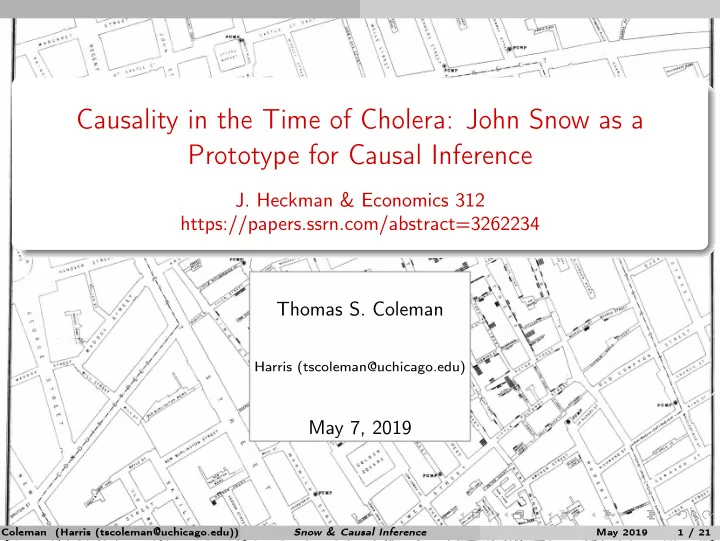
Causality in the Time of Cholera: John Snow as a Prototype for Causal Inference J. Heckman & Economics 312 https://papers.ssrn.com/abstract=3262234 Thomas S. Coleman Harris (tscoleman@uchicago.edu) May 7, 2019 Coleman (Harris


slide-1
SLIDE 1

Causality in the Time of Cholera: John Snow as a Prototype for Causal Inference

  • J. Heckman & Economics 312

https://papers.ssrn.com/abstract=3262234 Thomas S. Coleman

Harris (tscoleman@uchicago.edu)

May 7, 2019

Coleman (Harris (tscoleman@uchicago.edu)) Snow & Causal Inference May 2019 1 / 21

slide-2
SLIDE 2

John Snow Known for “Broad St Pump” & Mapping

Coleman Snow & Causal Inference May 2019 2 / 21

slide-3
SLIDE 3

But I’m Studying Snow as a Template for Causal Inference

Snow is fun for three reasons – here focus on (2):

1 Rollicking Good Tale – full of heroism, death, and statistics 2 Causal Inference – template for how to marshal evidence in support of a

causal explanation

3 Statistics & Instruction – The data are simple but the analysis

demonstrates multiple data analytic tools we use today

  • combining maps and data (GIS or geographic information systems)
  • regression and error analysis
  • difference-in-differences regression
  • natural experiments and randomization

Coleman Snow & Causal Inference May 2019 3 / 21

slide-4
SLIDE 4

But I’m Studying Snow as a Template for Causal Inference

Snow is fun for three reasons – here focus on (2):

1 Rollicking Good Tale – full of heroism, death, and statistics 2 Causal Inference – template for how to marshal evidence in support of a

causal explanation

3 Statistics & Instruction – The data are simple but the analysis

demonstrates multiple data analytic tools we use today

  • combining maps and data (GIS or geographic information systems)
  • regression and error analysis
  • difference-in-differences regression
  • natural experiments and randomization

Also humbling reminder: with overwhelming evidence and strong analysis, Snow still failed to convince the medical establishment, the public, or the authorities

Coleman Snow & Causal Inference May 2019 3 / 21

slide-5
SLIDE 5

Outline

1 Katz & Singer Causal Assessment Procedure 2 John Snow and the Story of Cholera 3 Data & Hypothesis Testing 4 Conclusion

Coleman Snow & Causal Inference May 2019 4 / 21

slide-6
SLIDE 6

Katz & Singer Causal Assessment Procedure

Causal Assessment Procedure – based on Katz and Singer [2007] – preliminary Katz and Singer propose an "Attribution Assessment Procedure" to weigh the disparate evidence and conflicting explanations associated with reports of a chemical weapons attack. Such an exercise has many similiarities with efforts to determine causal effects in social sciences generally, and cholera in 1850s London in particular. Katz and Singer propose seven steps, which I modify slightly:

Possible Chemical & Biological Weapons attacks, 1970s-80s, “Can an Attribution Assessment Be Made for Yellow Rain?”

Coleman Snow & Causal Inference May 2019 5 / 21

slide-7
SLIDE 7

Katz & Singer Causal Assessment Procedure

Katz & Singer as “Causal Assessment Procedure”

1 Divide evidence into blocks or types of evidence 2 Assign to each block a veritas rating – quality of data 3 Develop groups of hypotheses 4 Assess each evidence block for strength of rejection for each hypothesis

  • Consider rejection of hypotheses (refute, neutral, consistent) rather than

strength of association (support of hypotheses)

5 Organize evidence blocks by hypothesis into matrix 6 Choose hypothesis not contradicted 7 Strongest hypothesis checked

Coleman Snow & Causal Inference May 2019 6 / 21

slide-8
SLIDE 8

Katz & Singer Causal Assessment Procedure

Theory, Data, Hypothesis Testing

Data or Evidence Blocks

Broad St South London

~10 sq blocks 2wks, 700 deaths summer/fall 1854 ~400k subjects mixed treated & untreated

Hypothesis or Testing Blocks

Albion Terr Broad St

Map Cases Contin

South London

Diff-in-Diffs Mixing

Albion Terr

17 houses single outbreak

Theory & Hypotheses

water & small intestine miasma (airborne) elevation, class, ... Narrative No sub- district pop With sub- district pop Coleman Snow & Causal Inference May 2019 7 / 21

slide-9
SLIDE 9

John Snow and the Story of Cholera

1 Katz & Singer Causal Assessment Procedure 2 John Snow and the Story of Cholera 3 Data & Hypothesis Testing 4 Conclusion

Coleman Snow & Causal Inference May 2019 8 / 21

slide-10
SLIDE 10

John Snow and the Story of Cholera

Cholera – Disease of Poor Sanitation

What is Cholera?

  • Vibrio Cholerae – bacterium that infects the small intestine of humans
  • Causes severe diarrhea (& vomiting) that drains fluids
  • Death from dehydration & organ failure
  • Oral Rehydration Therapy highly succesfull (roughly 1960s)
  • In case you ever need it, here’s the recipe – 1 liter boiled water, 1/2 teaspoon

salt, 6 teaspoons sugar, mashed banana (potassium)

Cholera thrives in crowded cities with poor sanitation

  • Transmitted through recycling (drinking) sewage
  • When cholera exits one victim, needs to find a way into gut of others
  • Victorian London was an ideal playground for cholera to thrive

Coleman Snow & Causal Inference May 2019 9 / 21

slide-11
SLIDE 11

John Snow and the Story of Cholera

Well-Articulated Theory

Most importantly, Snow had a good idea—a causal theory about how the disease spread—that guided the gathering and assessment of

  • evidence. (Tufte)

Snow proposed his waterborne theory of cholera in the 1849 pamphlet On the mode of communication of cholera (Snow [1849]). Without the benefit of the germ theory of disease or any evidence on the bacterium Vibrio cholerae Snow nonetheless proposed a consistent (and correct) theory of the infection and transmission of cholera.

The strength of his model derived from its ability to use observed phenomena on one scale to make predictions about behavior on other scales up and down the chain. ... If cholera were waterborne then the patterns of infection must correlate with the patterns of water distribution in London’s neighborhoods. Snow’s theory was like a ladder; each individual rung was impressive enough, but the power of it lay in ascending from bottom to top, from the membrane of the small intestine all the way up to the city itself. (Johnson, Ghost Map)

Coleman Snow & Causal Inference May 2019 10 / 21

slide-12
SLIDE 12

John Snow and the Story of Cholera

John Snow’s 1849 Theory & 1855 Evidence

1849: Snow developed theory of infection & transmission

  • Based on medical knowledge and study of single events

– Horsleydown & Albion Terrace Fully-developed & modern theory of disease

  • Infects & reproduces in the small intestine
  • Exits from victim, into water supply
  • Infects new victims through drinking dirty water

Implications for patterns of infection, across scales

  • “from the membrane of the small intestine all the way

up to the city itself” (Johnson) Snow’s work grounded by theory Snow had a good idea – a causal theory about how the disease spread – that guided the gathering and assessment of evidence. (Tufte) 1855: evidence & argument to convince skeptics

Albion Terr

17 houses single outbreak

Theory

Victim’s gut Water supply

Coleman Snow & Causal Inference May 2019 11 / 21

slide-13
SLIDE 13

John Snow and the Story of Cholera

Alternative Theories

Miasma (Smells & Airborne)

  • Cholera infectious & transmitted through the air
  • Generally accepted in mid-1800s

Elevation, Crowding & Class, Others

  • Elevation: lower elevation → more infection
  • Crowding & Class: lower class & crowding → more infection

None of these absolutely crazy – correlated with cholera (and dirty water)

  • Raw sewage associated with bad smells & dirty drinking water
  • Lower class associated with crowding & poor sanitation

Other non-infectious theories (I won’t seriously consider)

  • Emanations from the ground
  • Plague burying-pit near Broad Street pump

Coleman Snow & Causal Inference May 2019 12 / 21

slide-14
SLIDE 14

Data & Hypothesis Testing

1 Katz & Singer Causal Assessment Procedure 2 John Snow and the Story of Cholera 3 Data & Hypothesis Testing 4 Conclusion

Coleman Snow & Causal Inference May 2019 13 / 21

slide-15
SLIDE 15

Data & Hypothesis Testing

Data & Hypothesis Testing

Data or Evidence Blocks

Broad St South London

~10 sq blocks 2wks, 700 deaths summer/fall 1854 ~400k subjects mixed treated & untreated

Hypothesis or Testing Blocks

Albion Terr Broad St

Map Cases Contin

South London

Diff-in-Diffs Mixing

Albion Terr

17 houses single outbreak

Theory & Hypotheses

water & small intestine miasma (airborne) elevation, class, ... Narrative No sub- district pop With sub- district pop Coleman Snow & Causal Inference May 2019 14 / 21

slide-16
SLIDE 16

Data & Hypothesis Testing

Locations of Events & Data

Coleman Snow & Causal Inference May 2019 15 / 21

slide-17
SLIDE 17

Data & Hypothesis Testing

Data & Hypotheses – Summary

Data Summary Statistical Testing Theory Refute? Albion Terrace, 1849 17 houses, narrative None Water NO Miasma YES Broad St – Hampstead Single case, “Far from pump but died” None Water NO Miasma YES Broad St – workhouse Single cases, “Close to pump but survived” None Water NO Miasma YES Broad St – 500 residents Infection rates – 500 residents drink y/n Contingency Table Water NO Miasma YES S London 1849 vs 1854, 480k people Mortality rates by supplier Diff-in-diffs Water NO Miasma YES S London quasi-randomized Mortality rates supplier RCT Water NO Miasma YES Coleman Snow & Causal Inference May 2019 16 / 21

slide-18
SLIDE 18

Data & Hypothesis Testing

Data & Hypotheses – Detail

Data Summary Statistical Testing Theory Refute? Comment Albion Terrace, 17 houses & 20-25 deaths, 1849 17 houses infected, surrounding not None Water NO Sewage leaked into shared water supply after storm. Crucial for developing theory Miasma YES Broad St – Susannah Eley (Hampstead, 1 person) Single Case, “Far from pump but died” None Water NO Water bottles shipped to Hampstead by sons Miasma YES Broad St – St. James workhouse (535 people, 5 deaths) Counterexample? “Close to pump but survived” None Water NO In-house well Miasma YES Broad St 500 residents, categorized by drinking & illness Infection rates differ by pump drinking Contingency Table Water NO Miasma YES S London 480k people, 1849 vs 1854 diff-in-diffs, aggregate sub-district Mortality rates differ by water supply, not

  • ther characteristics

Diff-in-diffs, linear & count regressions, error analysis Water NO Lambeth Water Co changed to clean water 1852, ⇒ control / treatment DiD design Miasma YES S London 480k people, direct District / sub-district comparison, quasi-randomized Mortality rates differ by water supply company RCT, Count regressions, detailed error analysis Water NO Mixing of water co customers, control / treatment, effectively randomized Miasma YES Coleman Snow & Causal Inference May 2019 17 / 21
slide-19
SLIDE 19

Data & Hypothesis Testing

Further Consideration of Data & Hypotheses

Only summarizes Water vs Miasma

  • Data also rejected other alternatives: class, crowding, elevation, weather – in

fact virtually any we can think of Must carefully consider how data rules out confounding factors

  • Broad St residents & contingency: most factors such as crowding & class
  • S London DiD: many factors such as weather, elevation, crowding
  • S London Quasi-Randomized: most factors such as class, age, income,

weather, elevation, crowding, ...

Coleman Snow & Causal Inference May 2019 18 / 21

slide-20
SLIDE 20

Data & Hypothesis Testing

Susannah Eley & Miasma – Data Does Not Tell Us The Answer

Data tells us nothing – must use judgment, logic, intuition, knowledge of the world

  • Cholera Commission rescued miasma with (in our eyes) ridiculous auxiliary

hypothesis: “[pump’s] impure waters having participated in the atmospheric infection of the district”

  • Imre Lakatos & “Core” vs “Protective Belt” of Auxiliary Hypotheses
  • We always need these “auxiliary hypotheses” – but need to judge suitability
  • Virtually any “core” theory can be protected by the “protective belt” of

auxiliary theories

Far from pump but died

Water Simple Water Extended Miasma Simple Miasma Extended Core Drinking Drinking Breathing Breathing Auxiliary P[drink~ distance] People travel to Broad St P[breath~ distance] Water infected by air Implication deaths~ distance deaths~ taste for Broad St deaths~ distance deaths~ taste for Broad St Core Refuted? YES NO YES NO Coleman Snow & Causal Inference May 2019 19 / 21

slide-21
SLIDE 21

Conclusion

1 Katz & Singer Causal Assessment Procedure 2 John Snow and the Story of Cholera 3 Data & Hypothesis Testing 4 Conclusion

Coleman Snow & Causal Inference May 2019 20 / 21

slide-22
SLIDE 22

Conclusion

Snow’s Strength: Theory & Evidence

John Snow’s 1855 monograph On the mode of communication of cholera provides a valuable example and guide for modern-day researchers in the social sciences, a guide for assembling persuasive evidence of a causal effect. The power of Snow’s argument derives from employing the following components, although the final was not really available to Snow at the time:

  • Well-articulated theory
  • Testing predictions against evidence – Consistent consideration and rejection
  • f alternatives
  • Multiple tests and source of data
  • Careful and honest assessment of the statistical reliability of the evidence

Coleman Snow & Causal Inference May 2019 21 / 21