Cat at-App Project t 2018 Results ts Presentati tion Programme - - PDF document

cat at app project t 2018 results ts presentati tion
SMART_READER_LITE
LIVE PREVIEW

Cat at-App Project t 2018 Results ts Presentati tion Programme - - PDF document

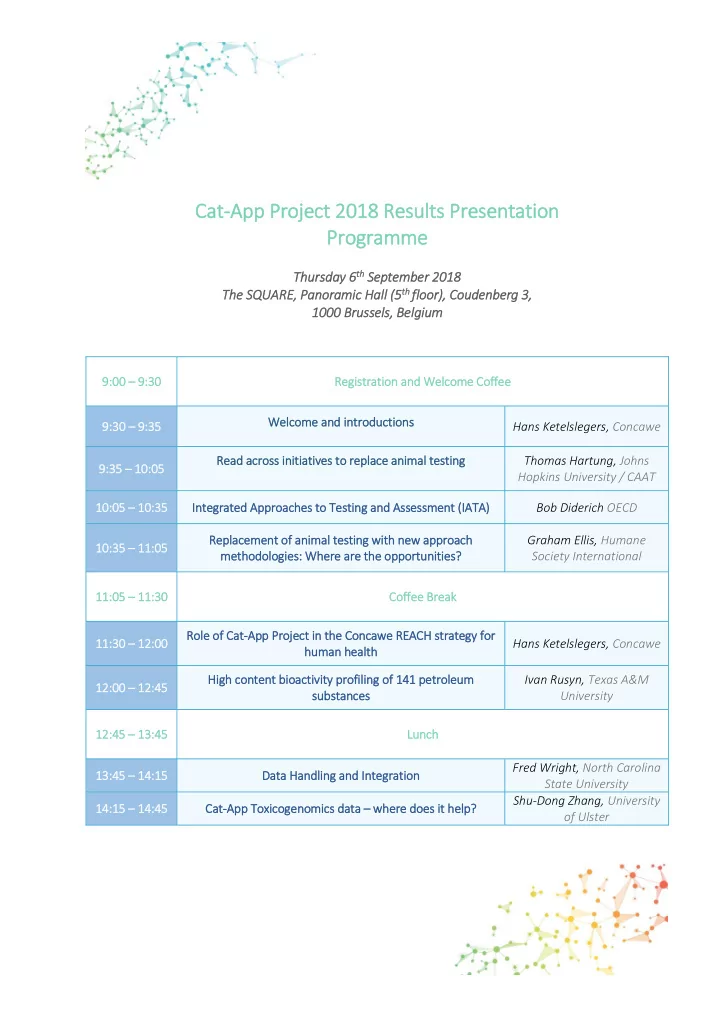
Cat at-App Project t 2018 Results ts Presentati tion Programme Thursday 6 th th Sep eptember er 2018 (5 th th fl The e SQUARE RE, Panoramic ic Hall ll (5 floor), ), Coudenber erg 3, 1000 Brussels, Belg elgiu ium 9:0 :00 9:3


slide-1
SLIDE 1

Cat at-App Project t 2018 Results ts Presentati tion Programme

Thursday 6th

th Sep

eptember er 2018 The e SQUARE RE, Panoramic ic Hall ll (5 (5th

th fl

floor), ), Coudenber erg 3, 1000 Brussels, Belg elgiu ium

9:0 :00 – 9:3 :30 Registr trati tion and Welco come Co Coffee 9:3 :30 – 9: 9:35 35 Welco come and i intr troducti tions Hans Ketelslegers, Concawe 9: 9:35 35 – 10:05 05 Read acr cross in initi tiati tives to to r replace ce animal te testi ting Thomas Hartung, Johns Hopkins University / CAAT 10: 10:05 05 – 10:35 35 Inte tegr grated A Approach ches to to Testi ting and A Assessment ( t (IATA) Bob Diderich OECD 10:3 :35 – 11:05 Replacement o

  • f an

animal t testing with new approach ch meth thodologi gies: : Where are t the opportu tuniti ties? Graham Ellis, Humane Society International 11: 11:05 – 11:30 Co Coffee Br Break 11:3 :30 – 12:00 Role o

  • f Cat-App P

Proje ject ct i in the Co Concawe R REACH CH s str trategy gy f for human h health th Hans Ketelslegers, Concawe 12:0 :00 – 12:45 High co conte tent b bioacti tivity ty p profiling o g of 1 141 p petr troleum substance ces Ivan Rusyn, Texas A&M University 12:4 :45 – 13:45 Lunch ch 13:4 :45 – 14:15 Data Handling g and In Inte tegr grati tion Fred Wright, North Carolina State University 14: 14:15 15 – 14:45 Ca Cat-App To Toxico coge genomics cs d data ta – where d does it h help? Shu-Dong Zhang, University

  • f Ulster
slide-2
SLIDE 2

14:45 45 – 15:15 The applicati tion o

  • f r

reference ce c chemicals in C Cat-App Tim Gant, Public Health England 15: 15:15 15 – 15: 15:45 45 Q&A Session All Cat-App speakers 15:4 :45 – 16:00 Co Coffee Br Break 16:0 :00 – 16:30 Ca Cat-App: : New approach ch meth thodologi gies in in a a r regulato tory co context (Followed by Q&A) George Daston, Procter & Gamble 16:3 :30 – 16:50 Future p perspecti tives Peter Boogaard, Shell 16:5 :50 – 17:00 Overall co conclusions and wrap-up up Hans Ketelslegers, Concawe 17:0 :00 – 18:30 Co Cock cktail R Recepti tion

slide-3
SLIDE 3

Background in informati tion on th the Cat-App Project

The overall obje ject ctive of the multi-year, transatlantic Cat-App research consortium was to develop a framework supporting the Concawe strategy for human health assessment of complex petroleum substances to meet the regulatory requirements under the REACH1 legislation. Petroleum substances are prototypical examples of UVCB2 materials, which are a particular challenge for science-informed regulatory decision making: given the complexity of these products, current alternative strategies provided in specific regulations, mainly focusing

  • n read across approaches, cannot be applied to petroleum UVCBs. In addition, taking animal welfare

considerations, time and testing cost into account, it is practically unfeasible to address hundreds of petroleum products with conventional toxicological guideline studies in animals. The Cat-App framework aims to address this, by applying state of the art technical, statistical and transparent data communication methods to make best use of all available data in an integrative way - facilitating chemical-biological grouping and read across of these and other complex substances. In addition, this framework should be the basis of an intelligent testing strategy, leading to a significant reduction in the use of test animals for the cost- and time effective toxicity testing of petroleum products by concentrating efforts on specific targets where no or insufficient data are

  • available. This work should eventually lead to a more sustainable way for the industry to screen for potential

health risks related to the production, transport and use of petroleum products for workers and the population at large

1 Regulation (EC) No 1907/2006 of the European Parliament and of the Council of 18 December 2006 concerning the

Registration, Evaluation, Authorisation and Restriction of Chemicals (REACH), establishing a European Chemicals Agency.

2 UVCB: Substances of Unknown, Variable composition, Complex reaction products, Biological materials.