Caring for Patients PPE and more CAS Town Hall Webinar MODERATOR : - - PowerPoint PPT Presentation

caring for patients ppe and more
SMART_READER_LITE
LIVE PREVIEW

Caring for Patients PPE and more CAS Town Hall Webinar MODERATOR : - - PowerPoint PPT Presentation

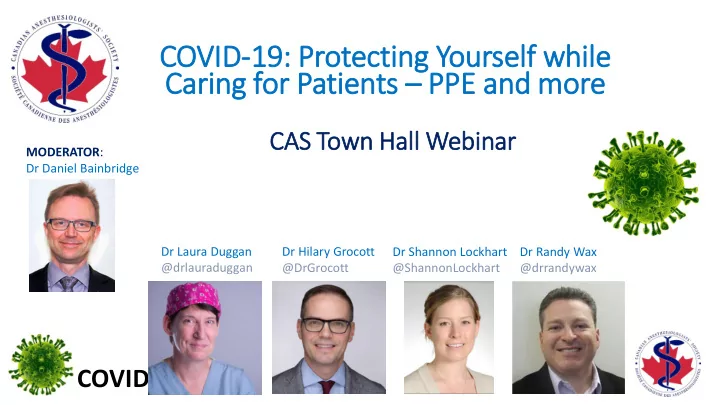
COVID-19: 19: Protecting Yourself while Caring for Patients PPE and more CAS Town Hall Webinar MODERATOR : Dr Daniel Bainbridge Dr Laura Duggan Dr Hilary Grocott Dr Shannon Lockhart Dr Randy Wax @drlauraduggan @DrGrocott


slide-1
SLIDE 1

COVID-19 CAS Town Hall Webinar

COVID-19: 19: Protecting Yourself while Caring for Patients – PPE and more

MODERATOR: Dr Daniel Bainbridge Dr Laura Duggan @drlauraduggan Dr Hilary Grocott @DrGrocott Dr Shannon Lockhart @ShannonLockhart Dr Randy Wax @drrandywax

slide-2
SLIDE 2

COVID-19

Evolving situation, Evolving Knowledge Absence of evidence doesn’t = Evidence of absence Pandemics call for rapid, sometimes imprecise action Healthcare workers need to stay safe

slide-3
SLIDE 3

COVID-19

slide-4
SLIDE 4

COVID-19

slide-5
SLIDE 5

COVID-19

COVID-19 patient on Nasal Prongs Requires an IV start

slide-6
SLIDE 6

COVID-19

No definitive evidence Varying recommendations site to site due to differences in air exchanges per hour

  • SPH: 1h, Ottawa Civic: 2h, Randy Wax: 0h
  • 3h aerosolized in static drum (in vitro)

Q: How long are airborne precautions required post-intubation? A: Based on air exchanges per hour at your site = Liaise with IPAC

  • newer standards = 12 exchanges/h
  • many of us not in new hospitals = 6 exchanges/h
  • CDC. Guidelines for Environmental Infection Control in Health-Care Facilities (2003)

American Society of Refrigerating Engineers

Post-intubation of Suspected/Diagnosed COVID Patient: Precautions required?

slide-7
SLIDE 7

COVID-19

https://coronavirus.jhu.edu/map.html

slide-8
SLIDE 8

COVID-19

Understanding fluid dynamics in disease transmission,

  • Dr. Lydia Bourouiba MIT
slide-9
SLIDE 9

COVID-19

Droplet Aerosol

Droplet > 5 microns (Contact <1 meter away) Airborne < 5 microns

Aerosol

http://www.cidrap.umn.edu/news-perspective/2020/03/commentary-covid-19- transmission-messages-should-hinge-science

slide-10
SLIDE 10

COVID-19

What are aerosol generating medical procedures (AGMP)?

Lack of precision in definition of AGMP “Aerosols are produced when an air current moves across the surface of a film of liquid, generating small particles at the air–liquid interface. The particle size is inversely related to the velocity of air. Therefore, if a procedure causes air to travel at high speed over the respiratory mucosa and epithelium, the production of aerosols containing infectious agents is a potential risk.”

Definitely Controversial Intubation Tracheotomy Non-invasive ventilation Manual ventilation CPAP, BiPAP, Optiflow High flow dry gas (nasal cannula, simple mask) CPR Endotracheal aspiration Open airway suction Nebulizers Bronchoscopy NG insertion Sputum collection

WHO Guidelines : Infection prevention and control

  • f epidemic- and pandemic-prone acute respiratory

infections in health care Tran et al. PLoS One. 2012;7(4):e35797. doi: 10.1371/journal.pone.0035797. Epub 2012 Apr 26.
slide-11
SLIDE 11

COVID-19

No definitive evidence Varying recommendations site to site due to differences in air exchanges per hour

  • SPH: 1h, Ottawa Civic: 2h, Randy Wax: 0h
  • 3h aerosolized in static drum (in vitro)

Q: How long are airborne precautions required post-intubation? A: Based on air exchanges per hour at your site = Liaise with IPAC

  • newer standards = 12 exchanges/h
  • many of us not in new hospitals = 6 exchanges/h
  • CDC. Guidelines for Environmental Infection Control in Health-Care Facilities (2003)

American Society of Refrigerating Engineers

Post-intubation of Suspected/Diagnosed COVID Patient: Precautions required?

slide-12
SLIDE 12

COVID-19

  • 1. COVID Suspected/Diagnosed
  • 2. AGMP
  • 3. Intubation or other AGMP

3 Questions To Guide PPE Decisions:

slide-13
SLIDE 13

COVID-19

Aerosol Generating Medical Procedures (AGMP): Risk

https://journals.plos.org/plosone/article?id=10.1371/journal.pone.0035797

OR=6 OR=3 OR=4

slide-14
SLIDE 14

COVID-19

slide-15
SLIDE 15

COVID-19

https://www.medicircle.in/italian-doctors-forced-to-choose-their-icu-patients-who-have-the-best-chance-for-survival

slide-16
SLIDE 16

COVID-19

slide-17
SLIDE 17

COVID-19

  • COVID-19 represents a paradigm shift
  • get comfortable putting your own health and safety first
  • protect healthcare workers so we can protect health care
  • You will perform better if you feel safe
  • PPE is a safety issue, but also a morale/mental health issue

Health and Safety for Anesthesiolgists

slide-18
SLIDE 18

COVID-19

Originally recommended PPE for AGMP: N95 respirator Eye protection (surgical mask with visor) Reusable yellow gown (AAMI* Level 2, prior to 25 washes) Single pair of nitrile gloves (no cuff specification) No head covering; no shoe covering Modified PPE for AGMP: N95 respirator Eye protection (surgical mask with visor) Disposable surgical gown (*AAMI Level 3) Double high-cuffed (surgical-type) gloves Surgical hood with ties (head and neck covering) Knee high shoe covering (not shown)

Evolving PPE for Aerosol-Generating Medical Procedures

Ideal PPE for AGMP: N95 respirator Eye protection (goggles) Disposable coverall (*AAMI Level 4) covers head and neck integrated shoe cover Double high-cuffed (surgical-type) gloves *AAMI =The Association for the Advancement of Medical Instrumentation https://www.fda.gov/medical-devices/personal-protective-equipment-infection-control/medical-gowns

Ideal

Not Acceptable

slide-19
SLIDE 19

COVID-19

slide-20
SLIDE 20

COVID-19