Caribbean forested wetlands- Pterocarpus officinalis forests as - - PowerPoint PPT Presentation

caribbean forested wetlands pterocarpus officinalis
SMART_READER_LITE
LIVE PREVIEW

Caribbean forested wetlands- Pterocarpus officinalis forests as - - PowerPoint PPT Presentation

Caribbean forested wetlands- Pterocarpus officinalis forests as models to understand wetlands in light of expected changes in sea level Elsie Rivera Ocasio 1 , Neftal Rios Lpez 1 , Amadou B 2 and Tamara Heartsill Scalley 3 1 University of


slide-1
SLIDE 1

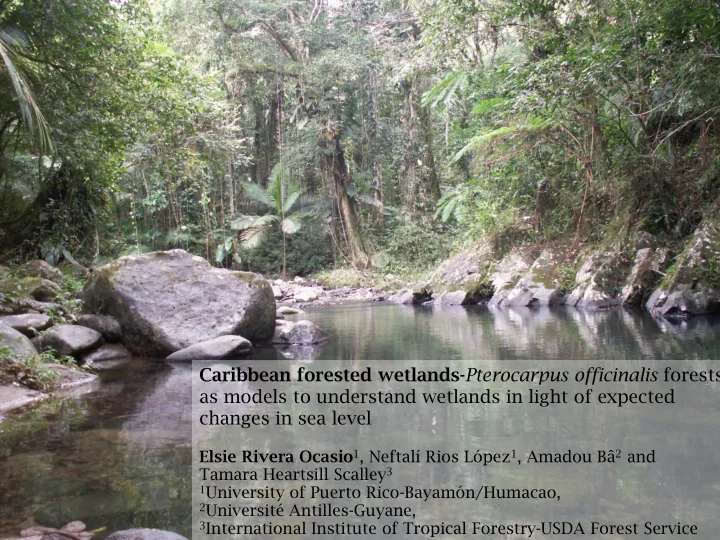
Caribbean forested wetlands-Pterocarpus officinalis forests as models to understand wetlands in light of expected changes in sea level

Elsie Rivera Ocasio1, Neftalí Rios López1, Amadou Bâ2 and Tamara Heartsill Scalley3

1University of Puerto Rico-Bayamón/Humacao, 2Université Antilles-Guyane, 3International Institute of Tropical Forestry-USDA Forest Service

slide-2
SLIDE 2

Pterocarpus officinalis

  • One of the main constituents of coastal freshwater-forested

wetlands in the Caribbean basin.

Grassland Pterocarpus swamp forest Mangrove

  • Provide unique and significant habitat

for many plant and animal species; endemic & neotropical migrant birds.

  • Prevent erosion along coastal margins

& along river banks in both coastal and montane areas.

  • Cultural resource for artisanal fishers

Figure 1. Distribution and relative size of P. officinalis, from grassland to mangrove along a salinity gradient in Guadeloupe (Saint-Etienne et

  • al. 2006).
slide-3
SLIDE 3
  • Pterocarpus stands cover large areas in Caribbean islands

and can dominate the canopy, with 47% to 100% coverage depending on site salinity levels.

slide-4
SLIDE 4

Pterocarpus officinalis

  • Stands are structured by

salinity and flooding in coastal areas

  • and by flooding along rivers

& seasonal variations in the water table in mountain areas

slide-5
SLIDE 5

Pterocarpus officinalis

  • Throughout the Caribbean,

expansion of agricultural and urban areas has reduced its distribution to isolated patches.

  • Current populations in coastal

areas often occur near the extreme of their salinity tolerance.

slide-6
SLIDE 6

Structure of this talk- What we currently

know about this species

  • Hydroperiods and topography
  • Salinity Influence
  • Intraspecific interactions
  • Genetic structure and

historical dynamics

  • Pterocarpus stand variability

from coastal to montane

  • Next Steps
slide-7
SLIDE 7

Hydroperiod

Figure 2. Water depth measurements in the pasture side, low salinity (N = 12) and Laguncularia side, high salinity (N = 12) sections of 1-ha plot in Sabana Seca, Puerto Rico.

Rivera Ocasio et al. (2007) Journal of Tropical Ecology 23:559–568.

  • Seasonally flooded wetland
slide-8
SLIDE 8

Basal area of Pterocarpus swamp forests decreases along salinity gradients that range from 9.7‰ to 15.0‰.

Salinity effects on forest structure

slide-9
SLIDE 9

50 100 150 200

Position in the 1ha plot

10 20 30 40 50 50 100 150 200

Position in the 1ha plot

10 20 30 40 50

Low salinity High salinity Juveniles Adults

Salinity effects on Forest Structure

Laguncularia side pasture side

slide-10
SLIDE 10

Salinity - Forest Structure - Mortality - Distribution

Rivera Ocasio et al. (2007) Journal of Tropical Ecology 23:559–568.

Low salinity High salinity Laguncularia side

pasture side

slide-11
SLIDE 11

Salinity effects- Forest Dynamics-Growth

0 ppt 5 ppt 10 ppt

Rivera Ocasio et al (2007) Journal of Tropical Ecology 23:559–568.

slide-12
SLIDE 12
  • Leaf litter, flower and fruit production of Pterocarpus

is 10 times less in high soil salinity than in low soil salinity.

Salinity effects- Litter, flower and fruit production

Eusse AM, Aide TM (1999) Plant Ecology 145: 307-315.

slide-13
SLIDE 13
  • Despite some degree of salt tolerance P. officinalis

cannot be considered a halophyte

  • The species is unable to complete its life cycle in

salt concentrations of 200 mM (12‰) NaCl

  • Medina et al. 2007

identified that P. officinalis associated to mangroves

  • ccupies low salinity sites

and sequesters Na in the rachis thus, actively preventing damage to leaf tissues

Pterocarpus officinalis- responses to salinity

slide-14
SLIDE 14

What do we currently know about the species?

  • Hydroperiods and

topography

  • Salinity Influence
  • Intraspecific interactions
  • Genetic structure and

historical dynamics

  • Pterocarpus stand variability

from coastal to montane populations

  • Next steps
slide-15
SLIDE 15

10 ppt 5 ppt 0ppt

Salinity effects- Intraspecific interactions

Root nodulation

Rivera Ocasio et al (2007) Journal of Tropical Ecology 23:559–568.

In the absence of salt, inoculation had a positive effect on biomass production of Pterocarpus when compared to un-inoculated plants. At 10‰ of NaCl, the decrease of seedling biomass has been linked to the reduction of the number of nitrogen fixating nodules.

slide-16
SLIDE 16

Salinity effects on Intraspecific interactions

Root mycorrhizal colonization

  • Pterocarpus officinalis is considered highly mycorrhizal dependent
  • AM colonization is always >50% within low (<10%) salinity levels

Saint-Etienne L, et al. (2006). Forest Ecology and Management 232 : 86-89.

slide-17
SLIDE 17

What do we currently know about the species?

  • Hydroperiods and

topography

  • Salinity Influence
  • Genetic structure and

historical dynamics

  • Pterocarpus stand variability

from coastal to montane populations

  • Next Steps
slide-18
SLIDE 18

Genetic diversity and Historical dynamics

  • Pterocarpus officinalis populations show

strong regional differentiation between Caribbean and Continental populations.

  • Relatively high population differentiation

within Puerto Rico.

  • Conservation implications at the regional

scale for populations from the two main regional groups.

  • Within the Caribbean, Trinidad has the most

diverse population.

  • Within the Continent, Venezuela has high

genetic diversity.

Rivera-Ocasio et al. 2005 Conservation Genetics

slide-19
SLIDE 19
  • Molecular markers suggest historical isolation,

local extinctions and recolonization events

  • f areas within the Caribbean Basin.
  • Clear separation between Insular (Puerto Rico, Trinidad and

Dominican Republic) and Continental populations.

  • Most P. officinalis populations had a unique haplotype per

population, indicating isolation and restricted geneflow.

  • Nuclear markers revealed that

pollen dispersal is limited (Rivera Ocasio 2007).

Genetic diversity and Historical dynamics

nrITS- gene network

slide-20
SLIDE 20

cpDNA- chloroplast structure/maternal seed dispersal history

  • Two major haplotypes-
  • -Differentiation between Venezuela and Trinidad
  • High diversity in

Central America

Genetic diversity and Historical dynamics

slide-21
SLIDE 21

Genetic diversity and Historical dynamics

  • A history of isolation, local extinctions and recolonization events

within the Caribbean Basin. Strong regional differentiation between Caribbean and Continental populations.

  • The Dominican Republic had similarities with both regional

groups, suggesting historical geneflow,

  • This correlates very well

with sea currents within the Caribbean Basin and the influence of the Orinoco River plume.

slide-22
SLIDE 22

What do we currently know about the species?

  • Hydroperiods and

topography

  • Salinity Influence
  • Intraspecific interactions
  • Genetic structure and

historical dynamics

  • Pterocarpus stand variability

from coastal to montane populations

  • Next steps
slide-23
SLIDE 23

Montane

  • Stands are structured by

flooding along rivers and seasonal variations in the water table.

Coastal

Pterocarpus stands dynamics from coastal to montane populations

  • Stands are strongly structured by

salinity and flooding

slide-24
SLIDE 24

Leaf K [ ] is greater in coastal sites, less in montane sites. Leaf percent carbon was greater in montane sites. No differences between sites in terms of N of leaves or fine roots.

Pterocarpus stands dynamics from coastal to montane populations-Leaves

slide-25
SLIDE 25

Montane sites greater nodule mass and more (96.3%) nodules active, compared to coastal sites (82.2%)

Pterocarpus stands dynamics from coastal to montane populations-Root nodules

slide-26
SLIDE 26

Nodule mass and diameter were larger near the surface of the soil and in montane sites.

Pterocarpus from coastal to montane populations- Root nodules

slide-27
SLIDE 27

What do we currently know about the species?

  • Hydroperiods and

topography

  • Salinity Influence
  • Genetic structure and

historical dynamics

  • Pterocarpus stand variability

from coastal to montane populations

  • Next Steps
slide-28
SLIDE 28

Next steps

  • Measure along salinity gradients

and along the continuum of coastal - montane ecosystems

  • soil carbon,
  • leaf decomposition rates,
  • nitrogen fixation and accumulation rates
  • Measure hydroperiod in coastal and montane stands

to understand sea level rise impacts.

slide-29
SLIDE 29
  • Study the function and structure of this wetland species

under its current range of environmental conditions

  • Help establish practical conservation goals that will

maintain this species and the wetlands where it occurs.

Next steps

slide-30
SLIDE 30