Ze Ze Free-ion terms for p 2 - - PowerPoint PPT Presentation

ze ze free ion terms for p 2 free ion terms for p 2
SMART_READER_LITE
LIVE PREVIEW

Ze Ze Free-ion terms for p 2 - - PowerPoint PPT Presentation

Where Are We Going? Many Electron Atoms For any 2 e - atom or ion, the Schrdinger equation cannot be solved for Week 10: Orbitals and Terms every electron: Russell-Saunders coupling of orbital and spin angular momenta


slide-1
SLIDE 1

Where Are We Going…?

  • Week 10: Orbitals and Terms

Russell-Saunders coupling of orbital and spin angular momenta Free-ion terms for p2 Free-ion terms for p2

  • Week 11: Terms and ionization energies

Free-ion terms for d2 Ionization energies for 2p and 3d elements

  • Week 12: Terms and levels

Spin-orbit coupling Total angular momentum

Slide 1/16

Total angular momentum

  • Week 13: Levels and ionization energies

j-j coupling Ionization energies for 6p elements

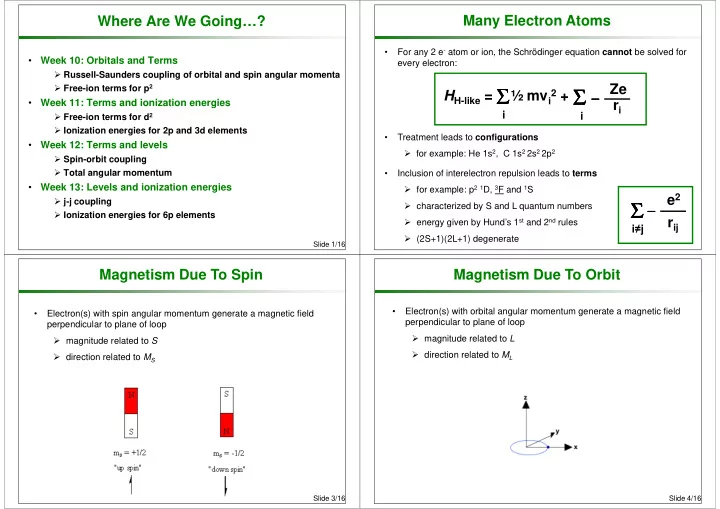
Many Electron Atoms

  • For any 2 e- atom or ion, the Schrödinger equation cannot be solved for

every electron:

Ze

Σ Σ Σ Σ Σ Σ Σ Σ

  • Treatment leads to configurations

for example: He 1s2, C 1s2 2s2 2p2

HH-like = ri Ze − − − −

Σ Σ Σ Σ Σ Σ Σ Σ

½ mvi

2 +

i i

  • Inclusion of interelectron repulsion leads to terms

rij e2 − − − −

  • Inclusion of interelectron repulsion leads to terms

for example: p2 1D, 3F and 1S characterized by S and L quantum numbers energy given by Hund’s 1st and 2nd rules (2S+1)(2L+1) degenerate

Σ Σ Σ Σ

ij

Magnetism Due To Spin

  • Electron(s) with spin angular momentum generate a magnetic field

perpendicular to plane of loop magnitude related to S magnitude related to S direction related to MS

Slide 3/16

Magnetism Due To Orbit

  • Electron(s) with orbital angular momentum generate a magnetic field

perpendicular to plane of loop magnitude related to L magnitude related to L direction related to ML

Slide 4/16

slide-2
SLIDE 2

Orbital Magnetism

  • Electrons generate magnetism through their orbital motion
  • This is associated with an ability to rotate an orbital about an axis into

an identical and degenerate orbital.

x y z x y z x x

rotation of a px orbital by 90 gives a py orbital and vice versa: generating magnetism about the z-direction

Orbital Magnetism

rotation of a px orbital by 90 gives a py orbital and vice versa: generating magnetism about the z-direction

  • To be able to do this:

the orbitals involved must have the same energy there must not be an electron in the second orbital with the same spin as that in the first orbital. If there is, the electron cannot orbit without breaking the Pauli principle.

Slide 6/16

free orbitals available for electron to hop into:

  • rbital magnetism

free orbital available for electron to hop into:

  • rbital magnetism

no free orbital available for electron to hop into: no orbital magnetism

L = 1 L = 1 L = 0

Spin Orbit Coupling

  • There is a magnetic interaction between the magnetism generated

by the spin and orbital motions results in different values for the total angular momentum, J

  • rbital magnetism

spin magnetism

Slide 7/16

  • rbital magnetism

lowest energy highest energy

Russell – Saunders Coupling

  • The magnetic interaction increases with the atomic number

for most of the periodic table, electrostatic >> magnetic

  • Treat electrostatic to give terms characterized by L and S

l1 + l2 + = L, s1 + s2 + = S

  • Then treat spin-orbit second to give levels:

L + S = J J is the total angular momentum

rij e2 − − − −

Σ Σ Σ Σ

ij

H = HH-like + L.S +

J is the total angular momentum

configurations terms levels

slide-3
SLIDE 3

Russell – Saunders Coupling

  • For each L and S value:

J = L + S, L + S 1, L + S 2 . L S Each level, MJ = J, J -1, J - 2, -J (2J+1 values) Each level, MJ = J, J -1, J - 2, -J (2J+1 values)

2S+1LJ

Slide 9/16

Hund’s 3rd Rule

  • For less than half-filled shells, smallest J lies lowest

p2: ground term is 3P with S = 1 and L = 1 J = 2, 1 and 0 J = 2, 1 and 0 less than half-filled:

3P2 Slide 10/16 3P 3P0 3P1

Hund’s 3rd Rule

  • For more than half-filled shells, highest J lies lowest

p4: ground term is 3P with S = 1 and L = 1 J = 2, 1 and 0 J = 2, 1 and 0 more than half-filled:

3P 3P0 Slide 11/16 3P 3P2 3P1

Magnetism

  • The magnetic moment is given by:

12 eff

  • g[J(J

1)] = +

where g is the Landé splitting factor,

[S(S 1) L(L 1)] 3 g 2 2J(J 1) + + = + +

Slide 12/16

  • p2: ground level is 3P0 with J = 0, S = 1, L = 1

eff = 0 (p2 is diamagnetic, at least at low temperature)

  • p4: ground level is 3P2 with J = 2, S = 1, L = 1

g = 3/2 and eff = 3.68 B.M. (B.M. = Bohr Magnetons)

slide-4
SLIDE 4

20 25

y (eV) 2p

Ionization Energies: (iii) Hund’s 3rd Rule

p-block ionization energies: M

  • M+

10 11 12

y (eV) 6p

5 10 15 1 2 3 4 5 6

pn ionization energy (e 3p 4p 5p 6p

5 6 7 8 9 1 2 3 4 5 6

pn ionization energy (

Slide 13/16

  • For 6p, there is a decrease between p2 and p3
  • No half-filled shell effect!

j-j Coupling

  • For very heavy elements, magnetic coupling becomes large
  • Treat spin-orbit first to give spin-orbitals for each electron:

j = l + s each value is (2j+1) degenerate

  • Then add individual j values together to give J

j1 + j2 + = J j = l + s each value is (2j+1) degenerate

  • For p-electrons, l = 1 and s = 1/2

j = 1/2 and 3/2 with former lowest in energy

Slide 14/16

j = 1/2 and 3/2 with former lowest in energy

j = 1/2 j = 3/2

j-j Coupling

  • For p-electrons, l = 1 and s = 1/2

j = 1/2 and 3/2 with former lowest in energy

j = 1/2 j = 3/2

  • If electrostatic >> magnetic

Slide 15/16

  • If electrostatic >> magnetic
  • verall increase due to increasing nuclear charge

decrease in ionization energy for p4 due to pairing (1st rule)

  • If magnetic > electrostatic
  • verall increase due to increasing nuclear charge

decrease in ionization energy for p3 due to repulsive magnetic interaction (3rd rule)

Summary

Spin and orbital magnetism

  • Electrons have intrinsic magnetism due to spin
  • Electrons may also have orbital magnetism
  • Electrons may also have orbital magnetism

Spin-orbit coupling

  • Usually weak magnetic coupling between spin and orbit
  • Characterized by levels with total angular momentum, J

Hund’s 3rd Rule

  • Lowest J lies lowest for < 1/2 filled shells
  • Highest J lies lowest for > 1/2 filled shells
  • Highest J lies lowest for > 1/2 filled shells

Consequences

  • Magnitude of magnetism due to J, L and S
  • Stabilization of p1 and p2, destabilization of p4 – p6

Task!

  • Work out ground levels and magnetism for fn elements