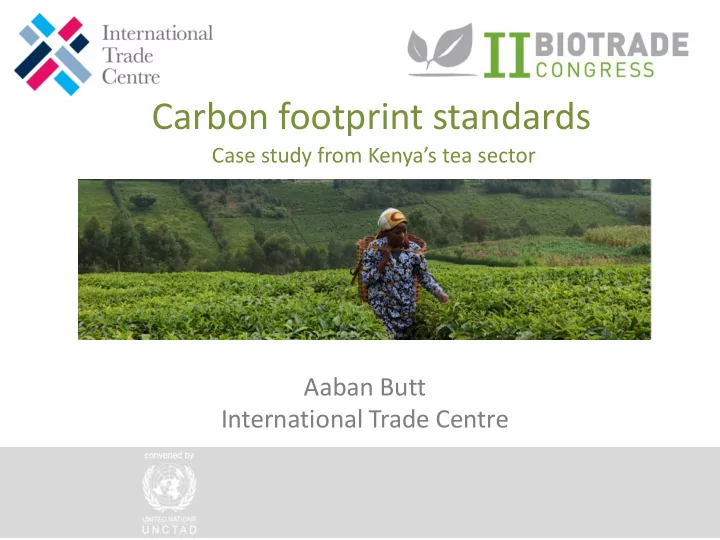
SLIDE 1
Carbon footprint standards
Aaban Butt International Trade Centre
Case study from Kenya’s tea sector
SLIDE 2
SLIDE 3 Climate Change and Trade
To strengthen the capacity of agricultural exporters to:
- Deal with carbon standards
- Mitigate GHG emissions
- Find synergies with
adaptation
SLIDE 4 Tea Sector in Kenya
- Provide $1.3 billion to Kenya’s economy
- Employs 3 million people
- 60% of which are smallholders
- Kenya Tea Development Agency manage smallholders
SLIDE 5 Climate change and Tea
- Climate Change affecting quality and
quantity of tea
- Buyers demanding tea exporters to
measure and report on emissions in the supply chain
- Non tariff barriers for many farmers
SLIDE 6
ITC Technical Paper
Product carbon footprinting standards in the agri-food sector
SLIDE 7
What is Carbon Footprint?
Carbon footprint is a calculation of the total greenhouse gas emissions in CO2e associated with a product, organization, process or event.
SLIDE 8
Steps for carbon footprint
SLIDE 9
Scoping
SLIDE 10
Steps for carbon footprint
SLIDE 11
CASE STUDY: Climate change mitigation in Kenya’s tea sector
SLIDE 12
Created Public Private Partnership
SLIDE 13
Develop climate change mitigation manuals
SLIDE 14
Selected pilot factory in Chinga
SLIDE 15 Mitigation training and action plan developed
trainers
management staff
and lead farmers
leaders
SLIDE 16
Climate change adaptation training
126,000 tea farmers are less vulnerable to the effects of climate change
SLIDE 17
Mitigating tea factory lead to:
Lower carbon emissions Increased energy efficiency Lower costs of production Increased profit Increased farmer incomes
SLIDE 18
http://www.youtube.com/watch?v=JD2TUwuIbjE