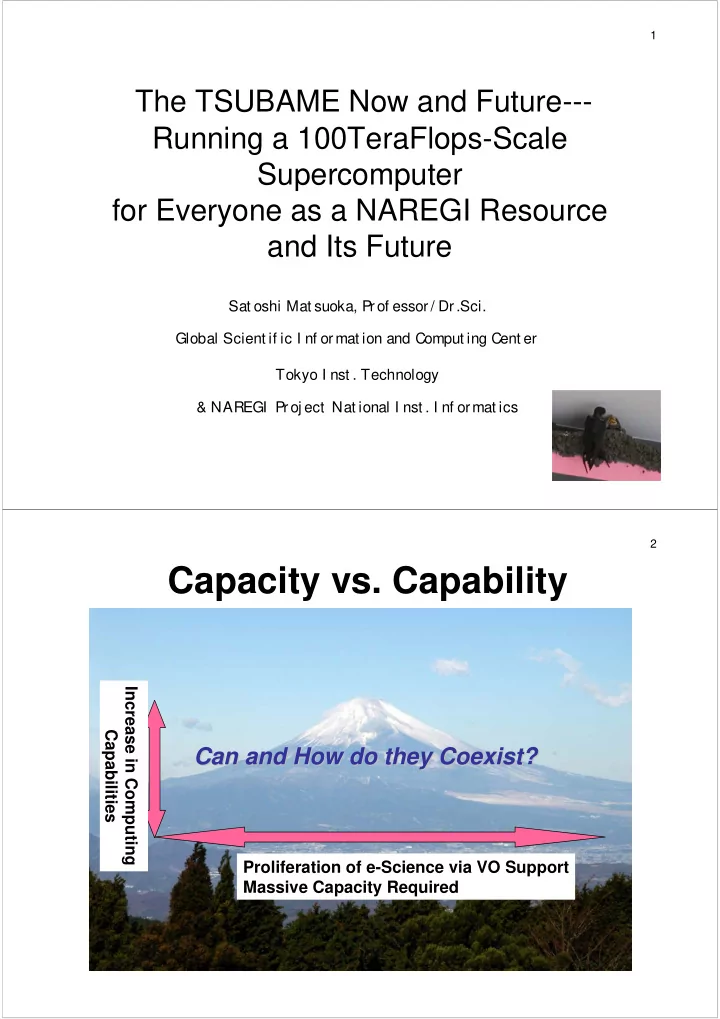
Capacity vs. Capability Increase in Computing Capabilities Can and - - PDF document

capacity vs capability
SMART_READER_LITE
LIVE PREVIEW

Capacity vs. Capability Increase in Computing Capabilities Can and - - PDF document

1 The TSUBAME Now and Future--- Running a 100TeraFlops-Scale Supercomputer for Everyone as a NAREGI Resource and Its Future Sat oshi Mat suoka, Prof essor/ Dr.Sci. Global Scient if ic I nf ormat ion and Comput ing Cent er Tokyo I nst .


slide-1
SLIDE 1

1

The TSUBAME Now and Future--- Running a 100TeraFlops-Scale Supercomputer for Everyone as a NAREGI Resource and Its Future

Sat oshi Mat suoka, Prof essor/ Dr.Sci. Global Scient if ic I nf ormat ion and Comput ing Cent er Tokyo I nst . Technology & NAREGI Proj ect Nat ional I nst . I nf ormat ics

2

Proliferation of e-Science via VO Support Massive Capacity Required Increase in Computing Capabilities

Can and How do they Coexist? Can and How do they Coexist?

Capacity vs. Capability

slide-2
SLIDE 2

3

TSUBAME “Grid” Clust er Supercomput er

  • Tokyo-t ech
  • Supercomput er and
  • UBiquit ously
  • Accessible
  • Mass-st orage
  • Environment

TSUBAME means “a swallow” in J apanese, Tokyo-t ech (Tit ech)’s symbol bird, and it s logo (but we are home t o massive # of parakeet s)

4

The TSUBAME Production “Supercomputing Grid Cluster” Spring 2006-2010

ClearSpeed CSX600 SIMD accelerator 360 boards, 35TeraFlops(Current)) Storage 1 Petabyte (Sun “Thumper”) 0.1Petabyte (NEC iStore) Lustre FS, NFS, CIF, WebDAV 50GB/s aggregate I/O BW

500GB 48disks 500GB 48disks 500GB 48disks

NEC SX-8 Small Vector Nodes (under plan)

Unified IB network

Sun Galaxy 4 (Opteron Dual core 8-socket) 10480core/655Nodes 21.4Terabytes 50.4TeraFlops OS Linux (SuSE 9, 10) NAREGI Grid MW

Voltaire ISR9288 Infiniband 10Gbps x2 (xDDR) ~1310+50 Ports ~1.4Terabits/s

10Gbps+External Network

“Fastest Supercomputer in Japan” 7th on the 28th Top500@38.18TF

slide-3
SLIDE 3

5

TSUBAME Global Partnership

AMD:Fab36

NEC: Main Integrator, Storage, Operations SUN: Galaxy Compute Nodes, Storage AMD: Opteron CPU Voltaire: Infiniband Network ClearSpeed: CSX600 Accel. CFS: Parallel FSCFS NAREGI: Grid MW Titech GSIC: us

UK Germany Israel USA Japan

6

Titech TSUBAME Titech TSUBAME ~ ~76 76 racks racks 350m2 floor area 350m2 floor area 1.2 MW (peak) 1.2 MW (peak)

slide-4
SLIDE 4

7

~500 TB out of 1.1PB ~500 TB out of 1.1PB Node Rear Node Rear Local Infiniband Switch Local Infiniband Switch (288 ports) (288 ports) Currently Currently 2GB/s / node 2GB/s / node Easily scalable to Easily scalable to 8GB/s / node 8GB/s / node Cooling Towers (~ Cooling Towers (~32 32 units) units)

8

TSUBAME Archit ect ure =

Commodit y PC Clust er + Tradit ional FAT node Supercomput er + The I nt ernet & Grid + (Modern) Accelerat ion

slide-5
SLIDE 5

9

Design Principles of TSUBAME(1)

  • Capability and Capacity : have the cake and eat it, too!

– High-performance, low power x86 multi-core CPU

  • High INT-FP, high cost performance, Highly reliable
  • Latest process technology – high performance and low power
  • Best applications & software availability: OS (Linux/Solaris/Windows),

languages/compilers/tools, libraries, Grid tools, all ISV Applications

– FAT Node Architecture (later)

  • Multicore SMP – most flexible parallel programming
  • High memory capacity per node (32/64GB)
  • Large total memory – 21.4 Terabytes
  • Low node count – improved fault tolerance, easen network design

– High Bandwidth Infiniband Network, IP-based (over RDMA)

  • (Restricted) two-staged fat tree
  • High bandwidth (10-20Gbps/link), multi-lane, low latency (<

10microsec), reliable/redundant (dual-lane)

  • Very large switch (288 ports) => low switch count, low latency
  • Resilient to all types of communications; nearest neighbor,

scatter/gather collectives, embedding multi-dimensional networks

  • IP-based for flexibility, robustness, synergy with Grid & Internet

10

Design Principles of TSUBAME(2)

  • PetaByte large-scale, high-perfomance, reliable storage

– All Disk Storage Architecture (no tapes), 1.1Petabyte

  • Ultra reliable SAN/NFS storage for /home (NEC iStore), 100GB
  • Fast NAS/Lustre PFS for /work (Sun Thumper), 1PB

– Low cost / high performance SATA2 (500GB/unit) – High Density packaging (Sun Thumper), 24TeraBytes/4U – Reliability thru RAID6, disk rotation, SAN redundancy (iStore)

  • Overall HW data loss: once / 1000 years

– High bandwidth NAS I/O: ~50GBytes/s Livermore Benchmark – Unified Storage and Cluster interconnect: low cost, high bandwidth, unified storage view from all nodes w/o special I/O nodes or SW

  • Hybrid Architecture: General-Purpose Scalar

+ SIMD Vector Acceleration w/ ClearSpeed CSX600

– 35 Teraflops peak @ 90 KW (~ 1 rack of TSUBAME) – General purpose programmable SIMD Vector architecture

slide-6
SLIDE 6

11

TSUBAME Timeline

  • 2005, Oct . 31: TSUBAME cont ract
  • Nov. 14t h Announce @ SC2005
  • 2006, Feb. 28: st opped services of old SC

– SX-5, Origin2000, HP GS320

  • Mar 1~Mar 7: moved t he old machines out
  • Mar 8~Mar 31: TSUBAME I nstallation
  • Apr 3~May 31: Experiment al Product ion phase 1

– 32 nodes (512CPUs), 97 Terabyt es st orage, f ree usage – Linpack 38.18 Teraf lops May 8t h, # 7 on t he 28t h Top500 – May 1~8: Whole system Linpack, achieve 38. 18 TF

  • J une 1~Sep. 31: Experiment al Product ion phase 2

– 299 nodes, (4748 CPUs), st ill f ree usage

  • Sep. 25- 29 Linpack w/ ClearSpeed, 47. 38 TF
  • Oct . 1: Full product ion phase

– ~10,000CPUs, several hundred Terabyt es f or SC – I nnovat ive account ing: I nt ernet -like Best Ef f ort & SLA

12

TSUBAME as No.1 in Japan

Total 45 TeraFlops, 350 Terabytes

>>

>85 TeraFlops 1.1Petabyte 4 year procurement cycle Has beaten the Earth Simulator Has beaten all the other Univ. centers combined

All University National Centers

slide-7
SLIDE 7

13

TSUBAME Physical Installation

  • 3 rooms (600m2), 350m2

service area

  • 76 racks incl. network &

storage, 46.3 tons

– 10 storage racks

  • 32 AC units, 12.2 tons
  • Total 58.5 tons (excl. rooftop

AC heat exchangers)

  • Max 1.2 MWatts
  • ~3 weeks construction time

1st Floor 2nd Floor A 2nd Floor B

Titech Grid Cluster

TSUBAME TSUBAME TSUBAME TSUBAME & Storage

14

TSUBAME Network: (Restricted) Fat Tree, IB-RDMA & TCP-IP

X4600 x 120nodes (240 port s) per swit ch => 600 + 55 nodes, 1310 port s, 13.5Tbps I B 4x 10Gbps x 2

Volt air I SR9288

I B 4x 10Gbps x 24

Bisect ion BW = 2.88Tbps x 2

I B 4x 10Gbps X4500 x 42nodes (42 port s) => 42port s 420Gbps Single mode f iber f or cross-f loor connect ions

Ext ernal Et her

slide-8
SLIDE 8

15

The Benef it s of Being “Fat Node”

  • Many HPC Apps f avor large SMPs
  • Flexble programming models---MPI , OpenMP, J ava, ...
  • Lower node count – higher reliabilit y/ manageabilit y
  • Full I nt erconnect possible --- Less cabling & smaller swit ches,

mult i-link parallelism, no “mesh” t opologies

1~8GB 10~40GF 2~4

Typical PC Clust er

0.5~1GB 5.6 GF 2

I BM BG/ L

16 16 64~128 8, 16 8, 32

CPUs/ Node

32~64GB

  • 76. 8GF+ 96GF

TSUBAME

(Tokyo Tech)

16GB 128GF

The Eart h Simulat or

512GB 532.48GF~799GF

Fuj it su PrimePower

(Kyot o-U, Nagoya-U)

32~64GB 60.8GF~135GF

Hit achi SR11000

(U-Tokyo, Hokkaido-U)

16~128GB 48GF~217.6GF

I BM eServer

(SDSC Dat aSt ar)

Memory/ Node Peak/ Node

16

Sun Tsubame Technical Experiences t o be Published as Sun Blueprint s

  • Coming RSN
  • About 100 pages
  • Principally aut hored

by Sun’s On-sit e Engineers

slide-9
SLIDE 9

17

TSUBAME in Production

  • Oct. 1 2006 (phase 3) ~10400 CPUs

18

TSUBAME Reliability

290,304 125,760 31,440 11,096 9,674 Unit MTBF (H) 33.13973 14.356164 3.589041 1.26672 1.1043 Unit MTBF (Y) 106.5 60.8 45.6 182.5 517.1 593.1 Over Year 0.29 0.17 0.13 0.50 1.42 1.63 Per Day 7 4 3 12 34 39 24 Days

Total HW Breakage Faults (excl. unknowns) Possible HW Faults (incl. unknowns) Overall Compute Node faults

Total HW Faults Thumper HDD Faults (2016 HDDs) Compute Nodes (655 nodes) Faults Date

TSUBAME Fault Overview 8/15/2006 - 9/8/2006

  • Very High Availability (over 99%)
  • Faults frequent but localized effect only

– Jobs automatically restarted by SGE

  • Most faults NOT HW, mostly SW

– Fixed with reboots & patches # Avail CPUs # Avail CPUs

slide-10
SLIDE 10

19

TSUBAME Applications---Massively Complex Turbulant Flow and its Visualization (by Tanahashi Lab and Aoki Lab, Tokyo Tech.)

Turbulant Flow from Airplane Taylor-Couette Flow 20

TSUBAME Turbulant Flow Visualization

  • Prof. Tanahashi and Aoki, Tokyo Tech)

Used TSUBAME for bot computing and vis. 2000CPUs for vis

( parallel avs)

20 Billion Polygons 20,000x 10,000 Pixels

slide-11
SLIDE 11

21

TSUBAME Job Statistics for ISV Apps (# Processes)

#

  • f

J

  • b

, e x c e p t P G I _ C D K A B A Q U S A M B E R A V S _ E x p r e s s ( D e v e l

  • p

e r + P C E ) E n S i g h t G a u s s i a n G a u s s V i e w G R O M A C S M a t h e m a t i c a M A T L A B M

  • l

p r

  • M

O P A C M S C _ N A S T R A N M S C _ P A T R A N N W C h e m P O V

  • R

a y S A S T i n k e r U T C h e m G A M E S S

A m b e r 8 % G a u s s i a n 1 % 10ヶ 月

1 , 3 6 3 , 3 7 4 P r

  • c

e s s e s ( I S V

  • n

l y , e x c l . P G I _ C D K ) A p p r

  • x

. 5 / d a y ( v i a S u n G r i d E n g i n e )

22

TSUBAME Job Statistics for ISV Apps (# CPU Timeshare)

C P U t i m e s h a r e f r

  • m

6 A p r . t

  • 7

J a n . ( I S V A p p s O n l y )

A B A Q U S A M B E R A V S _ E x p r e s s D i s c

  • v

e r y S t u d i

  • E

n S i g h t G a u s s i a n G a u s s V i e w G R O M A C S M a t e r i a l s E x p l

  • r

e r M a t e r i a l s S t u d i

  • M

a t h e m a t i c a M A T L A B M

  • l

p r

  • M

O P A C M S C _ N A S T R A N M S C _ P A T R A N N W C h e m P G I _ C D K

G a u s s i a n 5 5 % A m b e r 3 5 %

slide-12
SLIDE 12

23

Status as of Mar 13th, 2007

QUEUE FREE NODE FREE CPU FREE MEMORY

  • TOTAL 260 1676 CPU 5240 GB
  • bes1 107 783 CPU 2786 GB
  • bes2 110 606 CPU 1526 GB
  • default 26 112 CPU 412 GB
  • gridMathem

8 128 CPU 256 GB

  • high 9 47 CPU 260 GB
  • sla1 0 0 CPU 0 GB
  • sla2 0 0 CPU 0 GB

24

Perf ormance/ Wat t of TSUBAME Comparisons wit h ot her leading Supercomput ers

Machine CPU Cores Wat t s Peak GFLOPS Peak MFLOPS / Wat t Wat t s/ CPU TSUBAME(Opt eron) 10480 800,000 50,400 63 76.336 TSUBAME(w/ Clear Spee 11,200 810,000 85,000 104.94 72.321 Eart h Simulat or 5120

6,000,000

40,000 6.7 1171.9 ASCI Purple (LLNL) 12240

6,000,000

77,824 12.971 490.2

AI ST Supercluster

3188 522,240 14400 27.574 163.81 LLNL BG/ L (rack) 2048 25,000 5734.4 229.38 12.207 Next Gen BG/ P (rack) 4096 30,000 16384 546.13 7.3242 TSUBAME Next Gen (2010) 40000 800,000 1000000 1250 20

slide-13
SLIDE 13

25

TSUBAME Cooling Densit y Challenge

  • Room 2F-B

– 480 nodes, 1330W/ node max, 42 racks – Rack area = 2.5m x 33.2m = 83m2 = 922f t 2

  • Rack spaces only---Excludes CRC unit s

– Max Power = x4600 nodes 1330W x 480 nodes + I B swit ch 3000W x 4 = 650KW – Power densit y ~= 700W/ f t 2 (!)

  • Well beyond st at e-of -art dat acent ers

(500W/ f t 2 )

– Ent ire f loor area ~= 14m x 14m ~= 200m2 = 2200 f t 2 – But if we assume 70% cooling power as in t he Eart h Simulat or t hen t ot al is 1.1MW – st ill ~500W/ f t 2

26

TSUBAME Physical Installation 700W/ft2

  • n hatched area

500W/ft2 for the whole room High density cooling & power reduction

2nd Floor B

TSUBAME TSUBAME

slide-14
SLIDE 14

27

Cooling and Cabling 700W/ f t 2

  • -- hot / cold row separat ion and rapid airf low---

46U Rack 11 Sunfire x4600 Units Low Ceiling:3m smaller air volume CRC Unit 25-27 degrees

45cm raised f loor, cabling only

  • --no f loor cooling

no turbulant airf low causing hotspots

CRC Unit 46U Rack 11 X4600 Units 46U Rack 11 X4600 Units

Cold row Isolated hot row

Pressurized cool air Increase effective air volume, evens flow

Isolation plate prevents Venturi effect

Narrow Aisles Narrow Aisles

28

Very narrow hot row aisle-

  • - Hot air f rom the nodes
  • n the right is immediately

absorbed and cooled by the CRC units on the lef t Narrow Cold Row Aisle- - - no f loor cooling, just cables underneath Duct openings on the ceiling, and the transparent isolation plates to prevent hot- cold mixture

Pressurized cold air blowing down f rom the ceiling duct - - - very strong wind

slide-15
SLIDE 15

29

Everybody’s Supercomput er TSUBAME as a Grid Resource

Breaking t he Tradit ional Supercomput er and Grid Economics

30

  • Different usage env.

from

  • No HP sharing with

client’s PC

  • Special HW/SW, lack
  • f ISV support
  • Lack of common

development env. (e.g. Visual Studio)

  • Simple batch based,

no interactive usage, good UI

Massive Usage Env. Gap

Seamless,Ubiquitous access and usage =>Breakthrough Science through Commoditization of Supercomputing and Grid Technologies “Everybody’s Supercomputer”

Hmm, it’s like my personal machine

Might as well use my Laptop

IT Consolidation: Seamless integration of supercomputers with end-user and enterprise environment

Isolated High-End

“Everybody’s Supercomputer”

slide-16
SLIDE 16

31

Grand Challenge Supercomputing @ Titech

CFD EMF Simulation Nanotech Bioinformatics Bio-simulation + Bioinformatics Weather Prediction Civil Engineering Environmental

100 Teraflops-scale computing with Petascale Storage

32

Incubating the Next-Generation HPC Users

  • Specialized HPC

resources General-purpose usage for education, administration “Expert” HPC Users Provision High C/P Education Evolution Evolution All users, incl. education

Grand Grand-

  • Challenge

Challenge

  • General Purpose x86

Supercomputing Resources

slide-17
SLIDE 17

33

VO-Based Scheduling/Accounting

  • Q. How do you make capability and capacity coexist?
  • Three account types

– Small Usage: no prior allocations, small, ubiquitous resource usage (up to 16 CPUs, etc.), free – Service Level Agreement: Exclusive use of each SMP node, allocation charge on node-time basis, expensive – Best Effort (new): Internet-Inspired, Inexpensive

  • Flat allocation fee per each UNIT
  • Each UNIT is max 64 CPU usage at any given time
  • Group/VO-based accounting, multiple UNITs purchasable

64CPUs 64CPUs 64CPUs 64CPUs 64CPUs

Jan Feb

64CPUs 64CPUs 64CPUs

Mar Nano-VO Max CPU=192

Dynamic machine- level resource allocation SLA > BES > Small

Over 1300 users

34

Grid Portal based WebMO

Computational Chemistry Web Portal for a variety of Apps (Gaussian,NWChem,GAMESS, MOPAC, Molpro) (Prof. Takeshi Nishikawa @ GSIC)

1.SSO 2.Job Mgmt 3.Edit Molecules 4.Set Conditions

TSUBAME WinCCS

Supercomputing in All Educational Activities Over 10,000 users

  • High-End education using supercomputers in undergrad labs

– High end simulations to supplement “physical” lab courses

  • Seamless integration of lab resources to SCs w/grid technologies
  • Portal-based application usage

My desktop scaled to 1000 CPUs!☺

slide-18
SLIDE 18

35

TSUBAME General Purpose DataCenter Hosting As a core of IT Consolidation All University Members == Users

  • Campus-wide AAA Sytem (April 2006)

– 50TB (for email), 9 Galaxy1 nodes

  • Campus-wide Storage Service (NEST)

– 10s GBs per everyone on campus

PC mountable, but accessible directly from TSUBAME

– Research Repository

  • CAI, On-line Courses

(OCW = Open CourseWare)

  • Administrative Hosting (VEST)

I can backup ALL my data☺

36

Titech Titech PKI PKI -

  • based

based SSO/ AAA & SSO/ AAA & I T Services I T Services

slide-19
SLIDE 19

37

SSO WebMO Portal Access

38

GridVM for TSUBAME

NAREGI Bet a 2 Deployment @ Tit ech > 10,000 users per inst it ut ion

NAREGI UMS Information Service IS-DB PKI Card User

Grid Cert

C a m p u s S S O

TSUBAME Grid Engine DB NAREGI-CA/RA University WebTrust LDAP LDAP LDAP

TSUBAME Unix ID Acquire User Info

Generate GridMap File automatically Sun N1GE

MyProxy

P

  • r

t a l R e s

  • u

r c e m e n u

IS Client Embedded User Private key and x.509 cert (tamperproof)

NAREGI Cert.

NAREGI Cert Request

N A R E G I P

  • r

t a l

SGE

slide-20
SLIDE 20

39

Titech Supercomputer Contest “The 12th SuperCon”

  • High

High-

  • school students (~10 out

school students (~10 out

  • f 50 team apps)
  • f 50 team apps)
  • Since 1995: Cray => Origin =>

Since 1995: Cray => Origin => TSUBAM TSUBAME E

  • 700 CPUs allocated for 1 week

700 CPUs allocated for 1 week

sponsors

Multple Multple Testimonies Testimonies “ “TSUBAME was so easy to use, TSUBAME was so easy to use, just like my PC, but much faster! just like my PC, but much faster!” ”

40

Titech Campus Grid 2006

  • An x86 “DataCenter” Grid -
  • ~13,000 CPUs, 90 TFlops, ~26 TBytes Mem, ~1.1 PBytes HDD
  • CPU Cores: x86: TSUBAME (~10600), Campus Grid Cluster

(~1000), COE-LKR cluster (~260), WinCCS (~300) + ClearSpeed CSX600 (720 Chips)

すずかけ台 大岡山

数理・ 計算 C (予定) 計算工学 C (予定)

1.2km 35km, 10Gbps

Campus Grid Campus Grid Cluster Cluster

COE COE-

  • LKR

LKR (Knowledge) cluster (Knowledge) cluster 260 260 AthlonMP AthlonMP/Opteron /Opteron

TSUBAME TSUBAME WinCCS WinCCS 3 0 0 3 0 0 CPU CPUs s

slide-21
SLIDE 21

41

TSUBAME Siblings ---The Domino Ef f ect on Maj or J apanese SCs

  • Sep. 6t h, U-Tokyo, Kyot o-U, and U-Tsukuba

announced “common procurement procedure” f or t he next gen SCs in 1H2008

– 100-150 TFlops – HW: x86 clust er-like SC archit ect ure – NW: Myrinet 10G or I B + Et hernet – SW: Linux+SCore, common Grid MW

  • Previously, ALL cent ers ONLY had dedicat ed SCs
  • Ot her cent ers will likely f ollow…

– No ot her choices t o balance widespread usage, perf ormance, and prices – Makes EVERY sense f or Universit y Mgmt .

  • (VERY) st andardized SW st ack and HW

conf igurat ion

– Adverse archit ect ure diversit y has been impediment f or J apanese Grid I nf rast ruct ure

42 Hokkaido University

Information Initiative Center

HITACHI SR11000 5.6 Teraflops

Tohoku University

Information Synergy Center

NEC SX-7 NEC TX7/AzusA

University of Tokyo

Information Technology Center

HITACHI SR8000 HITACHI SR11000 6 Teraflops Others (in institutes)

Nagoya University

Information Technology Center

FUJITSU PrimePower2500 11 Teraflops

Osaka University

CyberMedia Center

NEC SX-5/128M8 HP Exemplar V2500/N 1.2 Teraflops

Kyoto University

Academic Center for Computing and Media Studies FUJITSU PrimePower2500

8.9 Teraflops

Kyushu University

Computing and Communications Center

FUJITSU VPP5000/64 IBM Power5 p595 5 Teraflops

Japan’s 9 Major University Computer Centers (excl. National Labs) circa Spring 2006 10Gbps SuperSINET Interconnecting the Centers

Tokyo Inst. Technology

Global Scientific Information and Computing Center

2006 NEC/SUN TSUBAME 85 Teraflops

University of Tsukuba

FUJITSU VPP5000 PACS-CS 14.5 TFlops

National Inst. of Informatics

SuperSINET/NAREGI Testbed 17 Teraflops

~60 SC Cent ers in J apan incl. Eart h Simulat or

  • 10 Pet af lop

cent er by 2012

slide-22
SLIDE 22

43 Hokkaido University

Information Initiative Center

HITACHI SR11000 5.6 Teraflops

Tohoku University

Information Synergy Center

NEC SX-7 NEC TX7/AzusA

University of Tokyo

Information Technology Center

NextGen x86 150 Teraflops

HITACHI SR11000 18 Teraflops Others (in institutes)

Nagoya University

Information Technology Center

FUJITSU PrimePower2500 11 Teraflops

Osaka University

CyberMedia Center

NEC SX-8 or SX-9

2008 x86 Cluster 35 Teraflops Kyoto University

Academic Center for Computing and Media Studies

NextGen x86 100-150 Teraflops Kyushu University

Computing and Communications Center

2007 x86 50 TeraFlops?

Fujitsu Primequest? IBM Power5 p595 5 Teraflops

Japan’s 9 Major University Computer Centers (excl. National Labs) circa 2008 >40Gbps SuperSINET3 Interconnecting the Centers

Tokyo Inst. Technology

Global Scientific Information and Computing Center

NEC/SUN TSUBAME 85 Teraflops 250 TFlops?

University of Tsukuba

2006 PACS-CS 14.5 TFlops NextGen x86 100-150 Teraflops

National Inst. of Informatics

NAREGI Testbed 4 Teraflops

x86 TSUBAME sibling dominat ion St ill - 10 Pet af lop cent er by 2012

? ? ?

44

Super SINET3 (new!)

Dynamic L1/L2/L3 provisioning 40 Gbps Backbone

slide-23
SLIDE 23

45

Industry/Societal Feedback International Infrastructural Collaboration

  • Restructuring Univ. IT Research Resources

Extensive On-Line Publications of Results Management Body / Education & Training Deployment of NAREGI Middleware (GOC)

VOs Live Collaborations

Japanese CyberScience Infrastructure Project

UPKI: National Research PKI Infrastructure

★ ★ ★ ★ ★ ★ ★ ☆

SuperSINET and Beyond: Lambda-based Academic Networking Backbone

Cyber-Science Infrastructure ( CSI)

Hokkaido-U Tohoku-U Tokyo-U N I I Nagoya-U Kyoto-U Osaka-U Kyushu-U ( Titech, Waseda-U, KEK, etc.)

NAREGI Output

GeNii (Global Environment for Networked Intellectual Information) NII-REO (Repository of Electronic Journals and Online Publications

46

NAREGI Beta 2 - v.1.0 Highlights

  • Production Release Candidate (2Q 2007)
  • Lots of bug, performance & stability fixes
  • Stable WS(RF) components and APIs (+ Globus 4.0.3)
  • RPM and Dynamic, VM-based deployment
  • VO and “Resource Provider” decoupling for multiple VO

management by VOs and Centers

  • Integration of NAREGI WF and Ninf-G GridRPC
  • More BQ and systems support

– NEC SX-NQS, SGE, Fujitsu NQS… (Condor?)

  • Flexible Job submission and WF management

– Non-grid jobs, non-reserved jobs, various WF tools

  • EGEE-GIN Interoperation (new)
  • Various Administration and Logging Tools
  • Support from dedicated NAREGI support team
slide-24
SLIDE 24

47

NAREGI β2 Operational Model

IS Cluster1 Cluster2 SX-8R

Osaka-U

GridVM NQS GridVM SGE GridVM PBS-Pro

VO “ Nano1 ”

IS SS

VO “ASTRO”

IS SS IS Clust er1 Clust er 2 PrimePower

Titech VO “ Bio1”

IS SS Portal GridVM NQS-II GridVM SGE

VO “Bio2”

IS SS GridVM PBS-Pro Portal

Keio U

VO Side

Resource Provider

Osaka-U Grid Center (CMC) Tokyo Tech Grid Center (GSIC)

VOMS VOMS VOMS VOMS

Classic (Non- Grid) Users Classic User Grid Users Grid Users

Portal Portal

VO Services

VO Services (Hosted by a Grid Center)

48

GIN

An activity of OGF for interoperation among production grids Major grid projects are participating

EGEE, NAREGI, UK National Grid Service, NorduGrid, OSG, PRAGMA, TeraGrid, ...

Trying to identify islands of interoperation between production grids and grow those islands Areas

GIN-auth: Authorization and Identity Management GIN-data: Data Management and Movement GIN-jobs: Job Description and Submission GIN-info: Information Services and Schema GIN-ops: Operations Experience of Pilot Test Applications

GIN (Grid Interoperation Now)

slide-25
SLIDE 25

49

NAREGI GIN Activities

Developing an interoperation island with EGEE Developing an Interoperation island with WS-GRAM based grids JSDL interoperability (for Phase-2)

50

Architecture Demo

NAREGI EGEE: using NAREGI Workflow EGEE NAREGI: using glite WMS commands

EGEE user NAREGI user gLite-WMS gLite-BDII NAREGI-IS GIN-BDII

lcgCE lcgCE

PreWS-GRAM gLite-UI NAREGI Portal Computing Resource Computing Resource NAREGI GridVM WS GRAM

gliteCE gliteCE

NAREGI-GAHP NAREGI Client Lib

NAREGI-SS NAREGI-SS

NAREGI-SC Interop-SC

GIN-jobs: NAREGI-EGEE Architecture

slide-26
SLIDE 26

51

Authentication

  • IGTF is framework of International Grid Trust Federation.
  • IGTF consists of APGridPMA, EUGridPMA and TAGPMA.
  • NAREGI CA joined the APGrid PMA.
  • NAREGI CA has been approved as a production-level CA by APGridPMA.

EUGridPMA TAGPMA APGridPMA NAREGI PMA

IGTF

(International Grid Trust Federation)

  • GSI compliant with x.509

proxy certificates for authentication.

  • It has become available

to use grid computing easily on the worldwide Internet by IGTF.

52

VO Management

  • The GIN VO is a VOMS service.
  • NAREGI uses VOMS as VO management system.
  • Transport of supported authorization attributes via VOMS extensions.

NAREGI EGEE VOMS VOMS nrggin gin

  • VO names are expected

to abide by the VO naming conventions described in GIN VO Naming in order to avoid name conflicts between grids.

  • All members of GIN VO

should observe AUP(Acceptable Use Policy).

reference http://forge.gridforum.org/sf/wiki/do/viewPage/projects.gin/wiki/GINAuth

slide-27
SLIDE 27

53

All of grid information can be retrieved by each of grid in its fashion WRT resource description schema, data format, query language, client API, … Each information service in grid acts as an information provider for the other and translator embedded in the provider performs conversion between different schemas.

Generic Information Provider

GIN-BDII EGEE OSG NDGF NAREGI TeraGrid Pragma Cell Domain connecting with BDII LRPS

OS

Processor

Storage

CIM Providers with Glue=>NRG translator

  • JobQueue

Service

OGSA

  • DAI

Aggregator RDB

CIM v 2.12 /w ext.

LDIF xmlCIM

ARC

  • BDII

Glue v1.2 NAREGI

TeraGrid/

MDS4

Glue v1.1 ARC

LDIF providers with X=>Glue translators : “Site on a map”

GIN-info: Architecture

54

GIN-data: Architecture

GridFTP Server EGEE gLite Client gLite Client SRM Client NAREGI NAREGI Client NAREGI Client SRM Client Gfarm API NAREGI Metadata Server LFC (Metadata Server) Gfarm Server DPM (SRM Server) Storage Storage

NAREGI and EGEE gLite clients can access to both data resources (e.g., bi-directional file copy) using SRM interface. GridFTP is used as its underlying file transfer protocol. File catalog (metadata) exchange is planned.

slide-28
SLIDE 28

55

NAREGI GIN Summary

NAREGI developed EGEE-NAREGI island as an activity of GIN

Bilateral information exchange Bilateral job submission Bilateral file exchange Interoperable security properties

Next steps

Improve interoperation interfaces and functions

WS-GRAM, BES, JSDL, …

Grow the island with other EGEE partners KEK will use NAREGI-EGEE interoperation environment for their high energy physics calculations

56

1TF 10TF 100TF 1PF 2002 2006 2008 2010 2012 2004

Earth Simulator 40TF (2002) TSUBAME2 1PF Sustained, >10PB (2010-11)

2010 TSUBAME 2.0

=> Interim 200TeraFlops @ 2008 => Sustained Petaflop @ 2010 Sustain leadership in Japan

10PF

Japanese “Keisoku” >10PF(2011-12)

T i t e c h S u p e r c

  • m

p u t i n g C a m p u s G r i d ( i n c l T S U B A M E ) ~ 9 T F ( 2 6 )

US Petascales (Peak) (2007~8) US HPCS (2010) BlueGene/L 360TF(2005) TSUBAME Upgrade >300TF (2008-2H) Quad Core Opteron + Acceleration US 10P (2011~12?) 1.3TF

Scaling Towards Petaflops

KEK 59TF BG/L+SR11100

Titech Campus Grid

U-Tokyo, Kyoto-U, Tsukuba 100-150TF (2008) Others

T S U B A M E 1 1 T F , S t

  • r

a g e 1 . 6 P B , 1 2 8 G B n

  • d

e s ( 2 7 )

slide-29
SLIDE 29

57

Future Petascale Designs

  • Assuming Upper bound
  • n Machine Cost
  • A single machine entails

compromises in all applications

  • Heterogeneous Grids of

Large Resources would allow multitple design points to coexist

  • And this also applies to

a single machine as well More FLOPS More Storage/BW

Classic Design Point New design points in a single machine

  • r aggregated as a Grid

58

Upscaling the Resources to a Petascale Grid

#Users Capacity ~1000 ~10TF

#Users

Capacity

~1,000,000 ~10PF > x1000

~1GF

x107

~1GF

x106