Can we diagnose + monitor PVD Dr. Keller has nothing to disclose. - - PowerPoint PPT Presentation

can we diagnose monitor pvd
SMART_READER_LITE
LIVE PREVIEW

Can we diagnose + monitor PVD Dr. Keller has nothing to disclose. - - PowerPoint PPT Presentation

3/9/2019 Disclosures Can we diagnose + monitor PVD Dr. Keller has nothing to disclose. in Group III without catheterization? Roberta L. Keller MD UCSF Benioff Childrens Hospital March 9, 2019 BPD: Lung development + pathology


slide-1
SLIDE 1

3/9/2019 1

Can we diagnose + monitor PVD in Group III without catheterization?

Roberta L. Keller MD UCSF Benioff Children’s Hospital March 9, 2019

Disclosures

  • Dr. Keller has nothing to disclose.

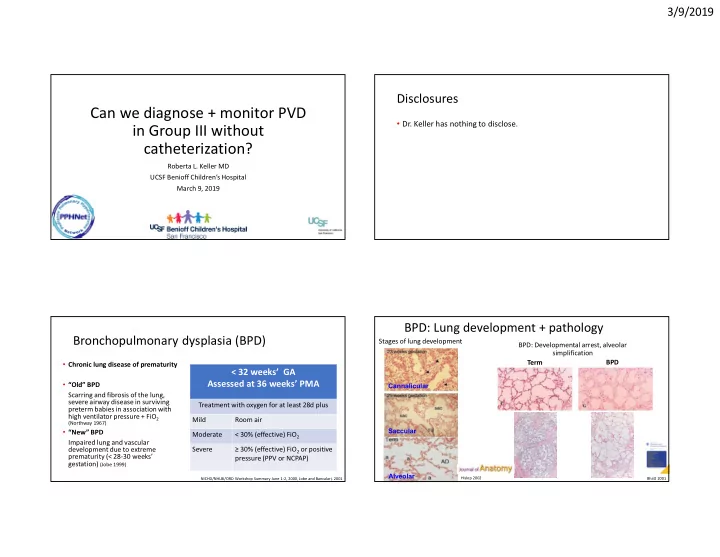
Bronchopulmonary dysplasia (BPD)

  • Chronic lung disease of prematurity
  • “Old” BPD

Scarring and fibrosis of the lung, severe airway disease in surviving preterm babies in association with high ventilator pressure + FiO2

(Northway 1967)

  • “New” BPD

Impaired lung and vascular development due to extreme prematurity (< 28-30 weeks’ gestation) (Jobe 1999)

< 32 weeks’ GA Assessed at 36 weeks’ PMA

Treatment with oxygen for at least 28d plus Mild Room air Moderate < 30% (effective) FiO2 Severe ≥ 30% (effective) FiO2 or positive pressure (PPV or NCPAP)

NICHD/NHLBI/ORD Workshop Summary June 1-2, 2000, Jobe and Bancalari, 2001

BPD: Lung development + pathology

BPD: Developmental arrest, alveolar simplification

Cannalicular Saccular Alveolar

Hislop 2002

Term BPD

Bhatt 2001

Stages of lung development

slide-2
SLIDE 2

3/9/2019 2

BPD + pulmonary vascular disease (PVD): echocardiography

Normal Flat D-shaped RV LV RV RV LV LV Echocardiography: interventricular septum (IVS) position

Echocardiography: defining PH in BPD?

Pressure estimates

Echo measurement Criteria used for classification* Tricuspid regurgitant (TR) jet velocity** Right ventricular systolic pressure (RVsp) > 40 mmHg [right atrial pressure (RAp) = 0] RVsp:SBP ratio ≥ 1/2 or 2/3 (RAp = 0 or 5 mmHg) Non-restrictive cardiac shunt (PDA, VSD, atrial septum) Right-to-left or bidirectional flow RV or PA pressure ≥ 1/2 or 2/3 systemic Interventricular septum (IVS) position D-shaped or convex into LV Flattened throughout the cardiac cycle Any flattening

*Assumes no RV outflow tract obstruction **By modified Bernoulli equation: RVsp = 4 x velocity2 + RAp (assumed RAp noted)

Mourani 2008, Keller 2010, Mirza 2014, Mourani 2015, Lusk 2015

Cardiac cathetherization: defining PH

Gold standard

  • Cardiac catheterization
  • Mean PPA ≥ 25 mmHg, and/or
  • PVR > 3 Woods Units
  • Wedge pressure ≤ 15 mmHg (no LA hypertension or PV obstruction)

Mortality in infants with bronchopulmonary dysplasia: data from cardiac catheterization

Steurer et al, Pediatric Pulmonology 2019, In Press

slide-3
SLIDE 3

3/9/2019 3

Patient characteristics (n=30)

Characteristic n = 30 Gestational age 25 5/7 (24 4/7 – 26 6/7) Male sex 60% History of surgical PDA closure 30% Cardiac catheterization Postmenstrual age 49 2/7 (42 4/7 – 57 1/7) Weight 3750 (3100-5100) Respiratory support at catheterization None 3% Nasal cannula ≤ 2 LPM 27% Nasal cannula > 2 LPM 13% Nasal CPAP 33% Mechanical ventilation 23% Mortality 27% (8/30)

Pulmonary vascular resistance (PVR) +

  • xygenation

PF Ratio vs PVR A-a gradient vs PVR

Steurer 2019

Catheterization: PH criteria + mortality

Steurer 2019

PVR < 3 vs > 3

P=0.12

mean PAP < 25 vs > 25

P=0.38

PVR + mean PAP criteria

P=0.15

Catheterization: Measured parameters + mortality

PV stenosis

P=0.005

Cardiac index < 3.5 vs > 3.5

P=0.66

mean RAp < 8 vs > 8

P=0.77

A-a gradient < 110 vs > 110

P=0.28

Steurer 2019

slide-4
SLIDE 4

3/9/2019 4

Mortality: Prematurity and PVS

Mahgoub 2017

# of veins affected < 3 vs ≥ 3 Unilateral vs bilateral SGA vs AGA/LGA Age at Dx < 6 mos vs ≥ 6 mos Echo diagnosis in only 56% (22/39)

PH by echocardiogram: validity

  • Survival lower with severe PH

(classified by IVS position, systemic- to-suprasystemic at any time) 37% vs 78% at 1y from diagnosis

  • Any PH (> 50% systemic) at 36 weeks’

PMA associated with higher mortality

(Mourani 2015):

4/39 (10%) vs 3/238 (1%); P=0.009

Khemani 2007

Severe BPD + PH (echo diagnosis)

No PH PH P value Discharge status n=1307 n=370 Mortality after 36 weeks’ PMA 5% 21% <0.001 Remains hospitalized at 1y corrected age 1% 5% <0.001 PHIS linkage n=961 n=184 Home oxygen 69% 86% <0.001 Tracheostomy + home ventilation 9% 27% <0.001 Readmission by 1y corrected age 41% 51% 0.01 ICU admission 16% 30% <0.001 Mechanical ventilation 15% 30% <0.001 Mortality 1% 1% 0.80

Lagatta 2018

Congenital diaphragmatic hernia

slide-5
SLIDE 5

3/9/2019 5

Neonatal pulmonary vascular status in CDH

assessment by echocardiography

  • Pulmonary hypertension (PH) due to increased pulmonary vascular

resistance (PVR)

  • Classification of PH severity
  • < 2/3 systemic (no-mild)
  • ≥ 2/3 systemic – systemic (moderate)
  • systemic – suprasystemic (severe)
  • Measurements (echocardiography): hierarchical evaluation
  • Patent ductus arteriosus flow direction + velocity
  • Interventricular septal (IVS) position
  • Normal, flattened, or D-shaped
  • Tricuspid regurgitant (TR) jet velocity
  • RVsp = 4 * velocity2 + RAp

Keller 2010

PH assessment (echocardiography)

  • TR jet less common with lower pressure estimate
  • < 2/3 systemic: 17/44 (39%)
  • ≥ 2/3 systemic: 29/47 (62%)
  • suprasystemic: 34/49 (69%)
  • 4/144 (3%) echocardiograms indeterminate

Normal Flat D-shaped RV LV RV RV LV LV

Keller 2010

Time to resolution of PH (echo validation)

70% 19% 11%

Time to resolution of PH (echo validation)

70% 19% 11%

17 d (IQR 7, 21 d)

slide-6
SLIDE 6

3/9/2019 6

Death Death/Prolonged respiratory support (56d) n (%) P n (%) P Week 1 PH 23/128 (18) 0.35 52/128 (41) 0.02 No PH 0/8 (0) 0/8 (0) Week 2 PH 20/86 (23) <0.001 47/86 (55) <0.001 No PH 0 (0/47) 3/47 (6) Week 3 PH 15/55 (27) <0.001 36/55 (65) <0.001 No PH 0 (0/73) 9/73 (12) Week 4 PH 13/46 (28) <0.001 30/46 (65) <0.001 No PH 0 (0/80) 13/80 (16) Week 6 PH 9/34 (26) <0.001 21/34 (62) <0.001 No PH 1/89 (1) 19/89 (21) Lusk 2015 Death Death/Prolonged respiratory support (56d) n (%) P n (%) P Week 1 PH 23/128 (18) 0.35 52/128 (41) 0.02 No PH 0/8 (0) 0/8 (0) Week 2 PH 20/86 (23) <0.001 47/86 (55) <0.001 No PH 0 (0/47) 3/47 (6) Week 3 PH 15/55 (27) <0.001 36/55 (65) <0.001 No PH 0 (0/73) 9/73 (12) Week 4 PH 13/46 (28) <0.001 30/46 (65) <0.001 No PH 0 (0/80) 13/80 (16) Week 6 PH 9/34 (26) <0.001 21/34 (62) <0.001 No PH 1/89 (1) 19/89 (21) Lusk 2015 Death Death/Prolonged respiratory support (56d) n (%) P n (%) P Week 1 PH 23/128 (18) 0.35 52/128 (41) 0.02 No PH 0/8 (0) 0/8 (0) Week 2 PH 20/86 (23) <0.001 47/86 (55) <0.001 No PH 0 (0/47) 3/47 (6) Week 3 PH 15/55 (27) <0.001 36/55 (65) <0.001 No PH 0 (0/73) 9/73 (12) Week 4 PH 13/46 (28) <0.001 30/46 (65) <0.001 No PH 0 (0/80) 13/80 (16) Week 6 PH 9/34 (26) <0.001 21/34 (62) <0.001 No PH 1/89 (1) 19/89 (21) Lusk 2015 Death Death/Prolonged respiratory support (56d) n (%) P n (%) P Week 1 PH 23/128 (18) 0.35 52/128 (41) 0.02 No PH 0/8 (0) 0/8 (0) Week 2 PH 20/86 (23) <0.001 47/86 (55) <0.001 No PH 0 (0/47) 3/47 (6) Week 3 PH 15/55 (27) <0.001 36/55 (65) <0.001 No PH 0 (0/73) 9/73 (12) Week 4 PH 13/46 (28) <0.001 30/46 (65) <0.001 No PH 0 (0/80) 13/80 (16) Week 6 PH 9/34 (26) <0.001 21/34 (62) <0.001 No PH 1/89 (1) 19/89 (21) Lusk 2015

slide-7
SLIDE 7

3/9/2019 7

Death Death/Prolonged respiratory support (56d) n (%) P n (%) P Week 1 PH 23/128 (18) 0.35 52/128 (41) 0.02 No PH 0/8 (0) 0/8 (0) Week 2 PH 20/86 (23) <0.001 47/86 (55) <0.001 No PH 0 (0/47) 3/47 (6) Week 3 PH 15/55 (27) <0.001 36/55 (65) <0.001 No PH 0 (0/73) 9/73 (12) Week 4 PH 13/46 (28) <0.001 30/46 (65) <0.001 No PH 0 (0/80) 13/80 (16) Week 6 PH 9/34 (26) <0.001 21/34 (62) <0.001 No PH 1/89 (1) 19/89 (21) Lusk 2015 Death Death/Prolonged respiratory support (56d) n (%) P n (%) P Week 1 PH 23/128 (18) 0.35 52/128 (41) 0.02 No PH 0/8 (0) 0/8 (0) Week 2 PH 20/86 (23) <0.001 47/86 (55) <0.001 No PH 0 (0/47) 3/47 (6) Week 3 PH 15/55 (27) <0.001 36/55 (65) <0.001 No PH 0 (0/73) 9/73 (12) Week 4 PH 13/46 (28) <0.001 30/46 (65) <0.001 No PH 0 (0/80) 13/80 (16) Week 6 PH 9/34 (26) <0.001 21/34 (62) <0.001 No PH 1/89 (1) 19/89 (21) Lusk 2015 Death Death/Prolonged respiratory support (56d) n (%) P n (%) P Week 1 PH 23/128 (18) 0.35 52/128 (41) 0.02 No PH 0/8 (0) 0/8 (0) Week 2 PH 20/86 (23) <0.001 47/86 (55) <0.001 No PH 0 (0/47) 3/47 (6) Week 3 PH 15/55 (27) <0.001 36/55 (65) <0.001 No PH 0 (0/73) 9/73 (12) Week 4 PH 13/46 (28) <0.001 30/46 (65) <0.001 No PH 0 (0/80) 13/80 (16) Week 6 PH 9/34 (26) <0.001 21/34 (62) <0.001 No PH 1/89 (1) 19/89 (21) Lusk 2015

RV: systemic pressure ratio

healthy newborns

Skinner 1991

  • Term

∆ Preterm

slide-8
SLIDE 8

3/9/2019 8

Pulmonary hypertension at 2 weeks

utility for outcomes

Outcome Sensitivity Specificity AUC (95% CI) Death Any PH 100% 48% 0.81 (0.76, 0.86) Echo severity 0.87 (0.80, 0.94) Death/ prolonged intubation (≥ 28d) Any PH 97% 51% 0.81 (0.74, 0.88) Echo severity 0.83 (0.75, 0.91) Death/ prolonged respiratory support (≥ 56d) Any PH 84% 54% 0.79 (0.72, 0.88) Echo severity 0.80 (0.72, 0.88)

Lusk 2015

Neonatal management

allow for transition/protect RV

  • Prevention (lung hypoplasia!)
  • gentle ventilation, permissive oxygenation
  • careful monitoring + assessment of RV function
  • Time
  • Interventions to consider
  • inhaled nitric oxide
  • maintenance of ductal patency to unload/protect RV (PGE)
  • additional pulmonary vasodilator therapy
  • “Acute” (milrinone) and chronic
  • Assessment for long-term therapy: cardiac catheterization

Pulmonary vasodilators Response in CDH

Baseline Baseline Vasodilator Room air 60 ± 16 d (41-89 d) 6/7 with PVR decrease by ≥ 20% (median 44%) 56 and 89 d PVR increase 0 and 39%

5 10 15 20 25 30

Pulmonary vascular resistance (Woods units)

2 4 6 8 10

*P=0.017

Vasodilation Vasoconstriction

How do shunts affect interpretation? Infants with BPD

ASD (n=6) PDA (n=4) VSD (n=2) Qp : Qs 1.7 (1.3, 2.9) 2.0 (1.3, 3.4) 1.5 (1.2, 1.7) PVRi (Woods units) 3.3 (1.7, 5.2) 4.2 (1.7, 5.8) 10.8 (8.9, 12.6) Closure in cath lab 1 2 Reactivity testing Pre PVRi (Woods units) 5.2 (4.6, 6.0) (n=7) Post PVRi (Woods units) 3.9 (3.0, 5.3) Change in PVRi

  • 1.5 (-0.7, -2.7)

Decrease in diastolic PAP ≥ 20% 1 (14%) Decrease in PVRi ≥ 20% 5 (71%) Decrease in mean PAP with preserved CI 1 (14%)

One patient with both atrial and ductal shunts excluded. Reactivity testing with FiO2 1.0 and iNO 40 ppm (some infants on FiO2 1.0 or iNO at baseline)

slide-9
SLIDE 9

3/9/2019 9

Mortality: Pediatric Functional Class

Balkin 2016

60% total Group III Improvements in FC associated with survival Most children improve FC during follow up/treatment