What do we know? What do we know? (How do we diagnose?) (How do we - - PDF document

what do we know what do we know how do we diagnose how do
SMART_READER_LITE
LIVE PREVIEW

What do we know? What do we know? (How do we diagnose?) (How do we - - PDF document

Diagnosis and Misdiagnosis of Gifted Youth Presented at the 2012 California Psychological Association, Monterey, CA Daniel Peters, Ph.D. Stephen H. Chou, Psy.D. What do we know? What do we know? (How do we diagnose?) (How do we diagnose?)


slide-1
SLIDE 1

www.summitcenter.us Page 1

Diagnosis and Misdiagnosis

  • f

Gifted Youth

Presented at the 2012 California Psychological Association, Monterey, CA Daniel Peters, Ph.D. Stephen H. Chou, Psy.D.

Summit Center: Daniel Peters, Summit Center: Daniel Peters, Ph.D. and Stephen H. Chou, Ph.D. and Stephen H. Chou, Psy.D Psy.D., 2012 ., 2012 2 2

What do we know? What do we know? (How do we diagnose?) (How do we diagnose?)

  • Behavior

Behavior

  • Functional Impairment

Functional Impairment

Summit Center: Daniel Peters, Ph.D. and Stephen H. Chou, Summit Center: Daniel Peters, Ph.D. and Stephen H. Chou, Psy.D Psy.D., 2012 ., 2012 3 3

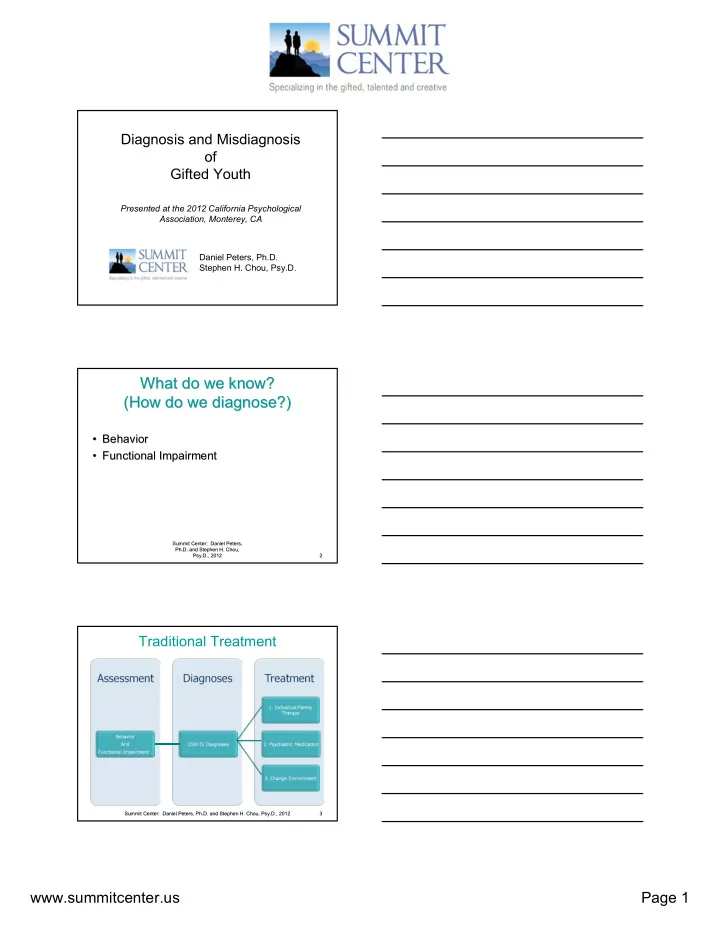
Traditional Treatment

slide-2
SLIDE 2

www.summitcenter.us Page 2

4 4

Treatment: Giftedness Lens

Summit Center: Daniel Peters, Ph.D. and Stephen H. Chou, Summit Center: Daniel Peters, Ph.D. and Stephen H. Chou, Psy.D Psy.D., 2012 ., 2012 4 4

Comparative Models of Diagnostic Comparative Models of Diagnostic Formulation Formulation

Traditional Lens Traditional Lens Giftedness Lens Giftedness Lens

5 5 Summit Center: Daniel Peters, Ph.D. and Stephen H. Chou, Summit Center: Daniel Peters, Ph.D. and Stephen H. Chou, Psy.D Psy.D., 2012 ., 2012 5 5 6 6

http://imagecache2.allposters.com/images/ARB/78341.jpg

Every child instinctively knows what many adults have long since forgotten; Our differences are not something to be tolerated, they are something to be celebrated Every child instinctively knows what many adults have long since forgotten; Our differences are not something to be tolerated, they are something to be celebrated

slide-3
SLIDE 3

www.summitcenter.us Page 3

GIFTED AND TALENTED GIFTED AND TALENTED

Summit Center: Daniel Peters, Summit Center: Daniel Peters, Ph.D. and Stephen H. Chou, Ph.D. and Stephen H. Chou, Psy.D Psy.D., 2012 ., 2012 7 7

What is Giftedness? What is Giftedness?

National Association for Gifted Children (NAGC), 2010

Gifted individuals are those who demonstrate outstanding Gifted individuals are those who demonstrate outstanding levels of levels of aptitude aptitude (defined as an exceptional ability to (defined as an exceptional ability to reason and learn) or reason and learn) or competence competence (documented (documented performance or achievement in top 10% or rarer) in one or performance or achievement in top 10% or rarer) in one or more domains. more domains. Domains include any structured area of activity with its Domains include any structured area of activity with its

  • wn symbol system (e.g., mathematics, music, language)
  • wn symbol system (e.g., mathematics, music, language)

and/or set of and/or set of sensorimotor sensorimotor skills (e.g., painting, dance, skills (e.g., painting, dance, sports). sports).

Summit Center: Daniel Peters, Ph.D. and Stephen H. Chou, Summit Center: Daniel Peters, Ph.D. and Stephen H. Chou, Psy.D Psy.D., 2012 ., 2012 8 8 Summit Center: Daniel Peters, Summit Center: Daniel Peters, Ph.D. and Stephen H. Chou, Ph.D. and Stephen H. Chou, Psy.D Psy.D., 2012 ., 2012 9 9

What is Giftedness? What is Giftedness?

Giftedness is Giftedness is asynchronous development asynchronous development in which in which advanced cognitive abilities and advanced cognitive abilities and heightened intensity heightened intensity combine to create inner experiences and awareness combine to create inner experiences and awareness that are qualitatively different from the norm. This that are qualitatively different from the norm. This asynchrony increases with higher intellectual asynchrony increases with higher intellectual

  • capacity. The uniqueness of the gifted renders them
  • capacity. The uniqueness of the gifted renders them

vulnerable and requires modifications in parenting, vulnerable and requires modifications in parenting, teaching and counseling in order for them to teaching and counseling in order for them to develop develop

  • ptimally
  • ptimally.

.

The Columbus Group, 1991 The Columbus Group, 1991

slide-4
SLIDE 4

www.summitcenter.us Page 4

What is Giftedness? What is Giftedness?

Common characteristics of gifted youth Common characteristics of gifted youth

  • rapid learners

rapid learners

  • strong memory

strong memory

  • large vocabulary

large vocabulary

  • advanced comprehension

advanced comprehension

  • f nuances
  • f nuances
  • largely self

largely self-

  • taught

taught

  • unusual emotional depth

unusual emotional depth

  • abstract/complex/

abstract/complex/ logical/insightful thinking logical/insightful thinking

  • idealism and sense of

idealism and sense of justice justice

  • intense feelings and

intense feelings and reactions reactions

  • highly sensitive

highly sensitive

  • long attention span and

long attention span and persistence persistence… …

Summit Center: Daniel Peters, Summit Center: Daniel Peters, Ph.D. and Stephen H. Chou, Ph.D. and Stephen H. Chou, Psy.D Psy.D., 2012 ., 2012 10 10

What is Giftedness? What is Giftedness?

Common characteristics of gifted youth Common characteristics of gifted youth (continued) (continued)

  • preoccupied with own

preoccupied with own thoughts thoughts

  • impatient with self and

impatient with self and

  • thers inabilities and
  • thers inabilities and

slowness, slowness,

  • asks probing questions

asks probing questions (able to go beyond what (able to go beyond what is taught), wide range of is taught), wide range of interests, interests,

  • highly developed curiosity

highly developed curiosity

  • interest in experimenting

interest in experimenting and doing things and doing things differently differently

  • divergent thinking

divergent thinking

  • keen and unusual sense

keen and unusual sense

  • f humor
  • f humor

Summit Center: Daniel Peters, Summit Center: Daniel Peters, Ph.D. and Stephen H. Chou, Ph.D. and Stephen H. Chou, Psy.D Psy.D., 2012 ., 2012 11 11

Giftedness: Identification Giftedness: Identification

(Clark, Barbara, (Clark, Barbara, “ “Growing Up Gifted, Growing Up Gifted,” ” 2008, p. 206) 2008, p. 206)

  • Multiple, domain

Multiple, domain-

  • specific measures of giftedness and

specific measures of giftedness and talent collected from multiple sources talent collected from multiple sources

  • Intellectual Ability (Intelligence tests)
  • Academic Achievement (General or specific)
  • Creative Ability (Divergent thinking tests: Torrance

Tests of Creative Thinking)

  • Leadership Ability
  • Behavioral Checklists
  • Portfolios of completed work
  • Peer Review
  • Family History and Student Background

Summit Center: Daniel Peters, Summit Center: Daniel Peters, Ph.D. and Stephen H. Chou, Ph.D. and Stephen H. Chou, Psy.D Psy.D., 2012 ., 2012 12 12

slide-5
SLIDE 5

www.summitcenter.us Page 5

Intellectual Ability Intellectual Ability

13 13 14 14

Levels of Giftedness Levels of Giftedness

  • 120-129

Advanced Learners

  • 130-144

Moderately Gifted

  • 145-159

Highly Gifted

  • 160-179

Exceptionally Gifted

  • 180 +

Profoundly Gifted

Summit Center: Daniel Peters, Summit Center: Daniel Peters, Ph.D. and Stephen H. Chou, Ph.D. and Stephen H. Chou, Psy.D Psy.D., 2012 ., 2012

Intellectual Ability Intellectual Ability Levels of Giftedness Levels of Giftedness

Level of Giftedness WISC-IV or WPPSI-III (FSIQ) Assessment of Children WISC-IV (FSIQ : Extended Norms) Technical Report #7 WISC–IV Extended Norms Stanford Binet – 5th Edition (FSIQ) Ruf Estimates of Levels of Giftedness WISC-III, WPPSI-R, SB-4, SB L-M (FSIQ) Gifted or Moderately Gifted (G or MG) 130-138 130-145 (1 in 50; 97.9th PR) 120-129 130 – 145 (SB-4: 132-148) Highly Gifted (HG) 138-145 145-160 (1 in 1000; 99.9th PR) 125-135 145 – 160 (SB-4: 148-164) Exceptionally Gifted (EG) 145-152 160+ (1 in 30,000; 99.997th PR) 130-140 160 – 180 (SB L-M only) Profoundly Gifted (PG) 152-160 175+ (1 in 3 million; 99.99997th PR) 135-141+ 180 and above (SB L-M only) Summit Center: Daniel Peters, Ph.D. and Stephen H. Chou, Summit Center: Daniel Peters, Ph.D. and Stephen H. Chou, Psy.D Psy.D., 2012 ., 2012 15 15

slide-6
SLIDE 6

www.summitcenter.us Page 6

16 16

Factors Influencing the Expression of Giftedness Factors Influencing the Expression of Giftedness

(as well as Educational, Social, and Emotional Functioning) (as well as Educational, Social, and Emotional Functioning)

1. 1.Level of Giftedness

Level of Giftedness

2. 2.Asynchronous Development

Asynchronous Development

3. 3.Dabrowski

Dabrowski’ ’s s Overexcitabilities Overexcitabilities

4. 4.Thinking and Learning Styles

Thinking and Learning Styles

The higher the child The higher the child’ ’s overall ability level, the more s overall ability level, the more these variables influence the behaviors. these variables influence the behaviors.

Summit Center: Daniel Peters, Summit Center: Daniel Peters, Ph.D. and Stephen H. Chou, Ph.D. and Stephen H. Chou, Psy.D Psy.D., 2012 ., 2012

Overexcitablities Overexcitablities ( (Oes Oes) )

Kazamierz Kazamierz Dabrowski Dabrowski explained the sensitivity and explained the sensitivity and intensity experienced by many gifted individuals in intensity experienced by many gifted individuals in terms of terms of overexcitabilities

  • verexcitabilities—

—a greater capacity to be a greater capacity to be stimulated by and respond to external and internal stimulated by and respond to external and internal stimuli.

  • stimuli. Overexcitability

Overexcitability permeates a gifted person permeates a gifted person’ ’s s existence existence… …and gives energy to their intelligence, and gives energy to their intelligence, talents and personality. talents and personality.

Summit Center: Daniel Peters, Summit Center: Daniel Peters, Ph.D. and Stephen H. Chou, Ph.D. and Stephen H. Chou, Psy.D Psy.D., 2012 ., 2012 17 17

Overexcitabilities Overexcitabilities (continued) (continued)

  • Psychomotor

Psychomotor -

  • movement, strong drive, energy,

movement, strong drive, energy, extended bouts of activity extended bouts of activity

  • Intellectual

Intellectual -

  • insatiable curiosity, voracious appetite and

insatiable curiosity, voracious appetite and capacity for intellectual effort and stimulation; mental capacity for intellectual effort and stimulation; mental activity is intensified and accelerated activity is intensified and accelerated

  • Sensual

Sensual -

  • heightened experiences of seeing, smelling,

heightened experiences of seeing, smelling, tasting, touching and hearing tasting, touching and hearing

  • Imaginational

Imaginational -

  • active imaginary and fantasy life

active imaginary and fantasy life

  • Emotional

Emotional -

  • capacity for emotional depth, empathy,

capacity for emotional depth, empathy, deeply feels own and others emotions deeply feels own and others emotions

Summit Center: Daniel Peters, Summit Center: Daniel Peters, Ph.D. and Stephen H. Chou, Ph.D. and Stephen H. Chou, Psy.D Psy.D., 2012 ., 2012 18 18

slide-7
SLIDE 7

www.summitcenter.us Page 7

Learning/Thinking Styles Learning/Thinking Styles (Continued) (Continued) Auditory Auditory-

  • Sequential

Sequential

  • Prefers verbal

Prefers verbal explanations; uses explanations; uses language to remember language to remember

  • Processes information

Processes information sequentially; deals with sequentially; deals with

  • ne task at a time
  • ne task at a time
  • Produces ideas logically;

Produces ideas logically; prefers analyzing activities prefers analyzing activities

Visual Visual-

  • Spatial

Spatial

  • Prefers visual

Prefers visual explanations; uses images explanations; uses images to remember to remember

  • Processes information

Processes information holistically; deals with holistically; deals with several tasks at a time several tasks at a time

  • Produces ideas intuitively;

Produces ideas intuitively; prefers synthesizing prefers synthesizing activities activities

Summit Center: Daniel Peters, Summit Center: Daniel Peters, Ph.D. and Stephen H. Chou, Ph.D. and Stephen H. Chou, Psy.D Psy.D., 2012 ., 2012 19 19

Learning/Thinking Styles Learning/Thinking Styles (Continued) (Continued) Auditory Auditory-

  • Sequential

Sequential

  • Prefers concrete

Prefers concrete thinking tasks; likes thinking tasks; likes structured structured experiences experiences

  • Prefers proper

Prefers proper working materials and working materials and proper settings for proper settings for working working Visual Visual-

  • Spatial

Spatial

  • Prefers abstract

Prefers abstract thinking tasks; likes thinking tasks; likes

  • pen, fluid
  • pen, fluid

experiences experiences

  • Improvises with

Improvises with materials available; materials available; creates own structure creates own structure

Summit Center: Daniel Peters, Summit Center: Daniel Peters, Ph.D. and Stephen H. Chou, Ph.D. and Stephen H. Chou, Psy.D Psy.D., 2012 ., 2012 20 20

Learning/Thinking Styles Learning/Thinking Styles (Continued) (Continued) Auditory Auditory-

  • Sequential

Sequential

  • Prefers to learn facts

Prefers to learn facts and details and details

  • Approaches problems

Approaches problems seriously seriously Visual Visual-

  • Spatial

Spatial

  • Prefers to gain

Prefers to gain general overview general overview

  • Approaches problems

Approaches problems playfully playfully

Summit Center: Daniel Peters, Summit Center: Daniel Peters, Ph.D. and Stephen H. Chou, Ph.D. and Stephen H. Chou, Psy.D Psy.D., 2012 ., 2012 21 21

slide-8
SLIDE 8

www.summitcenter.us Page 8

BEHAVIORS THAT CAUSE GIFTED STUDENTS TO BE REFERRED

(Compiled by James T. Webb, Ph.D., 2002)

  • Boredom with routine tasks; refusal to do rote homework
  • Reluctance to move to new topics in discussions
  • Self-criticism; impatience with failures
  • Criticism of other students and of teachers
  • Frequent strong disagreements with parents, teachers, or peers
  • Refusal to accept authority; non-conforming; stubbornness
  • Attempts to dominate others
  • Joking or punning at inappropriate times
  • Emotional over-sensitivity – may overreact, get angry easily, or cry if

things go wrong

  • Lack interest in details; handing in of messy work

Summit Center: Daniel Peters, Summit Center: Daniel Peters, Ph.D. and Stephen H. Chou, Ph.D. and Stephen H. Chou, Psy.D Psy.D., 2012 ., 2012 22 22 Summit Center: Daniel Peters, Ph.D. and Stephen H. Chou, Summit Center: Daniel Peters, Ph.D. and Stephen H. Chou, Psy.D Psy.D., 2012 ., 2012 23 23

Missed Diagnosis or Misdiagnosis? Missed Diagnosis or Misdiagnosis?

OE Description Psychomotor Movement, restlessness, driveness, an augmented capacity for being active and energetic Sensual Enhanced refinement and aliveness of sensual experience Intellectual Thirst for knowledge, discovery, questioning, love of ideas and theoretical analysis, search for truth Imaginational Vividness of imagery, richness of association, facility for dreams, fantasies, and inventions, endowing toys and other objects with personality (animism), preference for the unusual and unique Emotional Great depth and intensity of emotional life expressed in a wide range of feelings, great happiness to profound sadness or despair, compassion, responsibility, self-examination Disorder Pathology Attention-Deficit/Hyperactivity Disorder Psychotic Disorder ‘Sensory Integration D/O’ Asperger’s Disorder/PDD NOS's Oppositional Defiant Disorder ADHD, Inattentive Type Psychotic Disorder Mood Disorders Anxiety Disorders

FREQUENT MISDIAGNOSES OF GIFTED CHILDREN AND ADULTS

(Compiled by James T. Webb, Ph.D. and Ed Amend, Psy.D., 2002) [Note: the groupings below do not correspond to DSM-IV, although the diagnoses do correspond]

  • Attentional and activity problems

– Attention Deficit/Hyperactivity Disorder

  • Anger diagnoses

– Oppositional-Defiant Disorder – Conduct Disorder – Intermittent Explosive Disorder – Disruptive Behavior Disorder NOS – Narcissistic Personality Disorder

  • Ideational and/or anxiety disorders

– Obsessive-Compulsive Disorder – Obsessive-Compulsive Personality Disorder – Asperger’s Disorder – Schizoid Personality Disorder – Schizotypal Personality Disorder – Avoidant Personality Disorder

  • Mood disorders

– Bi-Polar Disorders – Cyclothymic Disorder – Dysthymic Disorder – Depression Disorder

Summit Center: Daniel Peters, Summit Center: Daniel Peters, Ph.D. and Stephen H. Chou, Ph.D. and Stephen H. Chou, Psy.D Psy.D., 2012 ., 2012 24 24
slide-9
SLIDE 9

www.summitcenter.us Page 9

Summit Center: Daniel Peters, Summit Center: Daniel Peters, Ph.D. and Stephen H. Chou, Ph.D. and Stephen H. Chou, Psy.D Psy.D., 2012 ., 2012 25 25

Cultural Blind Spot Syndrome Cultural Blind Spot Syndrome

  • The assumption that similarities in the cultural backgrounds of

The assumption that similarities in the cultural backgrounds of patient/client and therapist/psychologist mean there are no cult patient/client and therapist/psychologist mean there are no cultural ural differences between the patient and the health care provider, or differences between the patient and the health care provider, or there are no cultural barriers that might hamper optimal assessm there are no cultural barriers that might hamper optimal assessment ent and treatment. and treatment.

  • In the field of giftedness, at times, problems are misattributed

In the field of giftedness, at times, problems are misattributed to to “ “quirks quirks” ” or giftedness rather than the disorder

  • r giftedness rather than the disorder

DUAL DIAGNOSES DUAL DIAGNOSES 2E 2E – – TWICE EXCEPTIONAL TWICE EXCEPTIONAL

Summit Center: Daniel Peters, Summit Center: Daniel Peters, Ph.D. and Stephen H. Chou, Ph.D. and Stephen H. Chou, Psy.D Psy.D., 2012 ., 2012 26 26

Twice Twice-

  • Exceptional (2e)

Exceptional (2e) (Dual Diagnoses) (Dual Diagnoses)

  • 2e (twice

2e (twice-

  • exceptional) youth are both gifted and

exceptional) youth are both gifted and have a learning or emotional have a learning or emotional disability/difference/challenge disability/difference/challenge

27 27

  Therefore, 2e youth have many of the

Therefore, 2e youth have many of the aforementioned gifted characteristics, in addition aforementioned gifted characteristics, in addition to the following to the following… …

Summit Center: Daniel Peters, Summit Center: Daniel Peters, Ph.D. and Stephen H. Chou, Ph.D. and Stephen H. Chou, Psy.D Psy.D., 2012 ., 2012

slide-10
SLIDE 10

www.summitcenter.us Page 10

Twice Twice-

  • Exceptional (2e)

Exceptional (2e) (continued) (continued)

  • Aspergers

Aspergers Disorder Disorder -

  • a deficit in engaging in a reciprocal

a deficit in engaging in a reciprocal relationship; inability or difficulty noticing and relationship; inability or difficulty noticing and understanding social nuances understanding social nuances

  • Attention Deficit/Hyperactivity Disorder (ADHD)

Attention Deficit/Hyperactivity Disorder (ADHD) developmentally inappropriate levels of inattention, developmentally inappropriate levels of inattention, hyperactivity, and impulsivity (executive functioning hyperactivity, and impulsivity (executive functioning deficits) deficits)

Summit Center: Daniel Peters, Summit Center: Daniel Peters, Ph.D. and Stephen H. Chou, Ph.D. and Stephen H. Chou, Psy.D Psy.D., 2012 ., 2012 28 28

Twice Twice-

  • Exceptional (2e)

Exceptional (2e) (continued) (continued)

  • Dyslexia

Dyslexia -

  • difficulty learning and processing language,

difficulty learning and processing language, despite adequate intelligence, instruction, and motivation despite adequate intelligence, instruction, and motivation

  • Dysgraphia

Dysgraphia -

  • deficit in fine

deficit in fine-

  • motor functioning which

motor functioning which effects writing. effects writing.

  • Sensory Processing Disorder/Sensory Integration

Sensory Processing Disorder/Sensory Integration Disorder (SID) Disorder (SID) -

  • difficulty with different sensory systems

difficulty with different sensory systems and motor systems working together (difficulty with and motor systems working together (difficulty with muscle control, difficulty regulating sensory input muscle control, difficulty regulating sensory input-

  • light,

light, sound). sound).

Summit Center: Daniel Peters, Summit Center: Daniel Peters, Ph.D. and Stephen H. Chou, Ph.D. and Stephen H. Chou, Psy.D Psy.D., 2012 ., 2012 29 29

Twice Twice-

  • Exceptional (2e)

Exceptional (2e) (continued) (continued)

  • Anxiety

Anxiety -

  • persistent worries, fears, perfectionism,

persistent worries, fears, perfectionism, avoidance avoidance

  • Depression

Depression – – sadness, irritability, apathy, hopelessness sadness, irritability, apathy, hopelessness

Summit Center: Daniel Peters, Summit Center: Daniel Peters, Ph.D. and Stephen H. Chou, Ph.D. and Stephen H. Chou, Psy.D Psy.D., 2012 ., 2012 30 30

slide-11
SLIDE 11

www.summitcenter.us Page 11

2e Challenges 2e Challenges

  • reading and writing

reading and writing

  • taking tests

taking tests

  • showing academic

showing academic competence and mastery competence and mastery

  • public speaking

public speaking

  • tying shoes

tying shoes

  • completing and turning in

completing and turning in schoolwork schoolwork

  • meeting new people

meeting new people

Summit Center: Daniel Peters, Summit Center: Daniel Peters, Ph.D. and Stephen H. Chou, Ph.D. and Stephen H. Chou, Psy.D Psy.D., 2012 ., 2012 31 31

  • socially appropriate

socially appropriate behavior behavior

  • participating in sports

participating in sports

  • standing up for

standing up for themselves themselves

  • attempting new activities

attempting new activities

  • riding a bike and driving

riding a bike and driving a car a car

  • getting a job

getting a job

  • going to college

going to college

Additional Challenges Additional Challenges

Culturally/linguistically diverse

  • English as a second language; may not perform as well
  • n assessments in their secondary language

Low socio-economic

  • Lack of access to resources and enrichment
  • pportunities

Summit Center: Daniel Peters, Summit Center: Daniel Peters, Ph.D. and Stephen H. Chou, Ph.D. and Stephen H. Chou, Psy.D Psy.D., 2012 ., 2012 32 32

Impact of missed diagnoses or Impact of missed diagnoses or misdiagnoses of gifted children/youth misdiagnoses of gifted children/youth

  • High Stakes

High Stakes

– – Underachievement Underachievement – – Low self Low self-

  • esteem/self

esteem/self-

  • concept

concept – – Isolation Isolation – – Depression Depression – – Focus on deficits Focus on deficits – – Unnecessary medication management Unnecessary medication management

Summit Center: Daniel Peters, Summit Center: Daniel Peters, Ph.D. and Stephen H. Chou, Ph.D. and Stephen H. Chou, Psy.D Psy.D., 2012 ., 2012 33 33

slide-12
SLIDE 12

www.summitcenter.us Page 12

Summit Center: Daniel Peters, Summit Center: Daniel Peters, Ph.D. and Stephen H. Chou, Ph.D. and Stephen H. Chou, Psy.D Psy.D., 2012 ., 2012 34 34

Exercise: Vignette

Summit Center: Daniel Peters, Ph.D. and Stephen H. Chou, Summit Center: Daniel Peters, Ph.D. and Stephen H. Chou, Psy.D Psy.D., 2012 ., 2012 35 35

Recommendations Recommendations

  • Take a relevant psychosocial history to look through a

Take a relevant psychosocial history to look through a giftedness lens (e.g., for early milestones or precocious giftedness lens (e.g., for early milestones or precocious development) development)

  • Consider whether the behavior patterns identified or

Consider whether the behavior patterns identified or

  • bserved are ones that are typical for gifted (high
  • bserved are ones that are typical for gifted (high

intellectual or creative) children or adults. intellectual or creative) children or adults.

  • Evaluate the extent of the situational contribution to the

Evaluate the extent of the situational contribution to the

  • difficulties. (e.g., What is the context? AND What makes
  • difficulties. (e.g., What is the context? AND What makes

it better? What makes it worse?) it better? What makes it worse?)

  • Comprehensive psychological/neuropsychological

Comprehensive psychological/neuropsychological assessment from a giftedness lens to appropriately assessment from a giftedness lens to appropriately evaluate/diagnose levels of strengths and weaknesses. evaluate/diagnose levels of strengths and weaknesses.

Summit Center: Daniel Peters, Summit Center: Daniel Peters, Ph.D. and Stephen H. Chou, Ph.D. and Stephen H. Chou, Psy.D Psy.D., 2012 ., 2012 36 36

Online Resources

– National Association for Gifted Children (NAGC) www.nagc.org/ – California Association for the Gifted (CAG) www.cagifted.org/ – Supporting Emotional Needs of the Gifted (SENG) www.sengifted.org/ – Hoagies www.hoagiesgifted.org/ – Summit Center www.summitcenter.org/

slide-13
SLIDE 13

www.summitcenter.us Page 13

Summit Center: Daniel Peters, Ph.D. and Stephen H. Chou, Summit Center: Daniel Peters, Ph.D. and Stephen H. Chou, Psy.D Psy.D., 2012 ., 2012 37 37

Literary Resources

  • Webb, J.T., Gore, J.L., Amend, E.R., DeVries, A.R. (2007) “A Parent’s

Guide to Giftedness”

  • Webb, J.T., Amend, E.R., Webb, N.E., Goerss, J., Belian, P.,

Olenchak, F.R. (2005) “Misdiagnosis and Dual Diagnoses of Gifted Children and Adults: ADHD, Bipolar, Ocd, Asperger's, Depression, and Other Disorders [Paperback]”

  • Daniels, S and Piechowski, M.M. (2008) “Living with Intensity”
  • Mendaglio, S, Peterson J.S. (2006) “Models of Counseling Gifted

Children, Adolescents, and Young Adults”

  • Clark, B. (2007) “Growing Up Gifted: Developing the Potential of

Children at Home and at School (7th Edition)”