Disclosure of Relationships Wide Complex Tachycardias Consulting - - PDF document

disclosure of relationships
SMART_READER_LITE
LIVE PREVIEW

Disclosure of Relationships Wide Complex Tachycardias Consulting - - PDF document

9/29/16 Disclosure of Relationships Wide Complex Tachycardias Consulting Fees/Honoraria: St. Jude Medical, Biosense Webster, Inc., Boston Scientific Inc., Medtronic, Inc., Boehringer Ingelheim, Boston Edward P Gerstenfeld MD Scientific, Rhythm


slide-1
SLIDE 1

9/29/16 1

Wide Complex Tachycardias

Edward P Gerstenfeld MD Professor of Medicine University of California, San Francisco

Consulting Fees/Honoraria: St. Jude Medical, Biosense Webster, Inc., Boston Scientific Inc., Medtronic, Inc., Boehringer Ingelheim, Boston Scientific, Rhythm Diagnostic Solutions, Inc. Research Grants: Medtronic, Inc., Biosense Webster, Inc., St. Jude Medical., Rhythm Diagnostic Solutions, Inc.

Disclosure of Relationships History

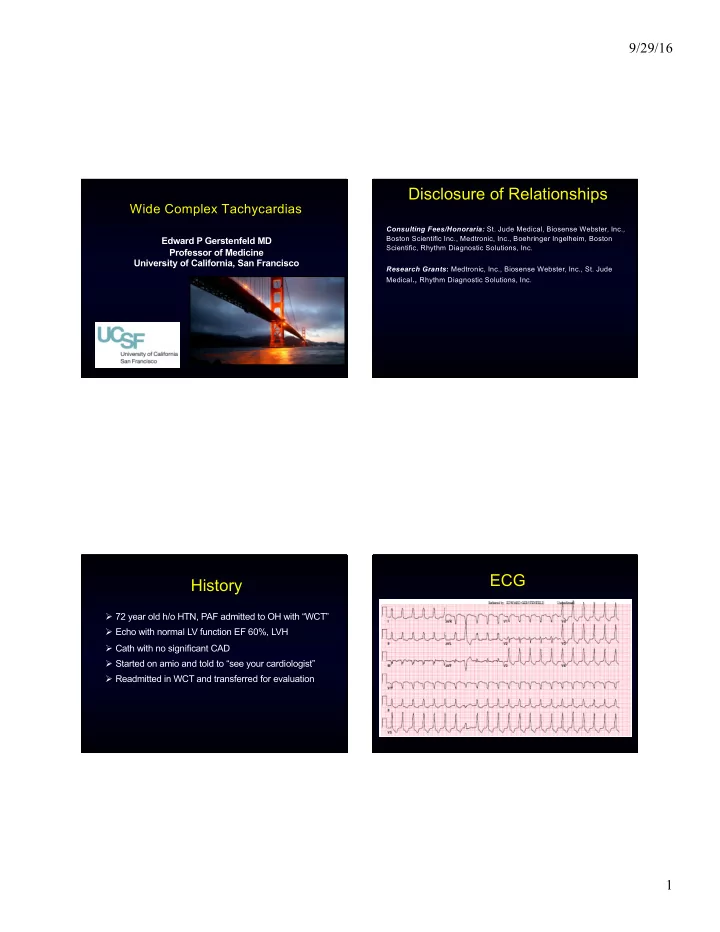
Ø 72 year old h/o HTN, PAF admitted to OH with “WCT” Ø Echo with normal LV function EF 60%, LVH Ø Cath with no significant CAD Ø Started on amio and told to “see your cardiologist” Ø Readmitted in WCT and transferred for evaluation

ECG

slide-2
SLIDE 2

9/29/16 2

Diagnosis?

a) SVT with aberrancy b) Preexcited SVT c) VT

Baseline – Does This Help?

Kindwall Criteria (LBBB)

VT vs. SVT

> 60 ms > 30 ms V1 or V2

Kindwall et al. Am J Cardiol 1988;61:1279-83.

ECG

slide-3
SLIDE 3

9/29/16 3

Diagnosis?

a) SVT with aberrancy b) Preexcited SVT c) VT

VT Exit Site?

a) RVOT free wall b) RVOT septum c) Parahisian region d) LV Summit e) Mitral annulus

VT Exit?

a) RVOT free wall b) RVOT septum c) Parahisian region d) LV Summit e) Mitral annulus

PS MS AS

RVOT PVC

slide-4
SLIDE 4

9/29/16 4

Ø Positive in lead 1, some positive force (w) in avL, notching in the inferior leads

RV Inflow Tract

ECG Next Best Step

a) Transition to oral amiodarone and observe b) Perform PET/CT c) Perform cardiac MRI d) Plan EPS/ablation

MRI

1. Asymmetric thickening of the left ventricular septal wall with a ratio to the lateral wall thickness of 2.75:1. This is consistent with asymmetric hypertrophic cardiomyopathy. 2. Small area of dense transmural delayed enhancement at the base of the interventricular septum in the region of the asymmetric septal wall thickening.

slide-5
SLIDE 5

9/29/16 5

RV Activation Map

His

RV

PA

What is the best next step?

a) Ablate at earliest site with RF b) Ablate at earliest site with cryo c) Map LV septum d) Map aortic root e) Terminate procedure and try flecainide

What is the best next step?

a) Ablate at earliest site with RF b) Ablate at earliest site with cryo c) Map LV septum d) Map aortic root e) Terminate procedure and try flecainide

R Cusp Activation

RAO LAO

22ms

His His RV RV

slide-6
SLIDE 6

9/29/16 6

RF to Right Cusp Term VT R Cusp Activation Summary

Ø 72 yo with parahisian VT Ø MRI with basal mid septal DE, ? HCM Ø Earliest activation in RV diffusely above His region Ø Successfully ablated from R cusp using ICE and EAM guidance Ø No VT with triples during PES after RFA

slide-7
SLIDE 7

9/29/16 7

ICD?

a) Yes – single chamber intravascular ICD b) Yes – subcutaneous ICD c) No

Summary

Ø Septal VTs can have a relatively narrow QRS Ø Suspect parahisian PVC/VT with LBB/inferior axis, lead I ++ and aVL flat/”w” Ø R cusp often safer and more stable then right parahisian region Ø Consider cryoablation if His present