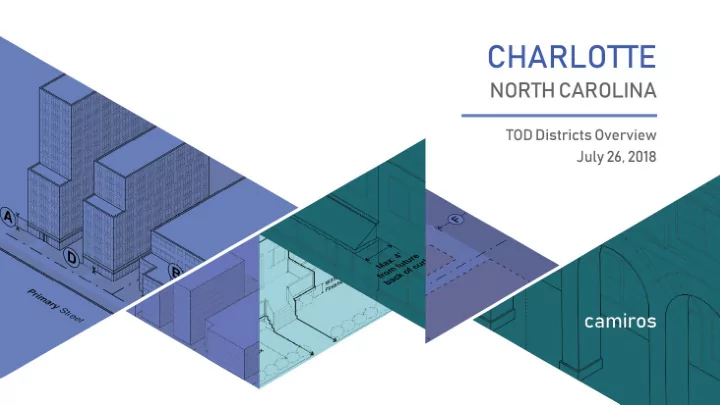
SLIDE 1
SLIDE 2
Camiros National Practice
Zoning Ordinances Sustainable Development Master Plans Downtown Plans Corridor Plans Urban Design Economic Development Public Engagement Landscape Architecture Historic Preservation
SLIDE 3
Camiros Zoning Practice
Baltimore, MD Buffalo, NY Clark County (Las Vegas), NV Davenport, IA Knoxville, TN New Orleans, LA Newark, NJ Pittsburgh, PA Providence, RI Rome, NY Trenton, NJ Salt Lake Co., UT Shreveport, LA Spring Hill, TN Yonkers, NY
SLIDE 4
Baltimore Maryland
Zoning Code Update Integrate URPs – 80+ URPs Rowhouse form-based standards Infill: Stable vs. High Vacancies Downtown form-based subdistricts New TOD Districts Urban vs. Suburban
SLIDE 5
Pittsburgh Pennsylvania
Riverfront Zoning Amendment 35 miles of riverfront Different character throughout geography: 5 subdistricts Riverfront access: View corridors Building passages Physical access to riverfront Increased density Reduced reliance on vehicles
SLIDE 6
Buffalo New York
City-Wide Form-Based Code GREEN CODE Form-based zones Neighborhood Zones District Zones Corridor Zones Building Typologies in N Zones TOD District: C-M Metro Rail
SLIDE 7
Buffalo New York
SLIDE 8
Buffalo New York
SLIDE 9
Buffalo New York
SLIDE 10
Buffalo New York
SLIDE 11
Buffalo New York
SLIDE 12
Buffalo New York
SLIDE 13 Charlotte TOD
Districts Formerly Known As Intent Applicability TOD-H1 High Intensity TOD-A Urban centers Rapid transit centers Streetcar for City Center & large sites in activity centers ½ mile walking distance of existing station
- r funded MTC/CATS alignment station
location TOD-H2 High Intensity Transitional TOD-B Transition from high intensity to adjacent neighborhoods Streetcar alignments 1 mile walking distance of existing station or adopted MTC/CATS alignment station location TOD-M1 Moderate Intensity TOD-C Transit outside of urban centers Streetcar for large sites in activity centers ½ mile walking distance of existing station
- r adopted MTC/CATS alignment station
location TOD-M2 Moderate Intensity Transitional TOD-D Transition from moderate intensity to adjacent neighborhoods More suburban in nature 1 mile walking distance of existing station or adopted MTC/CATS alignment station location
* Adjacent to single-family residential only when separated by separated by an interstate, parkway, boulevard, or a four or more lane avenue ** Any portion of a structure within 200 of single-family residential district limited to 65’ in height
SLIDE 14 TOD Form
Emphasize form in each Building dimensions Building siting Building height Required height stepback Building articulation Different levels of development intensity & transitions
Stricter design standards Transitions Frontage types Based on street type: local, Main Street, 4+ lane avenue, limited access
SLIDE 15
TOD Form
SLIDE 16
SLIDE 17
SLIDE 18
TOD Form
SLIDE 19
SLIDE 20
SLIDE 21
TOD Form
SLIDE 22
SLIDE 23
TOD Form
SLIDE 24
SLIDE 25
TOD Form
Height bonuses Open space Transportation Affordable housing Design standards Façade articulation Massing Entries + Parking Structures
+ Additional form & design standards for lower-intensity dwellings
SLIDE 26
TOD Streetscape
Sidewalk & Amenity Zone Determined by street type Will have applicability by district Minimum dimensions Pedestrian Connectivity Refinement of current ordinance regulations
SLIDE 27
SLIDE 28
TOD Use
Special use eliminated Use matrix only permitted uses All uses defined Generic use approach Prescribed conditions Why not just list prohibited uses?
SLIDE 29
TOD Administration
Administrative Adjustment Planning Director Proposed 10% modification to a quantitative standards Alternative Compliance Determining “how” without quasi-judicial process Alternative compliance to more qualitative standards TOD-___-EX Cite base district in name Similar to TOD-Optional Public benefit as part of the process
SLIDE 30
TOD Site Elements
Parking No minimum in TOD-H1/-M1 Maximums in all districts Bicycle parking Signs Determining appropriate signs in TOD (pedestrian-oriented) Scaled to district form Landscape Parking lot perimeter Buffer yard
SLIDE 31
TOD A Bigger Picture…
Foundation Sets a course for full UDO Establishes graphic style Key Parts of UDO Use approach Form criteria Note: The order presented in previous hand-out is not the final order of standards Less emphasis on use More emphasis on form & character
SLIDE 32