SEISMIC PROTECTIVE SYSTEMS Smart Semi-Active Materials, Seismic - - PDF document

seismic protective systems
SMART_READER_LITE
LIVE PREVIEW

SEISMIC PROTECTIVE SYSTEMS Smart Semi-Active Materials, Seismic - - PDF document

APPLICATIONS OF SEISMIC PROTECTIVE SYSTEMS IN OFFSHORE GAS AND OIL PLATFORMS Michael C. Constantinou Department of Civil, Structural, and Environmental Engineering University at Buffalo, State University of New York Dept. of Civil, Structural


slide-1
SLIDE 1

1

  • Dept. of Civil, Structural & Environmental Eng. , University at Buffalo

APPLICATIONS OF SEISMIC PROTECTIVE SYSTEMS IN OFFSHORE GAS AND OIL PLATFORMS Michael C. Constantinou

Department of Civil, Structural, and Environmental Engineering University at Buffalo, State University of New York

  • Dept. of Civil, Structural & Environmental Eng. , University at Buffalo

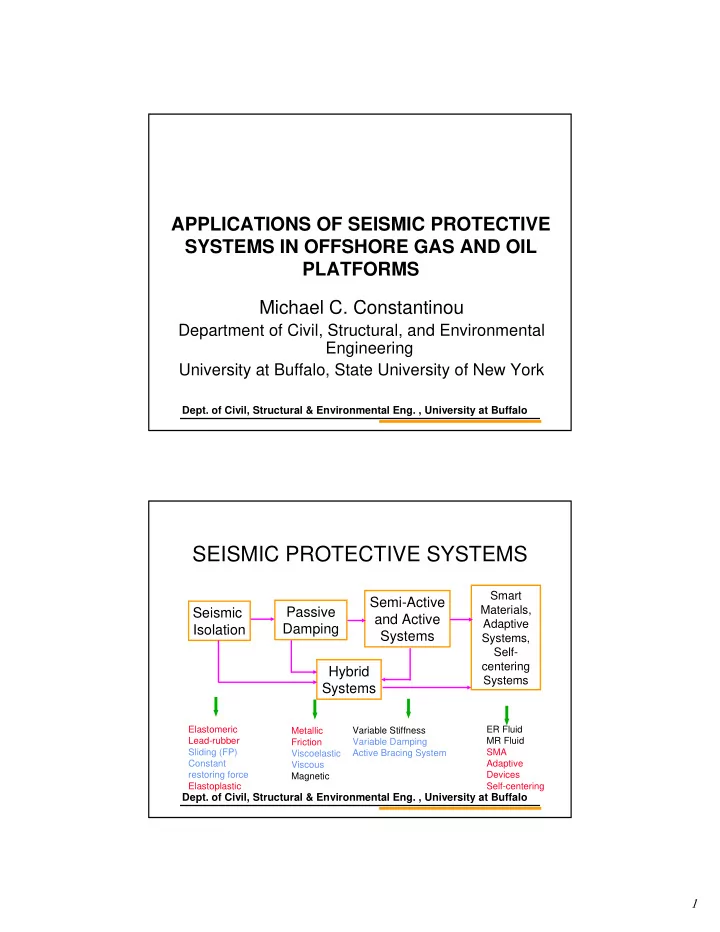
SEISMIC PROTECTIVE SYSTEMS

Hybrid Systems Seismic Isolation Passive Damping Semi-Active and Active Systems

Smart Materials, Adaptive Systems, Self- centering Systems

Elastomeric Lead-rubber Sliding (FP) Constant restoring force Elastoplastic Metallic Friction Viscoelastic Viscous Magnetic Variable Stiffness Variable Damping Active Bracing System ER Fluid MR Fluid SMA Adaptive Devices Self-centering

slide-2
SLIDE 2

2

  • Dept. of Civil, Structural & Environmental Eng. , University at Buffalo

SCOPE OF PRESENTATION

  • Description of seismic protective systems and

hardware

  • Presentation of selected implementations of

seismic isolation and energy dissipation hardware with emphasis on applications of infrastructure and particularly offshore gas and oil platforms

  • Mention of developmental work done at the

University at Buffalo

  • Dept. of Civil, Structural & Environmental Eng. , University at Buffalo

ACKNOWLEDGMENTS

  • Professors A.M. Reinhorn and A.S. Whittaker, Univ. at Buffalo
  • M. Efthymiou, Shell/Sakhalin Energy Development
  • C. Clarke, Mustang Engineering, formerly of AMEC, UK
  • R. Buchanan, AMEC, UK
  • Y. Rudolf, ExxonMobil (formerly of Sandwell, Vancouver, Canada)
  • W. Turner, ExxonMobil
  • Bora Tokyay, ExxonMobil
  • Mark Chatten, Motioneering, Guelph, Canada
  • Former doctoral and post-doctoral students: Prof. P. Tsopelas, Prof. O.

Ramirez, Prof. P. Roussis, Dr. A.S. Mokha, Dr. A. Kasalanati, Dr. E.D. Wolff, Dr. Ani N. Sigaher, Dr. E. Pavlou, Dr. C. Chrysostomou

  • Current students: Dan Fenz, Yiannis Kalpakidis
  • Research Sponsors: NSF, NCEER, MCEER, FEMA, State of NY,

Department of Commerce, Industry

slide-3
SLIDE 3

3

  • Dept. of Civil, Structural & Environmental Eng. , University at Buffalo

SEISMIC ISOLATION

Period lengthening

  • isolator flexibility
  • force reduction
  • displacement increase
  • Dept. of Civil, Structural & Environmental Eng. , University at Buffalo

SEISMIC ISOLATION

Displacements

  • isolator flexibility
  • period shift
  • isolator displacement

♦ energy dissipation

  • building displacement

♦ damage reduction

slide-4
SLIDE 4

4

  • Dept. of Civil, Structural & Environmental Eng. , University at Buffalo

SEISMIC ISOLATION

Energy dissipation

  • hysteretic

♦ high-damping rubber ♦ yielding of lead ♦ friction ♦ external hardware

hybrid systems

  • viscous

♦ external hardware

  • Dept. of Civil, Structural & Environmental Eng. , University at Buffalo

SEISMIC ISOLATION

CATHEDRAL CHRIST THE LIGHT, OAKLAND, CA (COURTESY SARAH DIEGNAN, SOM, SAN FRANCISCO)

slide-5
SLIDE 5

5

  • Dept. of Civil, Structural & Environmental Eng. , University at Buffalo

ISOLATION HARDWARE

  • Isolation bearings

Elastomeric

  • Low-damping rubber (NR)
  • High-damping rubber (HDR)
  • Lead-rubber (LR)

Sliding

  • Friction Pendulum (FP)
  • Sliding with Restoring Force
  • Sliding/Rolling with Constant

Restoring Force

  • Sliding with Yielding Devices

(Elastoplastic)

  • Energy dissipation devices

Viscous dampers

  • Dept. of Civil, Structural & Environmental Eng. , University at Buffalo

ISOLATION HARDWARE

  • Elastomeric Bearings for Sakhalin I Orlan Platform
  • Tested at University at Buffalo
slide-6
SLIDE 6

6

  • Dept. of Civil, Structural & Environmental Eng. , University at Buffalo

ISOLATION HARDWARE

  • LR bearing
  • Dept. of Civil, Structural & Environmental Eng. , University at Buffalo

LEAD-RUBBER BEARING

  • 1 5 0
  • 1 2 0
  • 9 0
  • 6 0
  • 3 0

3 0 6 0 9 0 1 2 0 1 5 0

  • 1 2 0
  • 9 0
  • 6 0
  • 3 0

3 0 6 0 9 0 1 2 0 D isp la ce m e n t (m m ) Lateral Force (kN) L e a d -ru b b e r B e a rin g

  • 2 6 oC fo r 4 8 h rs

ve l.= 2 5 0 m m /s Ve rtica l L o a d = 1 1 0 0 kN

  • 1 5 0
  • 1 2 0
  • 9 0
  • 6 0
  • 3 0

3 0 6 0 9 0 1 2 0 1 5 0

  • 1 2 0
  • 9 0
  • 6 0
  • 3 0

3 0 6 0 9 0 1 2 0 D isp la ce m e n t (m m ) Lateral Force (kN) L e a d -ru b b e r B e a rin g 2 0 oC , ve l.= 2 5 0 m m /s Ve rtica l L o a d = 1 1 0 0 kN

LEAD-RUBBER BEARING, UNIVERSITY AT BUFFALO LOAD=1100kN, DISPLACEMENT=100mm, VELOCITY=250mm/sec TEMP=20OC TEMP=-25OC

slide-7
SLIDE 7

7

  • Dept. of Civil, Structural & Environmental Eng. , University at Buffalo

ISOLATION HARDWARE

  • FP bearing
  • Dept. of Civil, Structural & Environmental Eng. , University at Buffalo

FP BEARING

Salkhalin II bearings

Largest seismic isolators

700mm displacement

87,400kN vertical load

Full-scale testing

Reduced scale dynamic testing (load of up to 13,000kN, velocity of 1m/sec).

slide-8
SLIDE 8

8

  • Dept. of Civil, Structural & Environmental Eng. , University at Buffalo

LARGE-SCALE DYNAMIC TESTING

LARGE-SCALE TESTING MACHINE OF EPS 67,000 kN 1 meter/sec 2500mm STROKE

  • Dept. of Civil, Structural & Environmental Eng. , University at Buffalo

FP BEARING

SAKHALIN II PLATFORMS PROTOTYPE BEARING PR1, LOAD=6925kN, DISPLACEMENT=240mm, VELOCITY=0.9 m/sec EPS BEARING TESTING MACHINE, OCTOBER 2005

slide-9
SLIDE 9

9

  • Dept. of Civil, Structural & Environmental Eng. , University at Buffalo

FP BEARING

SAKHALIN II PLATFORMS PROTOTYPE BEARING PR1, LOAD=6925kN, DISPLACEMENT=240mm, VELOCITY=0.9 m/sec EPS BEARING TESTING MACHINE, OCTOBER 2005

  • 300
  • 200
  • 100

100 200 300 5 10 15 20 TIME (sec) DISPLACEMENT (mm)

  • 1.5
  • 1
  • 0.5

0.5 1 1.5 5 10 15 20 TIME (sec) VELOCITY (m/sec)

  • Dept. of Civil, Structural & Environmental Eng. , University at Buffalo

FULL-SCALE DYNAMIC TESTING

  • SRMD Test Machine

Horizontal capacity

  • 4500 kN per actuator
  • 2500 mm stroke
  • 1.8 meters/sec
  • 19.3m3/min servovalves

Vertical capacity

  • 72 MN
  • Used for testing of bearings for

Benicia Martinez bridge (FP)

Coronado bridge (LRB)

I-40 bridge (FP)

Erzurum Hospital (LRB)

slide-10
SLIDE 10

10

  • Dept. of Civil, Structural & Environmental Eng. , University at Buffalo

IMPLEMENTATION OF SEISMIC ISOLATORS IN OFFSHORE GAS PLATFORMS

SAKHALIN ISLAND, RUSSIA OFFSHORE GAS PLATFORM WITH CONCRETE GRAVITY BASE

  • Dept. of Civil, Structural & Environmental Eng. , University at Buffalo

IMPLEMENTATION OF SEISMIC ISOLATORS IN OFFSHORE GAS AND OIL PLATFORMS

  • Orlan Platform, Sakhalin, 2006

♦ 100-ton Tuned Mass Damper to protect derrick ♦ Contributions of University at Buffalo (peer review

services, contributions in analysis of TMD, testing of rubber bearings used in TMD)

♦ Engineering: Sandwell, Motioneering, Canada

slide-11
SLIDE 11

11

  • Dept. of Civil, Structural & Environmental Eng. , University at Buffalo

TMD

CIDS (in Alaska- 1984) Orlan (in Russia- 2005)

ORLAN PLATFORM

  • Dept. of Civil, Structural & Environmental Eng. , University at Buffalo

Derrick: 550 t (Bailey / Holland) Wellbay: 2000 t (Triocean / Calgary) DES: 1450 t (Ocean Design / Houston) Drilling Stack: 4000 t

Hook Load 650 t

Drilling Stack Components

E-W N-S Drill Floor 13 m 80 m Skidbase

  • 20 well positions
  • Components sliding on each
  • ther
  • Varying hook load
  • Varying setback conditions

Setback

ORLAN PLATFORM

slide-12
SLIDE 12

12

  • Dept. of Civil, Structural & Environmental Eng. , University at Buffalo
  • Dynamics

First mode is rocking of a rigid DES/Derrick on flexible Skidbase Period of around 1 second The first mode has a modal mass participation of 40%, but it contributes 90% of overturning. This mode dominates the overstressing of the structure and its foundation

  • Effect on Structure

Structure is satisfactory in SLE. In DLE:

  • 1. Derrick columns significantly overstressed with no

ductility capacity

  • 2. Stack clamps overstressed in tension and at limits
  • f casting size
  • 3. Wellbay module columns overstressed and at limit
  • f plate thickness availability
  • 4. Deck strengthening at limit of feasibility
  • 5. Reactions transmitted to concrete structure

exceeding capacity with no ability of retrofit N-S mode

4. 3. 2. 1. 5.

E-W mode

ORLAN PLATFORM

  • Dept. of Civil, Structural & Environmental Eng. , University at Buffalo

ORLAN PLATFORM

  • General reduction in response of about 50%
  • Elastic conditions, low-damped structure
  • Heavy TMD, highly-damped TMD
  • Considerable variability in properties due to foundation property uncertainty
slide-13
SLIDE 13

13

  • Dept. of Civil, Structural & Environmental Eng. , University at Buffalo

Inclined VDs Multistage bearings

7 5 4500

ORLAN PLATFORM

  • Dept. of Civil, Structural & Environmental Eng. , University at Buffalo

ORLAN PLATFORM

LOCATION OF TUNED MASS DAMPER IN ORLAN PLATFORM GOAL IS TO PREVENT FAILURE OF MEMBERS IN DERRICK

slide-14
SLIDE 14

14

  • Dept. of Civil, Structural & Environmental Eng. , University at Buffalo

ORLAN PLATFORM

  • Dept. of Civil, Structural & Environmental Eng. , University at Buffalo

ORLAN PLATFORM

slide-15
SLIDE 15

15

  • Dept. of Civil, Structural & Environmental Eng. , University at Buffalo

IMPLEMENTATION OF SEISMIC ISOLATORS IN OFFSHORE GAS PLATFORMS

  • Lunskoye and Piltun Platforms, Sakhalin, 2006

♦ Seismic isolation of platforms ♦ Contributions of University at Buffalo (development of

procedures for scaling and testing seismic isolators, development

  • f technical basis for design of isolators, simplified analysis of

platforms)

♦ Engineering: AMEC, UK

  • Dept. of Civil, Structural & Environmental Eng. , University at Buffalo

SAKHALIN ISLAND GAS PLATFORMS PILTUN AND LUNSKOYE PLATFORMS

SAKHALIN II PROJECT LOCATION OF SEISMIC ISOLATION SYSTEM ON TOP OF CONCRETE GRAVITY BASE IN PILTUN AND LUNSKOYE PLATFORMS GOAL IS TO PROTECT ENTIRE STRUCTURE ABOVE CONCRETE GRAVITY BASE

slide-16
SLIDE 16

16

  • Dept. of Civil, Structural & Environmental Eng. , University at Buffalo

LUNSKOYE/PILTUN GAS PLATFORMS

  • Dept. of Civil, Structural & Environmental Eng. , University at Buffalo

LUNSKOYE/PILTUN GAS PLATFORMS

  • LOADINGS

Temperature

  • 360C to 360C

Snow and ice accumulation

  • 100-year return period
  • 2500 m. tons per

platform

Blast

  • Blast pressure greater

than normal due to sealed compartments used to maintain minimum temperature +50C

Ice and wave

Seismic

4 4 Number of GBS columns 105x88x13.5 105x88x13.5 GBS caisson size LxBxD (m) 70000 BPD 50000 BPD Oil/ Condensate production 100 MMSCFD 1850 MMSCFD Gas production Drilling Production Utilities Living Quarters Drilling Production Utilities Living Quarters Facilities 45 27 Number of Conductors 30 49 Water Depth (m) 100 x 70 100 x 50 Approximate Topsides Plan Dimensions (m) 33 500 27 000 Topsides Operating weight (m. tons) 27 500 21 000 Topsides Dry weight (m. tons) 30 30 Design Life (years)

Piltun Lunskoye

slide-17
SLIDE 17

17

  • Dept. of Civil, Structural & Environmental Eng. , University at Buffalo

LUNSKOYE/PILTUN GAS PLATFORMS-ICE LOADING

♦ Ice present for 6 months, up to 2m thick ♦ Horizontal loads per platform

  • 260MN (103MN per leg) for 1-year return period

(operational)

  • 324MN (124MN per leg) for 100-year return period

(frequent event)

  • 435MN (155MN per leg) for 10,000-year return period

♦ Necessitated all services to be within legs ♦ Design criteria

  • No damage to topsides for 100-year wave/ice effects
  • Survival criteria for 10,000-year return period wave/ice
  • Dept. of Civil, Structural & Environmental Eng. , University at Buffalo

LUNSKOYE/PILTUN GAS PLATFORMS-SEISMIC LOADING

Strength Level (SLE)

200-year return period

No loss of life

Essentially elastic behavior (some local limited yielding allowed)

Equipment functional

Shutdown and inspection likely

  • Ductility Level (DLE)

3000-year return period

Structural damage acceptable

Collapse prevention

Safety critical equipment fully functional

Means of escape intact

No major environmental damage

slide-18
SLIDE 18

18

  • Dept. of Civil, Structural & Environmental Eng. , University at Buffalo

LUNSKOYE/PILTUN GAS PLATFORMS-ISOLATORS

0.6 to 2.0 g 1.2 to 4.4 g Equipment Accel. (cranes, flare, etc.) 0.24 to 0.31g 0.65 to 0.85 g Deck Accel. (0 to +47m)

With isolation Without isolation

Calculations based on nominal properties

SLE Response

  • Isolators

Single concave FP

Cast steel suitable for low temperatures

Radius of curvature 3962mm

Displacement capacity 700mm

Contact diameter 1752mm

Pendulum period 4.0 sec

Lower bound friction 0.040

Upper bound friction 0.095

Range of nominal friction 0.04 to 0.06

λ-factors

  • 1.2 aging
  • 1.1 travel of 2900m
  • 1.4 temperature of -400C

Adjustment factor 0.75, so that λmax=1.60

  • Dept. of Civil, Structural & Environmental Eng. , University at Buffalo

LUNSKOYE/PILTUN GAS PLATFORMS

  • Nominal properties of

isolators and foundation were used for structural design

  • Upper/lower bound

isolator and foundation properties were used for isolator design and testing

1.48 1.24 0.45 Isolator velocity (m/sec) 10.4 9.0 1.5 Isolator travel (m) 149 146 123 Isolator axial force (MN) 24 22.3 13 Isolator shear force (MN) 630 550 118 Isolator

  • displ. (mm)

DLE Bounding analysis DLE nominal SLE nominal

Isolation System Response

slide-19
SLIDE 19

19

  • Dept. of Civil, Structural & Environmental Eng. , University at Buffalo

LUNSKOYE/PILTUN GAS PLATFORMS

FULL SIZE PRDUCTION BEARING REDUCED SIZE PROTOTYPE BEARING

  • Dept. of Civil, Structural & Environmental Eng. , University at Buffalo

LUNSKOYE/PILTUN GAS PLATFORMS

1. MAINTAIN AVERAGE PRESSURE 2. MAINTAIN EDGE PRESSURE 3. MAINTAIN THICKNESS OF LINER 4. SCALE OVERLAY THICKNESS 5. SELECT BEARING THICKNESSES TO MAINTAIN THERMODYNAMIC CONDITIONS

  • 6. SELECT TESTING PROCEDURE TO

SIMULATE TEMPERATURE RISE DUE TO FRICTIONAL HEATING AT SLIDING INTERFACE IN MOST CRITICAL LOADING CASE (RELATED TO WEAR OF LINER) SCALING PROCESS

100 200 300 400 500 10 20 30 40 Time (sec) Temperature rise (oC) Bidirectional seismic motion with varying axial load Unidirectional seismic motion 240 mm amplitude, 0.6 Hz, 10 cycles, 30.8 N/mm2 pressure

slide-20
SLIDE 20

20

  • Dept. of Civil, Structural & Environmental Eng. , University at Buffalo

LUNSKOYE/PILTUN GAS PLATFORMS- THERMODYNAMIC CALCULATIONS

  • 0.3
  • 0.2
  • 0.1

0.0 0.1 0.2 0.3

  • 0.3 -0.2 -0.1

0.0 0.1 0.2 0.3 Bearing displacement Y (m) Bearing displacement X (m)

20 40 60 80 100 120 140 10 20 30 40 50 Time (sec) Axial load (MN) 1 2 3 4 10 20 30 40

Time (sec) Heat flux (MW/m

2)

100 200 300 400 500 10 20 30 40 Time (sec) Temperature rise (oC) UPPER BOUND FRICTION UPPER BOUND FOUNDATION STIFFNESS LUNSKOYE DLE, EARTHQUAKE 3

  • Dept. of Civil, Structural & Environmental Eng. , University at Buffalo

LUNSKOYE/PILTUN GAS PLATFORMS

  • Example of effort in the

analysis and design of isolation system

  • Entire structure

modeled in ABAQUS, using analytical description of spherical sliding surfaces of FP bearings

  • Detailed FE analysis of

bearings

ANALYSIS OF FP BEARING AT MAXIMUM DISPLACEMENT ANALYSIS BY AMEC, UK

slide-21
SLIDE 21

21

  • Dept. of Civil, Structural & Environmental Eng. , University at Buffalo

LUN-A GBS TOW & INSTALLATION – JUNE 2005

  • Dept. of Civil, Structural & Environmental Eng. , University at Buffalo
  • Heaviest Topsides ever to be

installed by floatover

  • Winterised facilities

(fully winterised drilling rig)

  • High consumables storage

area

  • Steel Material qualified to –

40° C

LUN-A CONSTRUCTION OF TOPSIDES IN SHI,

  • S. KOREA
slide-22
SLIDE 22

22

  • Dept. of Civil, Structural & Environmental Eng. , University at Buffalo

LUN-A LOAD OUT – SHI YARD MAY 2006

  • Dept. of Civil, Structural & Environmental Eng. , University at Buffalo

LUN-A TOPSIDES ARRIVES AT LUNSKOYE FIELD JUNE 06

slide-23
SLIDE 23

23

  • Dept. of Civil, Structural & Environmental Eng. , University at Buffalo

LUN-A FLOATOVER INSTALLATION JUNE 2006

  • Dept. of Civil, Structural & Environmental Eng. , University at Buffalo

LUN-A TOPSDES INSTALLED JUNE 2006

slide-24
SLIDE 24

24

  • Dept. of Civil, Structural & Environmental Eng. , University at Buffalo

LUN-A ISOLATOR AT TOP OF LEG 2

  • Dept. of Civil, Structural & Environmental Eng. , University at Buffalo

WAVE PROTECTION SHIELD TO PROTECT FRICTION PENDULUM BEARINGS

slide-25
SLIDE 25

25

  • Dept. of Civil, Structural & Environmental Eng. , University at Buffalo

CHIRAG I OIL PLATFORM, AZERBAIJAN

  • 1990’s application
  • Elastoplastic isolation

system

  • System does not have

sufficient re-centering force capability per US

  • r European seismic

isolation specifications.

  • Dept. of Civil, Structural & Environmental Eng. , University at Buffalo

IMPLEMENTATION OF SEISMIC ISOLATORS IN INFRASTRUCTURE

  • LNG Tanks, Greece, 1996

♦ 430 Friction-pendulum bearings ♦ Development work at University at Buffalo

(development of computer code 3D-BASIS-ME, development of simplified procedures for analysis and design of inner tank under uplift conditions, development and implementation of quality control program for isolators, peer review services, inspection of isolators in 2002)

♦ Tested by manufacturer (EPS) ♦ Engineering: Whessoe, UK

slide-26
SLIDE 26

26

  • Dept. of Civil, Structural & Environmental Eng. , University at Buffalo

IMPLEMENTATION OF SEISMIC ISOLATORS IN LNG TANKS

65,000 m3 CAPACITY, 75m DIAMETER, 35m HEIGHT (ISOLATOR TO ROOF) 9% NICKEL INNER TANK PRESTRESSED CONCRETE OUTER TANK 1m PERLITE INSULATION WITH CURTAIN TO ALLOW THERMAL BREATHING 1m INSULATION AT BOTTOM 1m THICK CONCRETE SLAB UNANCHORED INNER TANK UNDERGROUND CONSTRUCTION FOR SAFETY REASONS (CONTAINMENT OF SPILLAGE, LOW PROFILE TARGET) AND AESTHETIC REASONS (DO NOT SIGNIFICANTLY ALTER VIEW OF ISLAND FROM MAINLAND) LNG TANKS, REVITHOUSSA, GREECE, 1996

  • Dept. of Civil, Structural & Environmental Eng. , University at Buffalo

IMPLEMENTATION OF SEISMIC ISOLATORS IN LNG TANKS

  • Hydrostatic and hydrodynamic

loadings cause shell hoop tension

  • Impulsive and convective liquid

loading cause shell compression in the vertical direction

  • Use of modification factors (R-

factors) for shell hoop stress (e.g., API 620 utilizes a value 2.0) virtually guarantees shell elastoplastic buckling (elephant’s foot buckling)

  • LNG tanks are tested by filling with
  • water. Since water has density

twice that of LNG, tanks have extra shell thickness and ability to resist moderate earthquake forces

  • Seismic isolation allows the use of

standard LNG designs in strong seismicity areas without the need to anchor the tank or change the diameter to height ratio

slide-27
SLIDE 27

27

  • Dept. of Civil, Structural & Environmental Eng. , University at Buffalo

IMPLEMENTATION OF SEISMIC ISOLATORS IN LNG TANKS

LNG TANKS, REVITHOUSSA, GREECE, 1996 Inspection, January 2002

  • Dept. of Civil, Structural & Environmental Eng. , University at Buffalo

IMPLEMENTATION OF SEISMIC ISOLATORS IN CHEMICALS TANKS

  • Case of chemicals

tanks near populated seismically active area (Sicily, Italy)

  • Demolition and

rebuilding not an option- cannot build anything new in that area

  • Seismic isolation retrofit

an attractive option

  • Difficult construction
slide-28
SLIDE 28

28

  • Dept. of Civil, Structural & Environmental Eng. , University at Buffalo

IMPLEMENTATION OF SEISMIC ISOLATORS IN CHEMICALS TANKS

  • Soft first story

construction

  • Strengthening of

columns would transfer problem to tank above

  • Seismic isolation

(reduction of force) an attractive option

  • Strengthening of

columns still needed

  • Dept. of Civil, Structural & Environmental Eng. , University at Buffalo

IMPLEMENTATION OF SEISMIC ISOLATORS IN CHEMICALS TANKS

slide-29
SLIDE 29

29

  • Dept. of Civil, Structural & Environmental Eng. , University at Buffalo

IMPLEMENTATION OF SEISMIC ISOLATORS IN CHEMICALS TANKS

  • Due to close spacing of

columns, temporary transfer of load not needed (but support system provided)

  • Isolators inserted

without need to preload (no use of flat jacks)

  • Use of FP bearings with

transfer of P-Δ moment

  • n strengthened column

below

  • Dept. of Civil, Structural & Environmental Eng. , University at Buffalo

IMPLEMENTATION OF SEISMIC ISOLATORS IN BRIDGES

  • Woodrow Wilson

Bridge, 2004

  • Arch bridge
  • Open lines of vision
  • Bascule and fixed

spans look the same

  • Seismically isolated
slide-30
SLIDE 30

30

  • Dept. of Civil, Structural & Environmental Eng. , University at Buffalo

IMPLEMENTATION OF SEISMIC ISOLATORS IN BRIDGES

  • Eastern US, small seismic displacements
  • Seismic isolators most useful in seismic load distribution
  • Behavior of bearings important in both service and seismic conditions
  • Two bearings underwent wear testing (1.6km total movement, 16,000

cycles at 25mm amplitude with dynamic testing prior to and after the wear test) at UB

LR BEARING LR BEARING

  • Dept. of Civil, Structural & Environmental Eng. , University at Buffalo

WOODROW WILSON BRIDGE

LEAD RUBBER BEARING DYNAMIC TESTING AT VELOCITY OF 250mm/sec, LOAD=1500kN LEAD RUBBER BEARING WEAR TESTING AT VELOCITY OF 3mm/sec, LOAD=2000kN 16,000 CYCLES, TOTAL TRAVEL 1600m

slide-31
SLIDE 31

31

  • Dept. of Civil, Structural & Environmental Eng. , University at Buffalo

WEAR TESTING

WEAR TEST

  • 100
  • 80
  • 60
  • 40
  • 20

20 40 60 80 100

  • 1.5
  • 1
  • 0.5

0.5 1 1.5 DISPLACEMENT (INCH) LATERAL FORCE (KIPS)

CYCLES 1-5 CYCLES 15401-15405 TRAVEL=1550 m WOODROW WILSON BRIDGE LR BEARINGS

  • Dept. of Civil, Structural & Environmental Eng. , University at Buffalo

WOODROW WILSON BRIDGE

BEARING NO. 2 TEST B1 (5 cycles, 4.5 inch, 10in/sec) BEFORE WEAR TEST

  • 100
  • 80
  • 60
  • 40
  • 20

20 40 60 80 100

  • 6
  • 4
  • 2

2 4 6 DISPLACEMENT (inch) LATERAL FORCE (kips) BEARING NO. 2 TEST B1 (5 CYCLES, 4.5 inch, 10 in/sec) AFTER WEAR TEST

  • 100
  • 80
  • 60
  • 40
  • 20

20 40 60 80 100

  • 6
  • 4
  • 2

2 4 6 DISPLACEMENT (inch) LATERAL FORCE (kips)

BEFORE WEAR TEST ( 1600m TRAVEL) AFTER WEAR TEST

slide-32
SLIDE 32

32

  • Dept. of Civil, Structural & Environmental Eng. , University at Buffalo

WOODROW WILSON BRIDGE

BEARING NO.2 THERMAL TEST BEFORE WEAR TEST VELOCITY = 0.006 in/sec (0.15 mm/sec)

  • 60
  • 40
  • 20

20 40 60

  • 4
  • 3
  • 2
  • 1

1 2 3 4 DISPLACEMENT (inch) LATERAL FORCE (kips) BEARING NO. 2 THERMAL TEST AFTER WEAR TEST VELOCITY= 0.006 in/sec (0.15 mm/sec)

  • 60
  • 40
  • 20

20 40 60

  • 4
  • 3
  • 2
  • 1

1 2 3 4 DISPLACEMENT (inch) LATERAL FORCE (kips)

BEFORE WEAR TEST AFTER WEAR TEST

  • Dept. of Civil, Structural & Environmental Eng. , University at Buffalo

WOODROW WILSON BRIDGE

20 40 60 80 100 120 140 160 180 200 400 600 800 1000 1200 1400 1600 1800 2000

TIME (sec) STRENGTH (kN)

158.3kN 44.5kN 55.3kN 8 minutes 30 minutes

RELAXATION OF LEAD RUBBER BEARING

slide-33
SLIDE 33

33

  • Dept. of Civil, Structural & Environmental Eng. , University at Buffalo

IMPLEMENTATION OF HYBRID SEISMIC ISOLATION SYSTEMS

SAN BERNANDINO HOSPITAL, CALIFORNIA, 1993 400 HIGH DAMPING RUBBER BEARINGS AND 186 NONLINEAR VISCOUS DAMPING DEVICES 600mm DISPLACEMENT CAPACITY

  • Dept. of Civil, Structural & Environmental Eng. , University at Buffalo

IMPLEMENTATION OF HYBRID SEISMIC ISOLATION SYSTEMS

HAYWARD CITY HALL, CALIFORNIA NEXT TO HAYWARD FAULT 53 FP BEARINGS AND 15 NONLINEAR VISCOUS DAMPING DEVICES 600 mm DISPLACEMENT CAPACITY

slide-34
SLIDE 34

34

  • Dept. of Civil, Structural & Environmental Eng. , University at Buffalo

IMPLEMENTATION OF HYBRID SEISMIC ISOLATION SYSTEMS

SHAKE TABLE TESTING OF SEISMICALLY ISOLATED STRUCTURE WITH HYBRID SYSTEMS AT UNIV. AT BUFFALO EMPHASIS ON SECONDARY SYSTEM RESPONSE AND VERIFICATION OF ACCURACY OF ANALYSIS TOOLS

  • Dept. of Civil, Structural & Environmental Eng. , University at Buffalo

CASE OF AN ADVANCED HYBRID SEISMIC ISOLATION SYSTEM: SHEMYA RADAR FACILITY

  • As part of the National Missile

Defense system, an advanced X- band radar facility was planned for Shemya Island

  • Radar featured a hybrid seismic

isolation system with horizontal and vertical flexibilities using FP isolators, helical springs and fluid viscous dampers.

  • Requirements for rigidity under

service loads were met by use of a two-stage active system capable of activation within seconds. Precise repositioning of the system following an earthquake was possible within short interval.

  • System components developed and

tested.

  • Construction postponed following

9/11 events.

Engineering: Black & Veach, Kircher & Assoc., USACE

slide-35
SLIDE 35

35

  • Dept. of Civil, Structural & Environmental Eng. , University at Buffalo

SHEMYA RADAR FACILITY

ISOLATION OF FOUNDATION OF XBR ANTENNA MOUNT DISPLACEMENT CAPACITIES:

  • HORIZ. 24 INCH
  • VERT. 6 INCH
  • Dept. of Civil, Structural & Environmental Eng. , University at Buffalo

SHEMYA RADAR FACILITY

Rocking/translational frequency ≈3.5 Hz Radius of curvature of FP bearings 154in Linear viscous dampers to minimize acceleration response

slide-36
SLIDE 36

36

  • Dept. of Civil, Structural & Environmental Eng. , University at Buffalo

TOPICS FOR DISCUSSION

  • Construction of offshore oil/gas platforms-problems and

advantages of seismic isolation:

Lack of redundancy

Redistribution of non-seismic loads

Great loads on isolators

Testing of isolators

Could other types of isolators be used?

  • TMD application in Orlan platform-any other options to

protection of derrick?

  • What is the most uncertain and yet very important part in the

analysis and design of seismic protective systems?

  • Is computer software capable of complex analysis required for

such projects?

Modeling isolator behavior

Modeling soil-structure interaction

Verification