Outline A brief tour of practice diversity Its everywhere you look! - - PDF document

outline
SMART_READER_LITE
LIVE PREVIEW

Outline A brief tour of practice diversity Its everywhere you look! - - PDF document

5/30/2014 I think Medicine has Practice diversity: What does it mean when everybody does it differently? 1. Too much practice diversity 2. Just enough practice diversity 3. Not enough practice diversity Avery Tung, M.D. FCCM Quality Chief


slide-1
SLIDE 1

5/30/2014 1

Practice diversity:

What does it mean when everybody does it differently? Avery Tung, M.D. FCCM Quality Chief for Anesthesia Department of Anesthesia and Critical Care University of Chicago

I think Medicine has…

1 2 3 0% 0% 0%

  • 1. Too much practice diversity
  • 2. Just enough practice diversity
  • 3. Not enough practice diversity

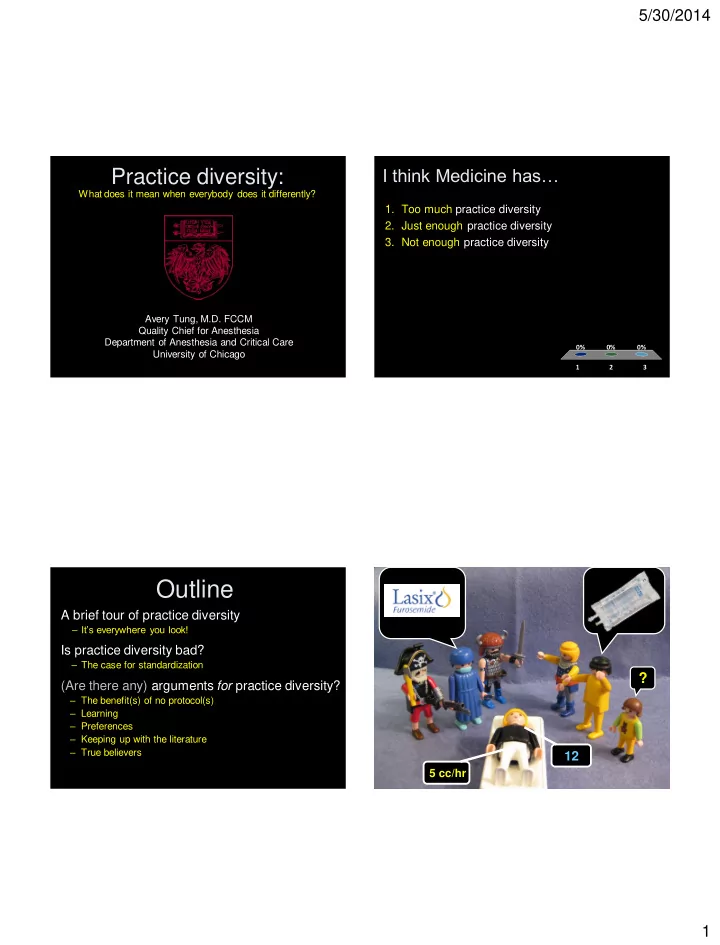
Outline

A brief tour of practice diversity

– It’s everywhere you look!

Is practice diversity bad?

– The case for standardization

(Are there any) arguments for practice diversity?

– The benefit(s) of no protocol(s) – Learning – Preferences – Keeping up with the literature – True believers

5 cc/hr

12

?

slide-2
SLIDE 2

5/30/2014 2

JAMA Surg 2013;148:29-35

“43 percent of surgeons reported sometimes or always experiencing conflict about postoperative goals of care with intensivists*”

**70% of intensivists

(AJRCCM 2009;80:853-60)

!

Marik PE et al.

Does central venous pressure predict fluid responsiveness? Chest 2008;134:172-8

!

Crit Care 2011;15:R197 368 ASA and ESA members surveyed regarding monitoring practices What monitoring do you routinely use for high risk surgery? ASA (n=237) ESA (n=195) Invasive art line 95.4 89.7

CVP 72.6 83.6

Noninvasive BP 51.9 53.8 CO 35.4 34.9 PCWP 30.8 14.4 TEE 28.3 19

SPV/PPV 20.3 23.6 SvO2 14.3 15.9

? Results

  • 96% agreed that optimal fluid resuscitation decreased

the risk of adverse events

  • COV for fluid rate >50%

(data had >100% variance)

77 survey* respondents

Surgeons, Anesthesiologists, Intensivists,

Can J Surg 2009;52:207-14 *50 yr 90kg M s/p lobectomy

slide-3
SLIDE 3

5/30/2014 3 ? Hb = 8.0

102,470 patients undergoing CABG 798 STS sites Primary isolated on-pump CABG

Massive variability in product use

7.8 to 92.8% for RBC 0 to 97.5% for FFP 0.4 to 90.4% for Platelets

JAMA 2010;304:1568-75 J Cardiothor Vasc Anesth 2008;22:662-9

Survey of Canadian perfusionists regarding blood product management

53% follow routine transfusion triggers for PRBC

?

slide-4
SLIDE 4

5/30/2014 4

Science 1973;182:1102-8

The case for standardization

JAMA 1990;263:1265-73

“Evidence based” “Wide ranges of uncertainty among practitioners, wide variations in beliefs among experts, and wide variations in actual practices all confirm what would be expected from common sense: the complexity

  • f modern medicine exceeds

the inherent limitations of the unaided human mind”

  • David Eddy, MD

When it comes to predicting…

  • College grades from admissions packets
  • Response to shock therapy for depression
  • Likelihood of violating parole
  • Which banks will go bankrupt
  • Etc…

…the algorithm usually beats the human

Science 1989;243:1668-74

“A search of the literature fails to reveal any studies in which clinical judgment has been shown to be superior to statistical prediction”

slide-5
SLIDE 5

5/30/2014 5

JAMA 2002;288:342-50

994 ER patients with suspected ischemia

No rule Rule* Efficiency (correct triage to OU)

27% 38%

Safety (correct triage to ICU)

75% 97%

*N Engl J Med 1996;334:1498-1504 J Palliat Med 2012;15:703-8

Retrospective review of 21,074 hospice patients* “Imminent death” on admission vs predictive model

*5,562 deaths < 7 days

“Guys, it’s more important that you do it the same way than what you think is the right way”

NY Times Nov 3, 2009

Create a protocol Measure

  • utcomes

Adjust as needed Remeasure

  • Brent James, M.D.
  • 103 ICUs and 375,757 catheter days in Michigan
  • Complex intervention: Goals, VAP, Safety program, etc

Results:

  •  infection rates from 7.7 to 1.4
  • OR (infection) = 0.34 at 16-18 months

N Engl J Med 2006;355:2725-32

slide-6
SLIDE 6

5/30/2014 6

168,113,488 patient-days 1 2 3 4 5 6 1990-1999 2001 2009 ICU CLABSI rates

(infections/1000 catheter days)

*

*NNIS data summary Am J Inf Cont 1999;27:520-32

0.8 per 1000 catheter days (2011) 0.76 per 1000 catheter days (2011) 0.3 per 1000 catheter days (2011) 0.97 per 1000 catheter days (2010) 0.6 per 1000 catheter days (2012) Monk: “What is the highest technique you hope to achieve?” Bruce: “To have no technique”

Is there value to practice diversity?

  • Enter the Dragon

Warner Bros 1973

“We always run the ball on 2nd down” “I always begin negotiations by offering 20% less than what I really want to pay” “I always raise with two-of-a-kind”

slide-7
SLIDE 7

5/30/2014 7

Chest 2003;123:1607-14

94 patients randomized to routine vs on demand CXR 519 total XRays

  • Nonroutine group was more likely to have new findings

that needed intervention (26% vs 13%)

  • No difference between groups in:
  • Ventilator days
  • ICU LOS
  • Hospital LOS
  • Adverse outcomes

979 CXRs in 165 patients Routine vs Restricted MORE relevant findings in the restricted group NO difference in outcomes 11 ICUs, 424 patients, 4,607 routine Xrays vs 3,128 on demand No difference in outcome

Lancet 2009;374:1687-93 Int Care Med 2008;34:264-70

Q: How do you get to Carnegie Hall? A: Practice

  • Anon

Q: How do you become the best doctor? A: See more variability?

Does practice variability facilitate learning?

Reg Anesth Pain Med 2012;37: 334-9

28 trials

15 trainees

slide-8
SLIDE 8

5/30/2014 8

J Mot Behav 2010;42:307-16

32 volunteers

Variable practice

Human preferences themselves are diverse!

“We all end up dead. Its just a question

  • f how and why”

Mel Gibson “Braveheart” 1995

slide-9
SLIDE 9

5/30/2014 9

J Am Geriatr Soc 2012; 60:1889-94

154 surgeons, geriatricians, and anesthesiologists

“We hypothesized that no effect of specialty

  • r recent experience on decision behavior

would exist”

Abdominal Aortic Aneurysms

  • Usually detected in

asymptomatic patients

  • Expands 0.2-0.4 cm

annually

  • Risk of rupture increases

with increasing size

JAGS 2012

  • Goal: operate when risk of rupture = risk of surgery

Decision: Operate now or wait?

  • If you decide to wait

– AAA expands (& risk of rupture increases)

  • If you decide to operate:

– 5% chance of operative mortality

But first, a practice test!

slide-10
SLIDE 10

5/30/2014 10

Annual meeting Chicago, IL 2006 N=62 Annual meeting San Francisco, CA 2007 N=92

Results

1 2 3 4 5 6 7 8 9 10

Surgeons Anesthesiologists

# of watchful waiting periods

0.6 1.0 1.4 2.0 5.5

Rupture risk (%) Aneurysm size

4.1 4.5 4.9 5.3 5.7

JAGS 2012

Surgeons by condition

1 2 3 4 5 6 7 8 9 10

0.6 1.0 1.4 2.0 5.5

Rupture risk (%) Aneurysm size

4.1 4.5 4.9 5.3 5.7

Successful surgery Surgical mortality Rupture*

# of watchful waiting periods

JAGS 2012

Surgeons vs Anesthesiologists

1 2 3 4 5 6 7 8 9 10

0.6 1.0 1.4 2.0 5.5

Rupture risk (%) Aneurysm size

4.1 4.5 4.9 5.3 5.7

Anesthesia (n=92) Surgeon (n=63)

Successful surgery Surgical mortality Rupture* Successful surgery Surgical mortality Rupture

# of watchful waiting periods

JAGS 2012

slide-11
SLIDE 11

5/30/2014 11

Surgeons by condition

1 2 3 4 5 6 7 8 9 10

0.6 1.0 1.4 2.0 5.5

Rupture risk (%) Aneurysm size

4.1 4.5 4.9 5.3 5.7

Successful surgery Surgical mortality Rupture*

# of watchful waiting periods

JAGS 2012

NHIS survey of 2,643 men from 2000 and 2005

J Clin Oncol 2011;29:1736-43

How do you make a decision when you don’t know the odds?

  • Identify the possible outcomes
  • Decide which outcome you LEAST want
  • Choose the other one
slide-12
SLIDE 12

5/30/2014 12

www.southwest.com

Getting on a Southwest plane

Unaccompanied minors & Businesspeople

A1-A60

Families with kids

B1-B60 C1-C60

~B23

The Early Bird process

Unaccompanied minors & Businesspeople A, B, or C Families with kids A,B, or C C1-C60

Early Bird

If you buy the Early Bird, how good will your number be? How many people will buy the Early Bird? Maybe you’ll get lucky anyway!

How bad is that middle seat!

A. B C

0% 0% 0%

Middle seat Aisle or Window Buy ($10)

A B

Don’t buy

C X

Choose carefully because regret lasts forever!

slide-13
SLIDE 13

5/30/2014 13

JAMA 2004;291:15-16

“What I didn’t anticipate was that the plaintiff’s attorney would argue that I should have never discussed the risk and benefits and just ordered the PSA” “4 physicians testified that when they see male patients > 50 yrs, they have no discussion with the patient about screening…they just do the test!”

“You don’t know what you don’t know”

  • T Swift

“Mean” Big Machine Records 2010

Adequate study design? Adequate power? Appropriateness of study group? Appropriateness of control group? Appropriateness of statistics? Stopped too soon? Publication bias? Funding bias? Fraud?

Anesth Analg 2011;112:498-500 HES (open) Crystalloid (solid)

IL-6

Before CPB 6 H post CPB 72 H post CPB 100 200 300 400

slide-14
SLIDE 14

5/30/2014 14

You are captured by space aliens

(who are fascinated by human decision behavior)

1. 2. 3.

0% 0% 0%

They ask:

  • A fair, 2-sided coin is flipped 30

times

  • Each time it lands heads
  • What is the probability it will land

“heads” on the 31th flip?

  • 1. Less than 50%
  • 2. 50%
  • 3. Greater than 50%

Since the coin is fair and each flip is independent, the probability should be 50% Answer: B It is extremely unlikely that a fair coin could come up heads 30 times in a row*. I bet the coin is not really

  • fair. It is likely to come

up heads the next time too

Answer: C

  • A. Less than 50%
  • B. 50%
  • C. Greater than 50%

*p(30 heads in row)=0.00000000093 Anesthesiology 2012; 116:539-73

* *

*Category A = Supportive literature *Category C = Equivocal literature Crit Care Med 2012;40:2479-85

17,376 catheters and 113,652 catheter days

slide-15
SLIDE 15

5/30/2014 15

“No significant differences were found between femoral and IJ routes in catheter colonization, CRBSI, and thrombotic complications”

Cochrane Database 2012, Issue 3 Crit Care Med 2013;41:263-306

“Why should we take into account popularity? Avery is right, Mehta’s study did show that DSI is not popular among

  • intensivists. Rather than conceding to a popularity contest,

she is performing a large multicenter study to compare DSI with intermittent nursing driven regimen*. This study will not be ready in time for our guidelines. We can’t just sit around and wait for ongoing trials. Our current guidelines must be based upon the current data! When the Mehta trial results are available, they should impact the NEXT rendition of these guidelines”

PAD T ask force internal email 4/22/10 *which found no benefit to DSI, published 2012

  • 24 yr M with ARDS after MVA
  • Discharged on POD #56

NEJM 1972;286:629-34

slide-16
SLIDE 16

5/30/2014 16

JAMA 1979;242:2193-6 90 hypoxemic patients*

randomized to ECMO or conventional ventilation

68 40 patients with hypoxemic respiratory failure

Stopped early for excess mortality in ECMO group (70 vs 60%)

AJRCCM 1994;149:295-305 1970 1975 1980 1985 1990 1995 2000 2005 2010 ARDS ECMO 1st ECMO Zapol (1979) Morris (1994) H1N1 Novalung Pubmed citations for ARDS and ECMO, 1970-2010 in 5 year increments www.pubmed.com, accessed Oct 7, 2011

Two negative RCTs but still alive

539 in last 12 months

180 patients randomized to ECMO* or conventional ventilation

90 control patients

  • 53% died

90 ECMO patients**

  • 37% died

Lancet 2009;374:1351-63

*Via referral to ECMO center **24 did not get ECMO and 5/24 (21%) died

slide-17
SLIDE 17

5/30/2014 17

ASAIO Journal 2007;53:e4-e6 www.ecmosurvivor.blogspot.com Accessed 4/1/2013

I think Medicine has…

Too muc... Just eno... Not enou.. 0% 0% 0%

  • 1. Too much practice diversity
  • 2. Just enough practice diversity
  • 3. Not enough practice diversity

Summary

  • Practice diversity is common, and can be seen both

in literature and in clinical practice

  • Practice diversity is not new, and does not appear

to be shrinking with time

  • The causes of practice diversity are not well
  • understood. Individual preferences and cognitive

heuristics are two possibilities

slide-18
SLIDE 18

5/30/2014 18

Summary II

  • The optimum amount of practice diversity in medicine

is unknown

  • Reducing practice diversity may reduce medical error

and improve patient safety

  • However, practice diversity has several uses in

medicine, including protecting against fraud, adjusting to change, facilitating learning, and preserving knowledge

  • In the ICU, adjusting to practice diversity is a vital

aspect of successful care delivery

J Thorac Cardiovasc Surg 2013 epub

43,482 procedures in 25 Australian hospitals

Arch Sex Behav 2013;42:1145-61

slide-19
SLIDE 19

5/30/2014 19

Neurology 2013;81:2009-14

Retrospective review of 226 organ donors

Results

  • 45% had complete documentation of absent brainstem and

motor responses

  • 73.5% completed apnea testing
  • 44.7% overall compliance with AAN guidelines

155 patients with Septic shock on Vasopressors

Crit Care Med 2013;41:2310-7

“Significant variability exists when corticosteroids are prescribed for septic shock…” 2,063,227 patients from the NIS 2002-2010 5 10 15 20 25 30 0-5 6-10 11-15 16-20 >20

Column1

% of total

Days after intubation

JCVA Dec 2013 epub JAMA 2013;309:2121-9

455 patients randomized to early (<4 days) vs late (>10 days) tracheostomy Only 45% of patients allocated to the late group underwent tracheostomy!

slide-20
SLIDE 20

5/30/2014 20

J Market Res 1991;28:406-16 NEJM 2000;342:1471-7

DSI group had fewer:

  • Ventilator days (4.9 vs 7.3)
  • ICU days (6.4 vs 9.9)
  • CT scans (9 vs 27)

NO difference in complications

268 MICU patients randomized to DSI or control:

Results:

  • DSI protocol amended after 3 study related adverse events
  • 4 DSI patients withdrawn at the request of the family
  • DSI:  mortality, Longer MV duration, ICU and hospital LOS
  • Study terminated after 74 patients

Critical Care 2008;12:R70

439 recommended interventions for 30 conditions

  • Large variability (10.5 to 78.7% of recommended care)
  • 54.9% of recommended care overall

“These deficits pose serious threats…”

NEJM 2003;348:2635-45

slide-21
SLIDE 21

5/30/2014 21

Crit Care Med 2012;40:3189-95)

” “

Sepsis bundle: 34% Ventilator setting: 37% Glucose control: 45% Sedation monitoring: 24% Forbes online, 10/15/12

9 “secure” trials* with 10,529 patients 6 DECREASE trials analyzed separately

Heart 2013 Jul 31 [epub ahead of print]

In “secure” trials, BBs:

  • Reduced nonfatal MI (RR = 0.73)
  • Increased hypotension (RR = 1.51)
  • Increased stroke (RR = 1.73)
  • Increased 30 day mortality by 27%

Crit Care Med 2006;34:374-80

50

slide-22
SLIDE 22

5/30/2014 22

JAMA 2012;308:1985-92

NO difference in ventilator days NO difference in ICU days NO difference in delirium Greater nursing workload with DSI

JAMA 2012;307:1035-66

“The news value of this result* made me feel better, not unlike the feeling I get when one of my favorite sports teams wins an important game. In fact, for several months thereafter, whenever something was troubling me, I said to myself “At least I don’t have prostate cancer””

*PSA = 0.91 at age 60

“ ”

*

IDIOT IDIOT http://www.jointcommission.org/assets/1/18/Root_Causes_Event_ Type_04_4Q2012.pdf, accessed 1/6/14

slide-23
SLIDE 23

5/30/2014 23

Ann Emerg Med 2013;62:117-124

Retrospective analysis of 1,038 patient cohort

  • 31% overall prevalence

Ann Intern Med 2000;132:373-83

  • 103 hospitals
  • 38,546 computer

decisions in 32,055 hours

  • 1.2 instructions/hour
  • Less barotrauma
  • Physicians objected

to only 0.3%

Well so what?

(Why am I learning about what stupid people do, anyway? I can’t help it if the world is full of idiots who don’t do it the way I do!)

Arch Surg 2011;146:1253-60 P1: 9 months, 168 patients, 2 Pulm/CC, 1 SCC P2: 16 months, 272 patients, 3 Cardiac surgeons

Results

  • No difference in mortality
  • No difference in VAPs, CLABSIs, INF-4, or transfusion
  • Shorter LOS (13.4 to 11.2 days)
  • Less $$ spent on drugs ($2,500 per patient)

“By virtue of their cardiac-specific operative and nonoperative training, cardiothoracic surgeons may be uniquely qualified to provide postoperative cardiac critical care”

slide-24
SLIDE 24

5/30/2014 24

Regret

“You only regret the things you don’t do, Johnston.”

“The consultants agree and ASA members are equivocal that venous access should be confirmed before insertion of a dilator”

ASA practice guidelines for central venous access Approved October, 2011

“Who cares what the yahoos think?”

ASA subspecialty president January, 2012

True Believers