
SLIDE 1
Min ineral l Ext xtractio ion Burlin ington, Wis isconsin
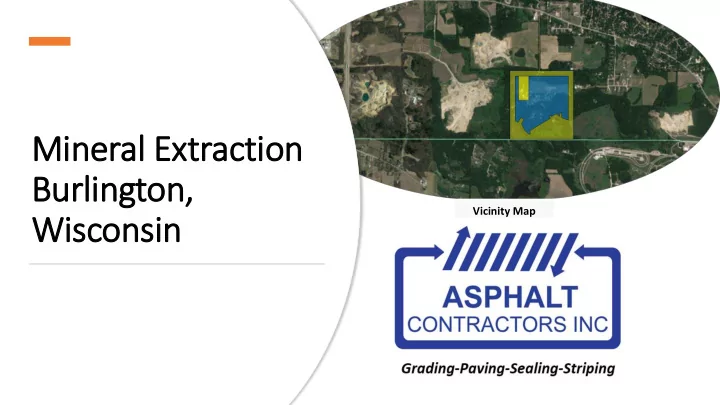
Vicinity Map
Burlin ington, Vicinity Map Wis isconsin Summary Groundwater - - PowerPoint PPT Presentation
Min ineral l Ext xtractio ion Burlin ington, Vicinity Map Wis isconsin Summary Groundwater Impact Min ineral Air Quality Impact Ext xtraction In Index Traffic Impact Noise Impact Phasing Plan Summary Asphalt Contractors, Inc.
Vicinity Map
Summary Groundwater Impact Air Quality Impact Traffic Impact Noise Impact Phasing Plan
Asphalt Contractors, Inc. is an asphalt maintenance, paving, and producing contractor with a home office located in Union Grove, WI and an asphalt plant in Burlington, WI. We will not be locating an asphalt plant on this site. The company employs around 100 people on average, performing services such as asphalt production, paving, sealing, striping, grading, crushing, and maintenance. We are proposing a mineral extraction process as depicted on the enclosed plans drawn by Cardinal Engineering. To produce asphalt, we need very specific type of aggregate. The aggregate resources in this area do not produce the gradations needed. With recent demand from construction projects in SE Wisconsin, the availability for aggregates is rapidly depleting. This year we have been successful in providing low bids to the Towns of Burlington and Lafayette, Villages of Sturtevant, Fontana, and Twin Lakes, and the City of Delevan. To remain competitive and offer low bids we need a viable source of aggregate. Initially, this project would be rezoned to allow mineral extraction. Asphalt Contractors is proposing an access road off County Highway P, with acceleration/deceleration lanes subject to the approval of Racine County. Traffic impact should be less than 1%. There would be no traffic on town roads other than travel for work being performed. The project would proceed according to the enclosed phasing diagram. We also have included a restoration phasing
completed it will return to agricultural zoning. There will be a scale house with bathroom facilities for truck drivers and employees. We will have a septic system that meets the requirements of Racine County. We have strategically located runoff ponds to collect site water. The entire site will have inward drainage and no water will be allowed to exit the mineral extraction area and enter streams, rivers, or
asphalt for crushing, those functions are already taking place at our Burlington Asphalt Plant. We have recorded the exiting noise/decibel levels on site and in the surrounding area. It is our intention that the noise level at the neighboring properties be no more than the existing levels prior to the projects start.
Asphalt Contractors will not adversely affect the existing neighboring water
Asphalt Contractors’ excavation will be above the water table. The water table is at an elevation of 804 ft. Asphalt contractors will not be excavating in the water table per our submitted plans. According to a study completed for the Minnesota Department of natural resources, gravel pit mining has minimal impacts on water aquifer levels and surrounding well levels in the areas. Gravel pit operations are considered a “clean” industry, which means that no chemicals or solvents are used throughout the excavation process; water quality in and around gravel mining pits is not normally an issue. Additionally, groundwater contamination that has occurred in certain situations were found to be caused entirely from human and animal waste. Aggregate extraction and processing is not a source of this type of contamination.
The United States Environmental Protection Agency (U.S. EPA) provides information pertaining to national ambient air quality standards (NAAQS) that all industries within the United States must comply with. These values are professionally reviewed and updated approximately every 6 years. A portion of the NAAQS table can be found below. The primary quality standard refers to sensitive populations, such as those that are asthmatic, elderly, or young. As long as the air emissions are below the primary value, those that are most vulnerable to air particles are protected. Particulate matter comes in many different forms and sizes. However, the U.S. EPA focuses on particles that are 2.5 microns and 10 microns in diameter. The 2.5-micron particles, which are smaller and more dangerous, are primarily made through combustion processes. The proposed gravel pit will not generate this type of particulate. The 10-micron particles are generated through stone crushing activities and will be the main-focus of air quality control on site.
NAAQS data provided by the United States Environmental Protection Agency.
The Wisconsin Department of Natural Resources (WDNR) follows and enforces the U.S. EPA values for air quality standards. Our crusher, which is the main source of particle emission on site, is regulated through the WDNR and has obtained an operational permit. This permit states that crusher air emissions are below the primary standard.
There will be minimal impact to traffic per the below calculations. The quarry will largely support Asphalt Contractors internal product needs and as such the truck traffic on Highway P already encompasses the current truck traffic of our
Operating Assumptions Estimated Mineral Extraction: 150,000 tons a year Season: April – November (8 months, 1 month = 4.25 weeks, 5 days/week) Truck Load: 20 tons
8 𝑛𝑝𝑜𝑢ℎ𝑡 𝑧𝑓𝑏𝑠
×
4.25 𝑥𝑓𝑓𝑙𝑡 𝑛𝑝𝑜𝑢ℎ
×
5 𝑥𝑝𝑠𝑙𝑗𝑜 𝑒𝑏𝑧𝑡 𝑥𝑓𝑓𝑙
=
170 𝑥𝑝𝑠𝑙𝑗𝑜 𝑒𝑏𝑧𝑡 𝑧𝑓𝑏𝑠 150,000 𝑢𝑝𝑜𝑡 𝑧𝑓𝑏𝑠
÷
20 𝑢𝑝𝑜𝑡 𝑢𝑠𝑣𝑑𝑙 = 7,500 𝑢𝑠𝑣𝑑𝑙𝑡 𝑧𝑓𝑏𝑠 7,500 𝑢𝑠𝑣𝑑𝑙𝑡 𝑧𝑓𝑏𝑠
÷
170 𝑥𝑝𝑠𝑙𝑗𝑜 𝑒𝑏𝑧𝑡 𝑧𝑓𝑏𝑠
=
44 𝑢𝑠𝑣𝑑𝑙𝑡 𝑒𝑏𝑧
Estimated Traffic Impacts by Direction
***For our model, we will round up to 50 trucks. Scenarios are in order from Most to Least likely.
Scenario 1: All 50 Trucks North: North: 0.6% of total daily traffic South: 0.0% of total daily traffic Note: If tonnage doubles, the maximum impact is 1.1% of total daily traffic Scenario 2: 25 Trucks North and 25 Trucks South: North: 0.3% of total daily traffic South: 0.8% of total daily traffic Note: If tonnage doubles, the maximum impact is 0.6% of total daily traffic North and 1.6% of total daily traffic South Scenario 3: All 50 Trucks South: North: 0.0% of total daily traffic South: 1.6% of total daily traffic Note: If tonnage doubles, the maximum impact is 3.2% of total daily traffic
Volumetric traffic data provided by the Wisconsin Department of Transportation.
levels than those that currently exist. Per the values and chart listed below, our target distance between our neighbors and crushing equipment would not be less than 700 ft with no berm. We have selected a minimum distance
insure a 45 dB level. We are also installing berms as shown
for calculations to ensure that the “worst case scenario” is
which represents the ambient sound level within the Asphalt Contractors parking lot.
would take 562 ft for the reduction of 100 dB to 45 dB. The graph below visually displays the distance to sound level relationship.
20 40 60 80 100 120 500 1000 1500 2000 2500 3000 3500
Sound Level (dB) Distance (ft)
Distance vs. Sound Level
Reference Values Normal Conversation: ≈ 60 dB Lawn Mower: ≈ 90 dB Loud Rock Concert: ≈ 120 dB Experimental Values Backup Alarm: ≈ 100 dB Burlington Crusher: ≈ 92 dB Milwaukee Crusher: ≈ 100 dB
To ensure that our estimations for noise impact were free of human error, we used the estimation calculator software provided by Georgia State University.
Distance from crusher necessary to be at 45 dB is 562 ft.
Noise level to the closest neighbor who is 867 ft away is 41.2 dB.
Note: Estimations are calculated at the house structure.
Noise level to the second closest neighbor who is 976 ft away is 40.2 dB.
Note: Estimations are calculated at the house structure.
Included is a mine and restoration phasing plan, where Asphalt Contractors will begin mining in area 1 and progress through the site to area 10. As an area is opened, we will mine the area until the proposed elevation is met. Once the mined area is complete, we will begin opening the next area while simultaneously restoring the prior area. This process ensures restoration by reducing redundancy in material handling.