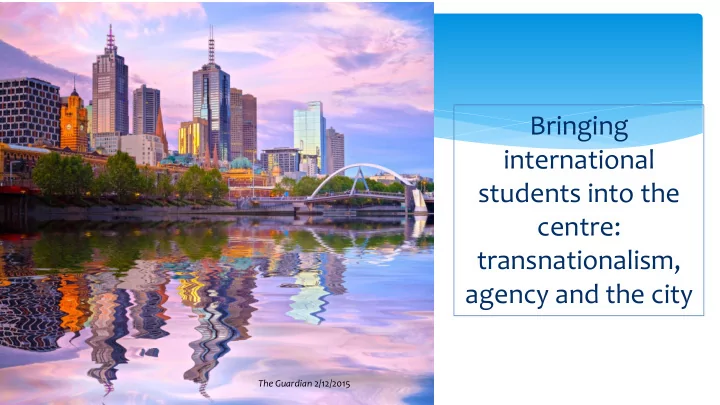
SLIDE 1 Bringing international students into the centre: transnationalism, agency and the city
The Guardian 2/12/2015
SLIDE 2 State Library Guy
In telling the story of these students, I want to tell the story of the city so it makes sense to people with a lifetime as residents of Melbourne, sitting as they have for a hundred years in the State Library or just outside, on one
- f those sunny Melbourne days that
- ffer calm to the city. I imagine these
people are wondering what has happened in this place that makes it appear so suddenly unfamiliar, or where all the people came from, who they are, why they are here or what the young man sitting outside on the bench thinks of it all.
About ‘centrism’, Journal, March 2011
SLIDE 3
Why do research?
Understand for better practice Make research space in a globalised environment Contribute to emerging knowledge and new interests Identify frontiers and less charted territory
SLIDE 4 Transnationalism in international education
- a research progression over time
International students as cultural others International student experience - the lives of transient migrants Transnational urbanism – locality in globalism
SLIDE 5 A research approach
- capturing the transnational moment
Understand time & place (Melbourne as a site of inquiry) Mobility, transnationalism, agency, space (theoretical texts) Imagination, reflexive practice (positionality & narrative) Agency (student interviews) Activism (analysis of events)
SLIDE 6 “Another few thousand”
- observing changes in the city 1990-2010
Once, the city at night was as dead as a dodo. And now it’s
- alive. I spend one evening a week in the city and I sit in QV to
have my dinner. I’m surrounded by students dining around me, some of whom I know. They come down from the [apartment] blocks where they live. And they are living in groups close together, they build communities. My
- bservations are that…RMIT and other universities being in
the city so close together has brought people into the city…you just have to walk around the city at night. Those people are students.
(University professional)
SLIDE 7 “Another few thousand”
- demographic changes in Melbourne
1994: 2100 CBD residents 1995-2004: increase of students by 62% 2001-2007: increase of residents by 124% 2013: 66% of CBD residents born overseas 2013: Median age of CBD residents – 26
SLIDE 8
Making the City: QV- our memories are not the same
,
’
SLIDE 9
Making the City: QV – student memories and imagination
,
It was all flat when I started… I had a Colombian friend and he and I used get together at the State Library and grab a sushi roll or sandwich or something like that and sit there [at the barrier enclosure of the site] and eat and for a couple of years we would watch it and see the building go up. I remember thinking that it was such a deep hole…. Now, having a supermarket at one end means you have to walk past a lot of shops to get there, and you can’t get back the same way, you have to go around, and up an escalator….. it’s a retail obstacle course.
SLIDE 10
Making the City: QV – ‘places for people’
,
’
SLIDE 11
Making the City: FED Square
,
’
SLIDE 12
Making the City: FED Square
,
’
SLIDE 13
Belonging in the City: insider or outsider (FED Square) Here, it’s all about being people oriented. I grew up in Mexico, and I hear Spanish all the time, but here it is different languages as well. I like to guess what languages people are speaking. I like having the different languages and cultures. It’s what I really like about Melbourne. We bring the world to Melbourne.
SLIDE 14 Belonging in the City: insider or outsider (FED Square)
Sometimes we live inside the walls. [It means] I’m neither here in Melbourne, or in my home country. I am sometimes just an observer. So being inside the wall…like that… is ok, it’s safe. I really like this place. You can come here and be the only
- ne, or you can be here with many people, groups going
- n tours and school children. International students have
to find their place and when you are alone it’s nice to have a comfortable place.
’
SLIDE 15 Making the City: identity and place
To my Australian friends, I am seen as Chinese but to my Chinese friends, I am seen as a foreigner because I have been living abroad for more than 10 years. Have you thought about the people who are neither Chinese or
- ther? Maybe I’m Chinese but I’m one of the out
group…I’m not Aussie, I’m not Chinese…I prefer to learn and learn about the rest of the world, other people and how to deal with different problems, and having a huge multinational network is valuable.
’
SLIDE 16 ’
Agency and Activism: place-making
‘I feel welcome, I feel among’ I’m not Australian but I have an Australian Story: cisa.edu.au afis.org.au
SLIDE 17 ’
Agency and Activism: policy implications
O
Flinders Street Melbourne 31 May 2009
RMIT 14 March 2008
SLIDE 18 The City deconstructed
Simply put, the nation-state is cast as the limiting, homogenising, assimilating power structure, which is now, finally, being deconstructed from within by those groups who used to be marginalised within its borders but are now bursting out of them through their diasporic transnational connections. Cities becomes sites for the potential of mobilised populations ‘to align and imagine themselves beyond the nation’
Ien Ang 2003, p.143.
SLIDE 19 The City re-constructed (badly)
Melbourne is the perfect place to get a degree down
- under. It scores full marks for
job prospects, a diverse mix of students and good quality of life, but fails to make the top spot due to its lack of world- beating universities.
The Guardian 2 December 15
SLIDE 20 Charles Robb, Sculptor 2005 SLV
Memory, imagination, belonging – stories of the city
SLIDE 21
Social inclusion, transnational lives - implications for collaboration between cities, education institutions and students
SLIDE 22
Thank you